
Kansas City Chiefs at Seattle Seahawks
2026-10-25 · 7:20 PM CT · Scheduled


ESPN standings data retrieved October 6, 2026. 2026 season totals at this snapshot.
| Measure | Kansas City Chiefs | Seattle Seahawks |
|---|---|---|
| Record | 4-0 | 3-1 |
| Points scored / game | 29.5 | 26.2 |
| Points allowed / game | 19.2 | 18.2 |
| Points differential | +41 | +32 |
| Home record | 2-0 | 2-0 |
| Road record | 2-0 | 1-1 |
How this game can be won
Kansas City Chiefs average 29.5 points scored and 19.2 allowed; Seattle Seahawks average 26.2 scored and 18.2 allowed. The first question is whether each offense can make ordinary downs useful. Repeated manageable gains keep more of the playbook available.
Watch the long gains separately. An offense can move steadily without breaking a big play, or spend an afternoon waiting for one big play to rescue it. The more repeatable approach is the one that can still move the ball when the defense removes its easiest option.
Field position changes the job. Starting near midfield means fewer yards are needed before a scoring chance. Once the drive reaches threatening territory, watch whether the offense finishes it with useful points instead of wasting the trip.
Finally, count the lost possessions. Turnovers can change a close game without explaining every down that came before them. Our football model needs efficiency, explosive-play rate, starting field position, drive finishing and turnover margin together. A scoring average or a third-down rate cannot replace that set.
Closer to game day
Spreads and win probabilities are reserved for confirmed games within the next seven days. This game stays on the schedule; its forecast opens inside that window.
Kansas City Chiefs · our 2026-10-06 assessment
Chiefs | 4-0
Read the table as text
| Season evidence | Chiefs | Opponents |
|---|---|---|
| Plays keeping pace | 48.8% | 39.4% |
| Long gains | 30 | 22 |
| Points / threatening drives | 118 / 26 | 77 / 20 |
| Defensive takeaways | 6 | 2 |
| Special-teams recoveries | 1 | 0 |
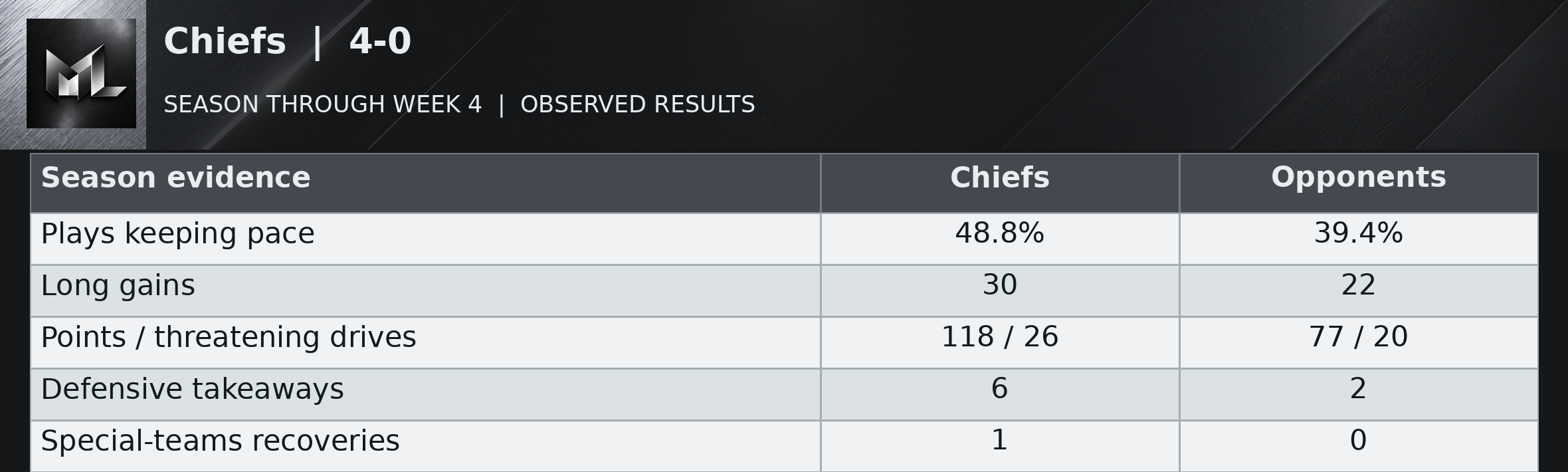
Kansas City has been consistently productive near scoring territory and consistently careful with possession. Its four weekly returns were 31 points on six threatening drives, 33 on nine, 24 on six and 30 on five. Only two giveaways have interrupted that work. The defense has allowed opponents to stay on schedule on just 39.4 percent of their plays, a stronger foundation than the latest 30-27 score suggests. The offense itself has been less steady, alternating between sustained movement and heavier reliance on long gains.
Patrick Mahomes said “it’s not always going to be pretty”. Sunday's eight long gains made that an accurate description. Kenneth Walker's 76-yard run and Tyquan Thornton's 55-yard catch did substantial repair work. The late kickoff fumble gave Kansas City another scoring possession, but that recovery belongs to special teams. Six of the season's seven takeaways came outside special teams. The Chiefs earned their 4-0 start; the close games also show how quickly opponents can make the finish uncomfortable.
After opponent punts or failed fourth downs, Chiefs possessions have begun at their own 23.2, on average, across 17 competitive drives. The weekly average has varied widely, from their own 12.5 to their own 28.8. The latest game averaged their own 22.8. The resulting possession started at midfield or closer to the end zone in 2 of those 17 cases. These are actual starting spots, including punt returns, rather than a measure of the defense alone. The return unit has added 42 punt-return yards over the season. Starts following turnovers are counted separately: 6 competitive possessions at their opponent 38.2 on average.
Seattle Seahawks · our 2026-10-06 assessment
Seahawks | 3-1
Read the table as text
| Season evidence | Seahawks | Opponents |
|---|---|---|
| Plays keeping pace | 43.2% | 35.1% |
| Long gains | 24 | 14 |
| Points / threatening drives | 105 / 20 | 67 / 14 |
| Defensive takeaways | 7 | 5 |
| Special-teams recoveries | 1 | 0 |
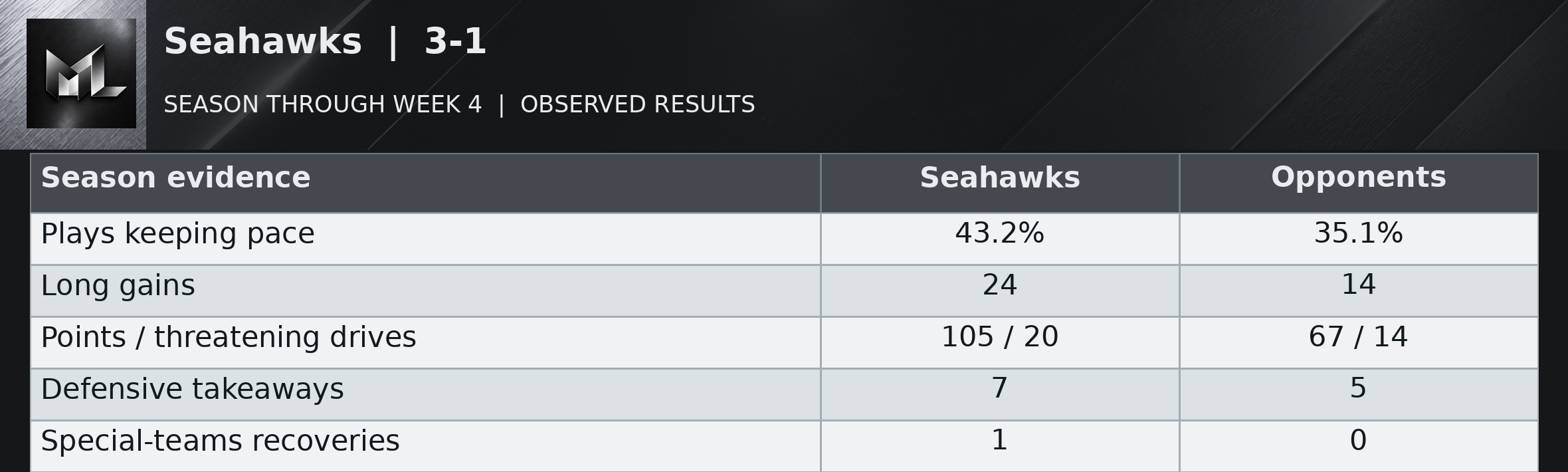
Seattle's most convincing recurring strength is making opposing offenses work for ordinary gains. Opponents have kept pace with the down on only 35.1 percent of their plays, and Seattle has allowed 14 long gains against 24 of its own. The offense has scored at least 30 in three straight games, but those totals disguise changes in how the points arrived. Sunday brought its lowest share of useful plays, 35.7 percent, along with seven long gains and four extra possessions from mistakes.
Mike Macdonald acknowledged “a lot of room for improvement”. Fourteen penalties for 150 yards and a 27-6 lead that became a 30-23 win support him. Three of Sunday's recoveries or interceptions were defensive plays; the fourth was a muffed punt. Seven of eight season takeaways belong to the defense. The finishing has repeatedly been productive, but Seattle should not expect either opponent mistakes or long gains to make careless operation harmless. The rebound was useful. The bill for the penalties was still enormous.
After opponent punts or failed fourth downs, Seahawks possessions have begun at their own 25.1, on average, across 23 competitive drives. The weekly average has stayed in a fairly narrow band, from their own 22.0 to their own 28.0. The latest game averaged their own 28.0. The resulting possession started at midfield or closer to the end zone in 3 of those 23 cases. These are actual starting spots, including punt returns, rather than a measure of the defense alone. The return unit has added 79 punt-return yards over the season. Pre-snap changes before the first run or pass affected 2 of these drives; those changes are excluded from the listed starting spots. Starts following turnovers are counted separately: 6 competitive possessions at their opponent 41.0 on average.
Our coverage of these teams
A matching published game video is not available in the verified archive yet.