
Indianapolis Colts at Pittsburgh Steelers
2026-10-11 · 12:00 PM CT · Scheduled
ESPN standings data retrieved October 6, 2026. 2026 season totals at this snapshot.
| Measure | Indianapolis Colts | Pittsburgh Steelers |
|---|---|---|
| Record | 2-2 | 2-2 |
| Points scored / game | 25.5 | 19.2 |
| Points allowed / game | 26.0 | 21.8 |
| Points differential | -2 | -10 |
| Home record | 1-1 | 2-0 |
| Road record | 1-1 | 0-2 |
How this game can be won
Indianapolis Colts average 25.5 points scored and 26.0 allowed; Pittsburgh Steelers average 19.2 scored and 21.8 allowed. The first question is whether each offense can make ordinary downs useful. Repeated manageable gains keep more of the playbook available.
Watch the long gains separately. An offense can move steadily without breaking a big play, or spend an afternoon waiting for one big play to rescue it. The more repeatable approach is the one that can still move the ball when the defense removes its easiest option.
Field position changes the job. Starting near midfield means fewer yards are needed before a scoring chance. Once the drive reaches threatening territory, watch whether the offense finishes it with useful points instead of wasting the trip.
Finally, count the lost possessions. Turnovers can change a close game without explaining every down that came before them. Our football model needs efficiency, explosive-play rate, starting field position, drive finishing and turnover margin together. A scoring average or a third-down rate cannot replace that set.
Our matchup simulation
nflverse 2026 play-by-play, regular-season Weeks 1–4. We apply the Lab measures, fit their relationship to the scoring margin, then sample possible results from the scoring errors observed in completed games.
 Indianapolis Colts44.9%
 Pittsburgh Steelers55.1%
Standard deviation shows how widely the simulated scoring margins vary. A larger number means a less steady outcome; it is not the error bar on the win percentage.
Indianapolis ColtsPittsburgh Steelers
Where the factor edge comes from
| Lab measure | Weight | Home − away · z | Baseline margin effect |
|---|---|---|---|
| Efficiency | 40% | -0.64 | -0.2 pts |
| Explosiveness | 25% | -0.29 | -0.1 pts |
| Field position | 10% | -1.28 | -0.1 pts |
| Finishing drives | 15% | -0.07 | -0.0 pts |
| Turnovers | 10% | +2.39 | +0.2 pts |
Positive effects favor Pittsburgh Steelers; negative effects favor Indianapolis Colts. Both offense and defense enter the net factors. Home-court / field term +1.1 points. These effects explain the fitted baseline; the simulation also varies its fitted coefficients and game outcomes.
Model inputs, variability and validation
Four games per team; league-average play/drive priors retained. Established NFL editorial weights 40/25/10/15/10 percent. Profiles use Completed Week 4, October 5, 2026. Historical calibration uses only each game’s earlier factor data; 48 completed games fit the margin and home advantage.
Chronological check 16 held-out games; margin RMSE 9.1 points; Brier score 0.254 (50/50 baseline 0.250; lower is better). The final fit then uses all available earlier games. This check is not proof of future calibration.
Outcome noise resamples observed scoring-margin errors, preserving the shape of the available results instead of imposing a bell curve. Bootstrap fits capture some uncertainty in the fitted coefficients. Between-batch win-rate standard deviation 6.4 percentage points. Monte Carlo sampling standard error 0.16 percentage points applies to the unsplit positive-margin frequency; it excludes model error. Zero-margin trials (2.4%) are split equally to estimate the final winner. That is an explicit overtime assumption, not a modeled overtime system.
Injuries, starting lineup changes, rest, travel and postseason rotation changes are not adjusted. The model uses no market odds. Forecast snapshot October 6 at 10:49 AM CT; only confirmed regular-season or playoff games in the following seven days qualify.
Indianapolis Colts · our 2026-10-06 assessment
Colts | 2-2
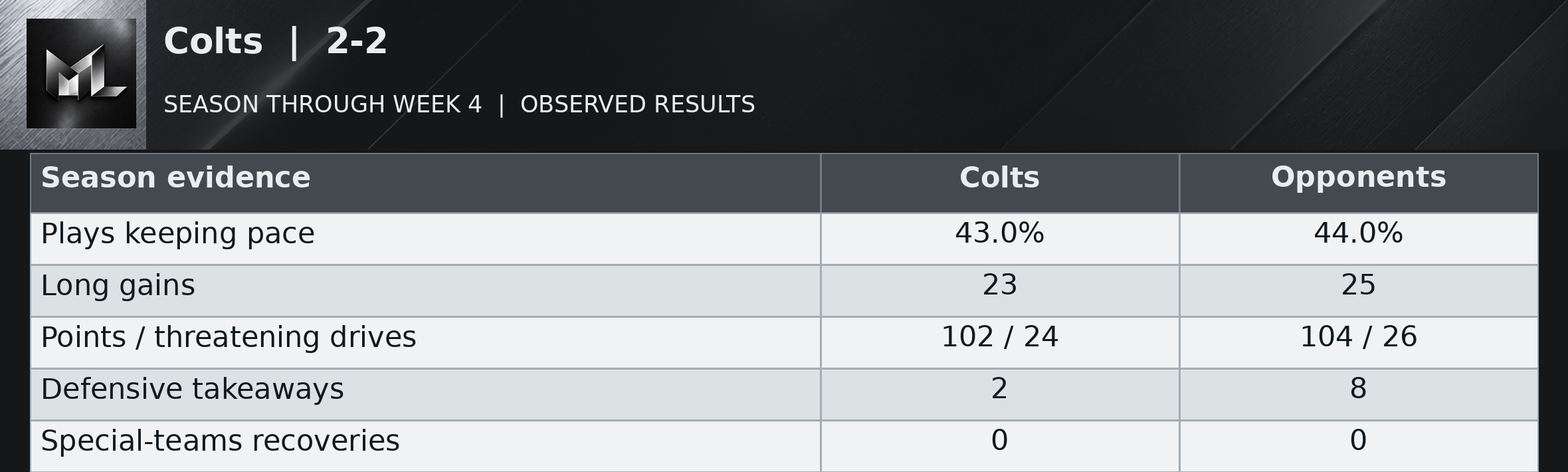
Read the table as text
| Season evidence | Colts | Opponents |
|---|---|---|
| Plays keeping pace | 43.0% | 44.0% |
| Long gains | 23 | 25 |
| Points / threatening drives | 102 / 24 | 104 / 26 |
| Defensive takeaways | 2 | 8 |
| Special-teams recoveries | 0 | 0 |
Indianapolis has been fairly consistent at moving the ball and remarkably consistent at putting that movement at risk. Its weekly useful-play shares have stayed between 40.6 and 46.0 percent. Its giveaways have run two, one, three and two. The Colts have eight giveaways against just two defensive takeaways, meaning the two-game winning streak has not repaired their most repeated possession problem. Their defense has also allowed 104 offensive points from 26 threatening possessions, close to the offense's 102 from 24.
Daniel Jones said “Can’t afford to turn the ball over like that”. He had just won 30-13 while contributing both of Sunday's giveaways. The scoreboard does not repeal his statement. Jonathan Taylor's 95 rushing yards and two touchdowns helped restore order, and an interception handed Indianapolis a 20-yard touchdown possession. The other offensive work still mattered, especially the answer after Washington cut the lead to four. At 2-2, the Colts have evidence of resilience and very little evidence that the turnover problem has stopped.
After opponent punts or failed fourth downs, Colts possessions have begun at their own 26.4, on average, across 20 competitive drives. The weekly average has varied widely, from their own 10.2 to their own 36.1. The latest game averaged their own 36.1. The resulting possession started at midfield or closer to the end zone in 2 of those 20 cases. These are actual starting spots, including punt returns, rather than a measure of the defense alone. The return unit has added 25 punt-return yards over the season. Starts following turnovers are counted separately: 2 competitive possessions at their opponent 17.5 on average.
Pittsburgh Steelers · our 2026-10-06 assessment
Steelers | 2-2
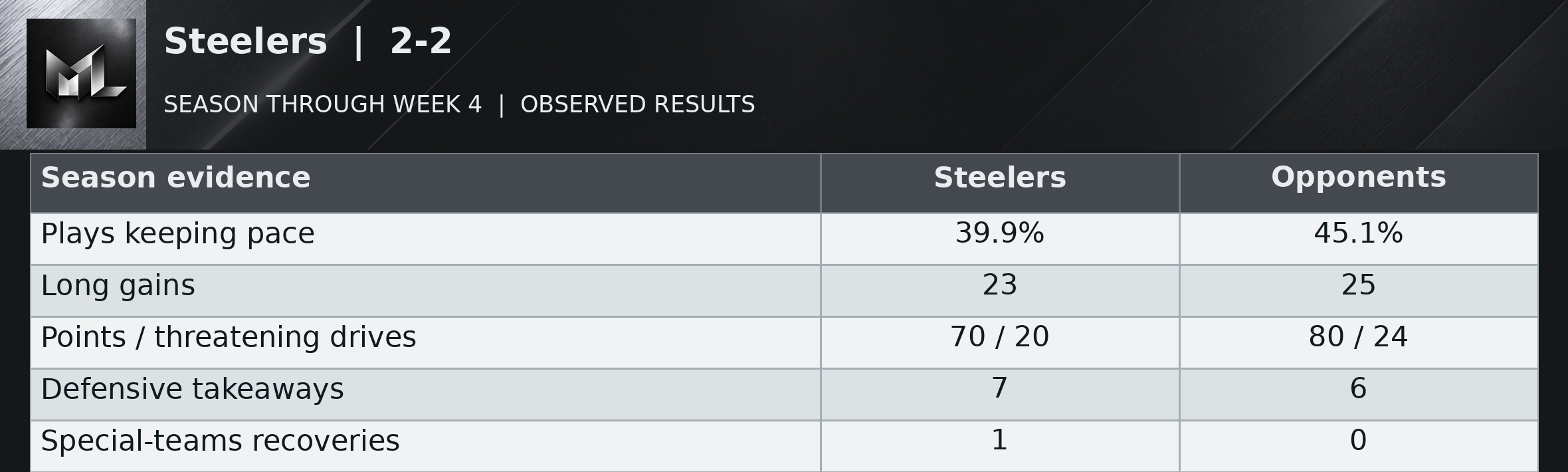
Read the table as text
| Season evidence | Steelers | Opponents |
|---|---|---|
| Plays keeping pace | 39.9% | 45.1% |
| Long gains | 23 | 25 |
| Points / threatening drives | 70 / 20 | 80 / 24 |
| Defensive takeaways | 7 | 6 |
| Special-teams recoveries | 1 | 0 |
Pittsburgh's offense has improved from its opening two games, but the improvement remains uneven. Its share of useful plays rose from 32.8 and 35.8 percent to 48.2 and 43.8. The long gains also increased from four and three to nine and seven. The defense has helped by allowing only 80 offensive points on 24 threatening possessions, but opponents have still made ordinary progress more frequently than Pittsburgh. Seven of eight takeaways were defensive, with one special-teams recovery.
Aaron Rodgers said, “I missed some throws I usually hit”. Two interceptions and five sacks in the 27-24 loss support the assessment, though his final interception came on a desperation throw and should not be treated as the same decision as an earlier live possession. The offense has given the ball away in every game, six times overall. Rallying from 21-7 behind demonstrated a capacity to recover. Allowing Cleveland the final scoring drive demonstrated that recovering late is not the same as controlling the game.
After opponent punts or failed fourth downs, Steelers possessions have begun at their own 19.2, on average, across 16 competitive drives. The weekly average has varied widely, from their own 11.5 to their own 23.0. The latest game averaged their own 21.5. The resulting possession started at midfield or closer to the end zone in 0 of those 16 cases. These are actual starting spots, including punt returns, rather than a measure of the defense alone. The return unit has added 69 punt-return yards over the season. Pre-snap changes before the first run or pass affected 1 of these drives; those changes are excluded from the listed starting spots. Starts following turnovers are counted separately: 6 competitive possessions at their own 42.8 on average.
Our coverage of these teams
A matching published game video is not available in the verified archive yet.