
Cincinnati Bengals at Baltimore Ravens
2026-10-25 · 12:00 PM CT · Scheduled


ESPN standings data retrieved October 6, 2026. 2026 season totals at this snapshot.
| Measure | Cincinnati Bengals | Baltimore Ravens |
|---|---|---|
| Record | 2-2 | 3-1 |
| Points scored / game | 24.2 | 29.0 |
| Points allowed / game | 21.2 | 24.0 |
| Points differential | +12 | +20 |
| Home record | 1-1 | 1-1 |
| Road record | 1-1 | 2-0 |
How this game can be won
Cincinnati Bengals average 24.2 points scored and 21.2 allowed; Baltimore Ravens average 29.0 scored and 24.0 allowed. The first question is whether each offense can make ordinary downs useful. Repeated manageable gains keep more of the playbook available.
Watch the long gains separately. An offense can move steadily without breaking a big play, or spend an afternoon waiting for one big play to rescue it. The more repeatable approach is the one that can still move the ball when the defense removes its easiest option.
Field position changes the job. Starting near midfield means fewer yards are needed before a scoring chance. Once the drive reaches threatening territory, watch whether the offense finishes it with useful points instead of wasting the trip.
Finally, count the lost possessions. Turnovers can change a close game without explaining every down that came before them. Our football model needs efficiency, explosive-play rate, starting field position, drive finishing and turnover margin together. A scoring average or a third-down rate cannot replace that set.
Closer to game day
Spreads and win probabilities are reserved for confirmed games within the next seven days. This game stays on the schedule; its forecast opens inside that window.
Cincinnati Bengals · our 2026-10-06 assessment
Bengals | 2-2
Read the table as text
| Season evidence | Bengals | Opponents |
|---|---|---|
| Plays keeping pace | 45.3% | 43.8% |
| Long gains | 22 | 26 |
| Points / threatening drives | 90 / 23 | 78 / 22 |
| Defensive takeaways | 5 | 4 |
| Special-teams recoveries | 0 | 1 |
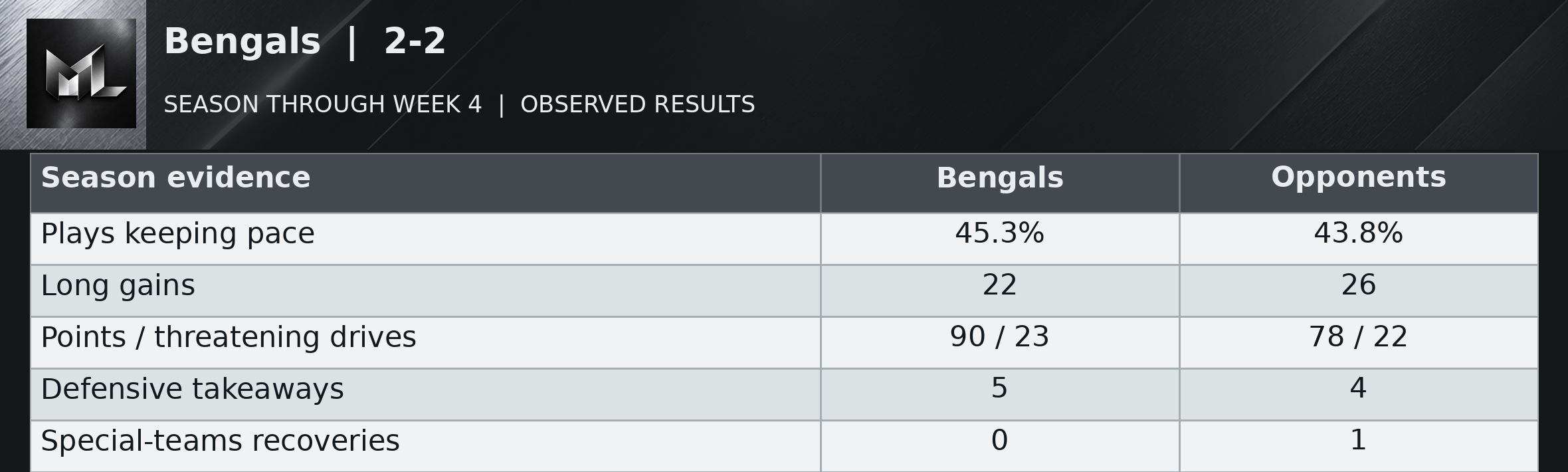
Cincinnati's offense has swung between productive stretches and stretches that depend on a rescue. Its weekly share of useful gains has run 50.0, 34.5, 51.8 and 45.1 percent, while the long gains slipped to three Sunday. Its 90 points from 23 threatening drives are respectable but not enough to erase the uneven execution. The defense has allowed 26 long gains against the offense's 22. The team has not built a dependable advantage from stopping big plays or finishing more effectively than opponents.
Joe Burrow singled out “the one in the red zone”. His concern about the interception in the 22-17 loss fits a recent pattern: two giveaways in each of the last two games. Four of the team's five defensive takeaways came in the opener. One of its five team-level giveaways was a special-teams mistake, so not every lost possession belongs to the offense. Cincinnati's 2-2 record reflects both a high enough ceiling to challenge good teams and too many possessions that require everything else to go right.
After opponent punts or failed fourth downs, Bengals possessions have begun at their own 29.5, on average, across 11 competitive drives. The weekly average has varied widely, from their own 15.7 to their own 34.6. The latest game averaged their own 15.7. The resulting possession started at midfield or closer to the end zone in 2 of those 11 cases. These are actual starting spots, including punt returns, rather than a measure of the defense alone. The return unit has added 28 punt-return yards over the season. Starts following turnovers are counted separately: 4 competitive possessions at their own 47.5 on average.
Baltimore Ravens · our 2026-10-06 assessment
Ravens | 3-1
Read the table as text
| Season evidence | Ravens | Opponents |
|---|---|---|
| Plays keeping pace | 52.2% | 41.6% |
| Long gains | 33 | 23 |
| Points / threatening drives | 113 / 24 | 96 / 22 |
| Defensive takeaways | 5 | 2 |
| Special-teams recoveries | 0 | 0 |
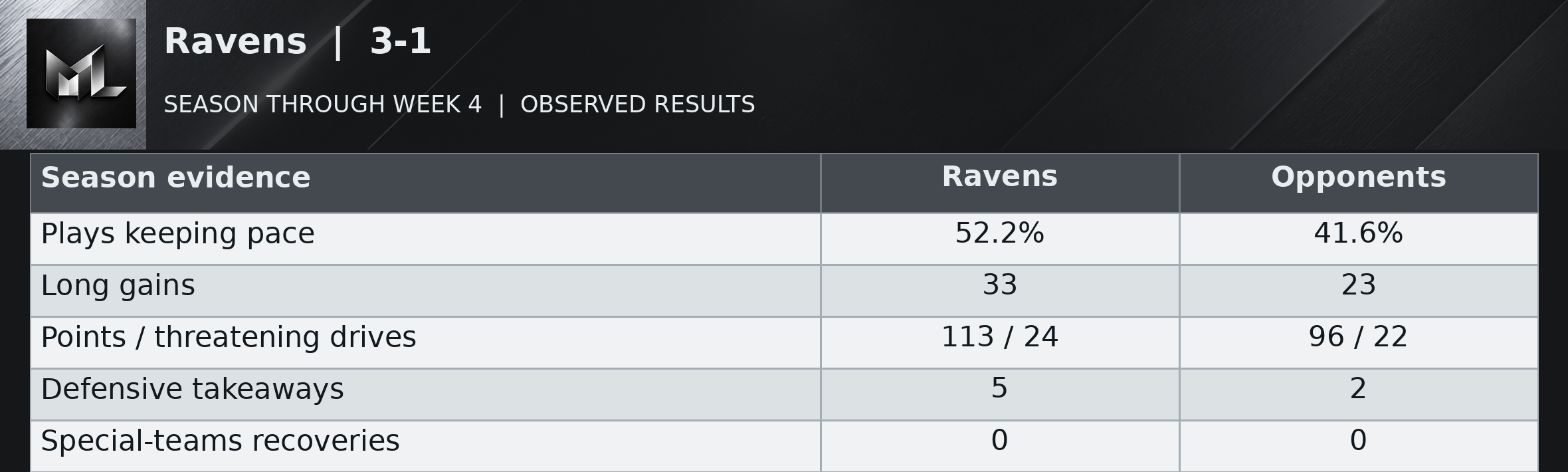
Baltimore has consistently moved the ball better than its opponents, with useful gains on 52.2 percent of its plays against 41.6 percent allowed. Its 33 long gains are a real offensive weapon, but 23 allowed mean the defense has not removed the same escape route for opponents. The finishing has varied sharply, from 17 points on five threatening possessions in Week 2 to 21 on four Sunday. A separate long field goal supplied the other three points against Tennessee.
Jesse Minter said Baltimore played “more conservative in the second half”. With Lamar Jackson leaving injured and a 24-7 lead becoming a 24-18 finish, the explanation fits the circumstances; it does not turn a scoreless second half into a repeatable plan. Five defensive takeaways against two giveaways have helped, and neither total includes a return mistake. The goal-line stop was valuable, but the following touchdown required a 99-yard drive. Stopping someone and giving the offense a short field are different achievements.
After opponent punts or failed fourth downs, Ravens possessions have begun at their own 27.9, on average, across 18 competitive drives. The weekly average has varied widely, from their own 21.3 to their own 34.7. The latest game averaged their own 21.3. The resulting possession started at midfield or closer to the end zone in 2 of those 18 cases. These are actual starting spots, including punt returns, rather than a measure of the defense alone. The return unit has added 65 punt-return yards over the season. Pre-snap changes before the first run or pass affected 2 of these drives; those changes are excluded from the listed starting spots. Starts following turnovers are counted separately: 5 competitive possessions at their own 49.0 on average.
Our coverage of these teams
A matching published game video is not available in the verified archive yet.