
Vanderbilt Commodores at Kentucky Wildcats
2026-10-23 · Time TBD · Scheduled · NIGHT: 6 - 8pm ET start


ESPN standings data retrieved October 6, 2026. 2026 season totals at this snapshot.
| Measure | Vanderbilt Commodores | Kentucky Wildcats |
|---|---|---|
| Record | 3-2 | 4-1 |
| Points scored / game | 25.4 | 34.6 |
| Points allowed / game | 25.0 | 26.8 |
| Points differential | +2 | +39 |
How this game can be won
Vanderbilt Commodores average 25.4 points scored and 25.0 allowed; Kentucky Wildcats average 34.6 scored and 26.8 allowed. The first question is whether each offense can make ordinary downs useful. Repeated manageable gains keep more of the playbook available.
Watch the long gains separately. An offense can move steadily without breaking a big play, or spend an afternoon waiting for one big play to rescue it. The more repeatable approach is the one that can still move the ball when the defense removes its easiest option.
Field position changes the job. Starting near midfield means fewer yards are needed before a scoring chance. Once the drive reaches threatening territory, watch whether the offense finishes it with useful points instead of wasting the trip.
Finally, count the lost possessions. Turnovers can change a close game without explaining every down that came before them. Our football model needs efficiency, explosive-play rate, starting field position, drive finishing and turnover margin together. A scoring average or a third-down rate cannot replace that set.
Closer to game day
Spreads and win probabilities are reserved for confirmed games within the next seven days. This game stays on the schedule; its forecast opens inside that window.
Kentucky Wildcats · our 2026-10-04 assessment
Kentucky
4-1 overall | Preview AP No. 24 | Matchup Lab No. 27 | Index 62.2
Kentucky's offense has recovered from its low point against Alabama, while its defense remains less predictable. After a 33.3 percent offensive successful-play rate in that charted game, its next three were above 52 percent. Defensive results have swung more sharply. The Wildcats' five-game turnover balance is plus five, and that possession advantage has helped them survive games in which opponents move the ball well.
The 35-34 overtime escape at South Carolina made both sides of the profile visible. Kentucky gave the ball away zero times and recovered two Gamecocks fumbles, yet was outgained 458-394. South Carolina rushed for 232 yards and converted half its third downs. Kentucky converted only four of 14 third downs but both fourth-down attempts, then won on the two-point conversion.
Friday's preview warned that Kentucky could not rely on repeatedly rescuing third down. That concern remains. The Wildcats found enough alternative routes to finish the game, but those routes included takeaways, fourth downs and an overtime decision. The offense's recent early-play improvement is real evidence; the defense's inability to prevent long productive stretches is also real. Kentucky earned the win. It did not earn a quiet review of the first 60 minutes.
Across the season, qualifying stops have handed the offense an average start at its own 31.3 over 25 possessions. Game averages range from its own 10.0 to 37.6. In the narrower 18-possession sample without an identified return or penalty effect, the average is its own 34.0. That is useful territorial support, although the opponent's kicking remains part of it. The offense has produced an estimated 4.31 points before extra points per scoring opportunity. That payoff must be read alongside how often it can build the next drive.
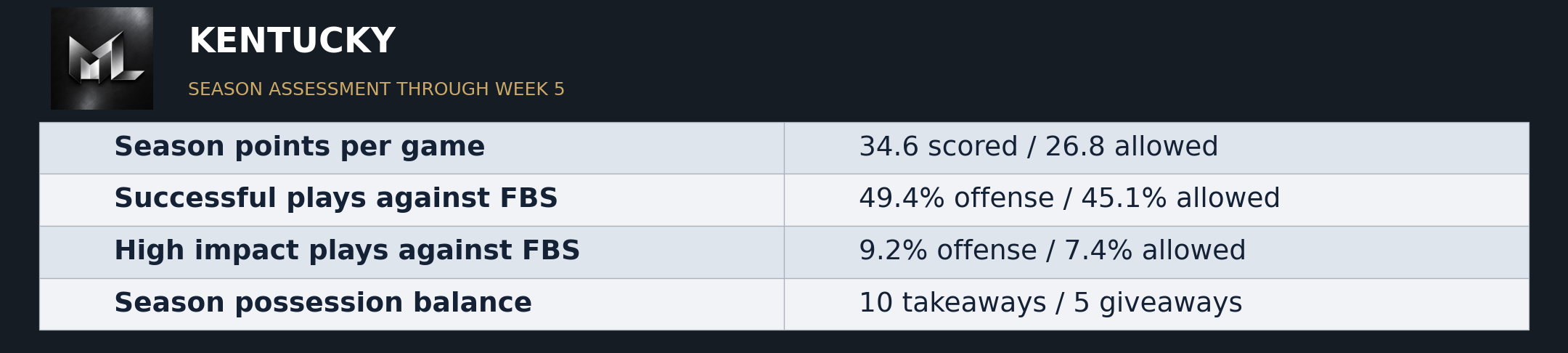
| Season points per game | 34.6 scored / 26.8 allowed |
| Successful plays against FBS | 49.4% offense / 45.1% allowed |
| High impact plays against FBS | 9.2% offense / 7.4% allowed |
| Season possession balance | 10 takeaways / 5 giveaways |
Our coverage of these teams
A matching published game video is not available in the verified archive yet.