
THE MATCHUP LAB · NFL
Game Center
Scores, statistics and the story behind the game.
Checking for updates…
Complete NFL Week 10 recap and all 32 team assessments
Minnesota scored the first 20 points. The Packers answered with a touchdown and a field goal in the third, giving their defense a chance to bring them back into the game. Kirk Cousins’ 20-yard touchdown pass to Gavin Bartholomew reopened the gap in the fourth. Minnesota had 129 rushing yards and converted eight third downs. Green Bay managed 56 rushing yards and turned it over four times. The Vikings could afford to settle for a kick on several long drives because the Packers so rarely got consecutive scoring chances of their own.
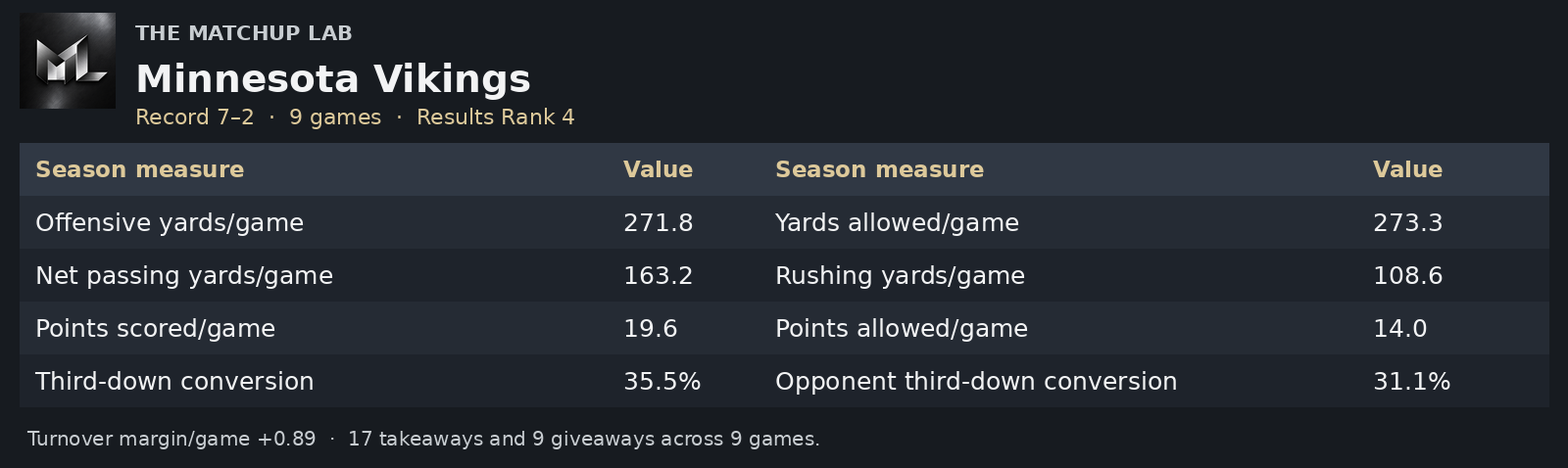
Eight conversions on 16 third downs in Green Bay helped Minnesota keep the ball for more than 35 minutes. Compare that with a 35.5 percent season conversion rate. Reproducing the whole afternoon would be a considerable improvement for an offense averaging 271.8 yards. The defensive performance is more familiar. Minnesota allows 273.3 yards and 14 points a game. With San Francisco next, even making a scoring drive last ten plays could be valuable if it keeps Purdy and McCaffrey off the field.
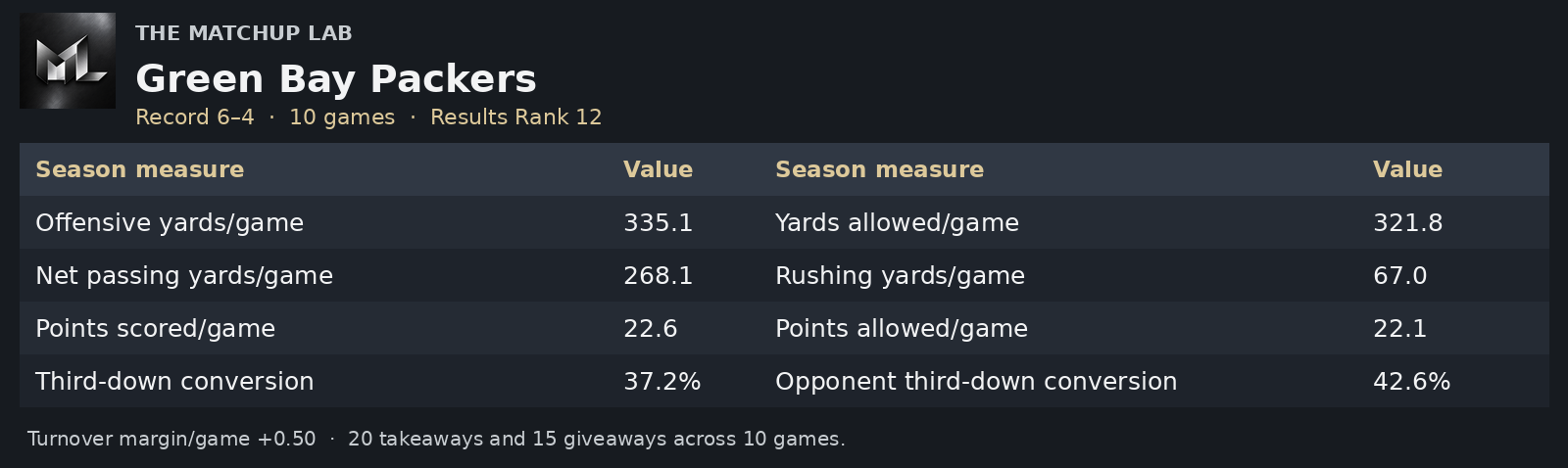
Green Bay averages 268.1 net passing yards and just 67 rushing yards. Minnesota pushed the imbalance further by holding the Packers to 56 on the ground and forcing four turnovers. Jordan Love threw for 220 gross yards, but the team finished with 164 net passing yards once sack losses counted. A week off gives the Packers time to ask how often the protection is facing a rush that already knows what is coming.
Sun Nov 15 · noon Central | Results Rank 4 and 11
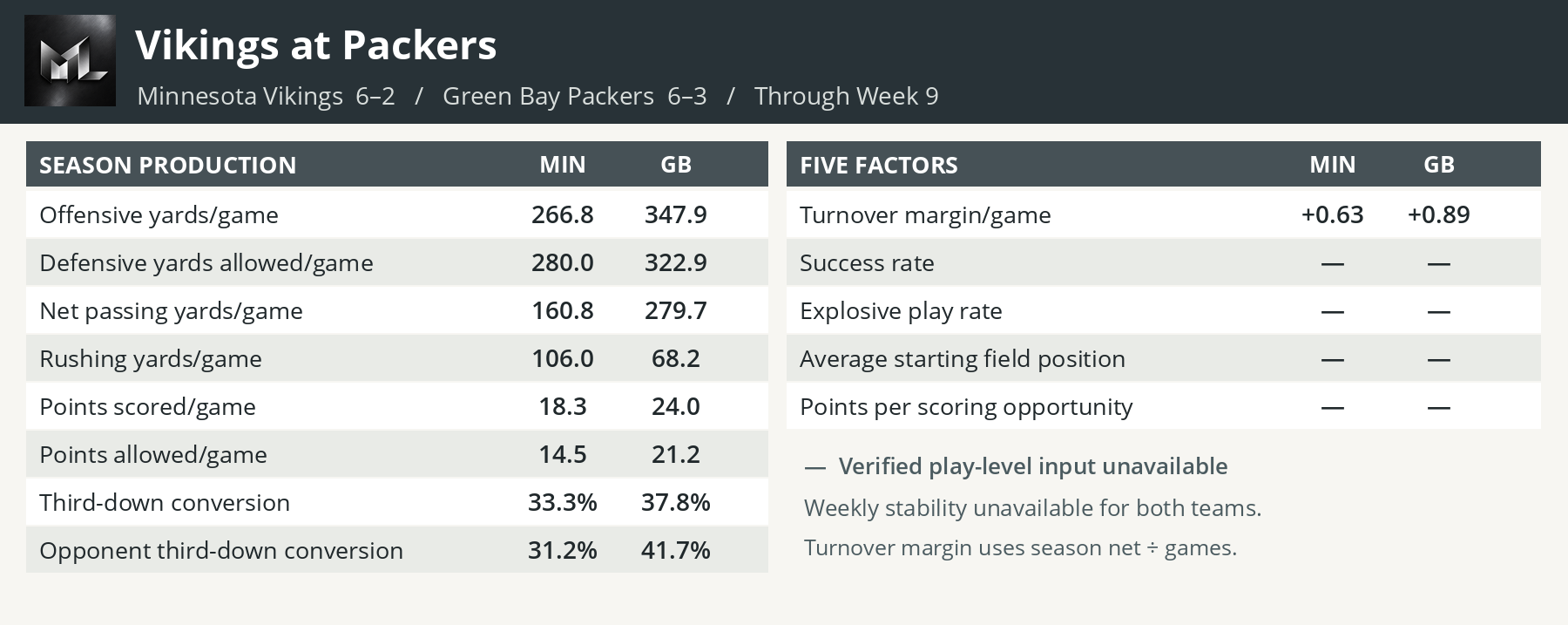
Green Bay put up 45 against New England. Minnesota scored six against Buffalo. That makes an inviting shortcut to a forecast until the season figures get in the way. The Vikings allow 14.5 points and 280.0 yards per game. The Packers average 24.0 points, and 279.7 of their 347.9 offensive yards come through the air. Green Bay’s big question is how long it can keep throwing on its own terms against a defense that rarely gives an opponent an easy series.
The Packers gain just 68.2 rushing yards per game. If Minnesota can defend that dimension without bringing a safety down, Green Bay’s passing game will have to create openings against numbers. The Vikings allow a conversion on only 31.2 percent of opponent third downs. A five-yard completion on first down is a useful alternative to an unsuccessful run. The same completion on third and eight is a win for Minnesota. The location in the series changes the value of exactly the same gain.
Minnesota’s offense faces an equally concrete problem. It averages 18.3 points and converts 33.3 percent of third downs. A defensive stop is a beginning, but even holding Green Bay to its ordinary scoring average would demand appreciably more than the Vikings managed last week. Both teams have benefited from winning the turnover comparison, Green Bay by eight over nine games and Minnesota by five over eight. Neither can assume the extra possession belongs to it. Minnesota needs to put its defense back on the field with a lead worth protecting. Green Bay needs its short passing game to work as a substitute for the missing rushing volume before the Vikings earn a chance to defend the sticks.
The early market favored Green Bay by 3.5, one of the week’s more interesting differences between the betting board and the Results Rank. The market and the ranking answer different questions. Green Bay still has to turn its larger passing totals into points against this particular defense.
Complete NFL Week 9 recap and all 32 team assessments
Week 9 loss 6–23 against Buffalo Bills
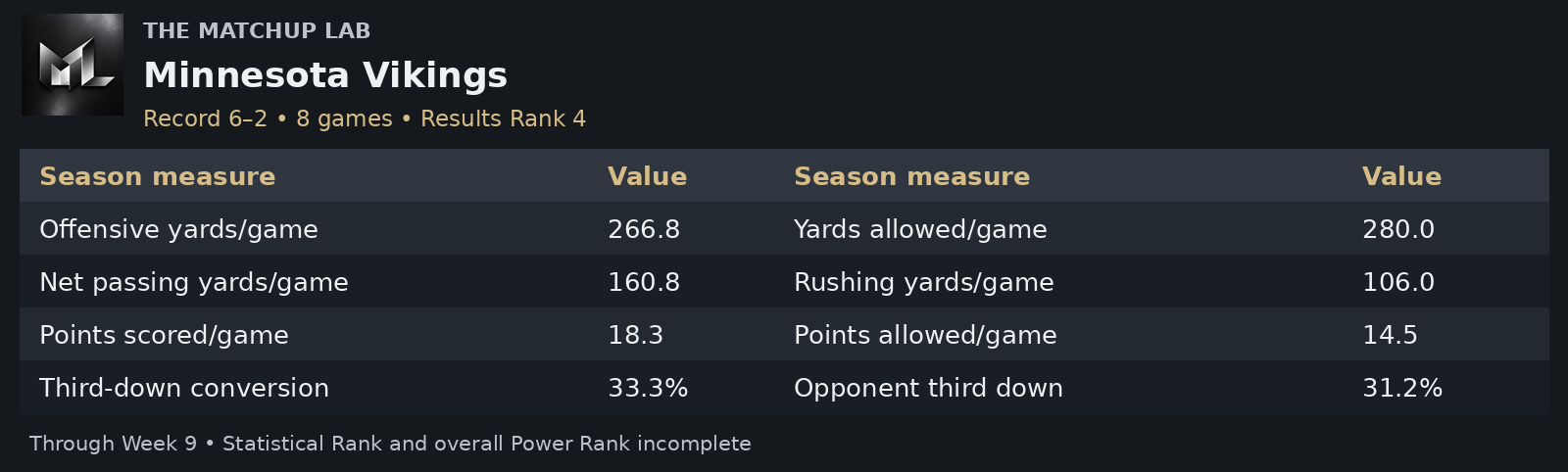
Minnesota's defense has carried considerable weight in a 6–2 start, and the last two games show what happens when the offense gives it too little help. The Vikings lost 19–15 to Detroit and 23–6 to Buffalo. They still allow only 14.5 points and 280.0 yards per game across the season, but their offense produces 18.3 points and 266.8 yards. A 33.3 percent third-down conversion rate leaves too many possessions vulnerable to ending before that defense has been properly rewarded.
Green Bay is next after scoring 45 against New England. The Packers generate 279.7 passing yards per game, giving Minnesota a substantial passing attack to measure against its own 31.2 percent opponent third-down rate. The Vikings need to preserve those stops while asking more from an offense averaging only 160.8 passing yards. Another low-scoring contest might suit their defensive strengths, but it would still require enough offensive production to turn those strengths into a result.
Week 9 win 45–27 against New England Patriots
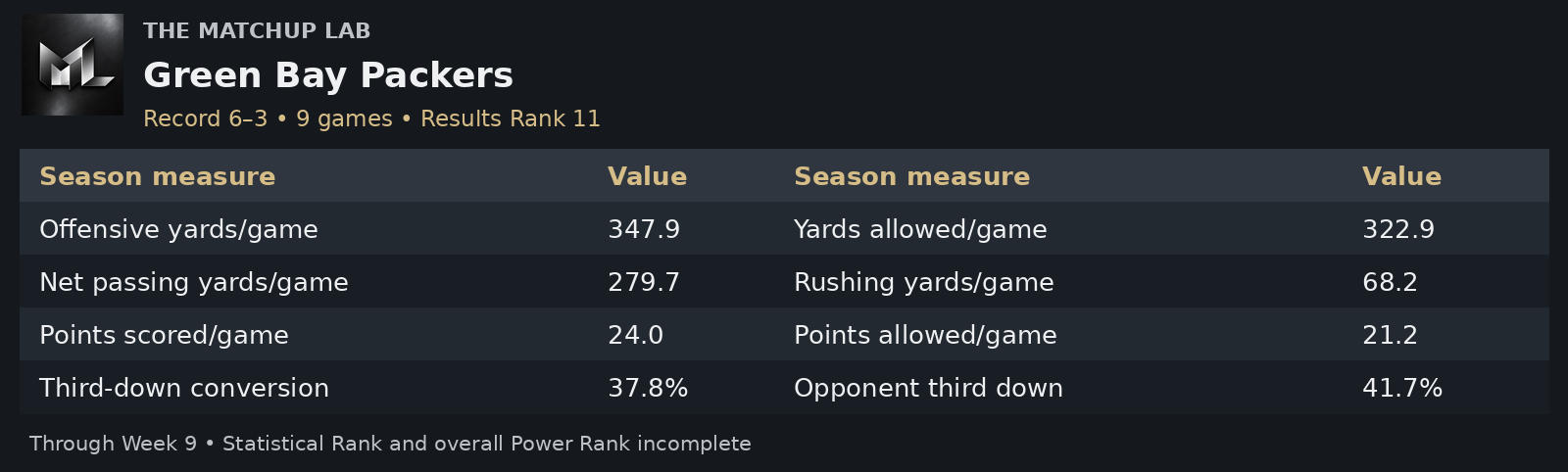
Green Bay's 45–27 win over New England supplied a forceful offensive answer and improved the Packers to 6–3. It also highlighted the area in which their season production is concentrated. Green Bay averages 279.7 passing yards against just 68.2 rushing yards per game. The total offense reaches 347.9 yards, but the ground contribution leaves less balance to fall back on when the passing game faces resistance. Scoring 45 is an excellent result; it does not make that imbalance disappear from the nine-game assessment.
Minnesota brings precisely the kind of defensive record that warrants a closer look. The Vikings allow 14.5 points per game and a 31.2 percent opponent third-down conversion rate. Green Bay converts 37.8 percent, so keeping possessions alive may be more difficult than the previous score suggests. The Packers also need a better defensive finish after allowing New England 27 points. A repeat of Sunday's offensive production would help, but requiring that much scoring each week would be an unnecessarily expensive habit.
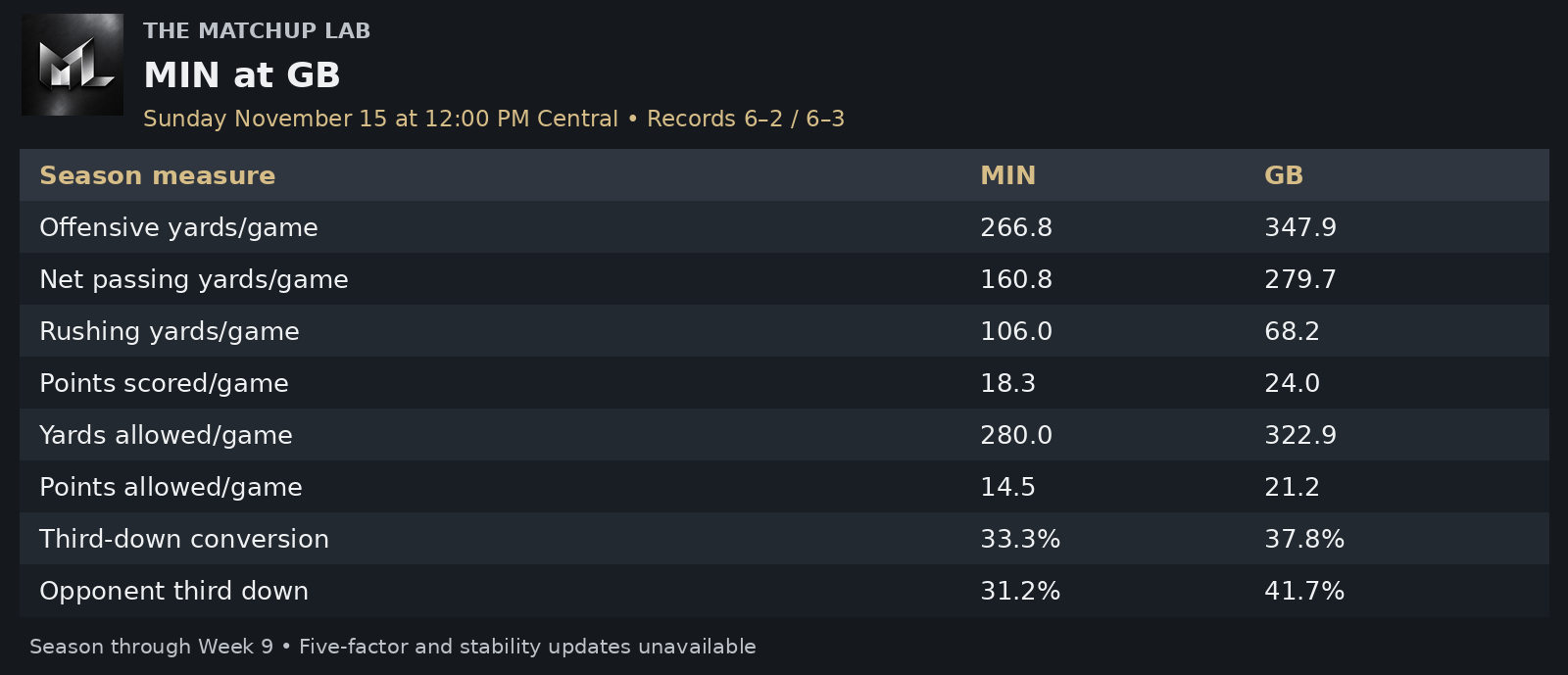
Minnesota visits Green Bay on Sunday, November 15 at noon Central, bringing a 6–2 record against the Packers' 6–3. Green Bay just scored 45 at New England, but its season average is 24.0 points per game against a Minnesota defense allowing 14.5. The Vikings also concede 280.0 yards per game and a 31.2% third-down conversion rate. Green Bay's offense averages 279.7 net passing yards and only 68.2 rushing yards, making its ability to sustain that passing production the most obvious matchup question.
Minnesota has an equally pressing issue with the ball. Its offense averages 18.3 points and 266.8 yards, and converts 33.3% of third downs. Six points against Buffalo made that limitation costly despite a strong defensive season. Green Bay allows 21.2 points and 322.9 yards per game, with opponents converting 41.7% on third down. That offers Minnesota an opening, but the Vikings must take it. The records make this an important divisional meeting; the numbers make Minnesota's offensive response as interesting as its defense against Green Bay's passing game.
The recent scoring paths run in opposite directions. Minnesota beat Indianapolis 16–10 before losing 19–15 at Detroit and 23–6 to Buffalo, leaving it with 16, 15 and six points in its last three games. Green Bay followed a 20–17 loss at Detroit with wins of 27–19 over Carolina and 45–27 at New England. That improvement matters, but the latest 45 should not become an assumed baseline against this defense. Minnesota needs more complete offensive possessions to give its stops value. Green Bay needs to maintain scoring production against a more restrictive season profile while keeping the Vikings' modest offense from finding relief.