
THE MATCHUP LAB · NFL
Game Center
Scores, statistics and the story behind the game.
Checking for updates…
Complete NFL Week 9 recap and all 32 team assessments
Week 9 loss 24–27 against Chicago Bears
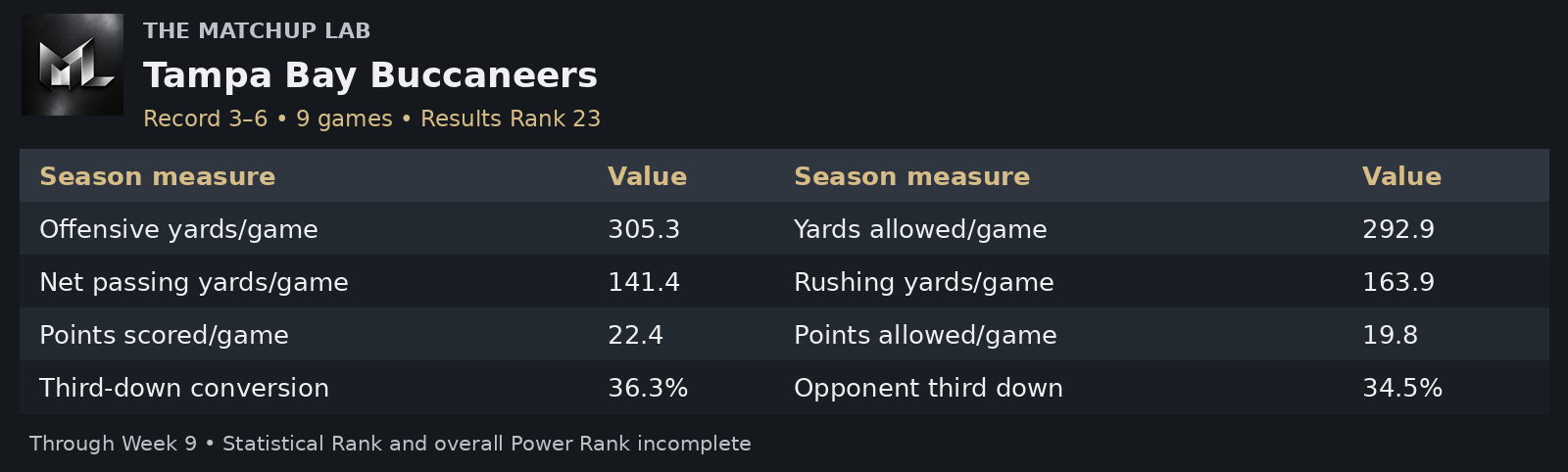
Tampa Bay's 3–6 record sits beside a positive season scoring balance, with 22.4 points scored and 19.8 allowed per game. The 27–24 loss to Chicago shows how that broader balance can coexist with another disappointing result. The Buccaneers had previously beaten Carolina 43–13 and Atlanta 16–0. Their offense remains unusually concentrated on the ground, averaging 163.9 rushing yards against 141.4 passing yards. That strength gives Tampa Bay a clear identity, but the smaller passing contribution leaves less variety when it needs a different route to points.
The Week 10 break offers a chance to work on that limitation without abandoning the productive part of the attack. Tampa Bay's defense allows 292.9 yards per game and a 34.5 percent opponent third-down conversion rate, enough substance to support improvement in results. The offense converts 36.3 percent of its own third downs. Turning more of those possessions into continued opportunities would help the Buccaneers convert a favorable scoring balance into a record that better reflects it.
Week 9 win 27–24 against Tampa Bay Buccaneers
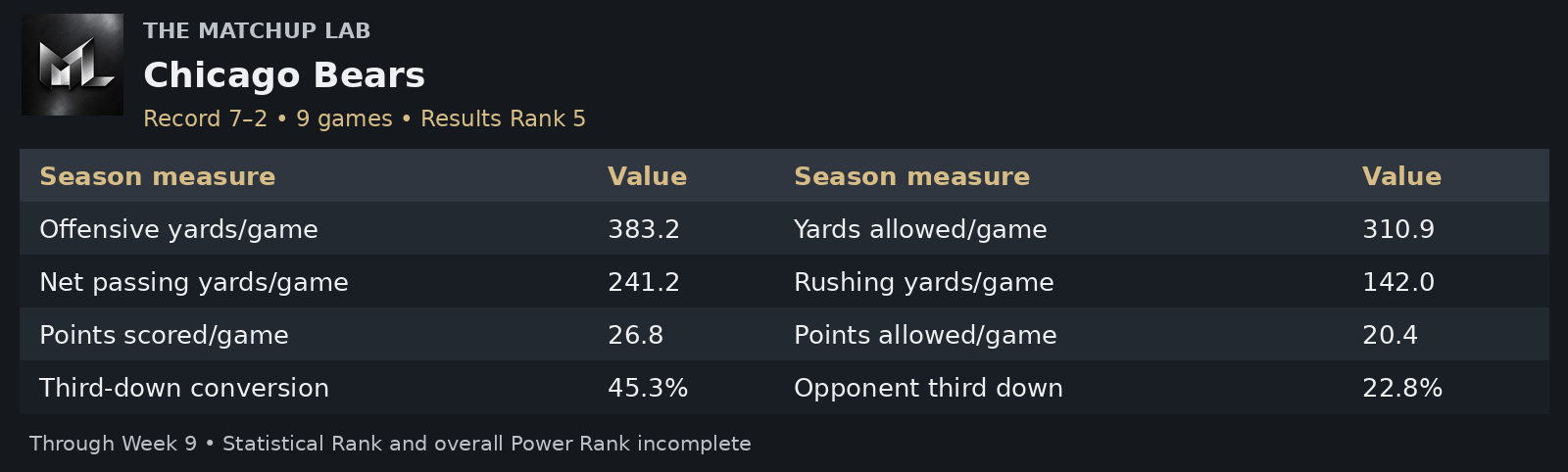
Chicago's 27–24 win over Tampa Bay was tighter than the previous victory over Seattle, but it still moved the Bears to 7–2. Their season has more behind it than a collection of narrow escapes. Chicago averages 383.2 yards, including 142.0 on the ground, and converts 45.3 percent of third downs. The defense allows 310.9 yards per game and has held opponents to a 22.8 percent third-down conversion rate. Those are distinct ways of extending Chicago possessions and ending the other side's, even though they do not make every game comfortable.
Chicago enters its Week 10 break on a four-game winning streak, scoring 30, 34 and 27 points in the latest three. That scoring has been sufficient, but Tampa Bay's 24 points show why the defense still needs attention alongside the celebrations. The useful standard after the break is to preserve the offense's balance while maintaining those third-down stops. Chicago has earned its strong record; keeping opponents away from easy scoring opportunities remains the work that protects it.
Chicago edged Tampa Bay 27–24 to improve to 7–2, leaving the Buccaneers 3–6. The Bears' broader profile supports the result. They average 383.2 yards per game, convert 45.3% of third downs and allow opponents only 22.8%. Tampa Bay offers a different combination, allowing 292.9 yards per game while generating 163.9 rushing yards and 141.4 net passing yards. Those strengths made this more than a simple comparison of records. Chicago added a narrow win to strong season indicators; Tampa Bay still needs its defensive and rushing production to translate into more victories.
Complete NFL Week 8 recap and all 32 team assessments
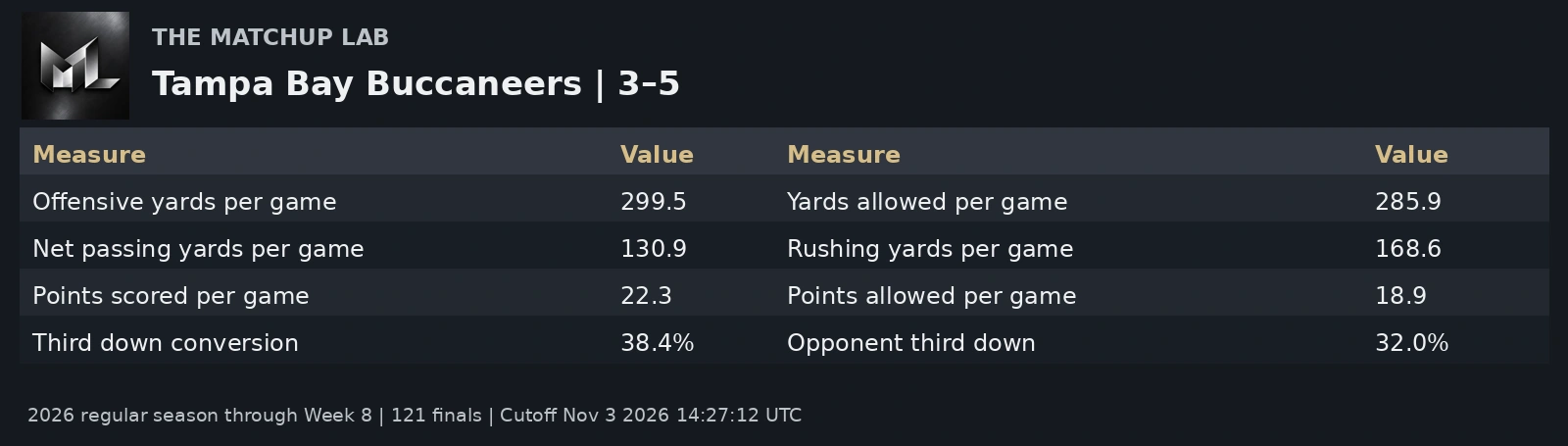
Tampa Bay’s 16–0 win over Atlanta displayed the defensive strength that makes its 3–5 record especially frustrating. The Buccaneers allow 285.9 yards and 18.9 points a game, and opponents convert only 32.0% of third downs. Their offense is led by 168.6 rushing yards against 130.9 net passing yards. That balance can support a controlled game, but 299.5 total yards and 22.3 points do not leave abundant room for a defensive lapse. The shutout is an achievement; a more flexible offense would make such defensive perfection less necessary.
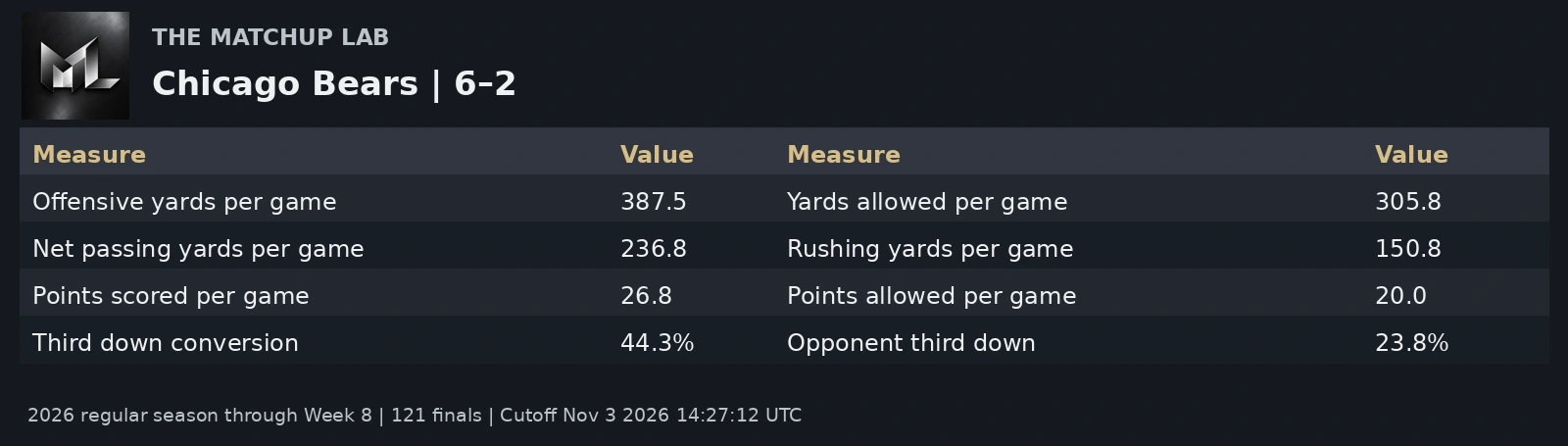
Chicago’s 34–17 win at Seattle completed Week 8 with a strong statement from a 6–2 team. The Bears gain 387.5 yards a game, including 150.8 rushing, and convert 44.3% of third downs. The defense allows only 23.8%, giving Chicago a striking advantage in continuing and ending series. Opponents still score 20.0 points a game against 26.8 for the Bears, so there is room to make that possession edge count more consistently. This was a convincing win with broader season support behind it.
Tampa Bay’s 168.6 rushing yards a game is a meaningful strength, but Chicago allows only 23.8% of third-down attempts to succeed. If the Buccaneers cannot extend series, their preference for the ground game will have fewer opportunities to shape the contest. Chicago has its own substantial rushing production, 150.8 yards a game, and converts 44.3% of third downs. Tampa Bay’s defense allows 18.9 points and 285.9 yards a game, so this is a serious test of how much of the Bears’ 26.8-point scoring rate carries into a restrictive matchup. The recent shutout should raise expectations of Tampa Bay’s defense without excusing its offense from scoring.