
THE MATCHUP LAB · NFL
Game Center
Scores, statistics and the story behind the game.
Checking for updates…
Complete NFL Week 9 recap and all 32 team assessments
Week 9 loss 3–17 against Seattle Seahawks
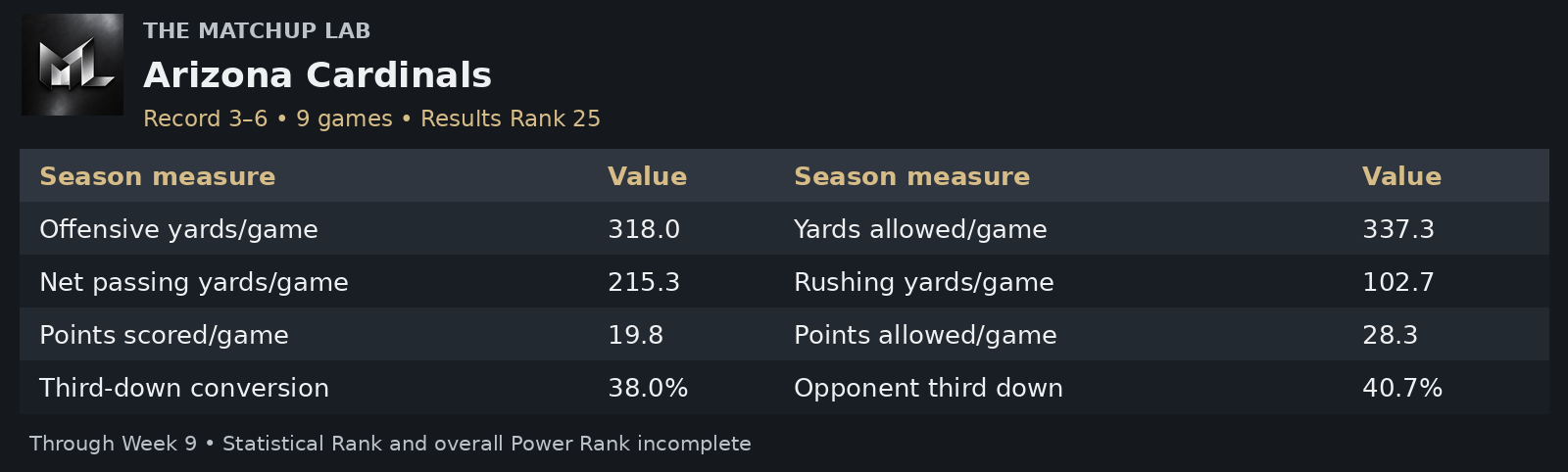
Arizona went from scoring 33 against Dallas to three against Seattle, a sharp reversal that left the Cardinals 3–6. The larger season picture is less flattering than the Dallas win. Arizona averages 318.0 yards and 19.8 points while allowing 28.3 points per game. Its 38.0 percent third-down conversion rate provides some ability to continue possessions, but the offense has not consistently produced enough to offset that scoring burden. The Seattle result was an extreme example of a problem already visible in the season totals.
The Rams arrive next with a defense allowing 302.4 yards per game and a 31.6 percent opponent third-down conversion rate. Arizona needs more sustained offense against that resistance while limiting a Los Angeles attack averaging 379.8 yards. Simply recovering the points missing from the Seattle game would address only part of the task. The Cardinals need both sides to contribute to a more manageable contest, rather than asking an offense below 20 points per game to repair another large defensive allowance.
Week 9 win 17–3 against Arizona Cardinals
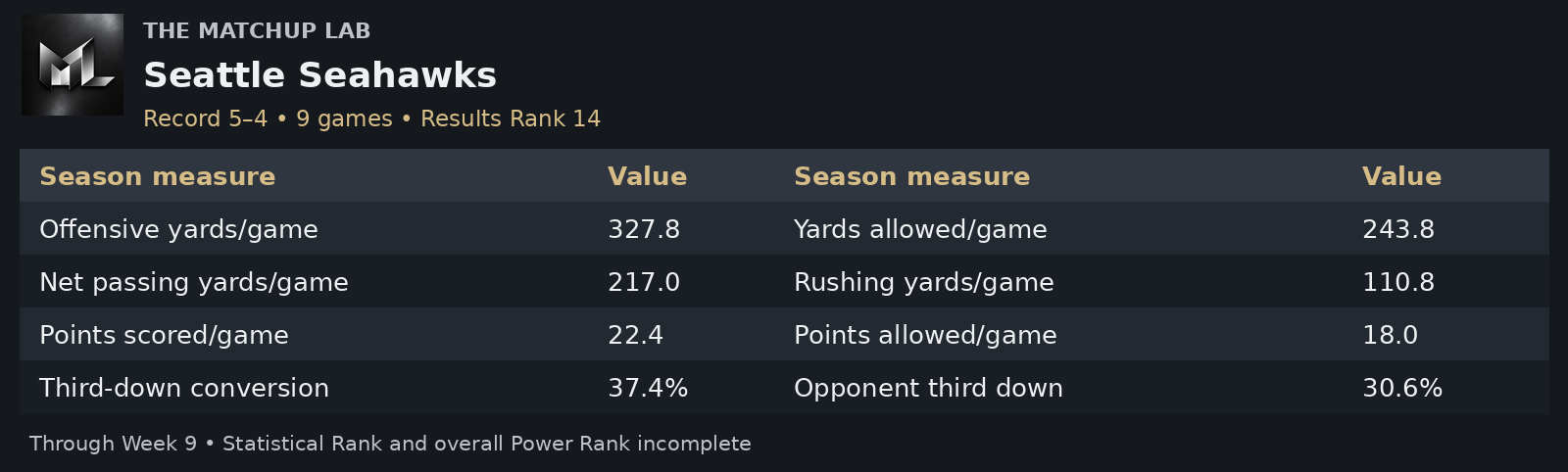
Seattle's defense gives a 5–4 team a substantial argument for optimism, even after an uneven recent sequence. The Seahawks beat Kansas City 20–3, lost 34–17 to Chicago, then held Arizona to three points in a 17–3 win. Across the season they allow 243.8 yards and 18.0 points per game, with opponents converting 30.6 percent of third downs. The Chicago result prevents the recent defensive story from becoming too tidy, but the full-season numbers remain strong evidence of Seattle's ability to restrict opposing offenses.
The next opponent, Las Vegas, allows 385.4 yards and 29.8 points per game. That presents an opportunity for a Seattle offense averaging 327.8 yards and 22.4 points to provide more comfortable support. The Raiders still generate 259.7 passing yards per game, so the defensive assignment is not empty simply because their record is worse. Seattle should be looking for a fuller offensive contribution while carrying its third-down stops into another game, rather than asking the defense to hold everyone to three.
Seattle's 17–3 win over Arizona brought the Seahawks to 5–4 and the Cardinals to 3–6. The defensive result fits Seattle's season foundation, with 243.8 yards and 18.0 points allowed per game, with opponents converting 30.6% of third downs. Its own scoring average is 22.4, so the Seahawks won without reaching their usual output. Arizona averages 19.8 points while allowing 28.3, and scoring three made that imbalance especially costly. Seattle has a clear defensive strength to build around; Arizona needs substantially more scoring to protect its margin for error.
Complete NFL Week 8 recap and all 32 team assessments
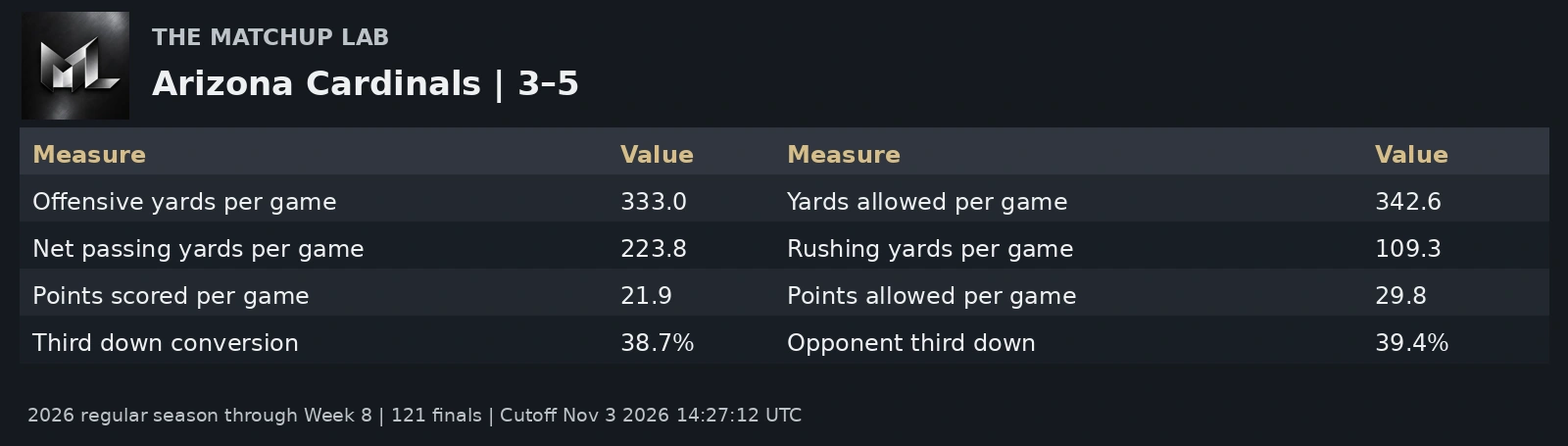
Arizona’s 33–30 overtime win at Dallas was valuable relief for a 3–5 team, but the Cardinals’ season scoring balance remains severe: 175 points for, 238 against. Their offense averages 333.0 yards and 21.9 points, while opponents score 29.8. The third-down comparison is fairly close, 38.7% converted against 39.4% allowed, so the broader defensive concessions cannot responsibly be reduced to one conversion statistic. Arizona needs the latest scoring output to become more repeatable and its defensive damage to become much less costly.
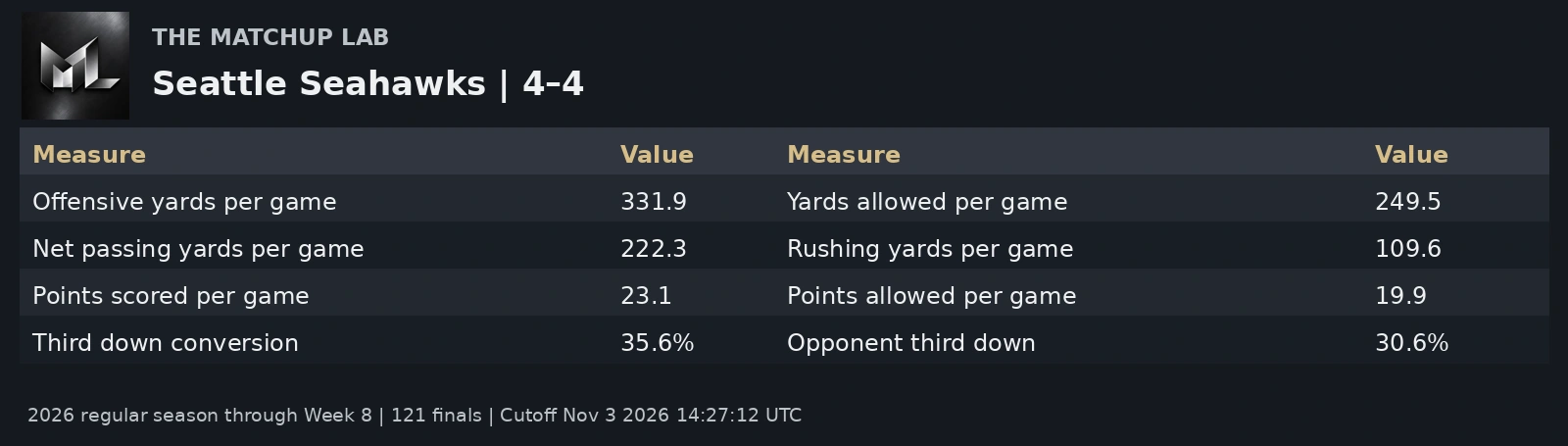
Seattle lost 34–17 to Chicago, a costly result for a defense that has otherwise allowed only 249.5 yards a game. Opponents convert 30.6% of third downs, and the Seahawks still own a 26-point season scoring advantage at 4–4. Their offense averages 331.9 yards but converts only 35.6% of third downs. The defensive foundation is meaningful; Seattle needs more offensive continuity to use it. One poor night should not erase the season’s stops, but those stops cannot be expected to compensate for every stalled possession.