
 Short
What in the Hog?!
Purdy’s Passing Window Had an Appointment | What the Hog
Publicado 26 oct 2026
THE MATCHUP LAB · NFL
Marcadores, estadísticas y la historia del partido.
Buscando actualizaciones…
COBERTURA DE THE MATCHUP LAB
San Francisco 49ers 20, Atlanta Falcons 29 in regulation
Complete NFL Week 7 recap and season assessment
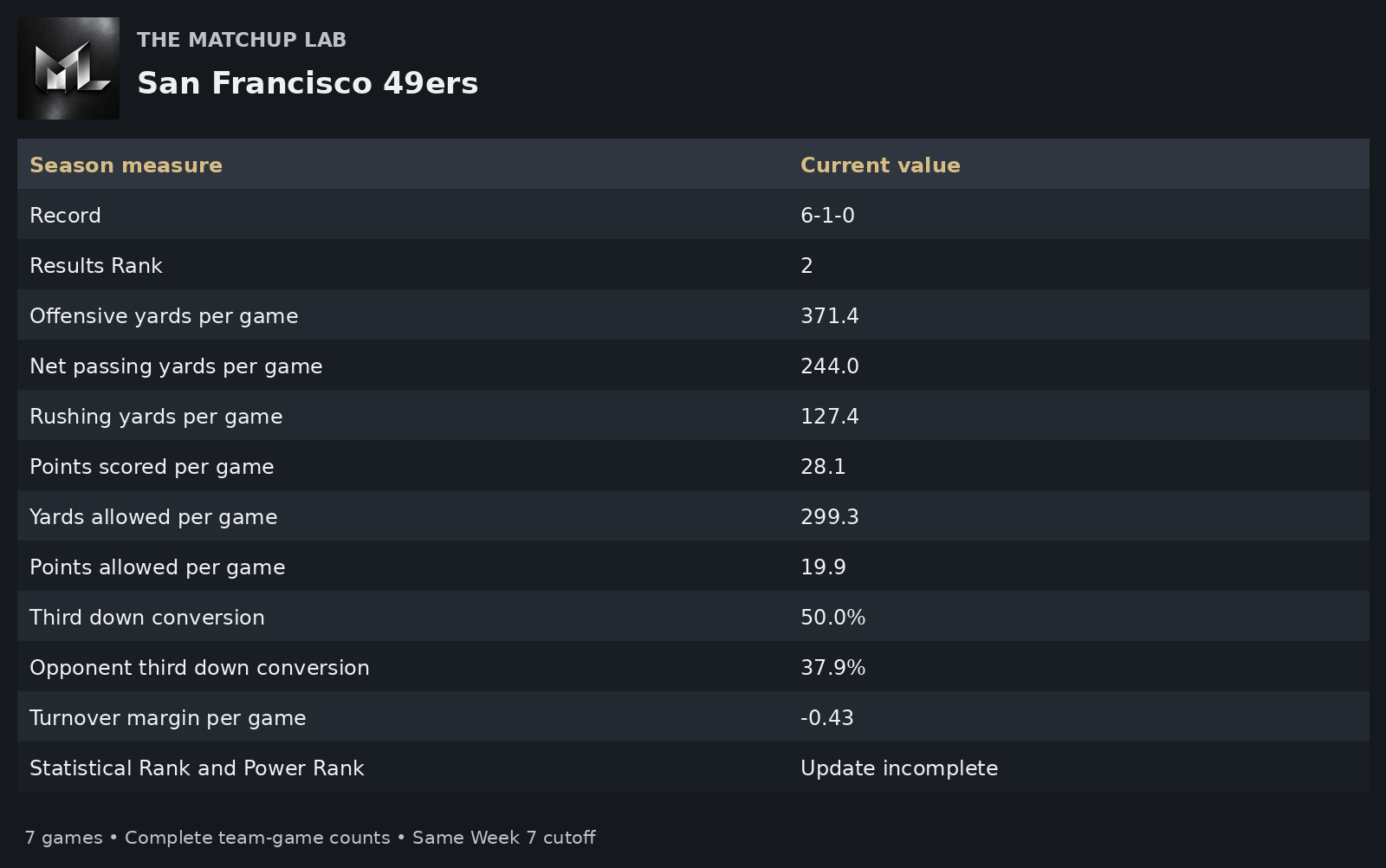
Four giveaways made San Francisco's 400 yards a poor answer to Atlanta's 295. The first defeat exposed the difference between moving the ball and preserving the chance to score. The 49ers still own six wins and a healthy season scoring margin. One messy afternoon does not erase that work, but the defense could not prevent the lost possessions from becoming a nine-point defeat. The useful correction starts with completing drives without gifting another opportunity. Asking the offense for still more yards would miss what actually changed this game.
San Francisco still averages 371.4 yards against 299.3 allowed, with a positive season scoring margin. That broader advantage survives the first loss. The offense's 50.0% third-down conversion rate supports sustained possessions, but useful conversions cannot recover a chance that ends with the ball going the other way. The next improvement is preserving that work through the last decision of the drive.
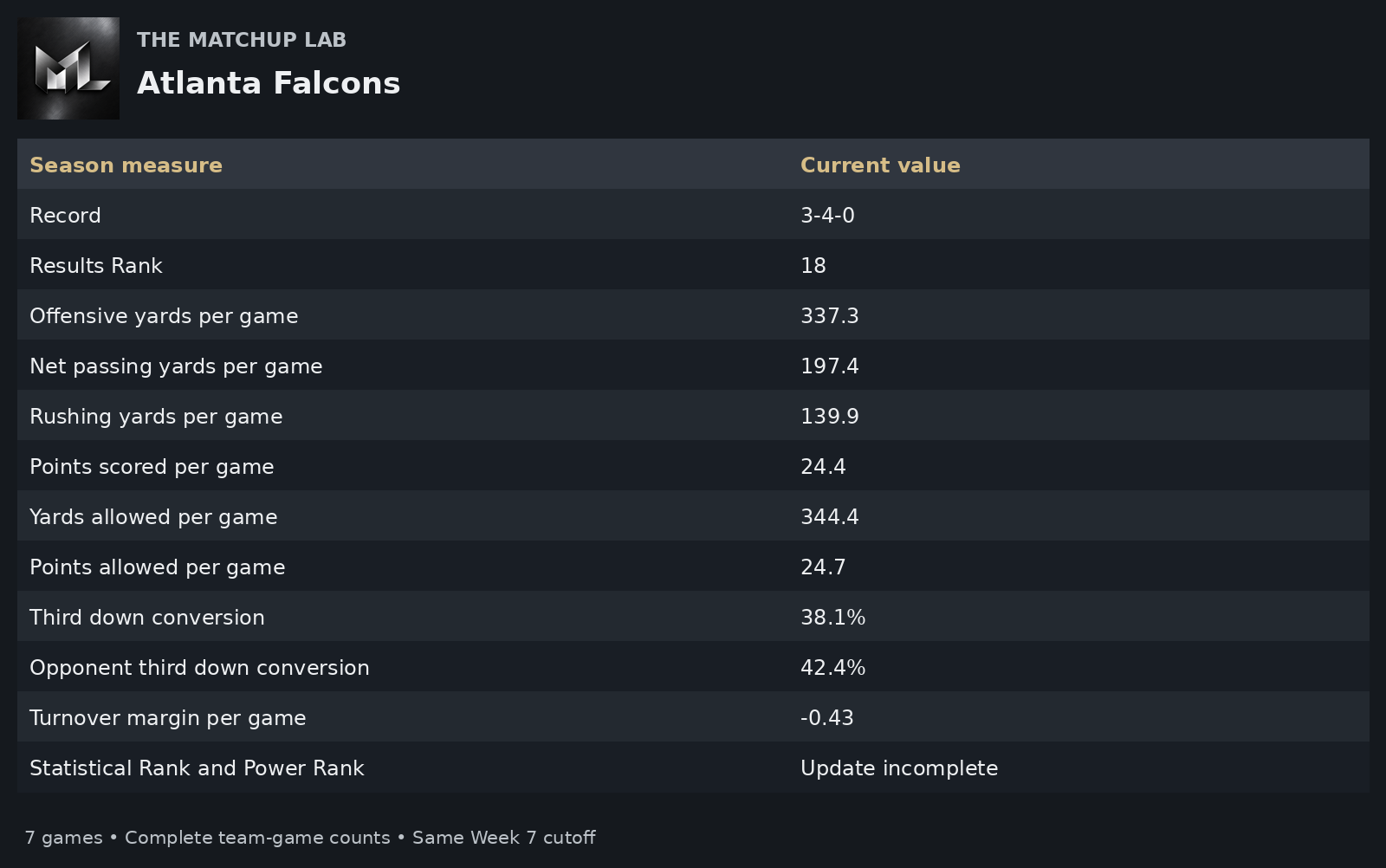
Atlanta beat San Francisco while gaining 105 fewer yards because it kept possession and took the ball away four times. Those are real contributions, not a reason to dismiss the victory. They also explain why the Falcons should resist treating twenty-nine points as a new offensive baseline. Four conversions in twelve third-down attempts left room for steadier progress. Their season scoring margin is close to level. Atlanta needs more chances it creates through its own sustained work, preserving the ball security that made the takeaways valuable without assuming another four will arrive next week.
Atlanta's season scoring is nearly level, 24.4 points per game against 24.7 allowed. That fits a team whose latest win improved the record without establishing a large margin for error. The offense averages 337.3 yards and converts 38.1% of third downs. More sustained production would let the Falcons make a defensive takeaway enlarge an advantage rather than become a necessary source of it.
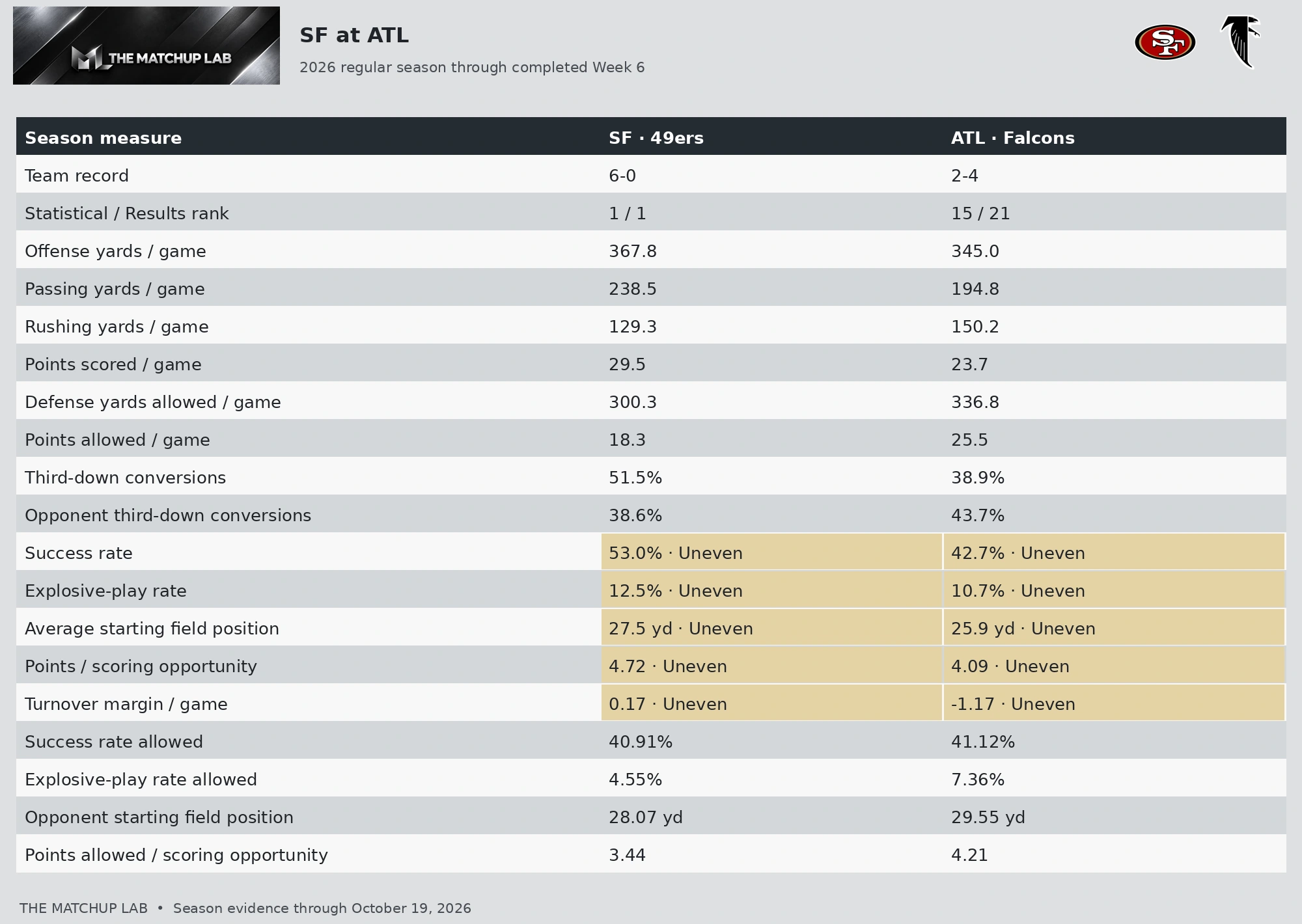
Atlanta's offense has enough useful work to make this more interesting than the records alone imply. The Falcons have produced ordinary gains and long plays more frequently than their opponents. San Francisco has done the same by a much larger margin, with an unbeaten record supported by the strongest statistical performance in this edition. The 49ers have allowed long gains on only 4.5% of qualifying plays. Atlanta cannot assume that one completion will repair an otherwise stalled possession. Its first responsibility is to reach manageable second and third downs without handing the ball back.
That last qualification is substantial. Atlanta's turnover margin is worse than minus one per game. Its non-turnover starting position has also been less favorable than the territory afforded to opponents. Those are separate costs. One makes a possession longer before it begins; the other removes the possession altogether. San Francisco's season return from scoring opportunities is stronger than what its defense has allowed, so gifting it an extra short field would make an already difficult assignment harder. Atlanta needs its useful offensive gains to survive all the way to a scoring attempt instead of disappearing with the next mistake.
Monday's six-point win over Washington still gave San Francisco something to address. A large halftime lead became a late defensive assignment, and the offense cannot treat an early advantage as permission to stop sustaining drives. Atlanta should force the 49ers to keep executing after the first successful series and avoid providing the cheap possession that creates separation. San Francisco should press the Falcons' ordinary defensive weaknesses while keeping its own down-to-down discipline. The decisive test is whether Atlanta can assemble several productive possessions against a defense that has denied both routine progress and escape plays. The Falcons need protection of the ball and a better opening sequence. The 49ers need their offense to remain useful after building the lead.