
New York Jets 12 · Chicago Bears 23
Team assessments and season evidence from our Week 4 recap.
Soldier Field · 2026-10-04
The final score was New York Jets 12 · Chicago Bears 23. The breakdown below uses this game’s figures, separate from season averages.
The scoring path
| Team | Q1 | Q2 | Q3 | Q4 | Final |
|---|---|---|---|---|---|
| New York Jets | 0 | 3 | 3 | 6 | 12 |
| Chicago Bears | 7 | 6 | 7 | 3 | 23 |
| Measure | New York Jets | Chicago Bears |
|---|---|---|
| First downs | 7 | 34 |
| Total yards | 157 | 492 |
| Yards per play | 4.9 | 5.5 |
| Passing yards | 98 | 260 |
| Rushing yards | 59 | 232 |
| Third-down conversions | 0-7 | 7-15 |
| Red-zone touchdowns / trips | 0-2 | 2-7 |
| Giveaways | 0 | 2 |
| Possession time | 17:15 | 42:45 |
Third-down conversion is shown as its own measure. It is not a substitute for overall play success rate. A dash means the source did not supply that field.
The Lab’s result test
Chicago Bears won by 11 points. Q1 supplied the largest scoring swing in the winner’s favor, a +7-points period. The chart shows the result’s path; the box score helps explain what created it.
New York Jets produced 157 total yards; Chicago Bears produced 492. Yardage describes how much ground was gained, not whether the most valuable drives were finished.
Chicago Bears committed 2 giveaways against the opponent’s 0. The winner still had to overcome a worse giveaway count.
The next test is repeatability. Separate staying on schedule from long gains, then examine field position and drive finishing. A large yardage total can coexist with missed scoring chances; a short field can make a modest drive valuable.
Our game coverage
A matching published game video is not available in the verified archive yet.
Game played 2026-10-04. These assessments cover the season through October 5, 2026, including this game.
Read the complete Week 4 article →
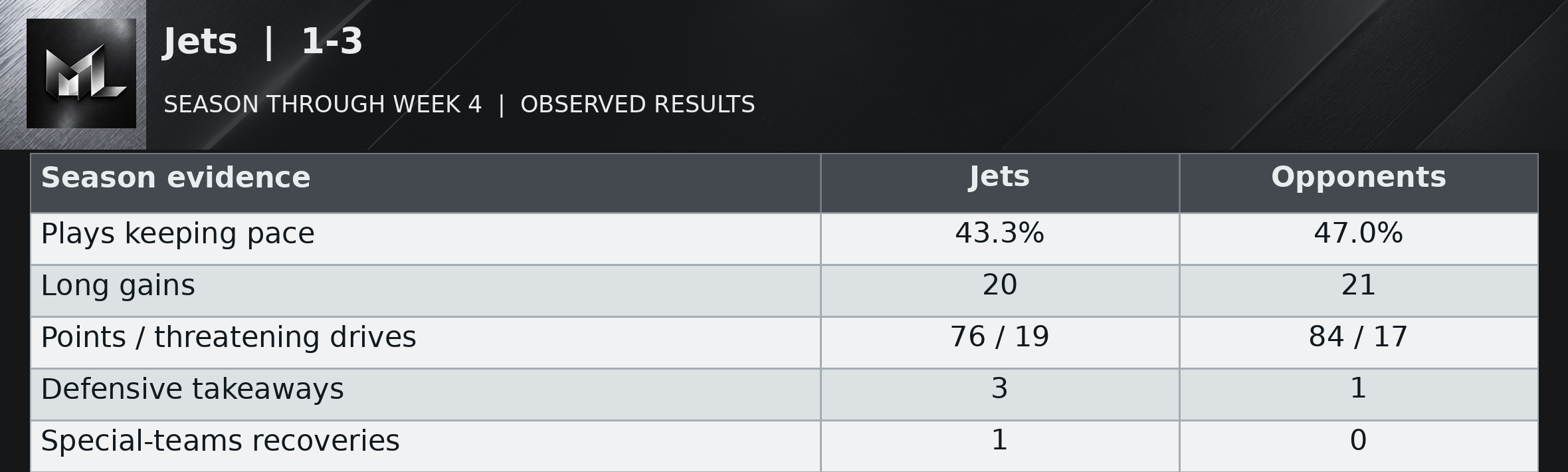
Jets | 1-3
Read the table as text
| Season evidence | Jets | Opponents |
|---|---|---|
| Plays keeping pace | 43.3% | 47.0% |
| Long gains | 20 | 21 |
| Points / threatening drives | 76 / 19 | 84 / 17 |
| Defensive takeaways | 3 | 1 |
| Special-teams recoveries | 1 | 0 |
The Jets have taken care of the ball, giving it away only once in four games, but clean possession has not become dependable possession. Their weekly useful-play shares have swung from 48.3 to 33.8 to 50.8 to 40.6 percent. The defense has allowed useful progress on 47.0 percent of plays and 84 offensive points from only 17 threatening drives. Three of the team's four takeaways were defensive, with the other coming on special teams. None of that adds up to enough stops and sustained answers.
Geno Smith said “keep our defense off the field”. Sunday's 0-for-7 third-down showing and the 89-to-32 play imbalance against Chicago make that less a slogan than an urgent instruction. The two takeaways did not rescue an offense that produced just two long gains. Chicago's waste near the goal line kept the 23-12 result within reach longer than the possession gap justified. New York's 1-3 season needs more than another clean giveaway column. It needs reasons to keep the next possession.
After opponent punts or failed fourth downs, Jets possessions have begun at their own 21.9, on average, across 17 competitive drives. The weekly average has varied widely, from their own 1.0 to their own 27.3. The latest game averaged their own 1.0. The resulting possession started at midfield or closer to the end zone in 1 of those 17 cases. These are actual starting spots, including punt returns, rather than a measure of the defense alone. The return unit has added 31 punt-return yards over the season. Starts following turnovers are counted separately: 4 competitive possessions at their opponent 29.5 on average.
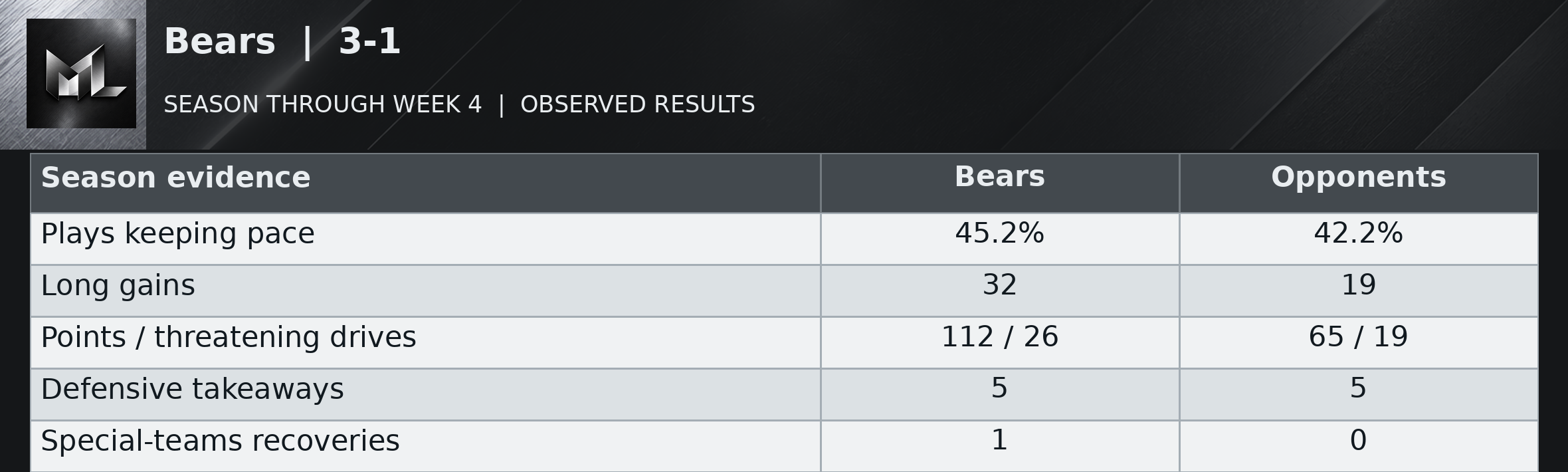
Bears | 3-1
Read the table as text
| Season evidence | Bears | Opponents |
|---|---|---|
| Plays keeping pace | 45.2% | 42.2% |
| Long gains | 32 | 19 |
| Points / threatening drives | 112 / 26 | 65 / 19 |
| Defensive takeaways | 5 | 5 |
| Special-teams recoveries | 1 | 0 |
Chicago's offense has varied far more than its 3-1 record suggests. It scored 59 in the opener, three in the next game, then 27 and 23. The long gains have remained available, 32 across the season, but the offense has not consistently turned its visits near scoring territory into touchdowns. Its defense has been steadier at limiting the damage, allowing 65 offensive points on 19 threatening possessions. Five of the team's six takeaways were defensive, with the other coming on special teams.
Sunday supplied a different kind of stress test. The Bears ran 89 plays to the Jets' 32 and rushed for 232 yards, yet scored only 23 points. Their two giveaways and two touchdowns on seven red-zone visits kept a dominant possession game from becoming a dominant scoreboard. The model's threatening-drive count uses a broader definition and removes intentional kneel endings, so it is not that red-zone count. Winning with a different quarterback is a credit to the operation. Spending almost the entire afternoon with the ball should buy more separation.
After opponent punts or failed fourth downs, Bears possessions have begun at their own 28.2, on average, across 20 competitive drives. The weekly average has varied widely, from their own 23.6 to their own 37.8. The latest game averaged their own 23.6. The resulting possession started at midfield or closer to the end zone in 1 of those 20 cases. These are actual starting spots, including punt returns, rather than a measure of the defense alone. The return unit has added 84 punt-return yards over the season. Pre-snap changes before the first run or pass affected 1 of these drives; those changes are excluded from the listed starting spots. Starts following turnovers are counted separately: 6 competitive possessions at their own 49.3 on average.
Week 4 daytime roundup
This is the multi-game edition, rather than a dedicated recap.