
New England Patriots 29 · Buffalo Bills 26
Team assessments and season evidence from our Week 4 recap.
Highmark Stadium · 2026-10-04
The final score was New England Patriots 29 · Buffalo Bills 26. The breakdown below uses this game’s figures, separate from season averages.
 New England Patriots
 Buffalo Bills
The scoring path
| Team | Q1 | Q2 | Q3 | Q4 | Final |
|---|---|---|---|---|---|
| New England Patriots | 7 | 7 | 7 | 8 | 29 |
| Buffalo Bills | 0 | 17 | 0 | 9 | 26 |
| Measure | New England Patriots | Buffalo Bills |
|---|---|---|
| First downs | 26 | 19 |
| Total yards | 405 | 340 |
| Yards per play | 5.5 | 6.3 |
| Passing yards | 262 | 249 |
| Rushing yards | 143 | 91 |
| Third-down conversions | 5-12 | 6-12 |
| Red-zone touchdowns / trips | 3-3 | 2-4 |
| Giveaways | 2 | 2 |
| Possession time | 33:41 | 26:19 |
Third-down conversion is shown as its own measure. It is not a substitute for overall play success rate. A dash means the source did not supply that field.
The Lab’s result test
New England Patriots won by 3 points. Q1 supplied the largest scoring swing in the winner’s favor, a +7-points period. The chart shows the result’s path; the box score helps explain what created it.
New England Patriots produced 405 total yards; Buffalo Bills produced 340. Yardage describes how much ground was gained, not whether the most valuable drives were finished.
New England Patriots committed 2 giveaways against the opponent’s 2. The giveaway counts were level, so that total alone does not separate these teams.
The next test is repeatability. Separate staying on schedule from long gains, then examine field position and drive finishing. A large yardage total can coexist with missed scoring chances; a short field can make a modest drive valuable.
Our game coverage
A matching published game video is not available in the verified archive yet.
Game played 2026-10-04. These assessments cover the season through October 5, 2026, including this game.
Read the complete Week 4 article →
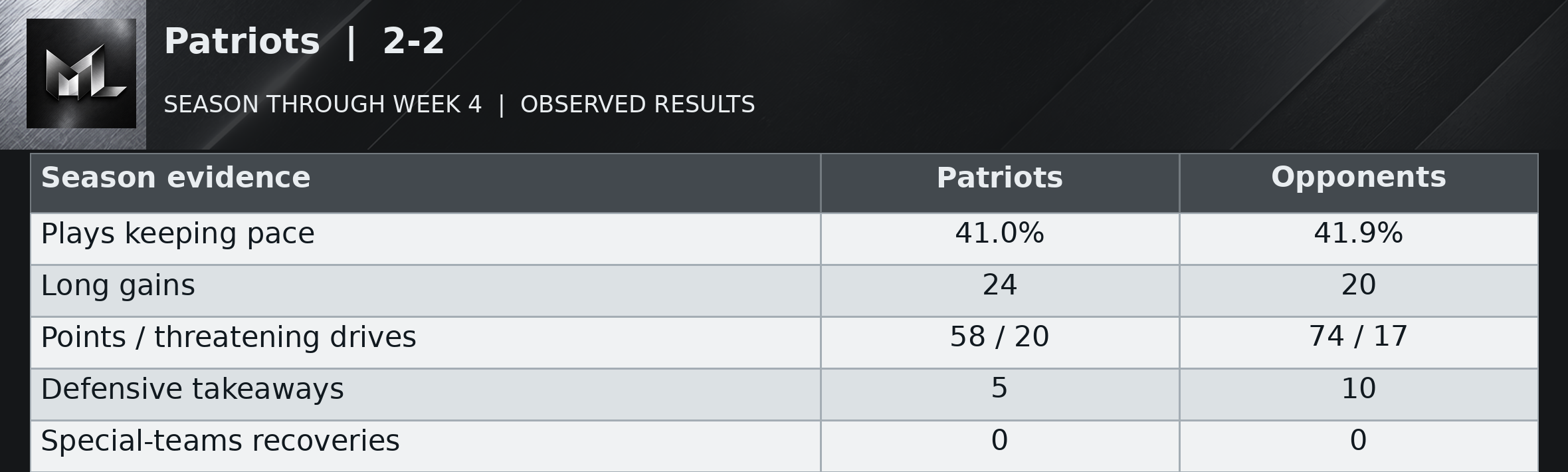
Patriots | 2-2
Read the table as text
| Season evidence | Patriots | Opponents |
|---|---|---|
| Plays keeping pace | 41.0% | 41.9% |
| Long gains | 24 | 20 |
| Points / threatening drives | 58 / 20 | 74 / 17 |
| Defensive takeaways | 5 | 10 |
| Special-teams recoveries | 0 | 0 |
New England's cleanest recurring description is repeated offensive waste followed by one much better performance. The offense produced 29 points from its first 15 threatening possessions across three games, then 29 from five Sunday. Its share of useful plays rose to 49.3 percent after staying between 35.0 and 41.2. That is a meaningful improvement, not four games of dependable scoring. The possession problem persisted: giveaways have run three, two, three and two, all outside special teams.
The 29-26 win at Buffalo showed the Patriots can sustain long drives rather than survive exclusively on takeaways. They gained 405 yards and 26 first downs while the defense added two interceptions or recoveries. Across the season, opponents have returned 74 offensive points from 17 threatening drives against New England's 58 from 20. The Patriots' 2-2 record now has a convincing offensive example behind it. Repeating that without giving the opponent two additional possessions would be an even more useful next step.
After opponent punts or failed fourth downs, Patriots possessions have begun at their own 22.4, on average, across 20 competitive drives. The weekly average has varied widely, from their own 13.0 to their own 32.3. The latest game averaged their own 25.8. The resulting possession started at midfield or closer to the end zone in 1 of those 20 cases. These are actual starting spots, including punt returns, rather than a measure of the defense alone. The return unit has added 77 punt-return yards over the season. Pre-snap changes before the first run or pass affected 1 of these drives; those changes are excluded from the listed starting spots. Starts following turnovers are counted separately: 4 competitive possessions at their own 41.5 on average.
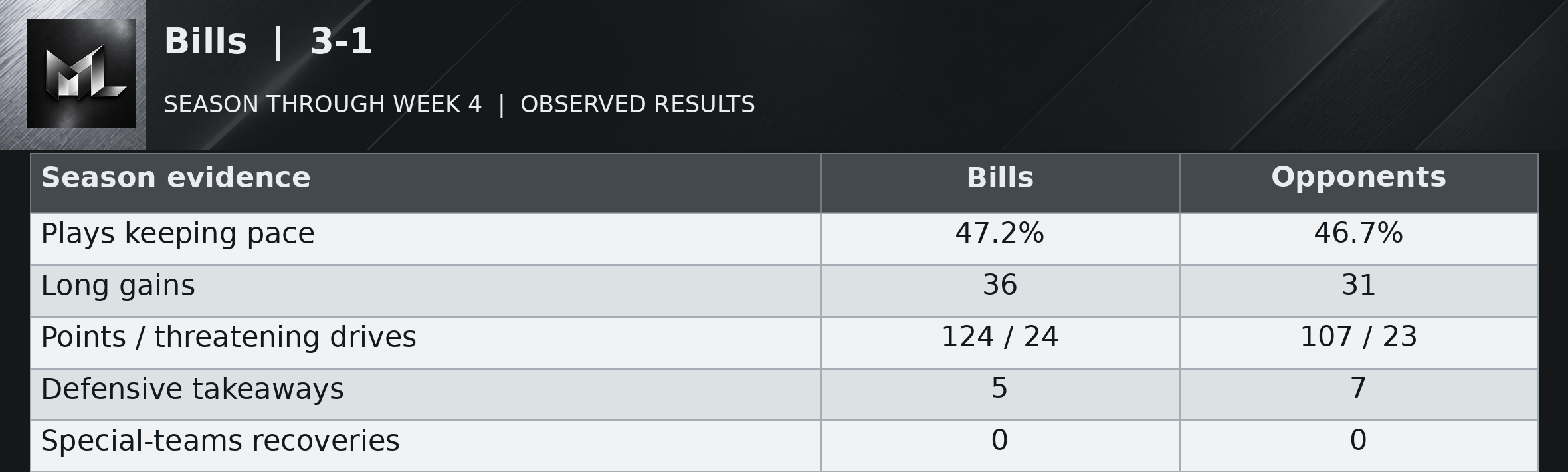
Bills | 3-1
Read the table as text
| Season evidence | Bills | Opponents |
|---|---|---|
| Plays keeping pace | 47.2% | 46.7% |
| Long gains | 36 | 31 |
| Points / threatening drives | 124 / 24 | 107 / 23 |
| Defensive takeaways | 5 | 7 |
| Special-teams recoveries | 0 | 0 |
Buffalo's offense has repeatedly found long gains and finished enough drives to win, but its defense has repeatedly invited opponents to answer. The Bills have 36 long gains against 31 allowed, and opponents have stayed on schedule on 46.7 percent of their plays. That leaves a 3-1 team with less room for offensive mistakes than its scoring talent suggests. The first two games were clean. Five giveaways in Week 3 and two more Sunday are a recent problem, rather than four weeks of identical carelessness.
Josh Allen said he should “live another day”. The late interception in the 29-26 loss made that lesson expensive. Buffalo collected two defensive takeaways, but New England still gained 405 yards and 26 first downs. The Bills' offense managed useful gains on only 40.7 percent of plays while eight long gains preserved its scoring chances. Their season finishing remains strong at 124 offensive points on 24 threatening drives. A defense that cannot end possessions makes each avoidable offensive mistake feel like a second assignment.
After opponent punts or failed fourth downs, Bills possessions have begun at their own 26.0, on average, across 16 competitive drives. The weekly average has varied widely, from their own 19.8 to their own 33.5. The latest game averaged their own 20.5. The resulting possession started at midfield or closer to the end zone in 2 of those 16 cases. These are actual starting spots, including punt returns, rather than a measure of the defense alone. The return unit has added 70 punt-return yards over the season. Starts following turnovers are counted separately: 3 competitive possessions at their own 46.7 on average.
Week 4 daytime roundup
This is the multi-game edition, rather than a dedicated recap.