
Los Angeles Chargers 23 · Seattle Seahawks 30
Team assessments and season evidence from our Week 4 recap.
Lumen Field · 2026-10-04
The final score was Los Angeles Chargers 23 · Seattle Seahawks 30. The breakdown below uses this game’s figures, separate from season averages.
The scoring path
| Team | Q1 | Q2 | Q3 | Q4 | Final |
|---|---|---|---|---|---|
| Los Angeles Chargers | 3 | 3 | 7 | 10 | 23 |
| Seattle Seahawks | 7 | 13 | 10 | 0 | 30 |
| Measure | Los Angeles Chargers | Seattle Seahawks |
|---|---|---|
| First downs | 20 | 19 |
| Total yards | 301 | 286 |
| Yards per play | 4.4 | 4.9 |
| Passing yards | 154 | 148 |
| Rushing yards | 147 | 138 |
| Third-down conversions | 5-15 | 3-12 |
| Red-zone touchdowns / trips | 2-3 | 2-4 |
| Giveaways | 4 | 1 |
| Possession time | 30:59 | 29:01 |
Third-down conversion is shown as its own measure. It is not a substitute for overall play success rate. A dash means the source did not supply that field.
The Lab’s result test
Seattle Seahawks won by 7 points. Q2 supplied the largest scoring swing in the winner’s favor, a +10-points period. The chart shows the result’s path; the box score helps explain what created it.
Los Angeles Chargers produced 301 total yards; Seattle Seahawks produced 286. Yardage describes how much ground was gained, not whether the most valuable drives were finished.
Seattle Seahawks committed 1 giveaways against the opponent’s 4. That possession advantage gave the winner fewer mistakes to overcome.
The next test is repeatability. Separate staying on schedule from long gains, then examine field position and drive finishing. A large yardage total can coexist with missed scoring chances; a short field can make a modest drive valuable.
Our game coverage
A matching published game video is not available in the verified archive yet.
Game played 2026-10-04. These assessments cover the season through October 5, 2026, including this game.
Read the complete Week 4 article →
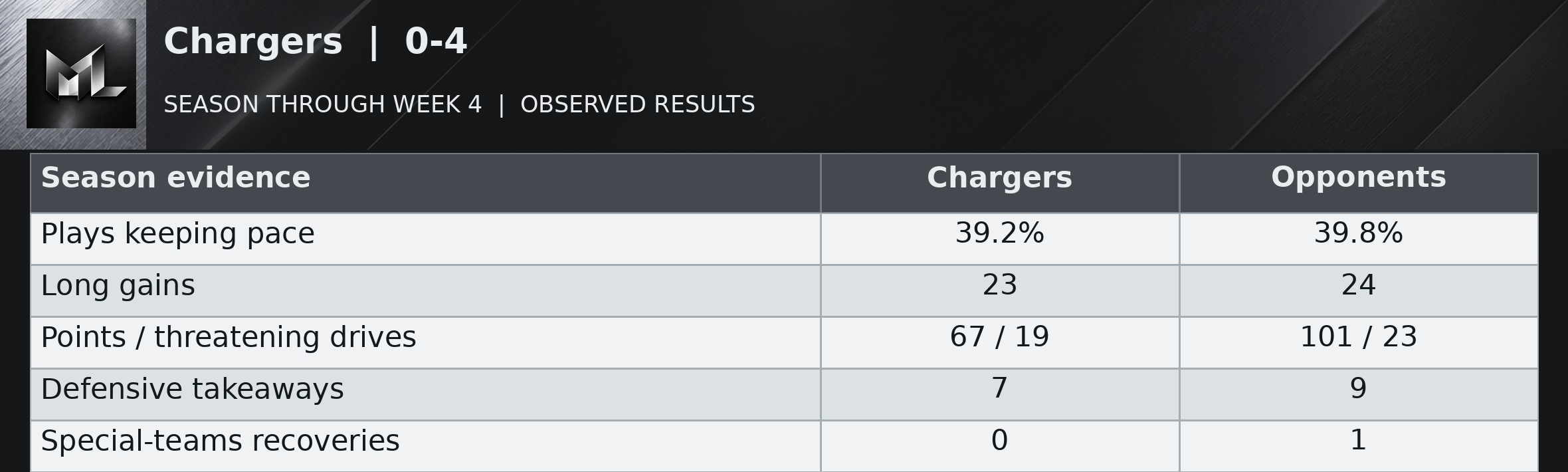
Chargers | 0-4
Read the table as text
| Season evidence | Chargers | Opponents |
|---|---|---|
| Plays keeping pace | 39.2% | 39.8% |
| Long gains | 23 | 24 |
| Points / threatening drives | 67 / 19 | 101 / 23 |
| Defensive takeaways | 7 | 9 |
| Special-teams recoveries | 0 | 1 |
The Chargers have allowed at least 24 points in every game and produced too few clean possessions to answer. Their offensive giveaways have run two, three, one and four. One of the 10 season giveaways came on special teams; the other nine did not. Seven defensive takeaways offered some help, but five came in a single game. The offense has kept moving on only 39.2 percent of plays and returned 67 points from 19 threatening drives, compared with 101 from 23 for opponents.
Jim Harbaugh praised a “never say die attitude”. Sunday supplied the comeback effort, from 27-6 down to a 30-23 final, and then the same ending problem: a sack-fumble on the final possession. Two interceptions, that fumble and a muffed punt gave Seattle four additional possessions. Seven long gains provided offensive life between stalls, but only 32.4 percent of plays made enough progress. Effort can narrow a score. Repeating possession mistakes is making 0-4 considerably easier to explain.
After opponent punts or failed fourth downs, Chargers possessions have begun at their own 16.8, on average, across 17 competitive drives. The weekly average has varied widely, from their own 13.4 to their own 29.0. The latest game averaged their own 18.3. The resulting possession started at midfield or closer to the end zone in 0 of those 17 cases. These are actual starting spots, including punt returns, rather than a measure of the defense alone. The return unit has added 14 punt-return yards over the season. Starts following turnovers are counted separately: 7 competitive possessions at their own 39.1 on average.
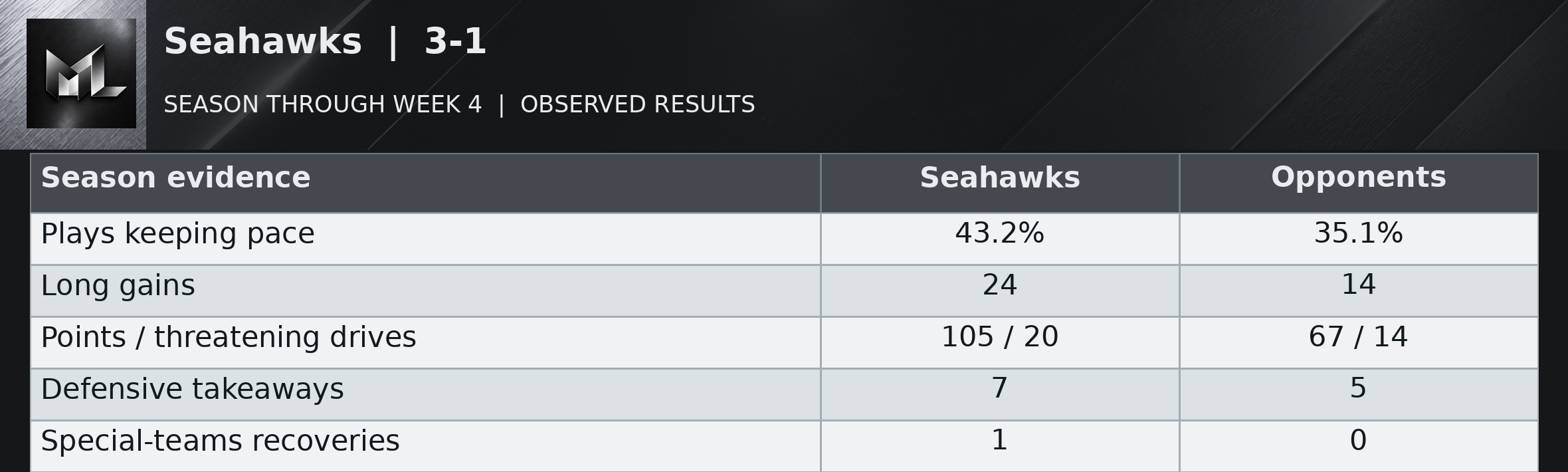
Seahawks | 3-1
Read the table as text
| Season evidence | Seahawks | Opponents |
|---|---|---|
| Plays keeping pace | 43.2% | 35.1% |
| Long gains | 24 | 14 |
| Points / threatening drives | 105 / 20 | 67 / 14 |
| Defensive takeaways | 7 | 5 |
| Special-teams recoveries | 1 | 0 |
Seattle's most convincing recurring strength is making opposing offenses work for ordinary gains. Opponents have kept pace with the down on only 35.1 percent of their plays, and Seattle has allowed 14 long gains against 24 of its own. The offense has scored at least 30 in three straight games, but those totals disguise changes in how the points arrived. Sunday brought its lowest share of useful plays, 35.7 percent, along with seven long gains and four extra possessions from mistakes.
Mike Macdonald acknowledged “a lot of room for improvement”. Fourteen penalties for 150 yards and a 27-6 lead that became a 30-23 win support him. Three of Sunday's recoveries or interceptions were defensive plays; the fourth was a muffed punt. Seven of eight season takeaways belong to the defense. The finishing has repeatedly been productive, but Seattle should not expect either opponent mistakes or long gains to make careless operation harmless. The rebound was useful. The bill for the penalties was still enormous.
After opponent punts or failed fourth downs, Seahawks possessions have begun at their own 25.1, on average, across 23 competitive drives. The weekly average has stayed in a fairly narrow band, from their own 22.0 to their own 28.0. The latest game averaged their own 28.0. The resulting possession started at midfield or closer to the end zone in 3 of those 23 cases. These are actual starting spots, including punt returns, rather than a measure of the defense alone. The return unit has added 79 punt-return yards over the season. Pre-snap changes before the first run or pass affected 2 of these drives; those changes are excluded from the listed starting spots. Starts following turnovers are counted separately: 6 competitive possessions at their opponent 41.0 on average.
Week 4 daytime roundup
This is the multi-game edition, rather than a dedicated recap.