
Formula 1
This event is outside the current daily snapshot. Return to the league schedule.
Las Vegas Aftermath as Verstappen Wins and McLaren Close on Red Bull
Reporting credits: Formula 1 official classifications, session results, championship tables and Qatar schedule; FIA race reports and steward decisions. Analysis by The Matchup Lab.
Heineken Las Vegas Grand Prix
Event window: 2026-11-20T00:30:00.000Z to 2026-11-22T04:00:00.000Z.
Analysis and tables from the November 23, 2026 weekly edition, at its stated reporting cutoff.
A race win for Verstappen, a larger return for McLaren
Max Verstappen won Las Vegas by 0.639 seconds, but McLaren left with the larger team return. Lando Norris and Oscar Piastri finished second and third for 33 points. Red Bull earned 25 and Mercedes 14 after late setbacks for both of its cars. The result cut Red Bull’s advantage over McLaren to nine points in the constructor standings.
The world titles are already settled. Kimi Antonelli secured the drivers’ championship in Mexico City and Mercedes clinched the constructors’ title in São Paulo. Las Vegas nevertheless changed the remaining position battles: Hamilton, Russell and Norris are separated by three points, Alpine gained ground on Racing Bulls, and Haas remain only three ahead of Audi.
This edition includes all 22 Las Vegas entrants, all 25 season participants in the driver standings, every constructor, qualifying and the issued grid, fastest laps, recorded pit visits and the complete Qatar weekend schedule. The analysis separates the final result from the timing evidence that helps explain it.
The Las Vegas points finishers
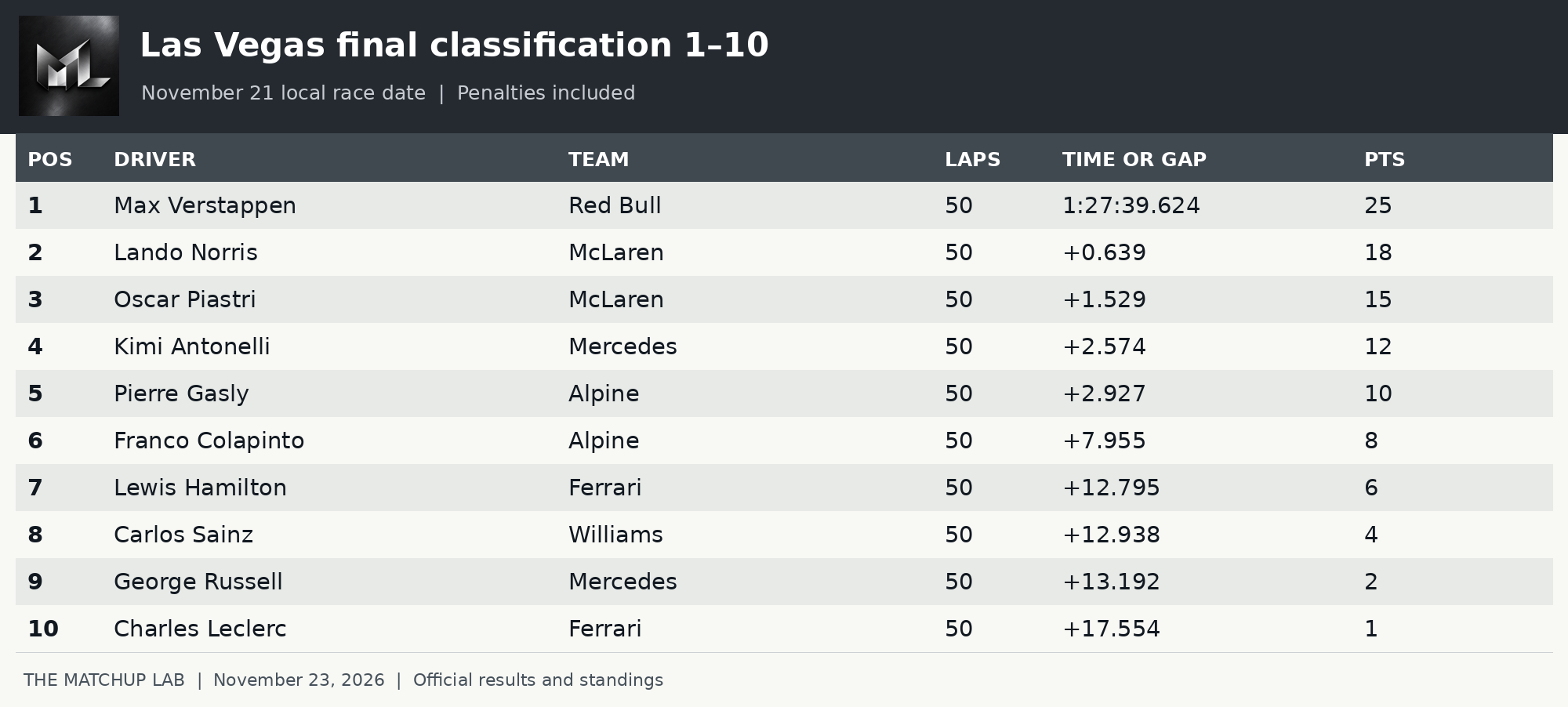
Norris finished 0.639 seconds behind Verstappen and Piastri another 0.890 behind Norris. Antonelli was fourth, with Gasly fifth only 2.927 seconds behind the winner. Colapinto’s sixth completed an 18-point race for Alpine. The top-five spread describes how closely the cars reached the flag; it does not mean their pace was identical over all 50 laps.
Russell’s late contact with the barriers and Antonelli’s loss of positions helped turn a Mercedes opportunity into a McLaren double podium. Ferrari’s internal contest also proved costly, with Hamilton seventh and Leclerc tenth after contact and separate penalties. Sainz added four points in eighth on his 250th Grand Prix start.
The team points from the race
McLaren scored 33, Red Bull 25, Alpine 18, Mercedes 14, Ferrari seven and Williams four. Those six totals add to the 101 points awarded across the first ten places. Alpine’s two-car result exceeded the combined Mercedes return, while Red Bull’s victory still allowed McLaren to reduce the gap between them.
The rest of the race field
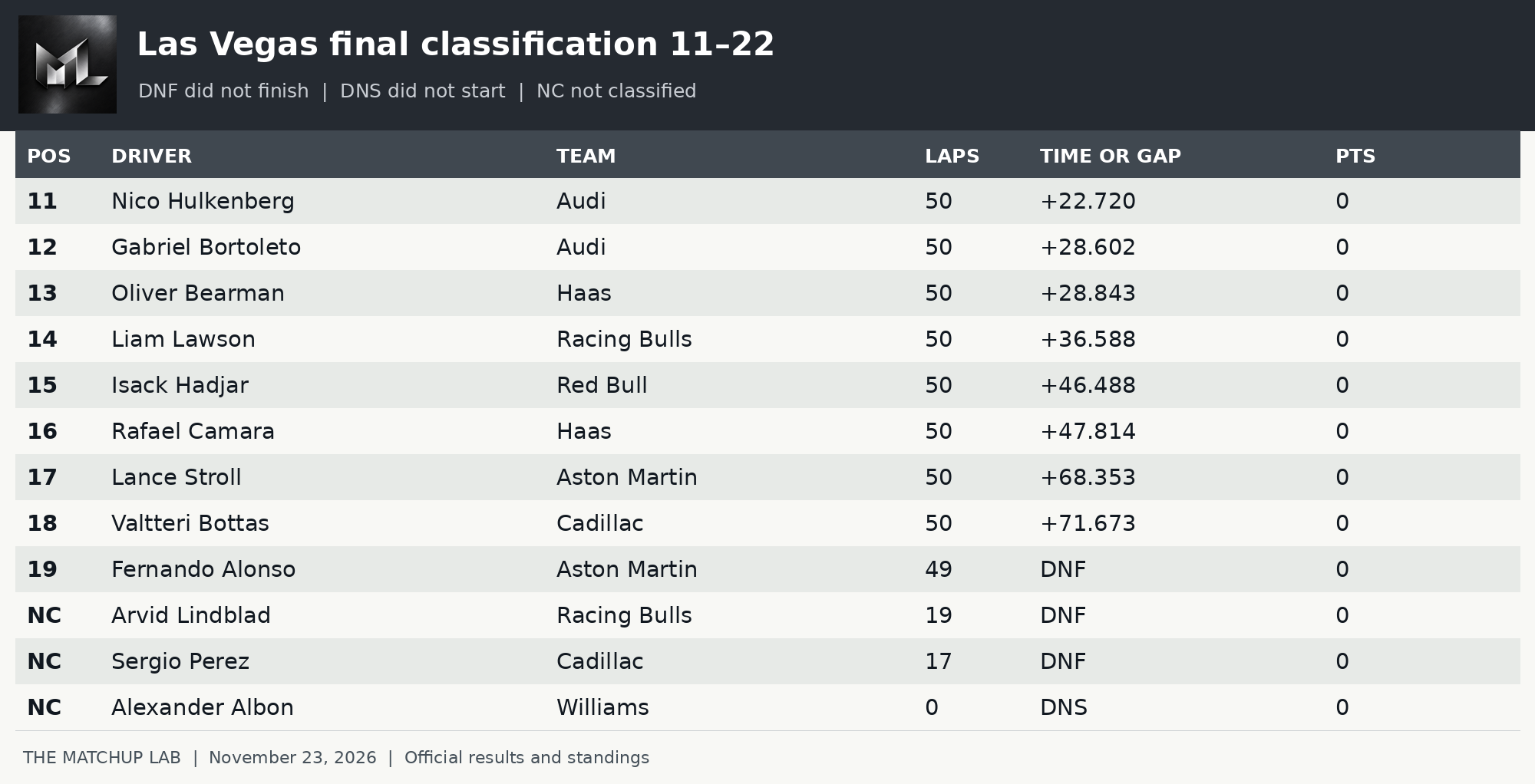
The final classification places Lawson fourteenth and Hadjar fifteenth. Hadjar’s ten-second penalty for driving unnecessarily slowly under Safety Car conditions changed their order after the race. Earlier reports recorded the order before that decision; the figures here use the final result.
Alonso completed 49 laps and is listed nineteenth with a DNF. Lindblad and Perez retired after nineteen and seventeen laps respectively. Albon did not start after a brake-related problem on the way to the grid. Audi filled eleventh and twelfth, immediately outside the points; Bearman was thirteenth.
Perez’s collision with Camara has a further consequence for Qatar. The stewards converted an unserved ten-second sanction into a five-place grid penalty for his next race. Camara continued and finished sixteenth. That decision belongs in the next-week outlook as well as the Las Vegas account.
Qualifying and the grid tell different stories
Antonelli’s 1:33.893 was the fastest Q3 lap, 0.258 seconds ahead of Verstappen. His five-place penalty placed him sixth on the issued grid. Piastri qualified seventh but was listed seventeenth after a ten-place penalty. The panels preserve the qualifying order while showing each driver’s issued starting position.
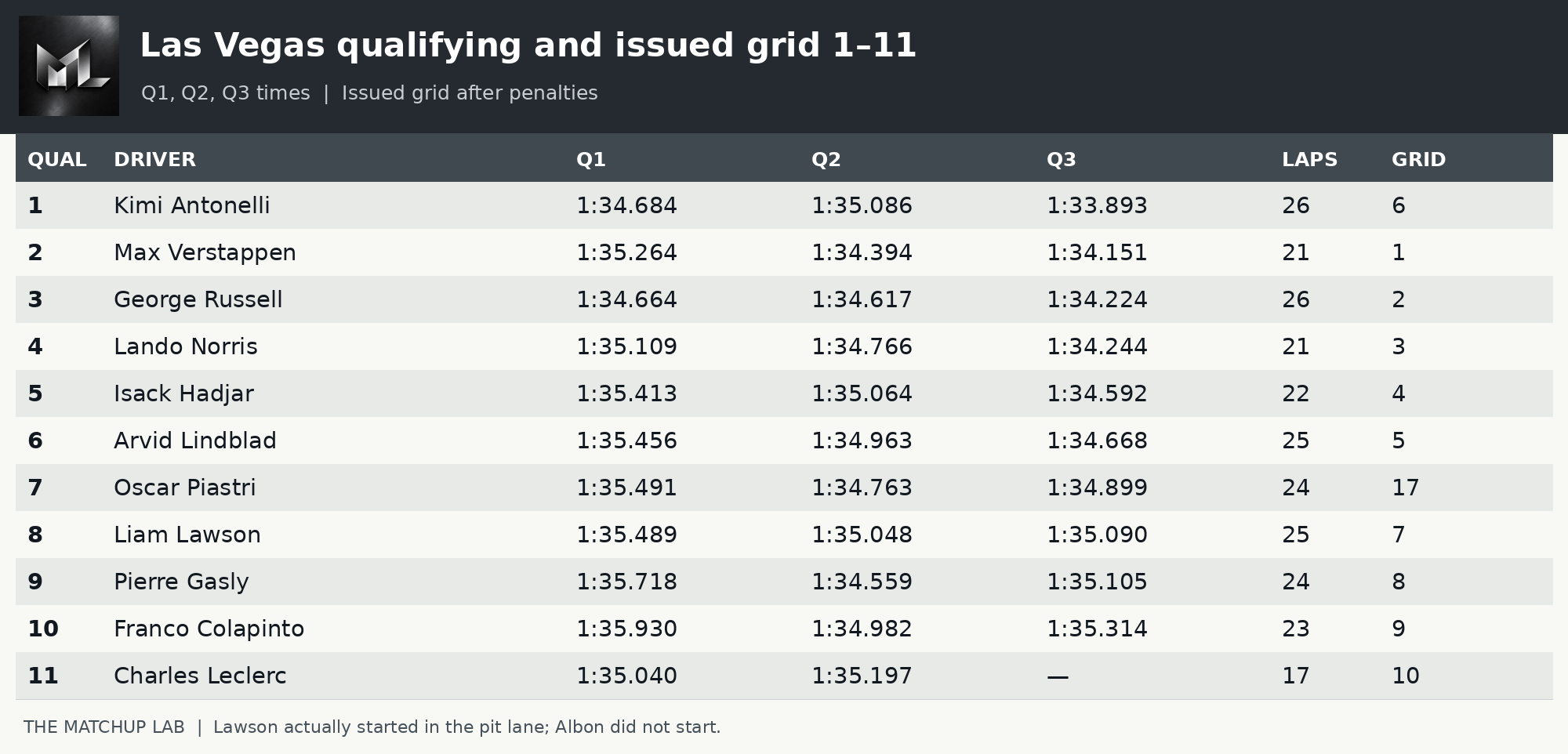
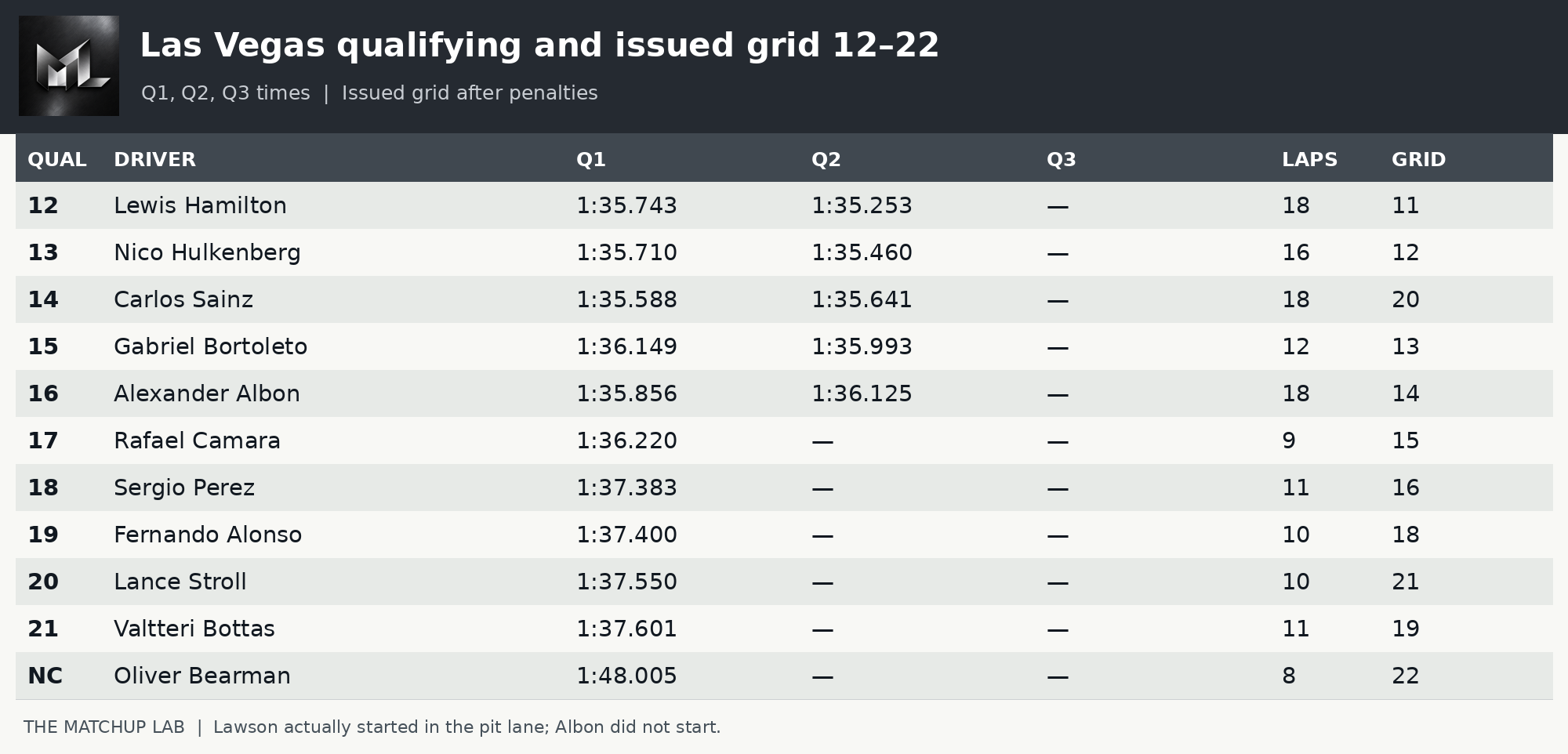
The issued grid is not the same as the actual start. Lawson started from the pit lane, and Albon did not start. Bearman was permitted to race despite a Q1 time outside the usual 107-percent threshold. These distinctions matter when interpreting movement between qualifying, the grid and the final result.
The driver championship
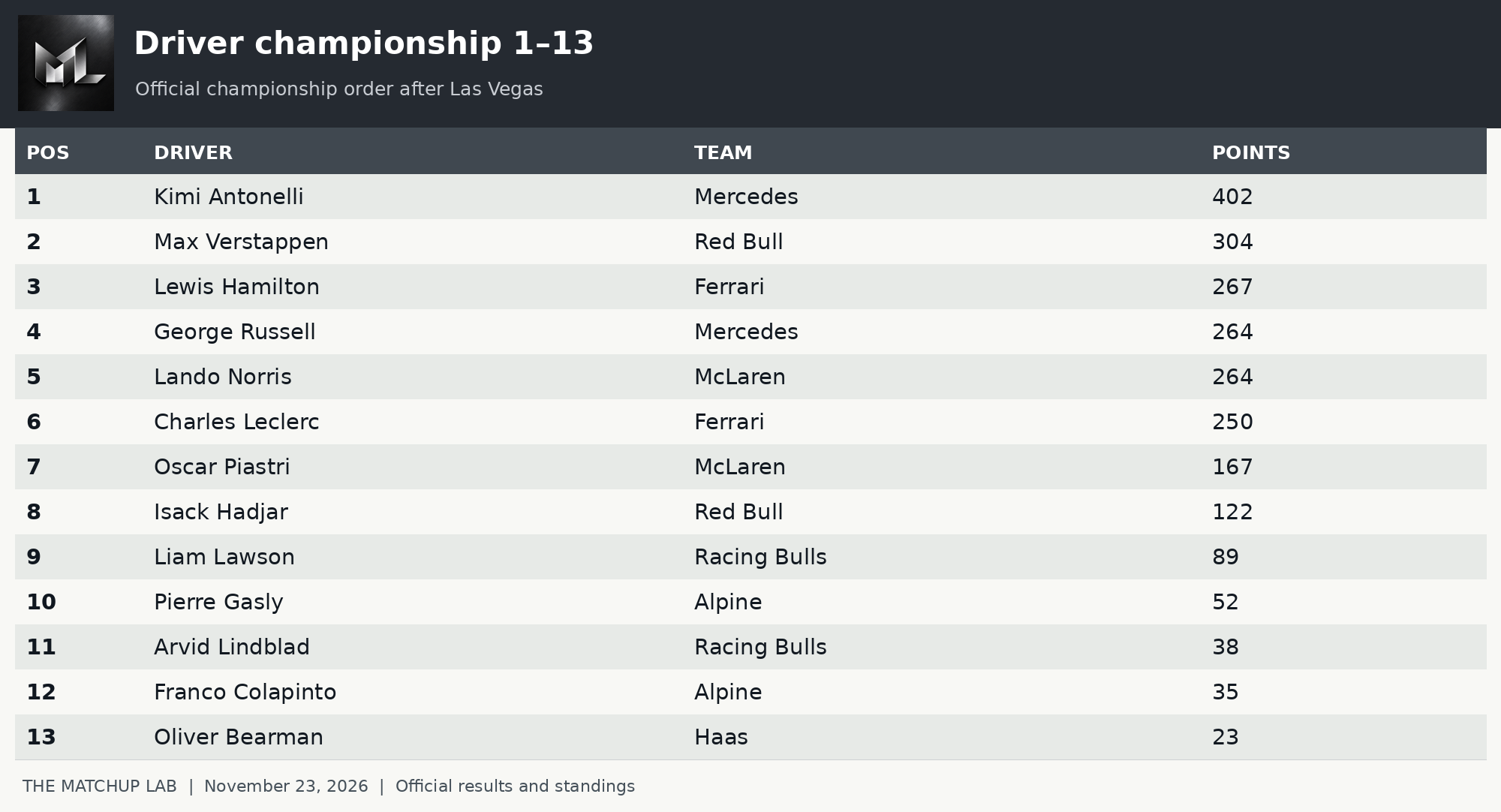
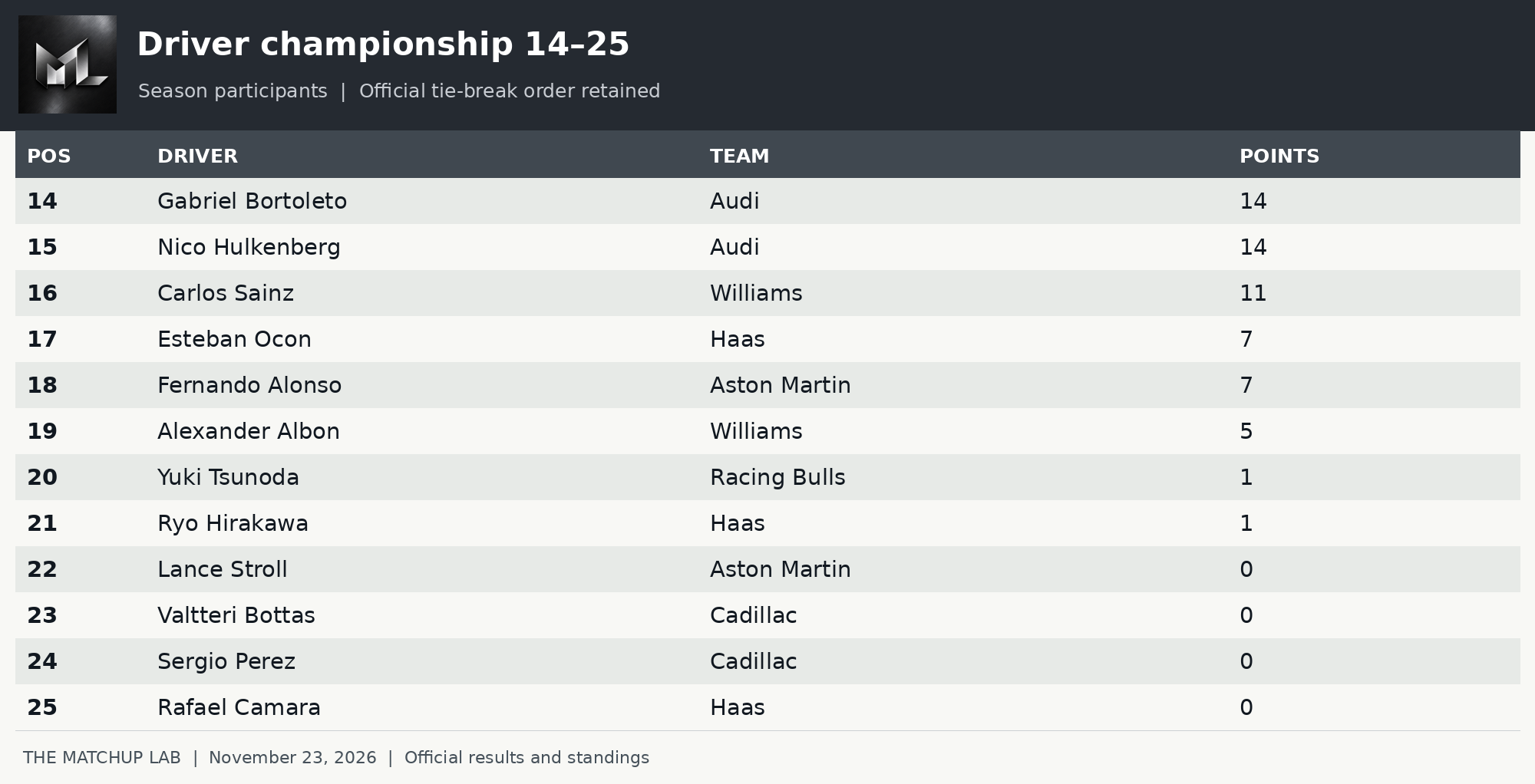
Champion Antonelli has 402 points, 98 more than Verstappen. Hamilton is third on 267, with Russell and Norris both on 264; the official tie-break order places Russell fourth. Leclerc follows on 250. The table includes drivers who competed earlier in the season as well as the current race field.
The constructor championship
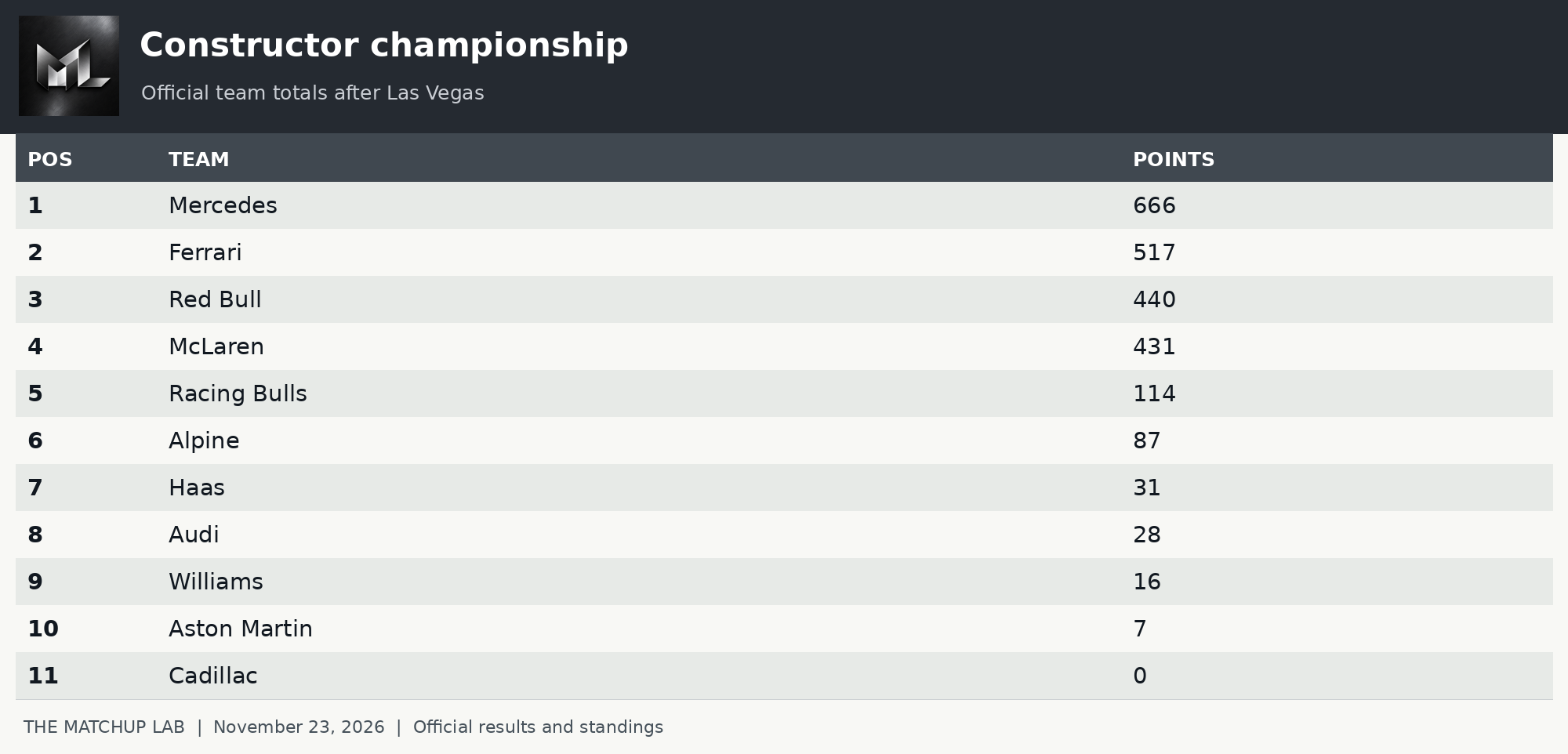
Mercedes have 666 points and Ferrari 517, a 149-point difference. Below them, Red Bull’s 440 and McLaren’s 431 create the nearest contest among the leading four. Racing Bulls are fifth on 114, with Alpine’s Las Vegas return taking them to 87. Haas have 31 and Audi 28.
The official constructor totals are used directly. Adding drivers’ points under their current team labels would not reliably reconstruct the season totals because those labels do not establish where every point was earned. The table therefore preserves the governing competition record rather than forcing an incorrect reconciliation.
Where one result can change the order
Audi need a net gain of four points to move ahead of Haas, while Alpine need a much larger swing against Racing Bulls. Red Bull and McLaren are close enough that the contribution of the second car is central. Las Vegas made that visible: the winner’s 25 points could not match the 33 available from second and third.
Fastest laps: useful evidence with a narrow meaning
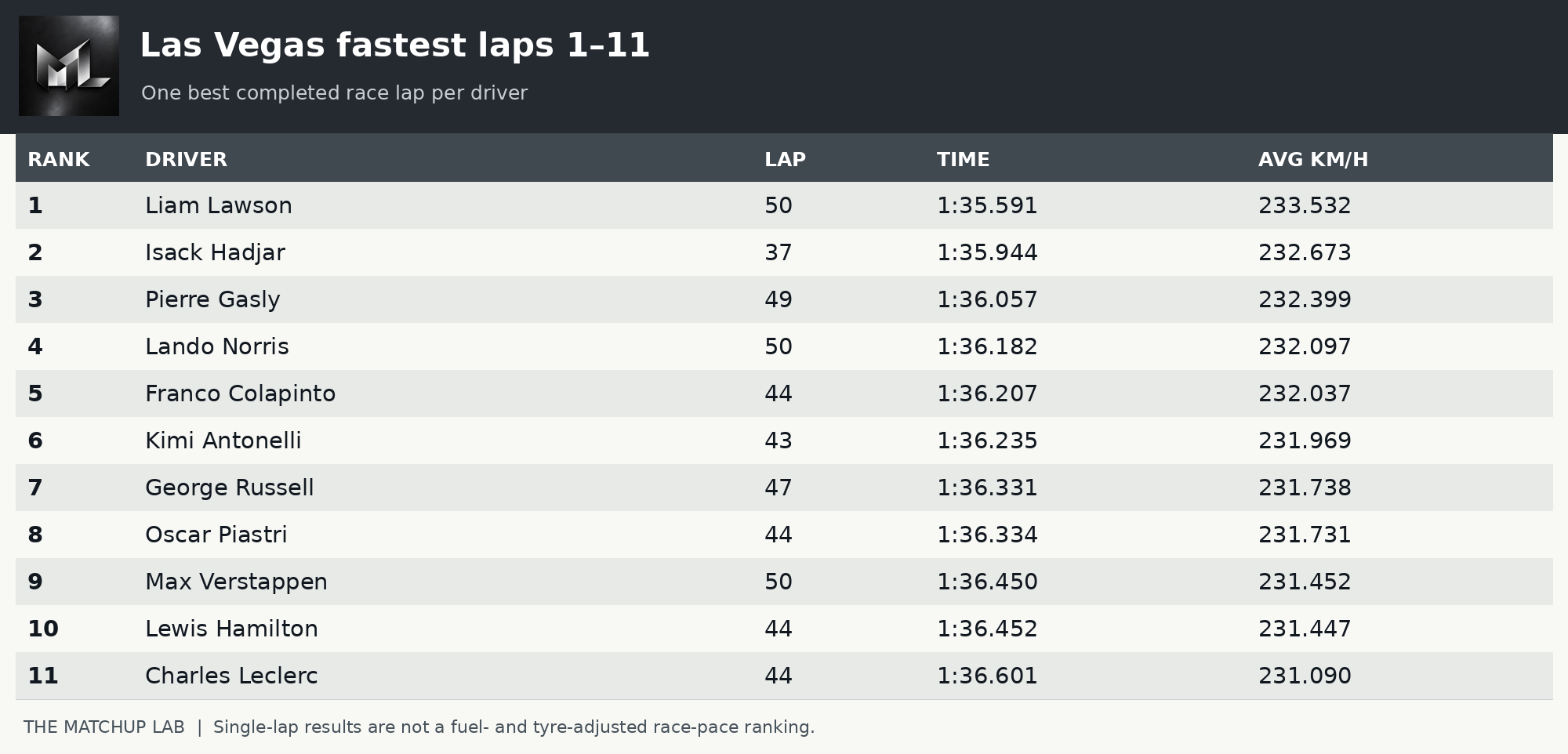
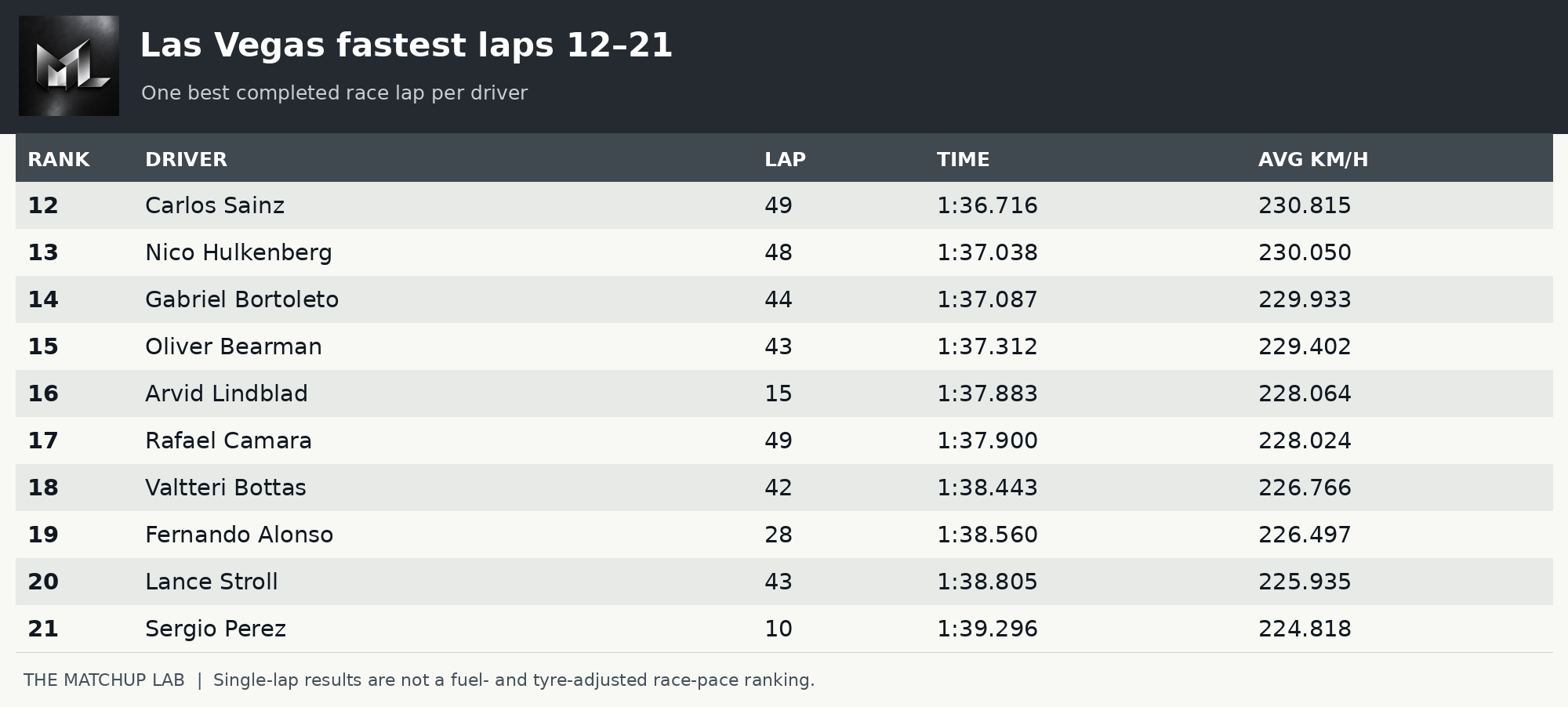
Lawson set the race’s fastest lap, 1:35.591 on lap fifty, despite finishing outside the points. Hadjar was second in this timing list and fifteenth in the final result. A single best lap measures one completed lap under its particular conditions; it does not correct for fuel, tyre age, traffic or the timing of a pit visit.
The recorded pit visits
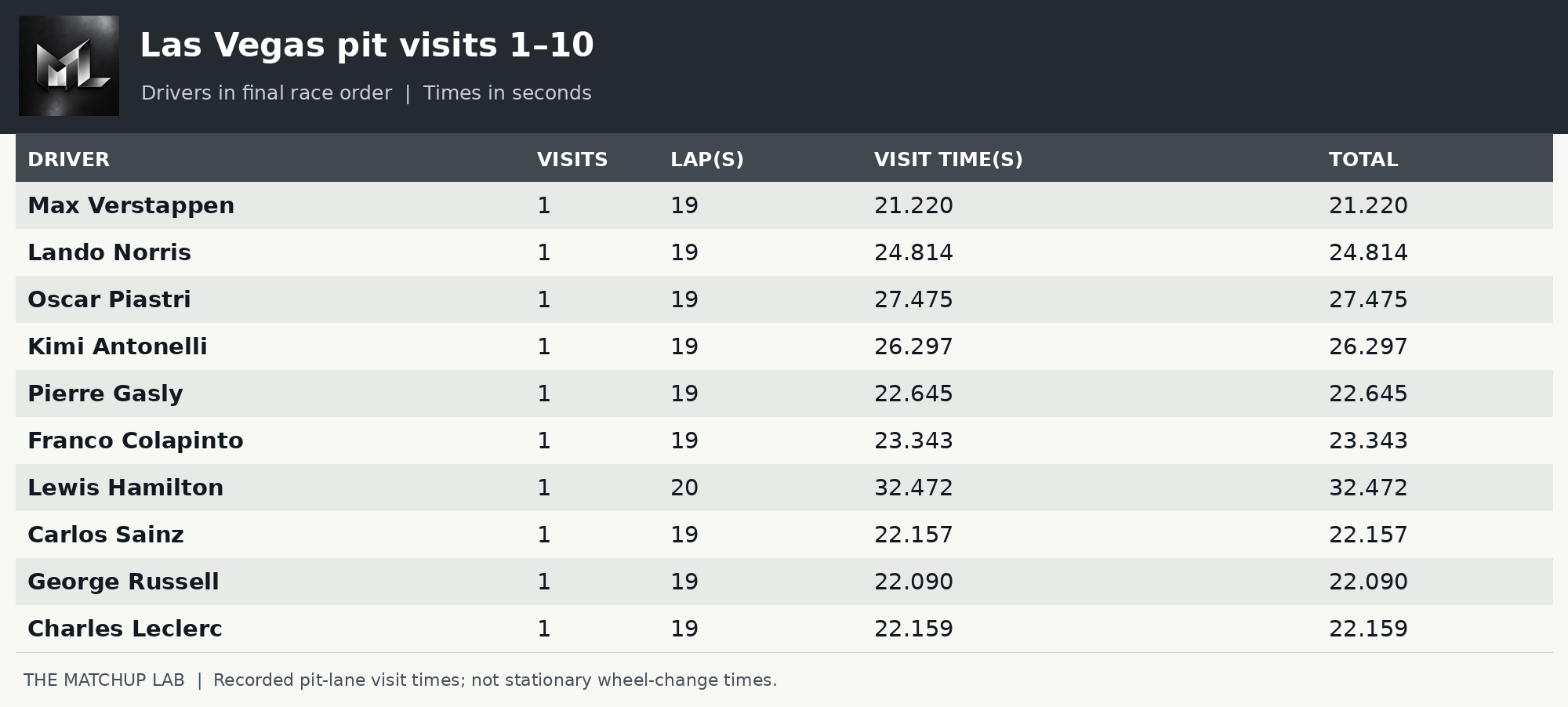
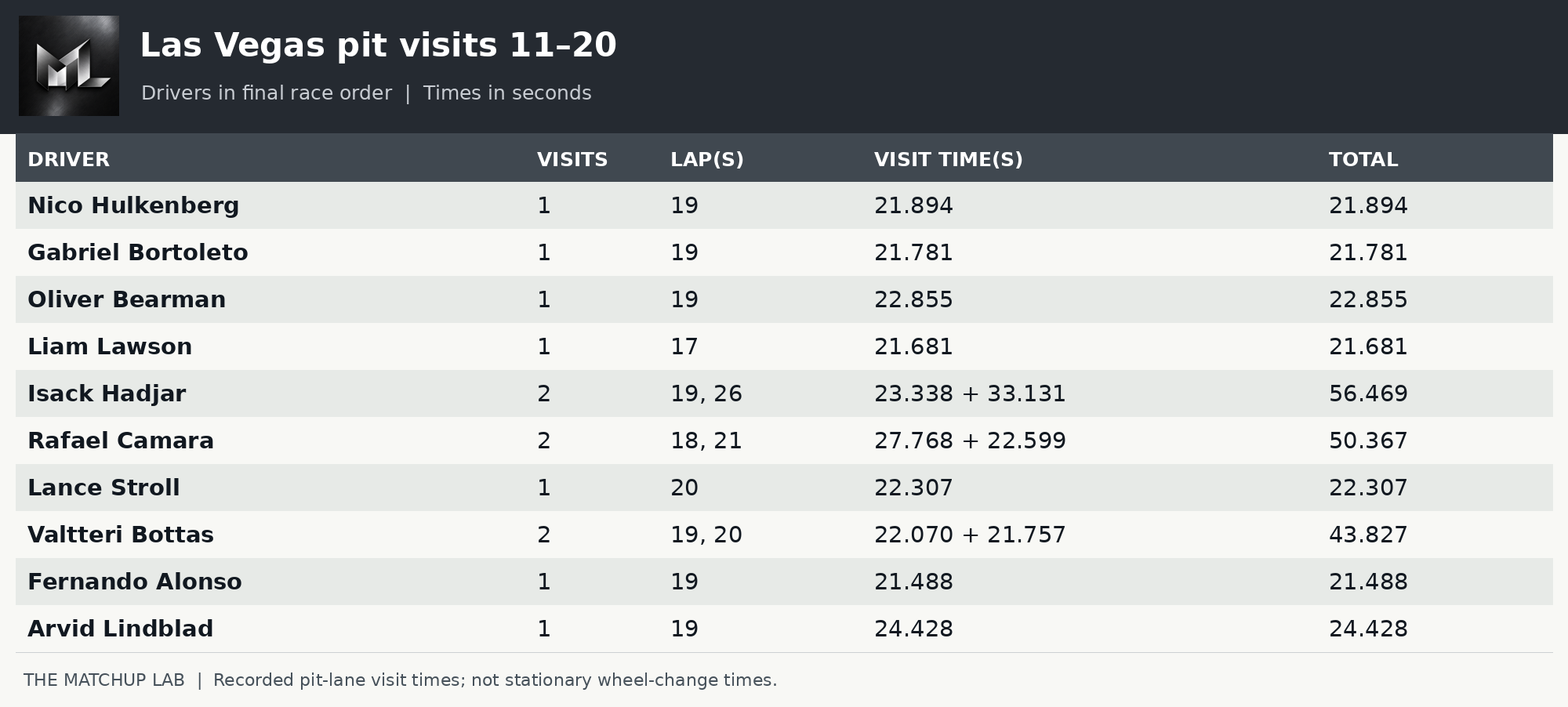
The timing record contains 23 visits by twenty drivers. Sixteen first visits occurred on lap nineteen. Hadjar, Camara and Bottas each made two recorded visits. The values include travel through the pit lane and any time spent there; they should not be read as stationary tyre-change performance.
Mercedes / Ferrari
Mercedes
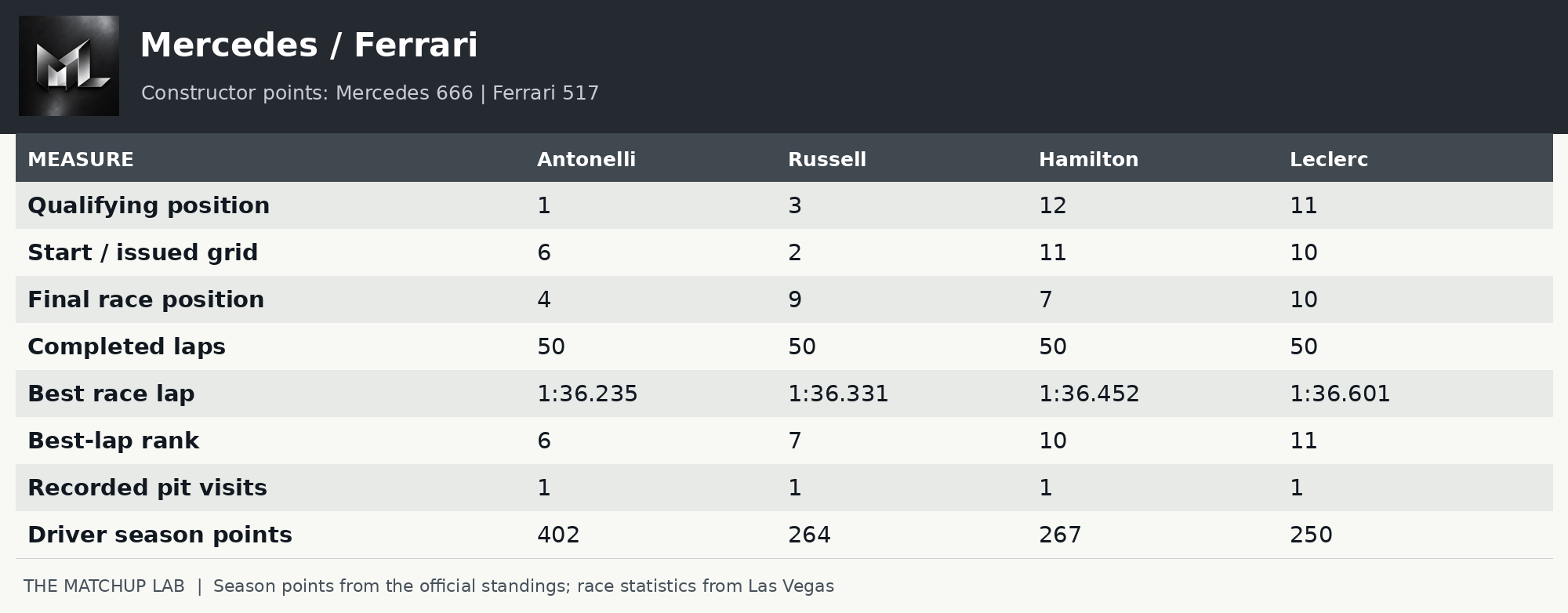
Antonelli led Q3 by 0.258 seconds, while Russell’s 1:34.224 was only 0.020 ahead of Norris. The issued grid put Russell second and Antonelli sixth after the latter’s penalty. Their eventual fourth and ninth places therefore tell a different story from the qualifying speed. Both cars reached the finish, but late events reduced the combined return to fourteen points.
The pit record lists Antonelli at 26.297 seconds and Russell at 22.090 for their lap-nineteen visits. That 4.207-second difference is a timing observation, not a complete explanation of their race. Likewise, their fastest laps came on different tours. For Qatar, the useful test is whether the car can repeat its qualifying advantage through Lusail’s medium- and high-speed corners and sustain it across a longer run. The championships are secured, so this is an execution question rather than a title calculation.
Ferrari
Leclerc and Hamilton qualified eleventh and twelfth, separated by 0.056 seconds in Q2. They were tenth and eleventh on the issued grid. Hamilton eventually finished seventh and Leclerc tenth, but their contact and penalties restricted the team to seven points. The result cannot be described adequately as a simple gain of positions from a weak qualifying session.
Hamilton’s recorded visit on lap twenty lasted 32.472 seconds; Leclerc’s lap-nineteen visit was 22.159. The gap includes the circumstances of each visit and is not a ten-second judgement on the pit crews. Their best race laps were only 0.149 apart, yet both were outside the top nine on that measure. At Lusail, Ferrari need to establish their starting position earlier in the weekend and manage any close-running phase between the cars so that one recovery does not compromise the other.
Red Bull / McLaren
Red Bull
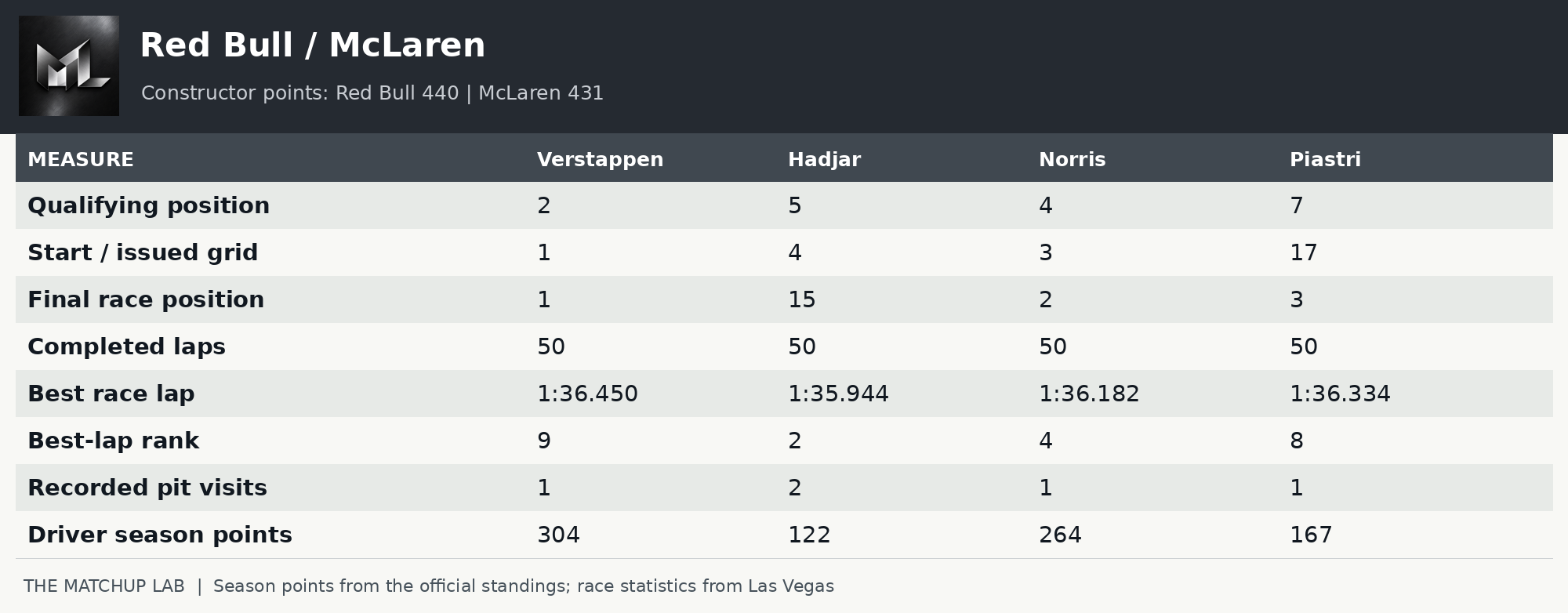
Verstappen qualified second, inherited the front of the issued grid and won. Hadjar qualified fifth, was listed fourth on the grid and finished fifteenth after front-wing trouble and the post-race penalty. That contrast explains why Red Bull’s victory produced fewer points than McLaren’s double podium. The constructor advantage is now nine.
Hadjar’s 1:35.944 was the second-fastest single race lap, showing why his final position alone should not be used as a complete performance description. He also recorded two pit visits totaling 56.469 seconds, against Verstappen’s single 21.220-second visit. Those facts identify interruptions to his race without proving a counterfactual finish. Qatar’s sustained cornering asks whether both cars can remain useful throughout a stint, allowing the team to combine Verstappen’s front-running capacity with another points contribution.
McLaren
Norris qualified fourth and Piastri seventh, but their issued grid positions were third and seventeenth. Piastri’s recovery to third was fourteen positions relative to that published grid, not a count of fourteen overtakes. Norris finished second, and the 33-point total reduced the gap to Red Bull by eight.
Their recorded lap-nineteen visits were 24.814 seconds for Norris and 27.475 for Piastri. Norris’s best race lap was 1:36.182, 0.152 quicker than Piastri’s best, with the laps set on different tours. The small finishing gap and strong points return are established; a claim of equal stint pace would require more evidence. At Qatar, the relevant benchmark is putting both cars in contention from qualifying onward, so another large recovery is not needed to produce a two-car result.
Racing Bulls / Alpine
Racing Bulls
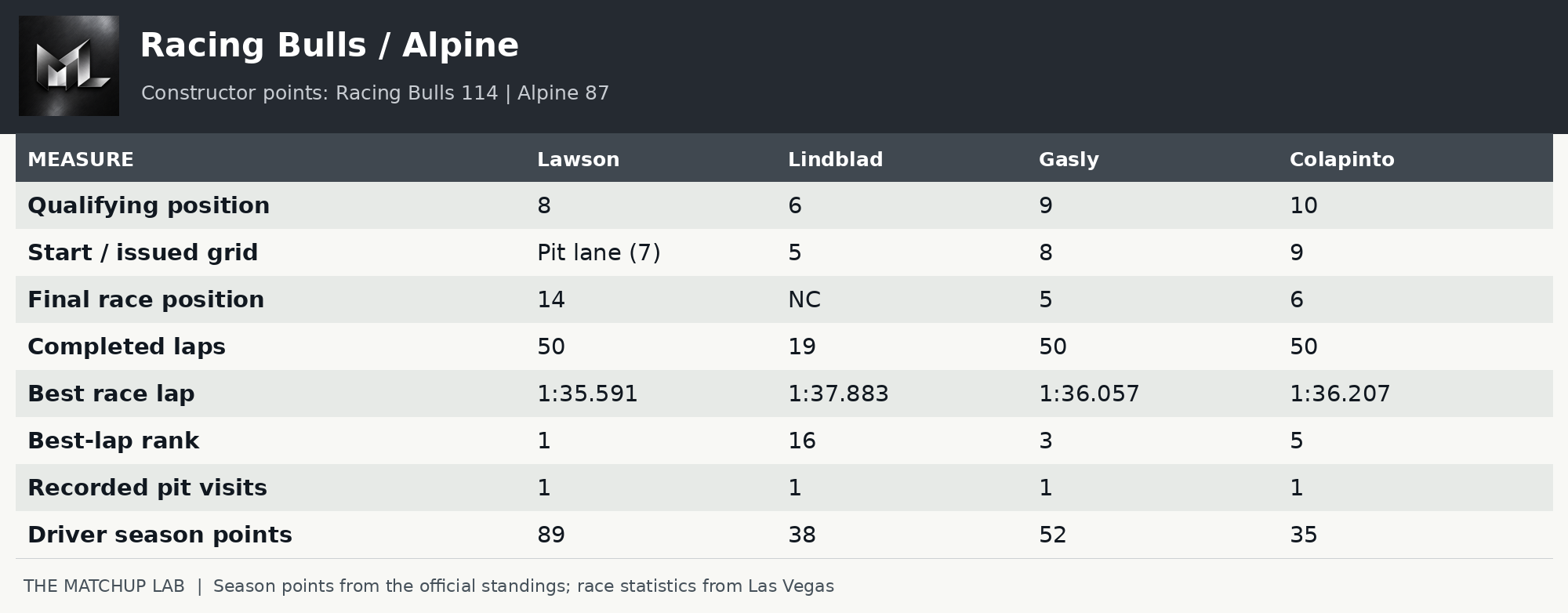
Lindblad reached sixth in qualifying and Lawson eighth, then appeared fifth and seventh on the issued grid. Lawson actually started from the pit lane; Lindblad retired after nineteen laps. The team therefore received no points despite placing both cars in Q3. Its 114-point total is now only 27 ahead of Alpine.
Lawson’s 1:35.591 on the last lap was the fastest of the race, and his single recorded visit came on lap seventeen. That combination is evidence of a strong isolated lap, not proof that the entire race should have ended near the front. Lindblad’s best was set on lap fifteen, before his retirement, making a direct late-race comparison especially limited. Qatar will test whether the qualifying competitiveness can survive the opening stint and subsequent transitions into a complete points opportunity.
Alpine
Gasly and Colapinto both reached Q3, qualifying ninth and tenth. Their issued grid positions were eighth and ninth, and they finished fifth and sixth for eighteen points. This was a useful result across both cars rather than one driver carrying the constructor total. Alpine now have 87 points.
Gasly’s best race lap, 1:36.057, was third in the timing list. Colapinto’s 1:36.207 was fifth, only 0.150 slower, although the laps were recorded five tours apart. Both made one listed visit on lap nineteen, at 22.645 and 23.343 seconds. Those paired results give Alpine several concrete benchmarks to carry into Qatar: two Q3 cars, two top-six finishes and a strong isolated lap from each. Lusail asks whether that breadth of performance can survive a different cornering profile, not whether one best lap can be repeated mechanically.
Haas / Audi
Haas
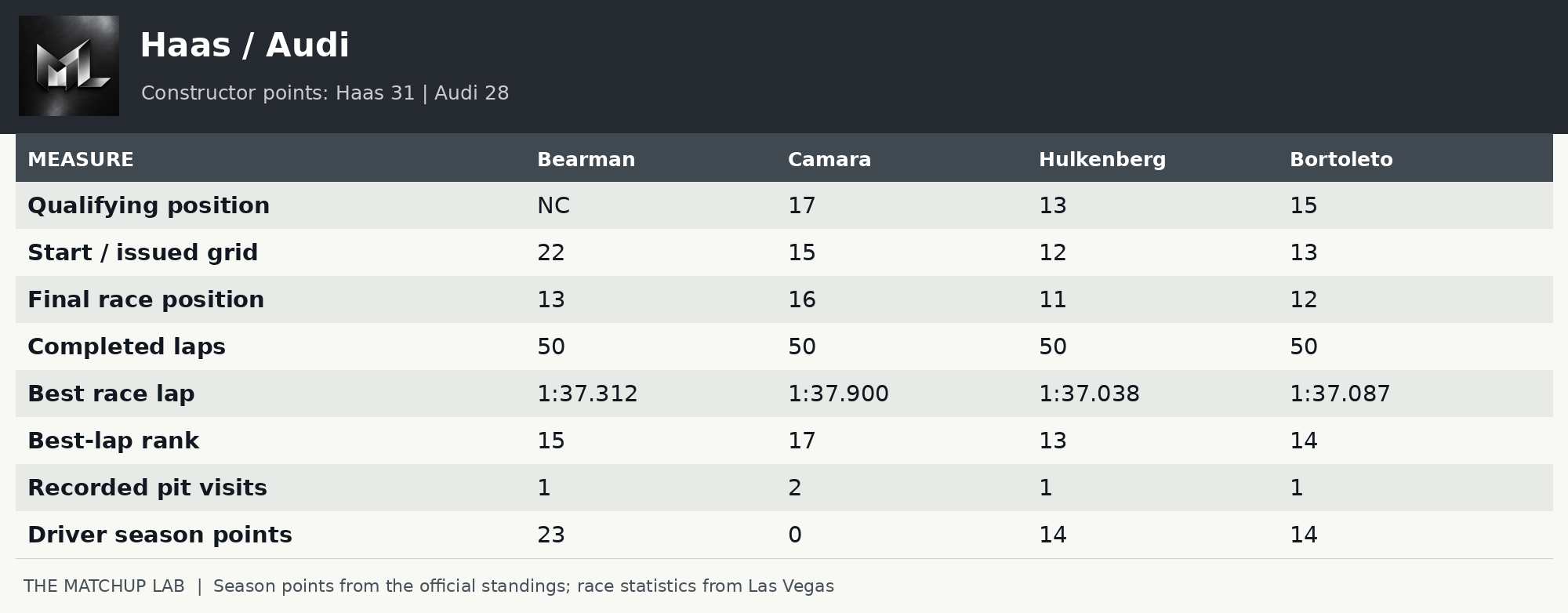
Camara was seventeenth in qualifying and fifteenth on the issued grid. Bearman’s slow Q1 time left him unclassified in the session, but he was permitted to race and was listed twenty-second. They finished sixteenth and thirteenth respectively, with neither scoring. Haas remain seventh in the constructors on 31 points, three ahead of Audi.
Camara completed the race after the Perez collision and made two recorded visits totaling 50.367 seconds. Bearman made one visit of 22.855. Bearman’s best race lap was 0.588 quicker than Camara’s, set six laps earlier; that is useful context but not a full-stint comparison. Qatar’s immediate test is the starting position. Audi put both cars ahead of Haas at the Las Vegas finish, so avoiding another weekend of recovery from the back would give Haas a stronger way to defend their narrow advantage.
Audi
Hulkenberg qualified thirteenth and Bortoleto fifteenth, with a 0.533-second difference between their Q2 laps. Their issued grid positions were twelfth and thirteenth; they finished eleventh and twelfth. The team placed both cars immediately outside the points but added nothing to its 28-point season total.
Their best race laps were only 0.049 seconds apart, Hulkenberg’s 1:37.038 and Bortoleto’s 1:37.087, although set four laps apart. Each made one recorded visit on lap nineteen, separated by only 0.113 seconds in the pit-lane timing. That relatively close paired evidence makes the qualifying gap a useful area to examine. At Lusail, a stronger shared starting position could reduce the amount of race work required merely to reach tenth; the three-point deficit to Haas makes a modest points finish consequential.
Williams / Aston Martin
Williams
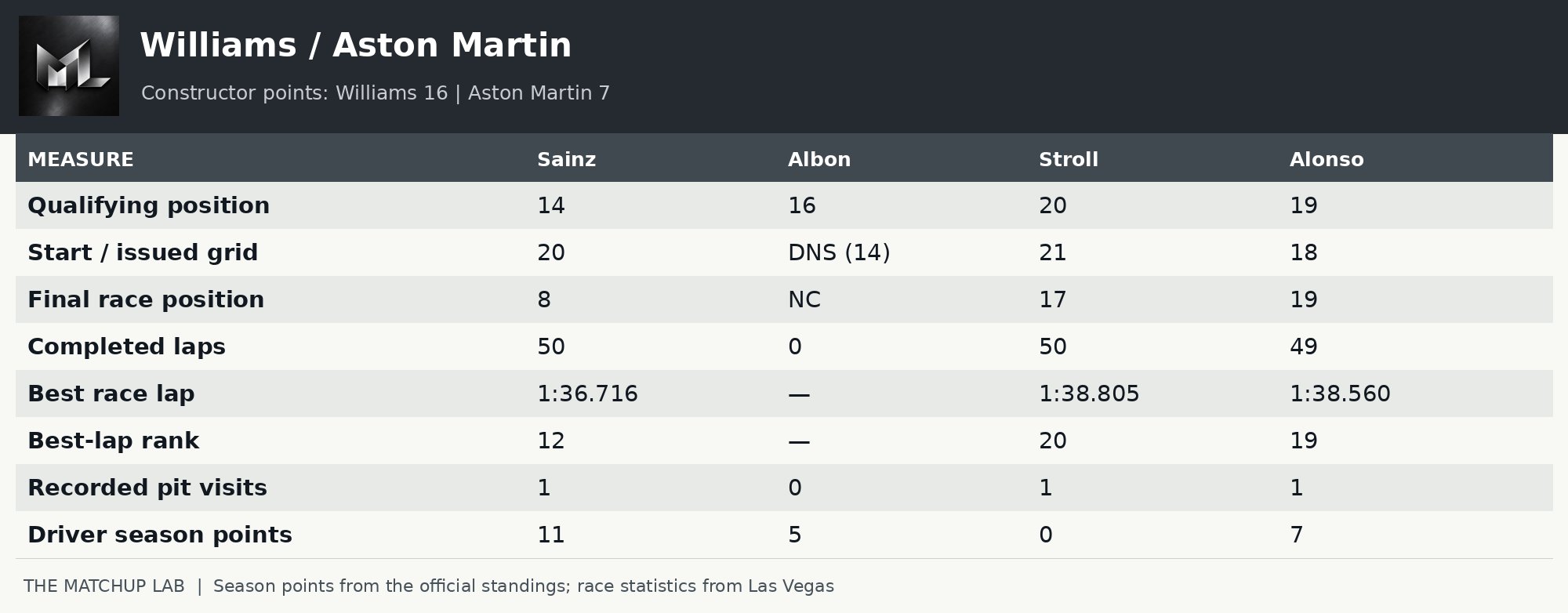
Sainz qualified fourteenth, 0.484 seconds ahead of Albon in Q2, but a penalty left him twentieth on the issued grid. He finished eighth for four points. Albon was listed fourteenth and did not start after the brake-related problem on the way to the grid. Williams therefore had only one car available to turn its qualifying work into a race result.
Sainz finished 0.143 seconds behind Hamilton and 0.254 ahead of Russell in the final classification. His best race lap ranked twelfth, and his single recorded visit took 22.157 seconds. That combination shows the value of the final position without requiring a claim that he had the eighth-fastest car throughout. Qatar’s corner sequence is a different examination, but Williams first need both cars to reach the start so the team has two possible routes to add to its sixteen points.
Aston Martin
Alonso and Stroll qualified nineteenth and twentieth, separated by 0.150 seconds in Q1. Their issued grid positions were eighteenth and twenty-first. Stroll finished seventeenth; Alonso completed 49 laps and was classified nineteenth with a DNF. Aston Martin remain on seven points.
Alonso’s best lap was 1:38.560 and Stroll’s 1:38.805, ranking nineteenth and twentieth among drivers with a timed race lap. Each had one recorded pit visit. Those observations show a deficit to the leading midfield timings in Las Vegas, but they do not establish the same deficit at Lusail. The useful early Qatar comparison is the gap to the cars around the Q1 cutoff, followed by whether the car can hold that proximity through sustained cornering over several laps.
Cadillac
Cadillac
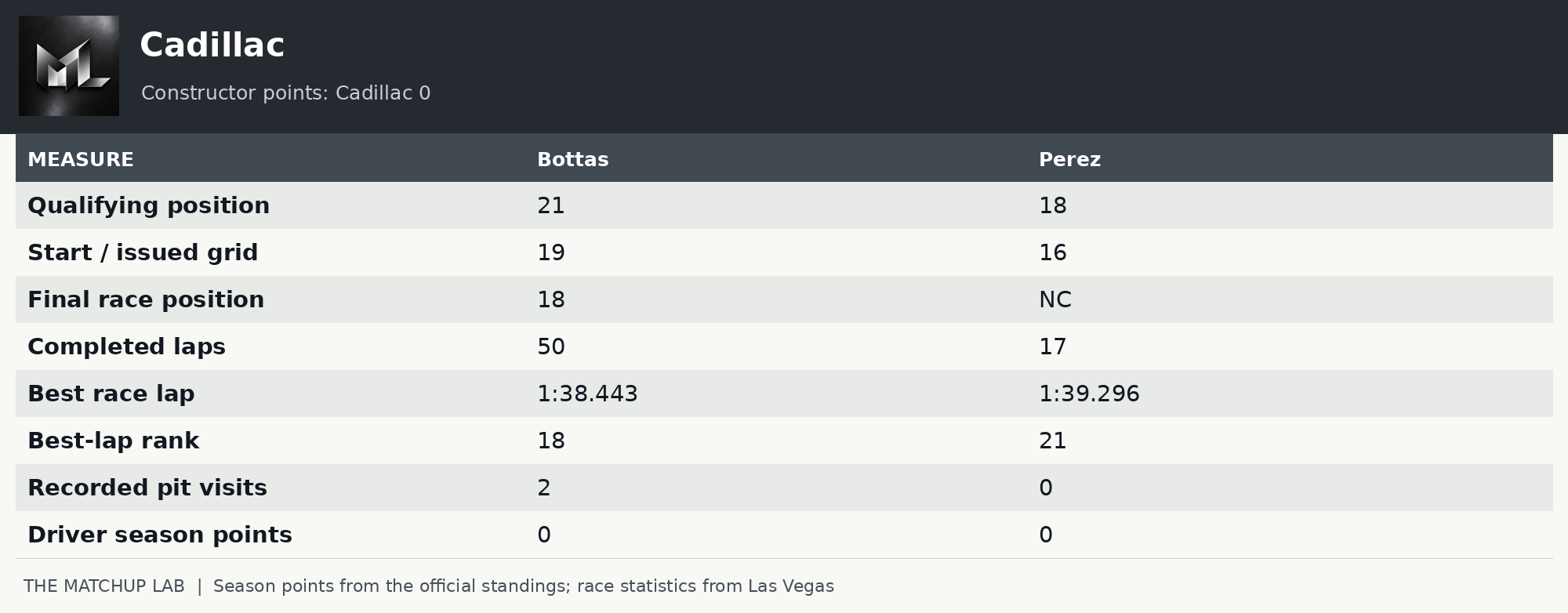
Perez qualified eighteenth and Bottas twenty-first, with Perez 0.218 seconds quicker in Q1. The issued grid placed them sixteenth and nineteenth. Perez retired after seventeen laps following the collision with Camara; Bottas completed fifty laps and finished eighteenth. Cadillac remain without a point.
Bottas made two recorded visits totaling 43.827 seconds, while Perez has no pit visit in the published race summary. Bottas’s best lap ranked eighteenth at 1:38.443. Perez now carries a five-place penalty into Qatar, so the next weekend already includes a known starting-position constraint. With three practice sessions available, the practical task is to establish the car’s balance through Lusail’s long corner sequences before qualifying. The penalty makes a clean understanding of the race setup more valuable, but it does not justify inventing a projected recovery or assuming that another team will supply an opening.
Mercedes has its title and Red Bull has a 17-point fight
Las Vegas Grand Prix weekend, November 19–21. The race is scheduled for 8 p.m. Pacific and 10 p.m. Central on Saturday, November 21.