
Mercedes has its title and Red Bull has a 17-point fight

Norris won in São Paulo, Red Bull matched McLaren’s haul, and Las Vegas puts second through sixth in the drivers’ standings back in play.
Formula 1 was idle on November 14 and 15. The last racing evidence comes from Interlagos on November 8, when Lando Norris won from pole, Max Verstappen finished second from 21st on the grid, and Mercedes wrapped up the constructors’ championship with fourth and fifth. No points have been added since. The next race is on Saturday night, November 21, in Las Vegas.
The drivers’ championship
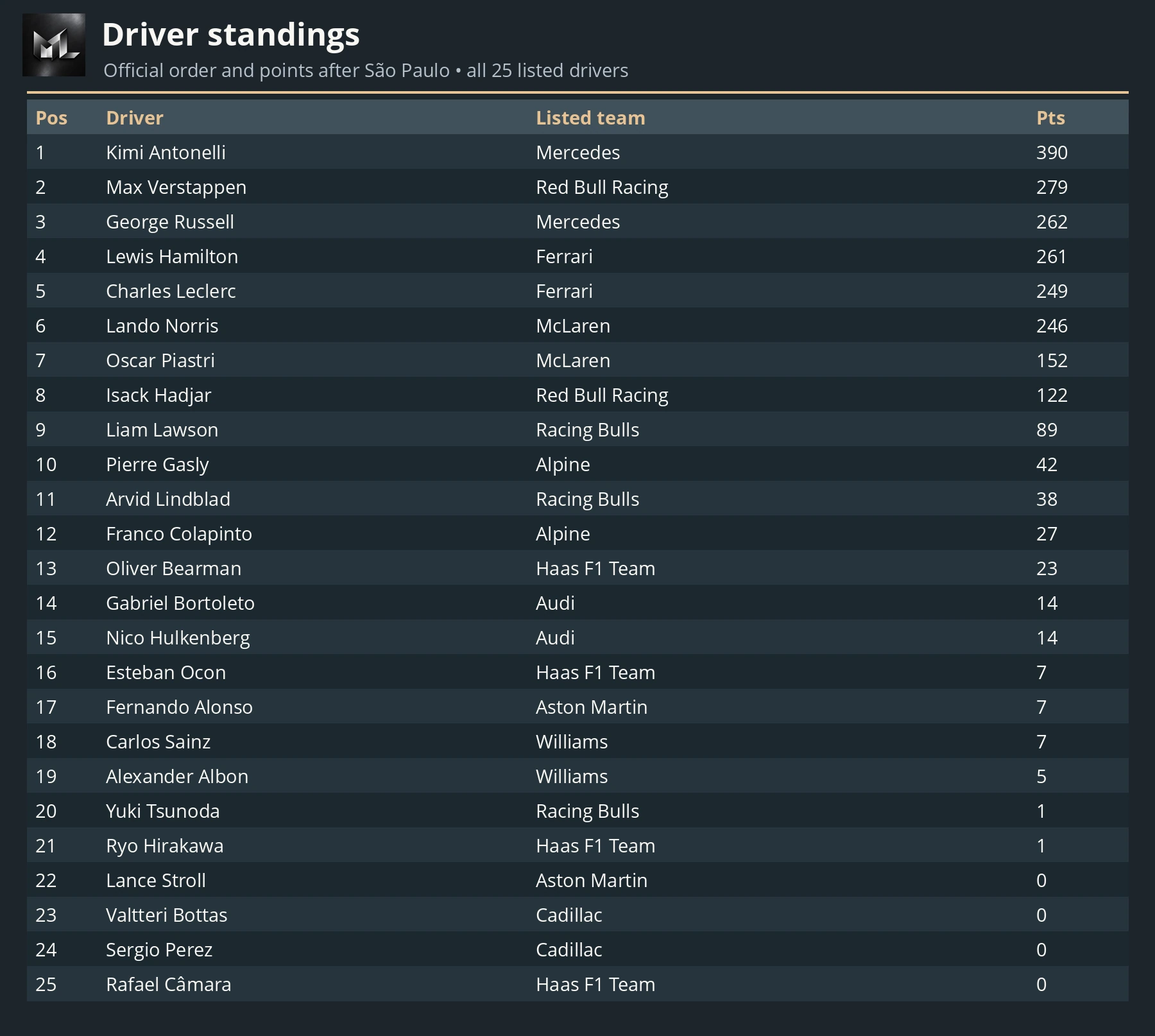
Kimi Antonelli is the champion on 390 points. Behind him, 33 points cover Verstappen in second through Norris in sixth. George Russell has a one-point advantage over Lewis Hamilton for third. Charles Leclerc has three points in hand over Norris for fifth. Positions shown are the official championship order, including ties on points. Twenty-five drivers have appeared in the championship standings this season.
The constructors’ championship
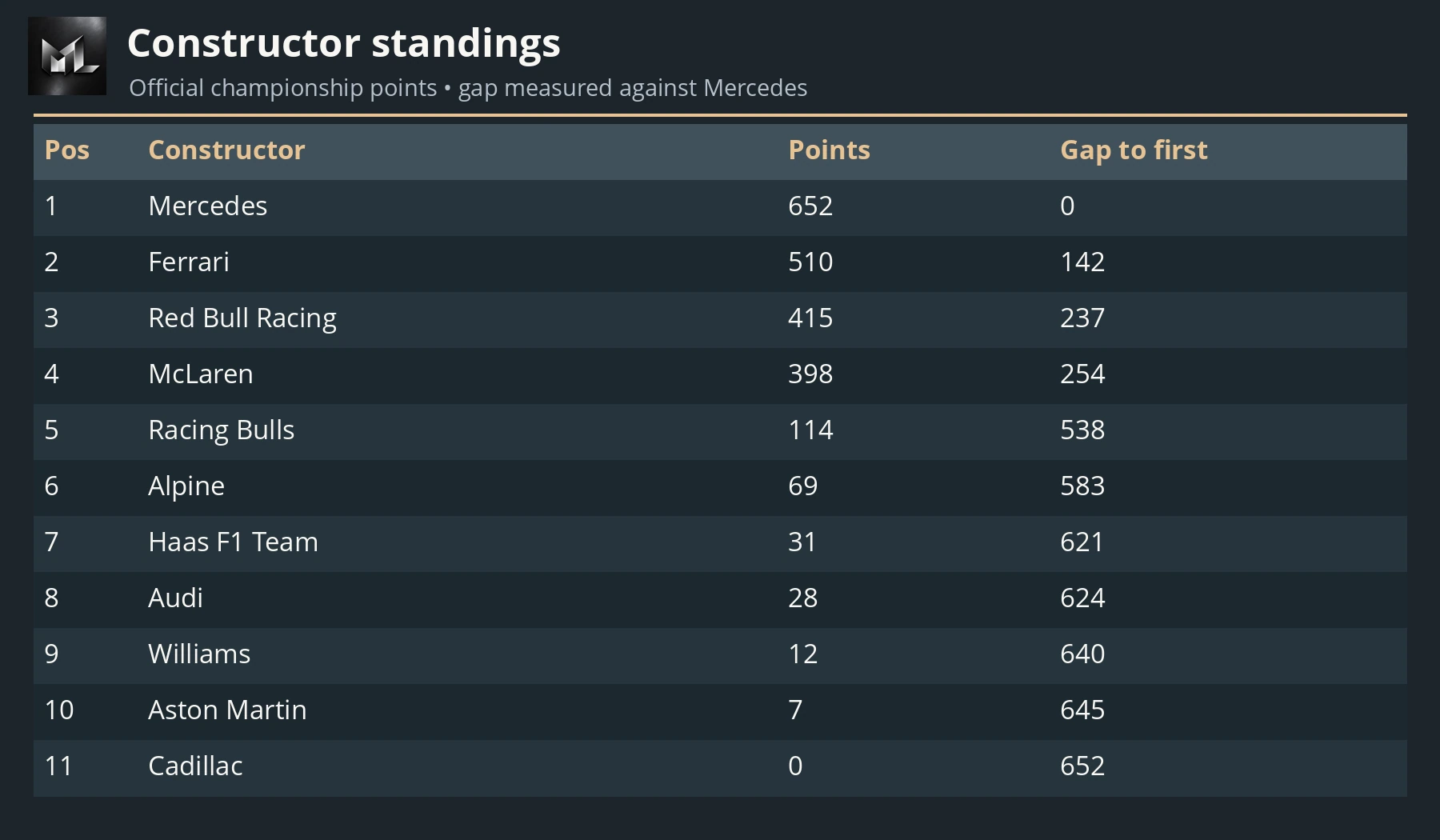
Mercedes has 652 points to Ferrari’s 510. Red Bull and McLaren both added 33 in Brazil, preserving Red Bull’s 17-point advantage for third. Further back, one third-place finish would be worth more than Williams’s entire season tally of 12. Those smaller gaps change the value of a point for the teams battling behind Alpine.
The full São Paulo classification
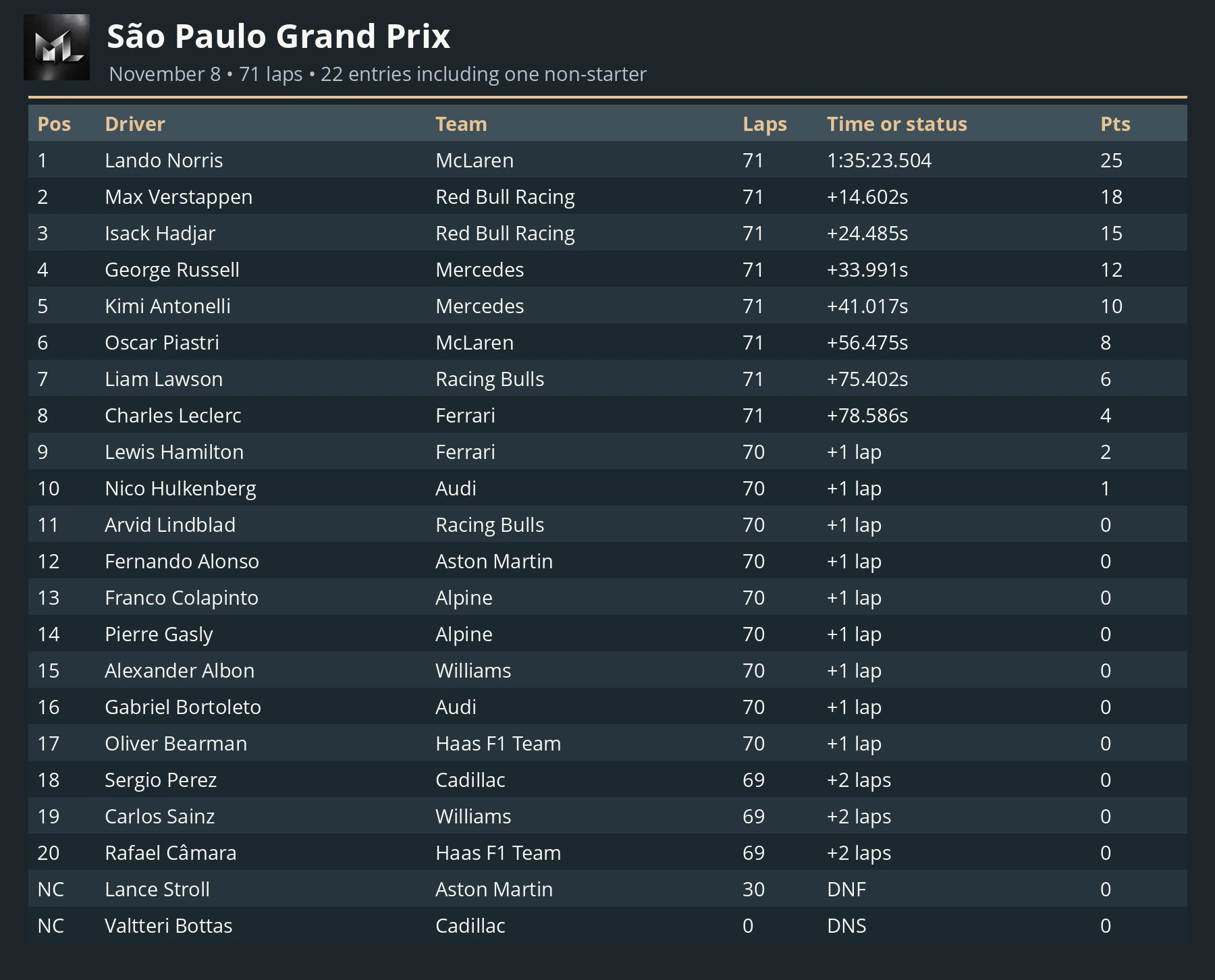
Norris led Verstappen by 14.602 seconds at the flag after 71 laps. Hadjar finished 9.883 seconds behind his team-mate. The ten scoring positions distributed 101 points. Stroll retired after 30 laps. Bottas remained on the official entry and grid lists but did not start. The classification records both cases as unclassified and specifies DNF or DNS.
Qualifying and the starting grid
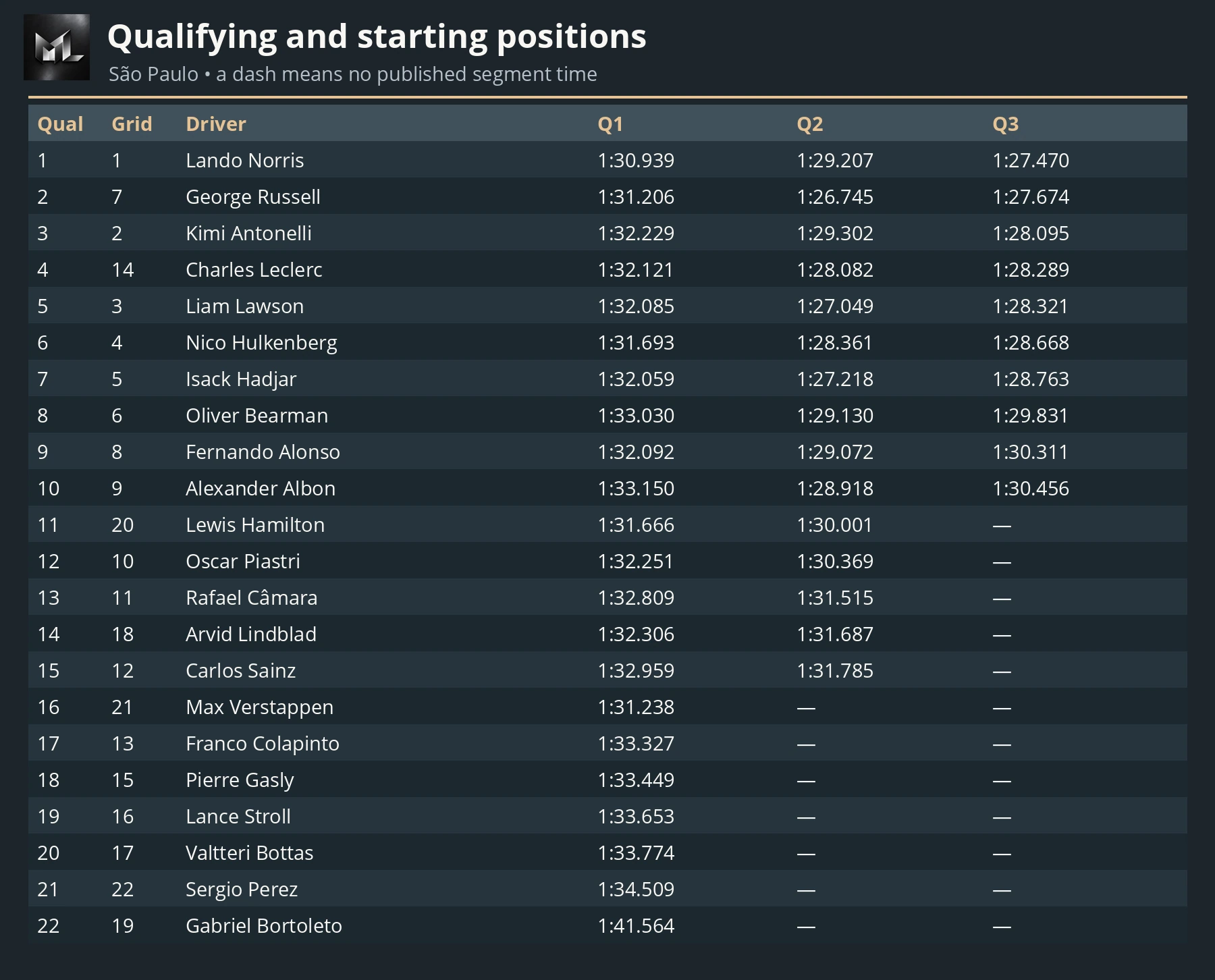
Short of winning, Verstappen could scarcely have improved more on his starting place. His 16th in qualifying became 21st on the official grid, then second in the race. Russell had the second-best Q3 lap and started seventh. In the other direction Lawson qualified fifth and started third. Reading the qualifying and grid columns separately keeps those changes from being counted as Sunday overtakes.
Fastest individual race laps
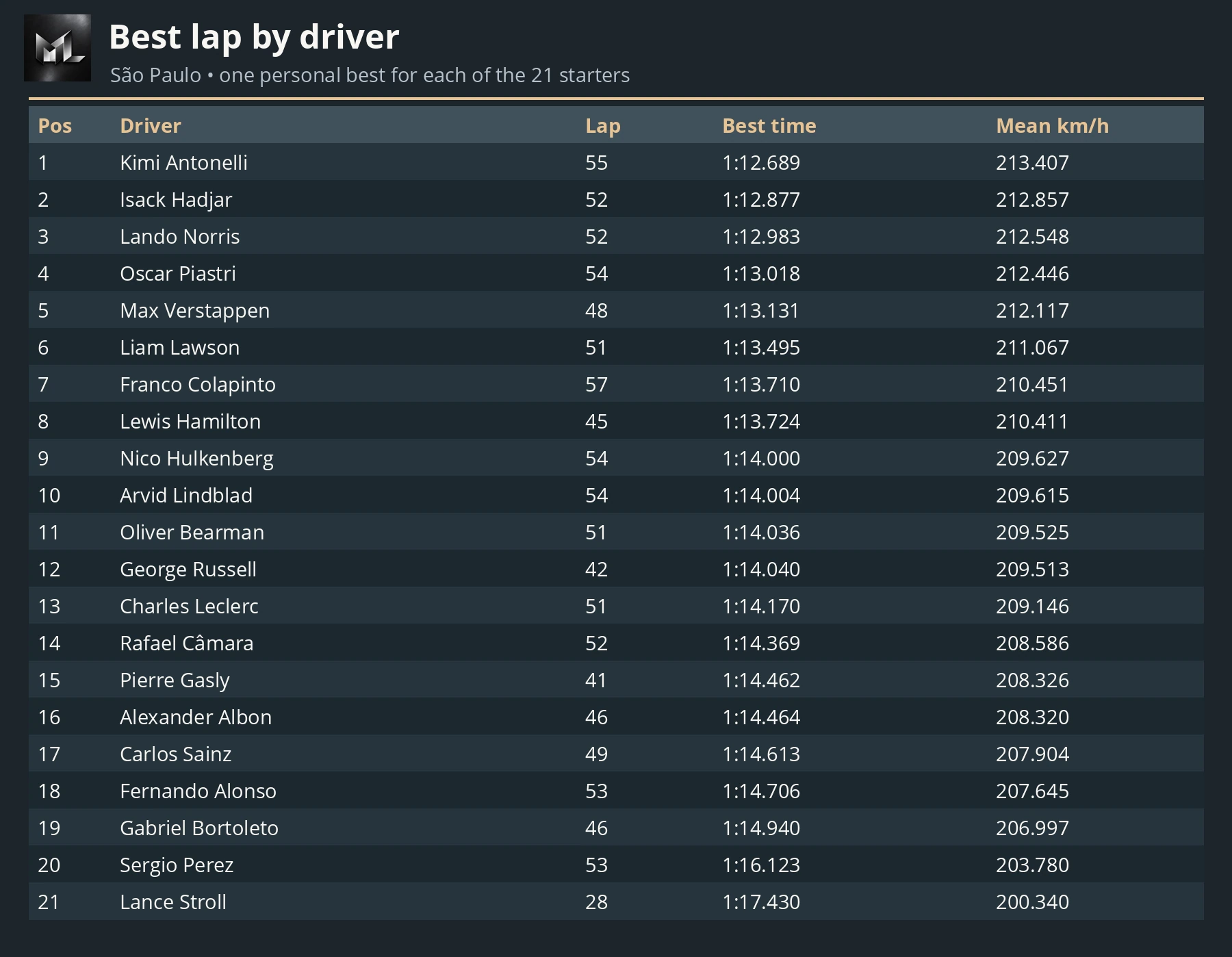
Antonelli’s best, 1:12.689 on lap 55, was 0.188 seconds quicker than Hadjar’s best on lap 52. Norris, also on lap 52, was third on this list while winning the race. Each entry is a single lap under the conditions that driver encountered. Bottas recorded no race lap and therefore has no entry.
How often the contenders made the podium
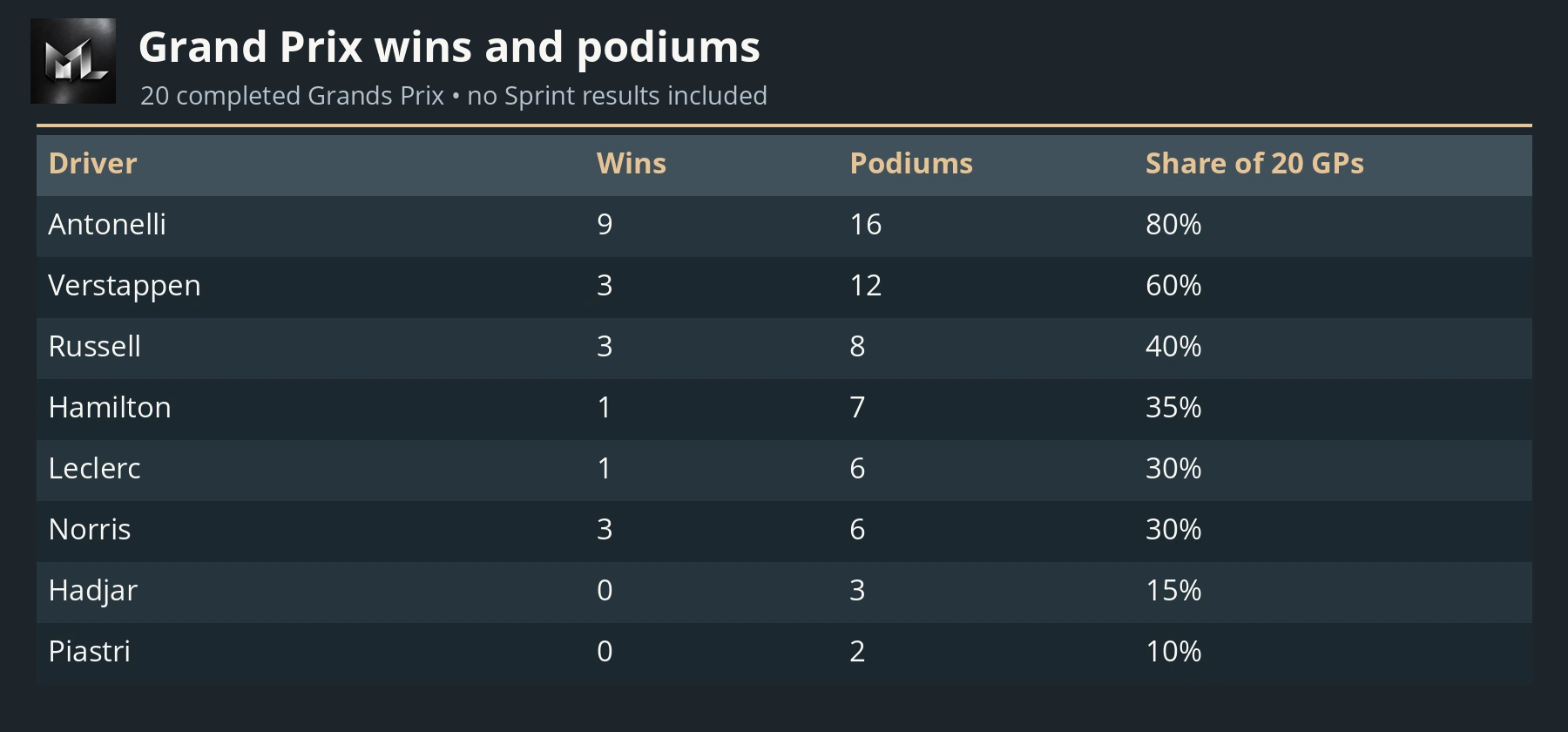
Twenty completed Grands Prix yield 20 wins and 60 podium places. Antonelli accounts for nine wins and 16 podiums. Verstappen has 12 podiums and three wins. Norris has won three of his six podium races. These counts use Grand Prix results only. The percentage uses all 20 completed rounds as its denominator.
Mercedes
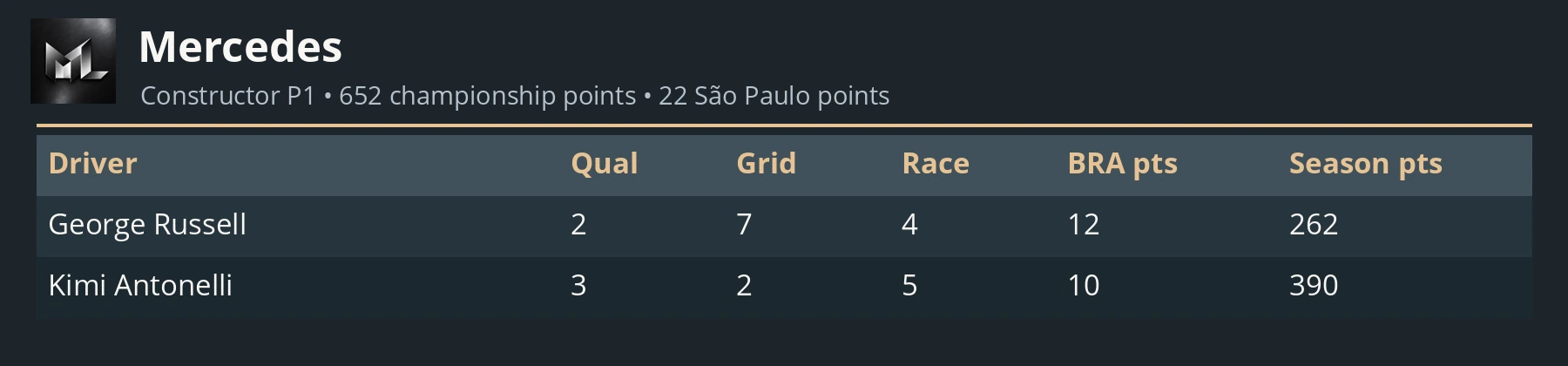
Russell and Antonelli brought home the 22 points that settled the constructors’ championship. They took different routes. Russell qualified second, started seventh and finished fourth. Antonelli started second and took the lead into Turn 1. Two spins across the afternoon, including one on the reconnaissance lap, left him fifth. He still set the race’s fastest individual lap, 1:12.689 on lap 55. His speed on a drying track and his fifth place are both part of the result.
Las Vegas leaves Russell a much closer contest than the team table suggests. He has 262 points, one more than Lewis Hamilton. Antonelli, already drivers’ champion, has 390. His nine wins and 16 podiums across 20 Grands Prix explain how Mercedes could leave Interlagos without either car on the podium and still clinch the title.
Ferrari
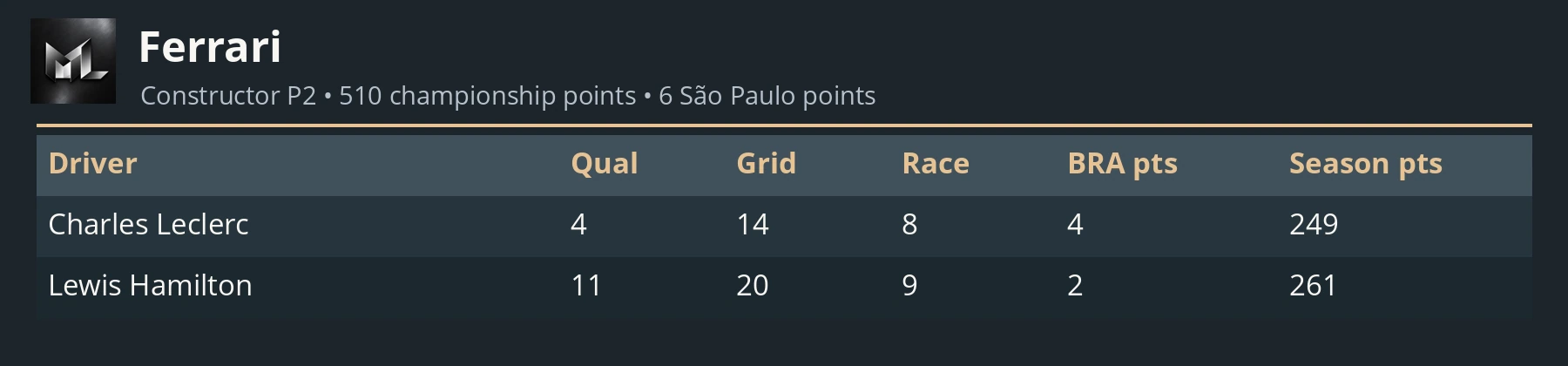
Charles Leclerc qualified fourth but lined up 14th. Lewis Hamilton lined up 20th for his 400th Formula 1 start. Both reached the points. Leclerc crossed the line ahead of Liam Lawson, then dropped behind the Racing Bulls driver after a five-second penalty for contact. Eighth and ninth earned Ferrari six points. Only three points separate Leclerc, on 249, from São Paulo winner Lando Norris.
Ferrari can take something to Las Vegas from Hamilton’s first lap. He reached ninth before the end of it, then lost positions as his intermediates wore on the drying surface. The 71-lap result includes both phases. Qualifying higher in Nevada would give him a route to the same fight without having to recover eleven places on the opening lap.
Red Bull Racing
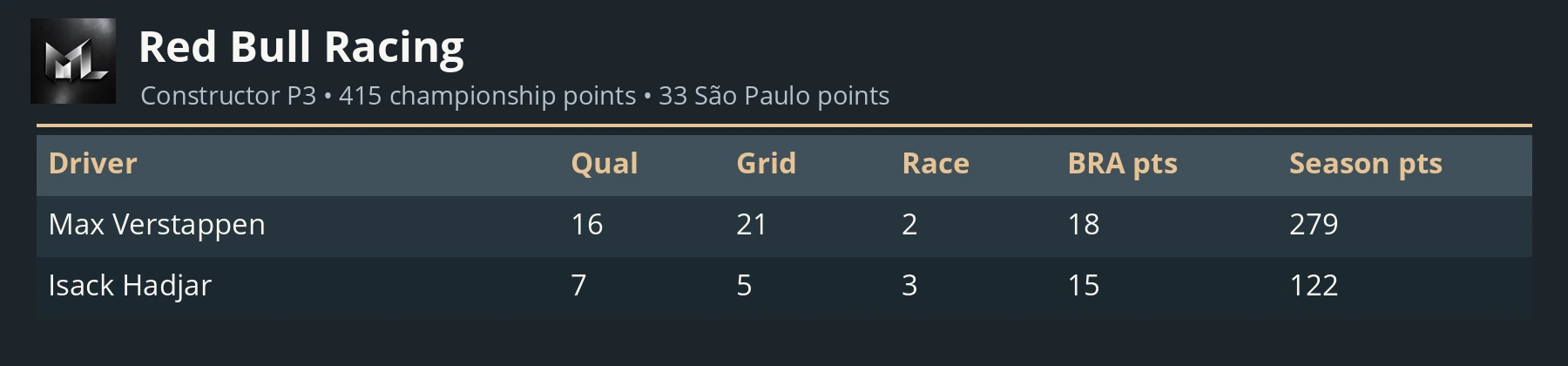
Verstappen started 21st and finished second, a gain of 19 places. Hadjar took a shorter, equally important route from fifth to third. Together they scored 33 points, exactly matching McLaren despite the win going to Norris. Red Bull therefore takes a 17-point advantage over McLaren to Las Vegas. A single race can produce a swing that large, but São Paulo shows why McLaren needs more than a winning car to make one.
Hadjar’s best lap was second only to Antonelli’s. His pit record lists visits on laps 16 and 50, while Verstappen visited on laps 17, 45 and 62. Two different sequences both produced podiums. For Las Vegas, the question is whether Red Bull can keep both cars near the front through qualifying instead of asking one to pass nearly the whole field.
McLaren
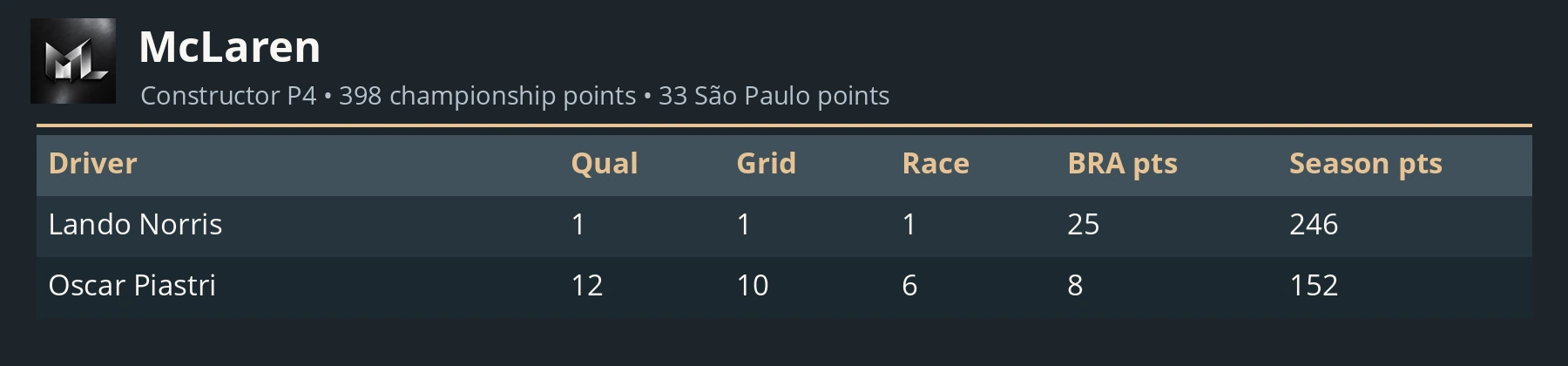
Norris earned pole by 0.204 seconds over Russell and won the Grand Prix by 14.602 seconds over Verstappen. It was his third win of 2026, following Hungary and the Netherlands. Piastri started tenth, finished sixth and scored eight points. Both cars made their first stop on lap 16 and their last on lap 62, yet their finishes were five places apart. The starting positions help explain how similar stop windows produced different returns.
Norris now sits three points behind Leclerc and 15 behind Hamilton. The team gained nothing on Red Bull in Brazil because Hadjar’s third place offset Piastri’s sixth. A couple of qualifying places for Piastri matter as much to that constructors’ contest as repeating Norris’s pole.
Racing Bulls
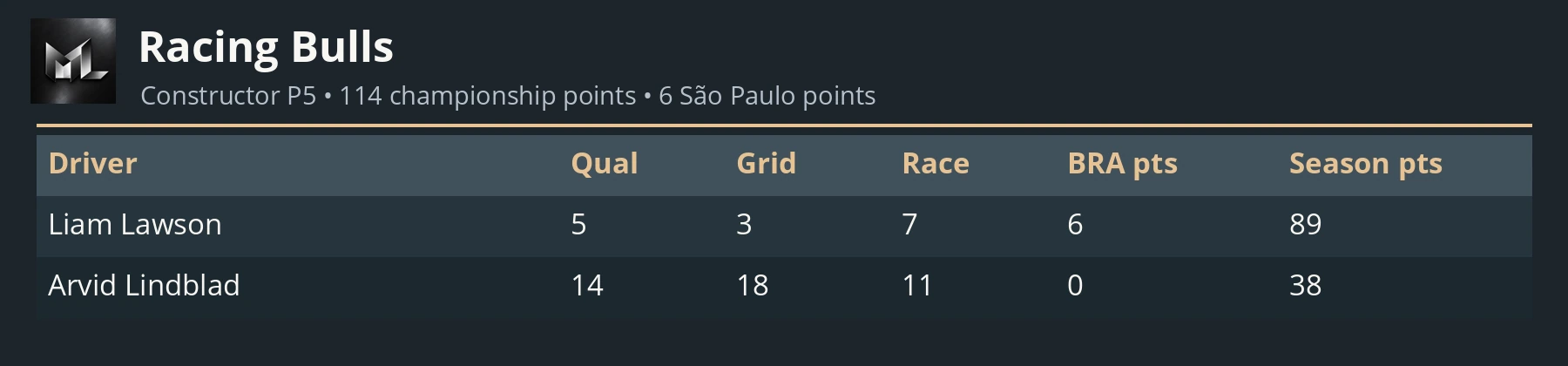
Lawson started third and ran second in the opening laps. When the racing line began to dry and his intermediate tyres lost performance, Norris, Hadjar and Russell all got through. Lawson eventually regained seventh in the classification after the penalty to Leclerc. Those six points took him to 89, 47 clear of Gasly in the drivers’ table. He has built that margin without a Grand Prix podium in the season’s first 20 rounds.
Lindblad started 18th and climbed to 11th, one place short of a point. Racing Bulls scored through only one car but left Brazil 45 points ahead of Alpine. Friday qualifying in Las Vegas is a chance to put Lindblad closer to Lawson before they have to manage traffic.
Alpine
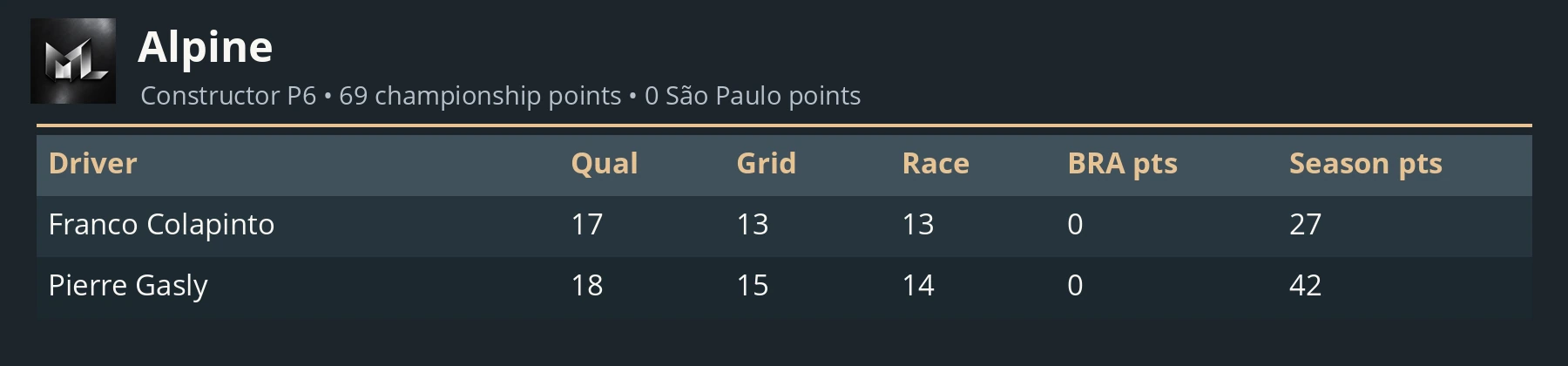
The two Alpines started 13th and 15th, and finished 13th and 14th. Colapinto led Gasly home by one place. He also recorded the seventh-fastest individual lap, while Gasly ranked 15th in that table. A fast lap on a changing track can show what was possible for a few corners at a particular time. It could not erase the laps Colapinto had already spent outside the points.
Alpine stays sixth on 69 points. It trails Racing Bulls by 45 and leads Haas by 38. A car starting around the seventh row will probably need to take places from more than its immediate neighbours to score. Las Vegas offers a straightforward test of progress in Friday qualifying, before strategy enters the comparison.
Haas F1 Team
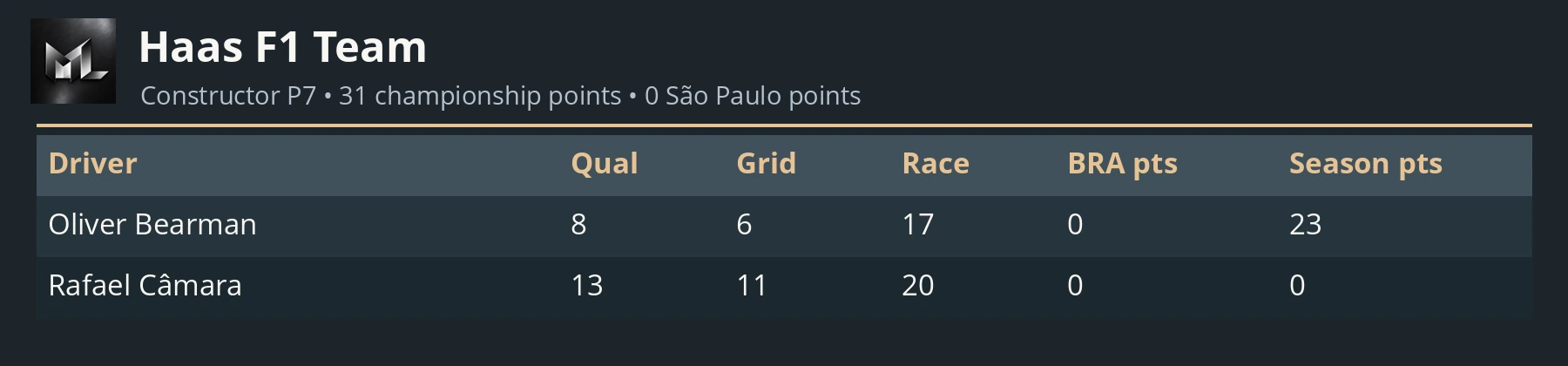
Bearman qualified eighth and started sixth. A 39.773-second first pit-lane visit on lap 16 stands out in his race record. His later visits took 27.554 and 25.357 seconds. The timing measures passage through the lane and does not isolate time spent changing tyres. He finished 17th. Rafael Câmara qualified 13th for his debut, started 11th and completed 69 laps in 20th.
Brazil leaves Haas on 31 points, just three ahead of Audi. Bearman has 23 of his own in the drivers’ championship. His Saturday at Interlagos demonstrated what qualifying can buy, while the final classification shows how quickly a good starting place can go unused. One extra scoring result for either team could shift seventh in Las Vegas.
Audi
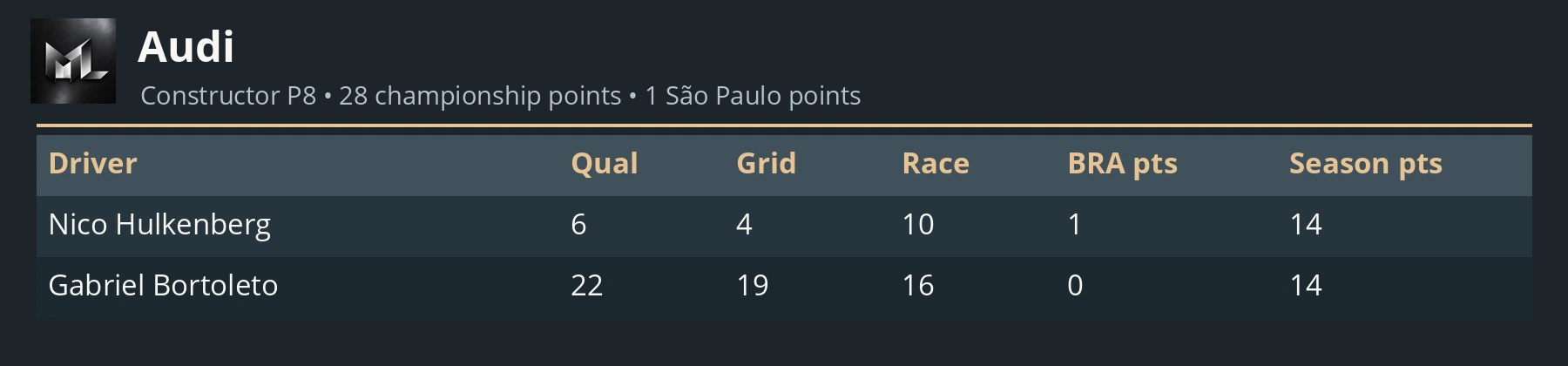
Hulkenberg advanced from sixth in qualifying to fourth on the published grid, then finished tenth. The single point took him to 14, level with Bortoleto. Formula 1’s official order still places Bortoleto 14th in the championship and Hulkenberg 15th. Bortoleto started his home race 19th and finished 16th. Both completed 70 laps. The Brazilian’s 19th-best individual lap also shows why the finishing order alone tells little about outright speed.
Audi has 28 points. The gap to Haas is three, small enough for a single eighth-place finish to erase if Haas goes scoreless. Hulkenberg’s weekend makes the calculation tangible. Four points were on offer for eighth, and his tenth brought one.
Williams
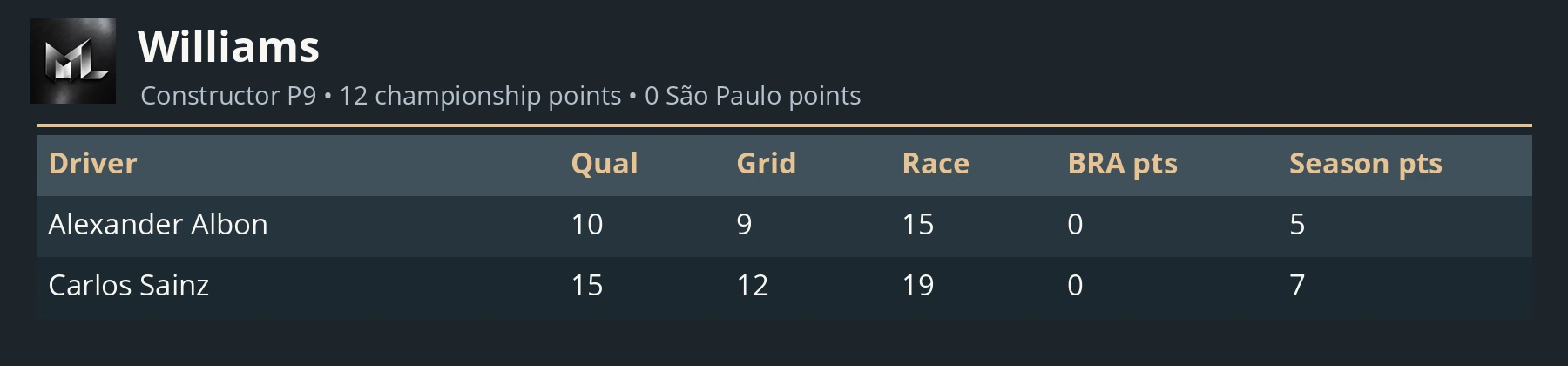
Albon qualified tenth, lined up ninth and finished 15th. Sainz went from 12th on the grid to 19th. Neither added to Williams’s 12 points. Albon’s middle pit visit on lap 42 took 30.721 seconds, more than six seconds longer than either of his other visits. The chart identifies a loss of time in the lane but cannot assign its cause.
Williams is five points above Aston Martin. Its drivers sit next to other midfield drivers on points. Sainz has seven, level with Alonso and Ocon, while Albon has five. A return to Q3 would mean more if the team could keep that car in the points through the first tyre change.
Aston Martin
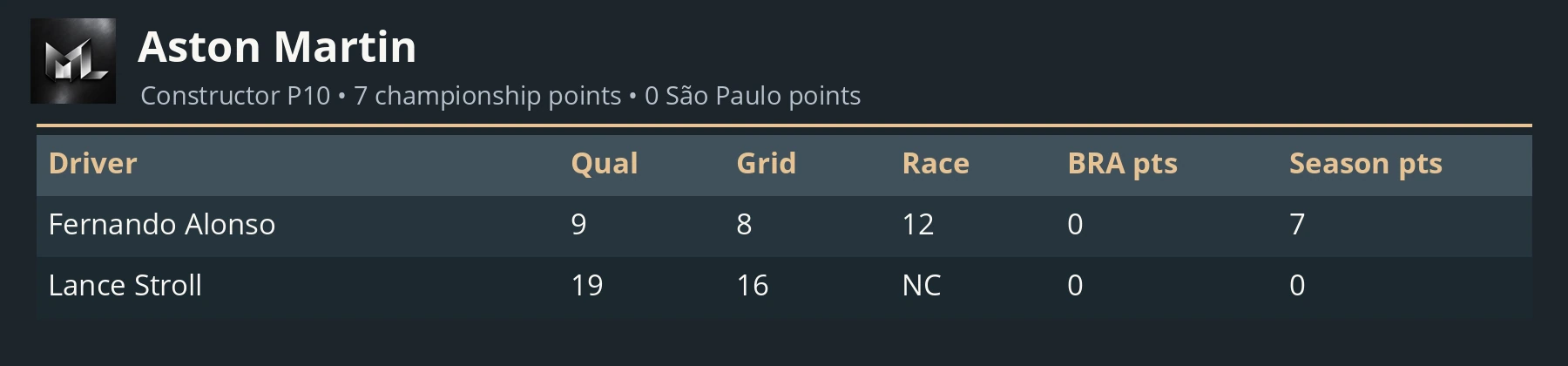
Alonso qualified ninth and started eighth. His 12th place left him two positions away from scoring. Stroll completed 30 laps before retiring and was listed as unclassified. The two results leave little basis for comparing their whole-race pace. Alonso’s final individual best came on lap 53, long after Stroll’s race had ended.
Alonso has all seven of Aston Martin’s championship points. Williams, the team directly ahead, has 12. Finishing seventh once would deliver six points, enough to pass a scoreless Williams. Brazil shows both the opportunity and the difficulty. Alonso started inside the top ten but finished just outside it.
Cadillac
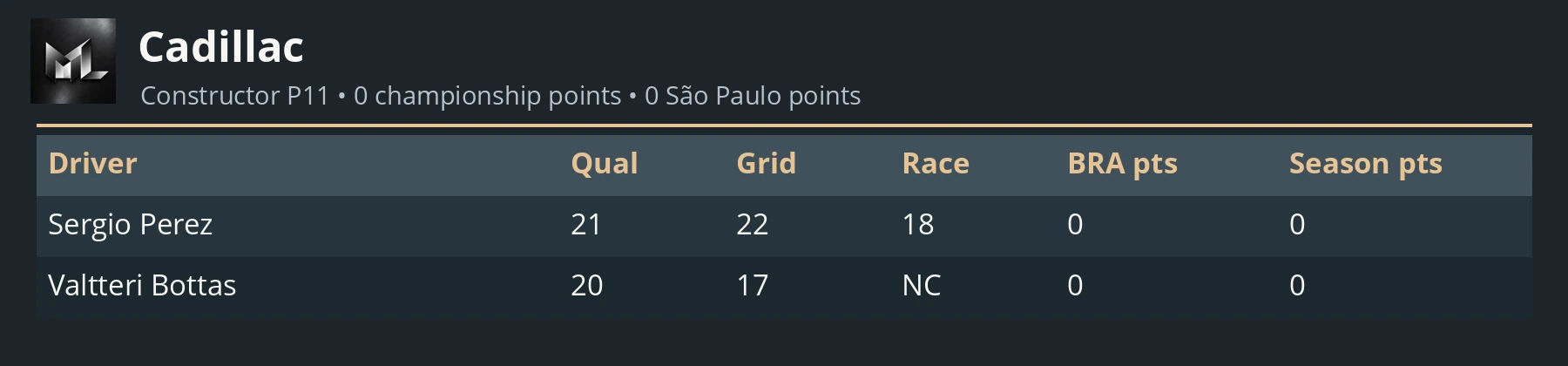
Perez started 22nd and finished 18th after 69 laps. Bottas appeared 17th on the published grid but his car was withdrawn before the start. His race entry shows zero laps and DNS. The fastest-laps sheet consequently lists 21 drivers, with no Bottas time. The official driver standings retain both Cadillac drivers on zero points.
For Las Vegas, the first useful comparison is how both cars perform across consecutive sessions. Only one Cadillac supplied any race-lap evidence in Brazil. Perez’s timing sheet contains pit visits on laps 15 and 59. Without a second classified car, the team could draw no same-race comparison between its drivers’ approaches to the changing grip.
How Norris won and Red Bull kept its lead
Norris’s weekend at Interlagos started with an advantage small enough to disappear by Turn 1. He took pole by 0.204 seconds. On Sunday Antonelli came from second on the grid to lead, and Lawson slipped ahead of Norris into second. On a damp track that was beginning to dry, Lawson’s tyres started to fade. Norris passed him, and so did the Red Bulls as they moved forward. By the finish, the driver who had lost two places at the outset had won by more than 14 seconds.
Verstappen began on the back row and reached 13th on the first lap. He was eighth by lap five. His final fifth-fastest individual lap understates that performance. The decisive work came over several laps in traffic before some of the fastest times of the afternoon had even been set. Hadjar needed to gain just two places from his fifth grid slot for a podium, then delivered the second-fastest individual lap. Gaining 19 places from his starting position made Verstappen the conspicuous story. Hadjar’s share of the points was just as important to Red Bull.
Piastri’s race shows why McLaren needed more from qualifying. He gained four places from tenth, and his best lap was 1:13.018, only 0.035 seconds slower than Norris’s. Yet he finished 56.475 seconds behind his team-mate. A pair of quick laps put the McLarens almost level on one timing sheet. It took 71 laps to produce the gap on the other.
The two teams that occupied the podium split their rewards evenly. Norris’s win and Piastri’s sixth brought 25 and eight points. Second and third gave Red Bull 18 and 15. The result kept their season margin at 17. In Las Vegas, moving Piastri ahead of Hadjar could make a meaningful dent in that lead even if Norris wins again.
What the pit visits reveal about a wet race
A late shower complicated a race that had already moved from a wet surface toward dry conditions. Norris and Verstappen both visited the pits for a third time on lap 62. The official pit-lane times on that lap were 24.917 seconds for Norris and 23.888 for Verstappen. The difference was 1.029 seconds. Norris nevertheless finished 14.602 seconds ahead. That last stop accounted for only a small part of the gap that separated them at the flag.
Hadjar took a different route to the podium. His two recorded visits came on laps 16 and 50. Russell also had two, on laps 16 and 61. The first window was shared. Their final visits came eleven laps apart. One driver took third and the other fourth. Without matched tyre, traffic and lap-by-lap evidence, the timing sheet cannot support a claim that an earlier or later stop alone decided their order. It can establish that both two-visit and three-visit races produced a podium finish.
Ferrari’s two cars reached adjacent positions with different stop histories. Hamilton’s first visit came on lap 14, on the same lap as Sainz. He returned on laps 38 and 62. Leclerc made his first visit on lap 16 and waited until lap 61 for his second. They finished eighth and ninth, with the Ferrari that stopped twice ahead.
The pit-lane record covers 57 visits across the 21 drivers who completed a race lap. Every reported visit number follows consecutively for its driver. The displayed durations measure a trip through the pit lane, including time spent stationary. Treating an entire 24-second transit as the time taken by a tyre crew would miss most of what the figure measures. For Las Vegas, the comparable question is when stopping reintroduces a driver to traffic, as well as how long the visit itself takes.
Las Vegas moves the qualifying question to Friday night
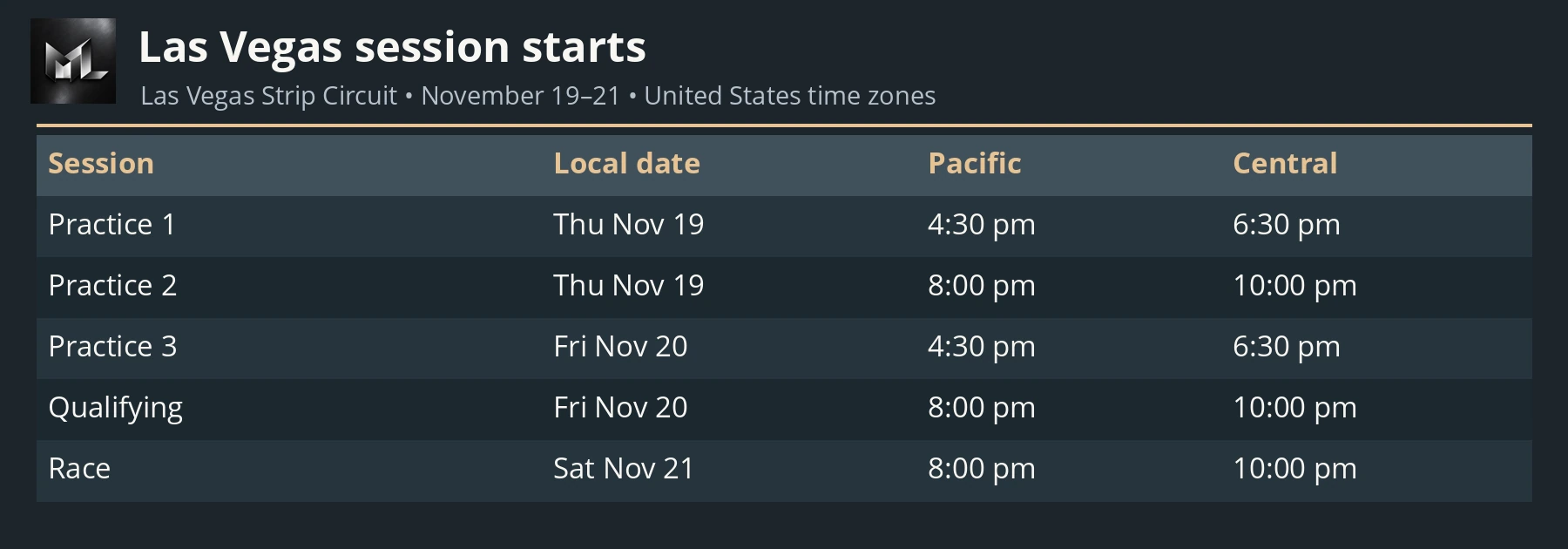
Three race weekends remain on the published calendar. Las Vegas comes first, followed by Qatar and Abu Dhabi. The Las Vegas Strip Circuit measures 6.201 kilometres and the Grand Prix is scheduled for 50 laps. The race starts at 8 p.m. Pacific on Saturday, November 21. That is 10 p.m. Central the same night and 04:00 UTC on Sunday. The date on an international timing screen can therefore differ from the date on a Nevada ticket.
Practice starts in the late afternoon on Thursday and Friday, while second practice moves into Thursday night. Second practice, qualifying and the race all begin at 8 p.m. local time. That makes Thursday evening particularly informative. A driver’s first run in daylight and a later run after dark are different comparisons, even before fuel loads or tyre choice enter the picture. Watch Friday qualifying for whether both Red Bulls can make their way toward the front row and whether Piastri can start closer to Norris.
There is a useful benchmark for Friday’s qualifying session. In São Paulo the McLarens were separated by 0.035 seconds on their best race laps, yet qualified eleven places apart. If they both get through to the last qualifying session in Las Vegas, compare their best laps in that session. That comparison puts the cars on track much closer together in time.
The championship at the very top is settled. Just behind it, Russell’s one-point cushion over Hamilton and Leclerc’s three-point lead over Norris put ordinary points finishes in sharper focus. A two-place difference can matter on either side of the pit wall. The midfield carries its own version of that arithmetic. Haas leads Audi by three points, Williams leads Aston Martin by five, and one well-timed high finish can change their order before the series heads to Qatar.