
College Football Week 9 Preview
Data coverage and limitations
The common evidence cutoff is 2026-10-30T10:20:00Z. All 572 completed regular-season games are included, including six Week 9 finals. Two Thursday finals missing from the season summary were reconciled from actual game and play inputs before recalculation. Scheduled or unfinished games do not enter records or season totals. The shared schedule observation preceded those Thursday finals; their completed status and scores were verified separately. No unsupported availability claim, quotation, betting line or probability is included.
Our current Power Rankings
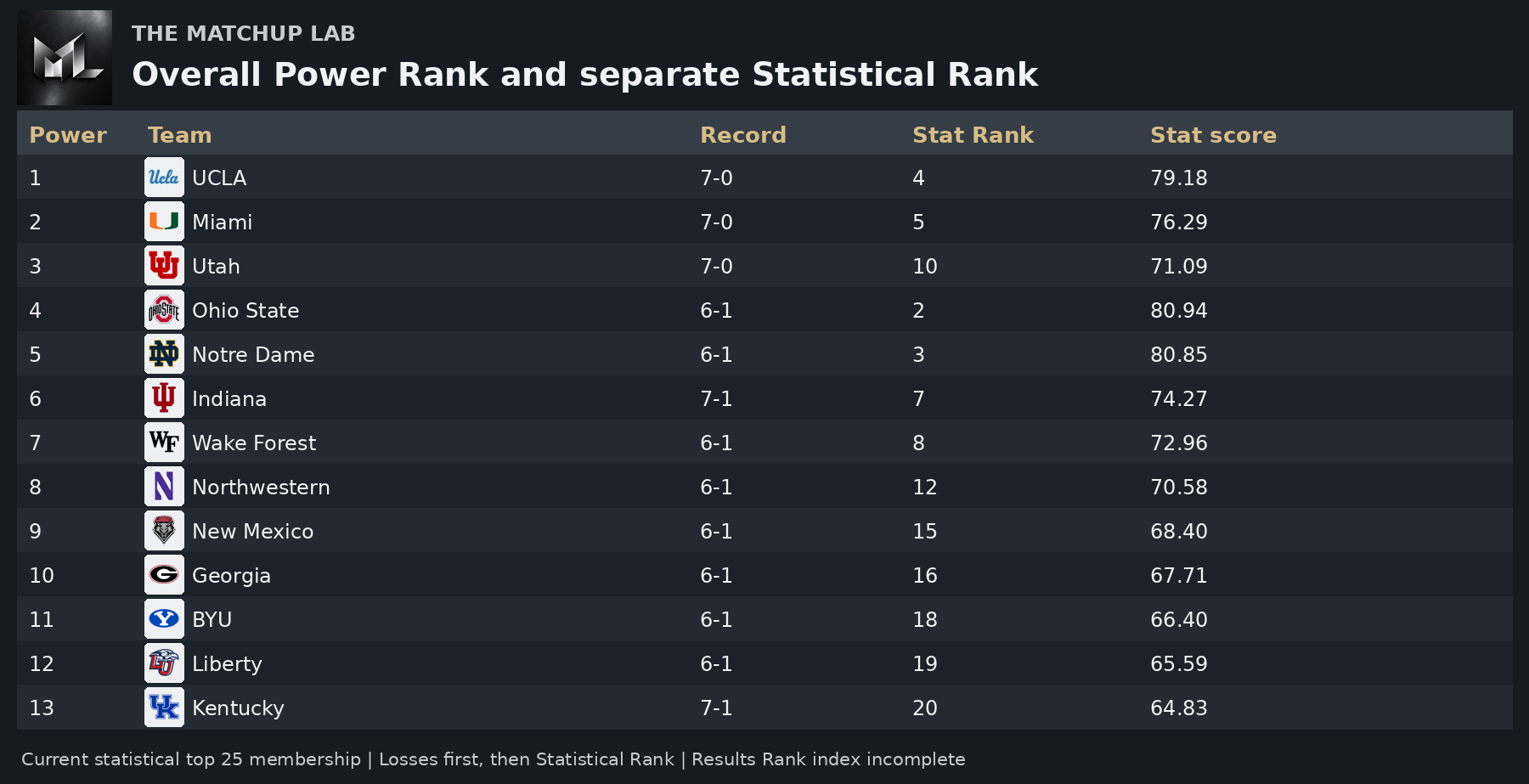
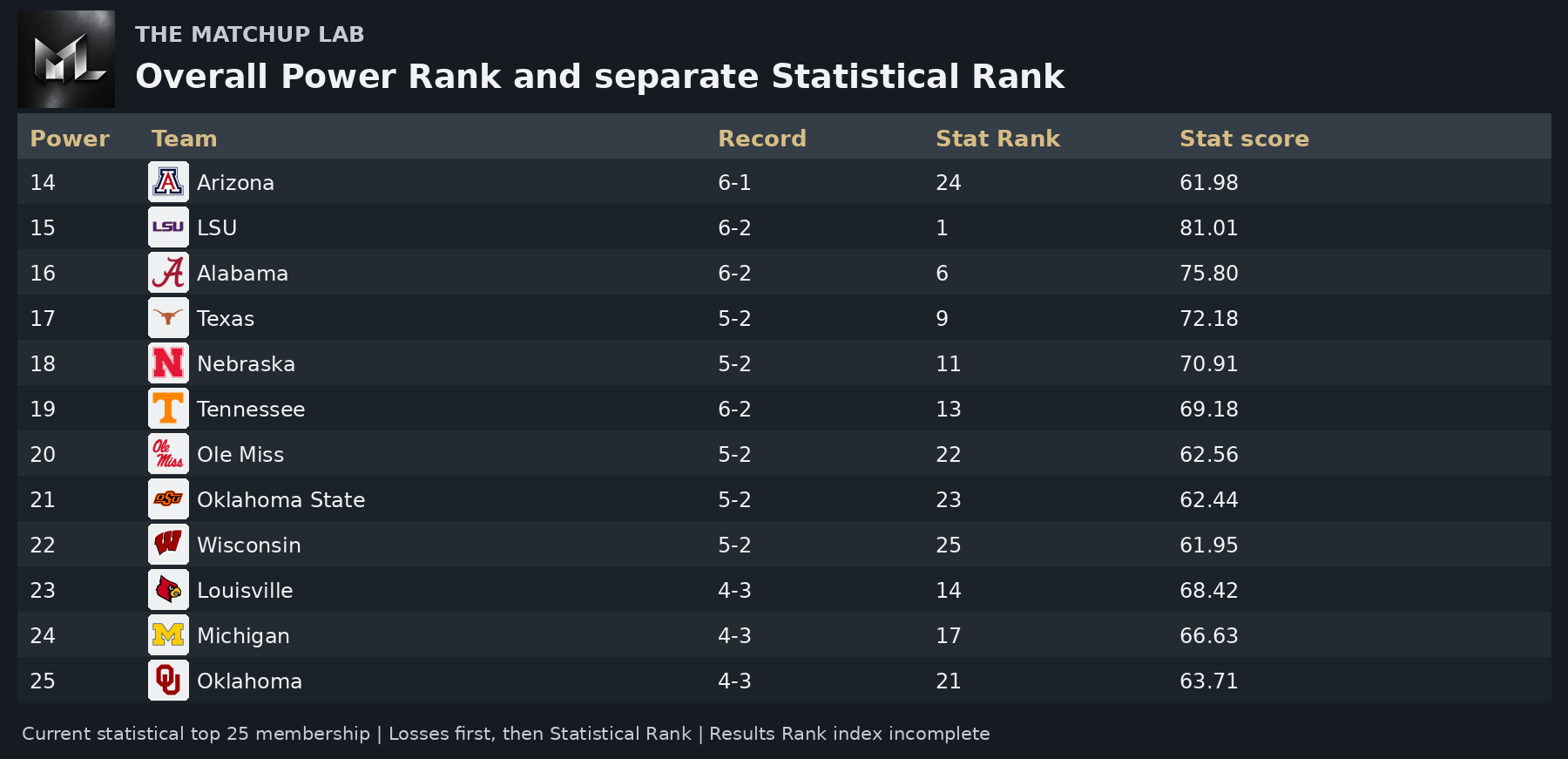
Overall Power Rank orders completed regular-season losses from fewest to most within our calculated statistical top 25. Unchanged Statistical Rank breaks ties within each loss group, followed by the official team ID for an exact tie. Zero-game teams would remain provisional. Team records and Statistical Rank are separate columns. The distinct calculated Results Rank update is incomplete because the complete FCS opponent-record population required by that method is unavailable; no substitute index is shown.
Our established college statistical method evaluates offense and defense together. Its underlying categories weight efficiency at 40 percent, explosive plays at 25 percent, finishing opportunities at 15 percent, field position at 10 percent and turnovers at 10 percent. Efficiency combines successful plays with expected scoring value. The saved college definitions count positive expected points added as success; explosive thresholds are 2.4 expected points on passes and 1.8 on runs. These college definitions differ from simple yardage thresholds.
The saved method smooths finishing with eight neutral scoring opportunities and turnovers with two neutral games. It standardizes the categories across all 138 FBS teams and caps category extremes. That five-category result contributes 30 percent of the final assessment. The remaining 70 percent comes from the established opponent-adjusted network of game performance, with two neutral games of regularization and a measured FCS anchor. The index is centered on 50. It measures observed performance, including schedule context, rather than a betting probability.
Every ratio uses summed numerator and denominator counts. Paired table values show offense and defense allowed; drive-start pairs instead show the team's own starting yard line and opponents' starting yard line. Those starts reflect stops, returns, penalties and turnovers together, so they do not assign all credit to the defense. A qualifying scoring opportunity is a drive estimated to reach the opposing 40 from its start and recorded yards, or a scoring drive. Its points count six per touchdown and three per field goal, excluding extra points.
The Consistent and Uneven labels describe week-to-week variation, not whether performance is good. For each measure, we compare the team's weekly offense-minus-defense swings with the current full-FBS median variation; turnovers use takeaways minus giveaways per game. At least four active weekly samples are required. A swing no larger than the league median is Consistent, and a larger swing is Uneven. This descriptive check does not change any statistical score or ranking weight.
The Week 9 test
Three unbeaten teams lead our overall order, but their cases are not identical. UCLA combine a powerful running contribution with a defense that has repeatedly ended third downs. Miami have produced a much larger scoring total while still leaving defensive details worth examining. Utah have kept winning as the recent margins tightened. Behind them, one-loss teams face distinct tests of whether their strongest season evidence can survive a more difficult possession game.
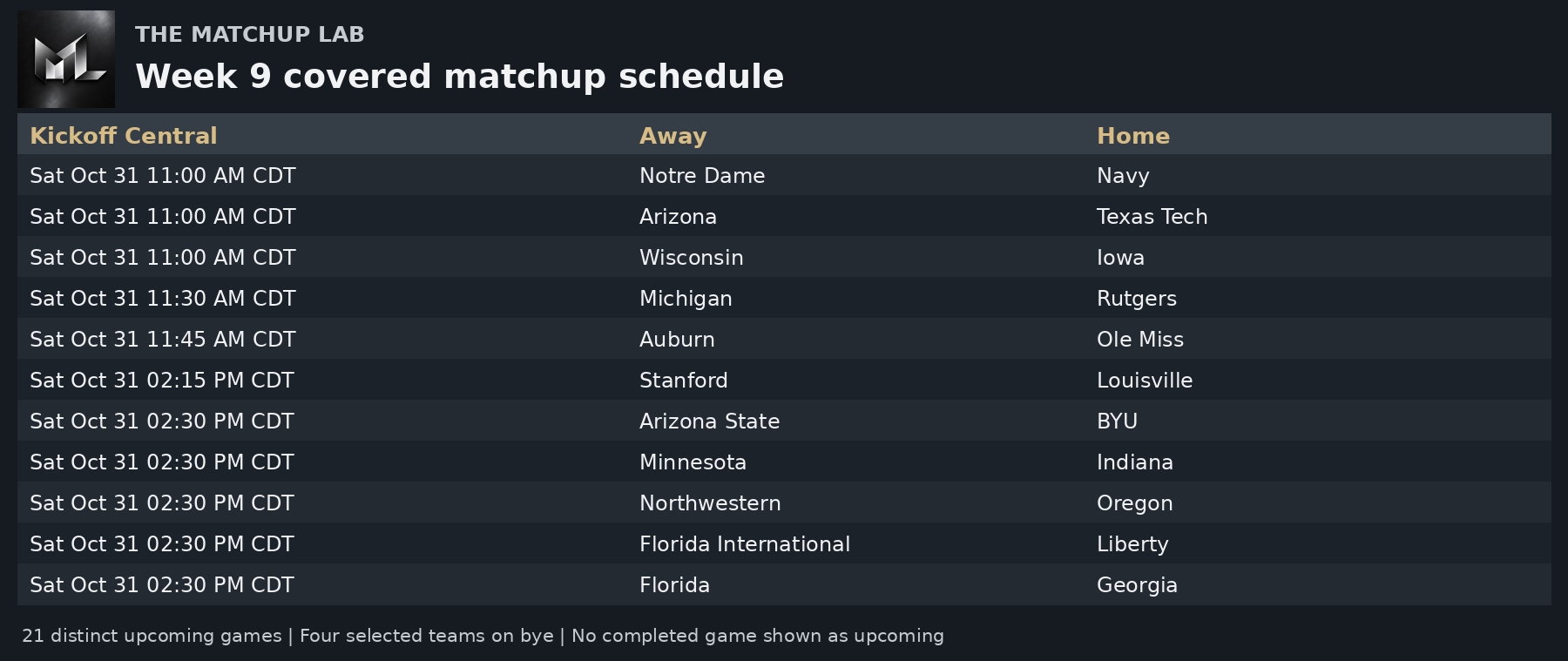
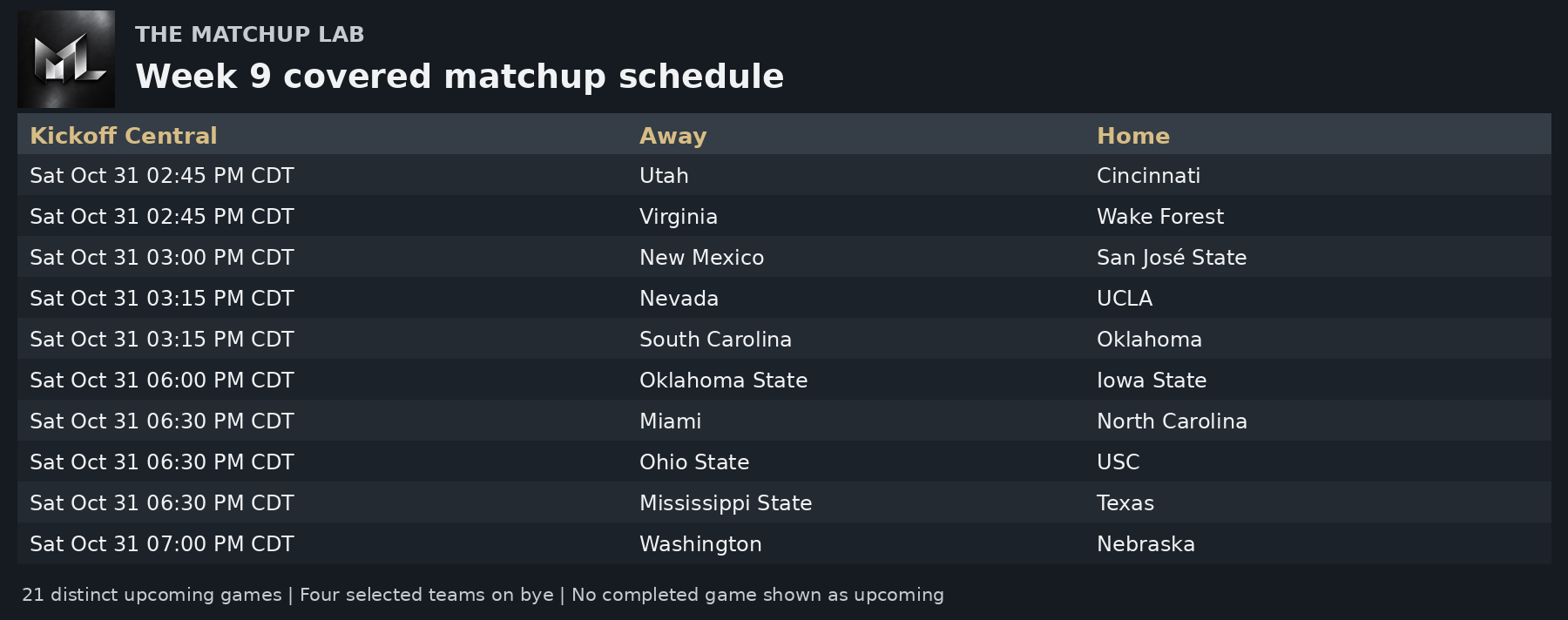
This preview covers exactly the current 25 teams selected by our saved statistical calculation. Twenty-one distinct games provide the matchup sections, while LSU, Alabama, Tennessee and Kentucky receive individual bye assessments. Opponents appear as matchup context, rather than expanding the ranking graphic beyond our selected population. Records describe outcomes. The statistical assessment helps explain why an impressive win and an ugly loss can belong to the same season, without pretending to guarantee the next result.
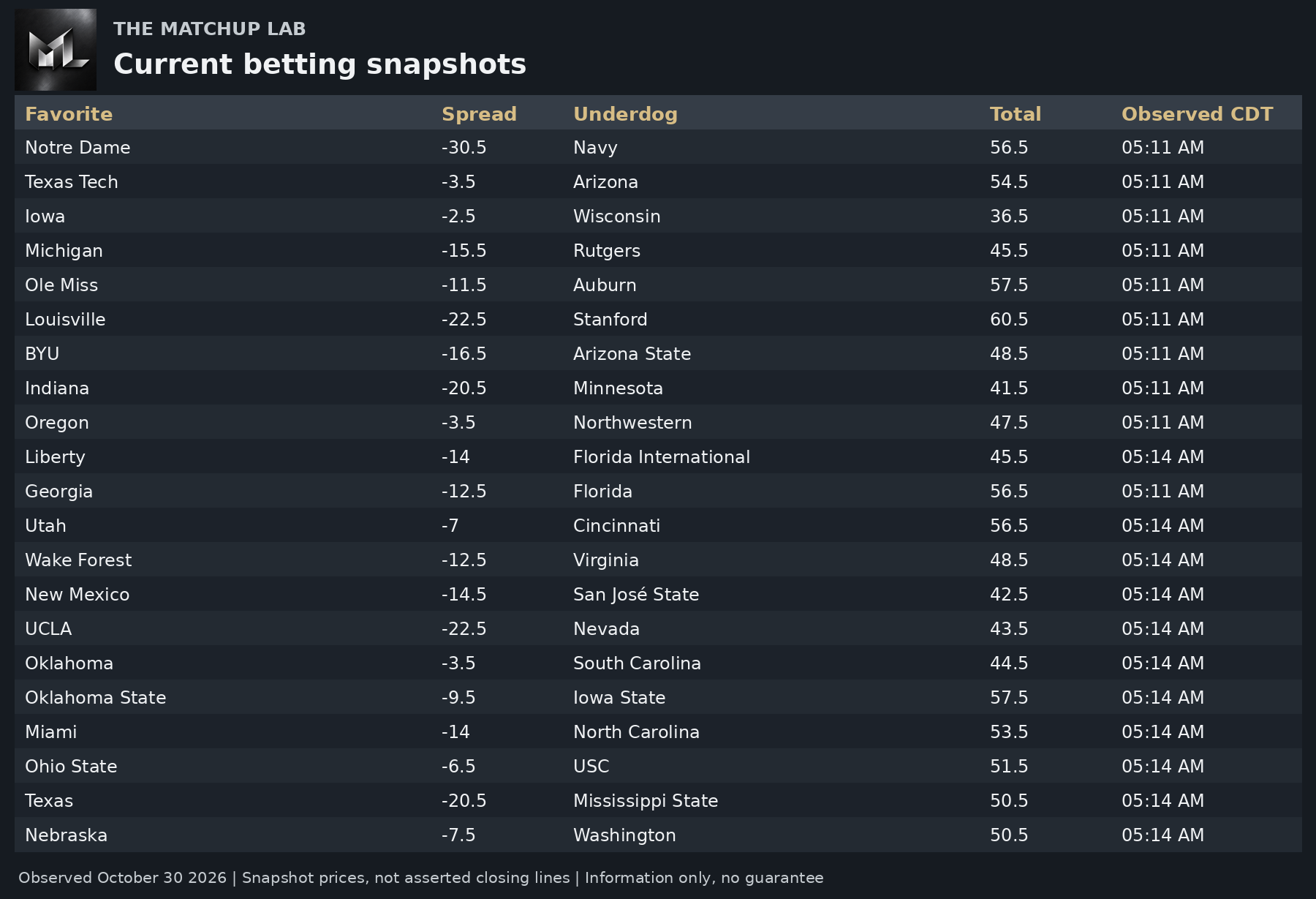
The spreads and totals above were observed on October 30, 2026, at the Central times printed for each game. They can change before kickoff and are information rather than a guarantee of results. These recorded snapshots are not asserted closing lines. No betting probability or guaranteed pick is issued.
Notre Dame vs Navy
Sat Oct 31 11:00 AM CDT
Neutral site at Gillette Stadium, Foxborough, Massachusetts. Away and home columns show administrative designations.
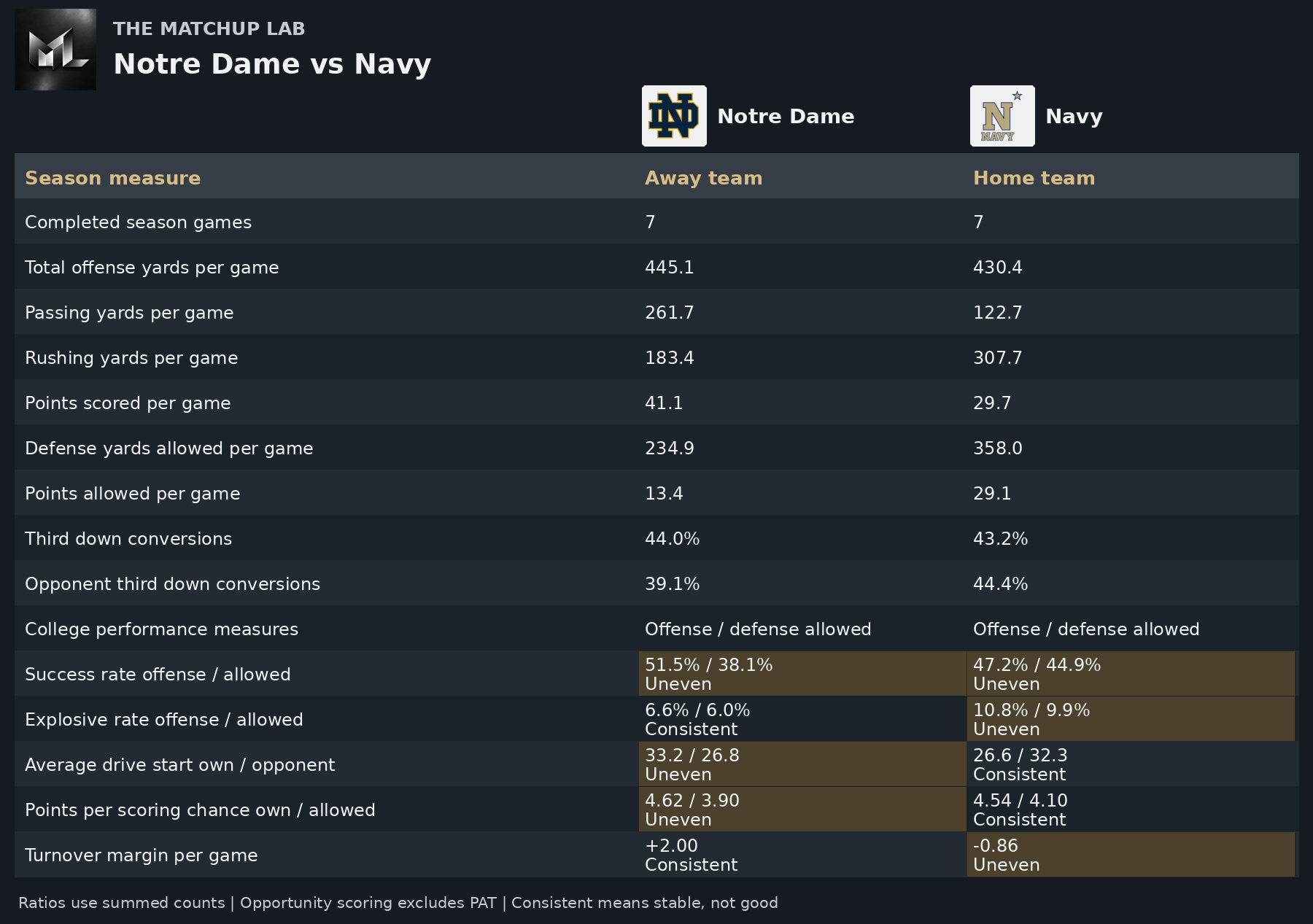
Notre Dame's first loss did not erase seven games of strong defensive work. It did expose how a good overall afternoon can be undone when the opponent keeps extending possessions. BYU converted eight of twelve third downs in the Irish's most recent game and won 28-24 despite gaining slightly fewer yards. After a bye, Notre Dame need to make the next useful defensive play arrive before the opponent has already crossed midfield. Navy's running volume makes that demand more immediate. An early stop that still leaves third-and-short has not finished the job.
The Midshipmen average more than 300 rushing yards, so their defeats should not be mistaken for an inability to move the ball. They ran for 363 against North Texas and scored 39, then lost by ten. That game fits a season in which productive offense has repeatedly been followed by another damaging defensive possession. Notre Dame's combination of passing production and a substantial running contribution can make Navy defend the whole field. The Irish should value an ordinary gain that keeps both options available rather than letting an impatient throw waste a favorable situation.
There is a warning for the visitors in their own turnover advantage. Notre Dame average two more takeaways than giveaways per game, an unusually helpful supply of extra possessions. The defense's low yardage allowance supports the broader assessment, but that turnover return should not be treated as something the next opponent is obliged to provide. Navy have had the opposite problem across the season. They need clean possessions that end with points or a useful change of field position, rather than giving an already efficient opponent another short route to the end zone.
The decisive matchup is Navy's ability to stay ahead of the down against Notre Dame's ability to turn territorial control into an actual stop. If Navy can keep the Irish offense waiting and finish their best drives, their rushing production has practical value. If Notre Dame force repeated long passing situations, the game moves toward the visitors' more complete offensive options. The Irish also need better finishing resistance than they showed against BYU. A favorable season assessment is useful context; it does not tackle anyone on third down.
Arizona at Texas Tech
Sat Oct 31 11:00 AM CDT
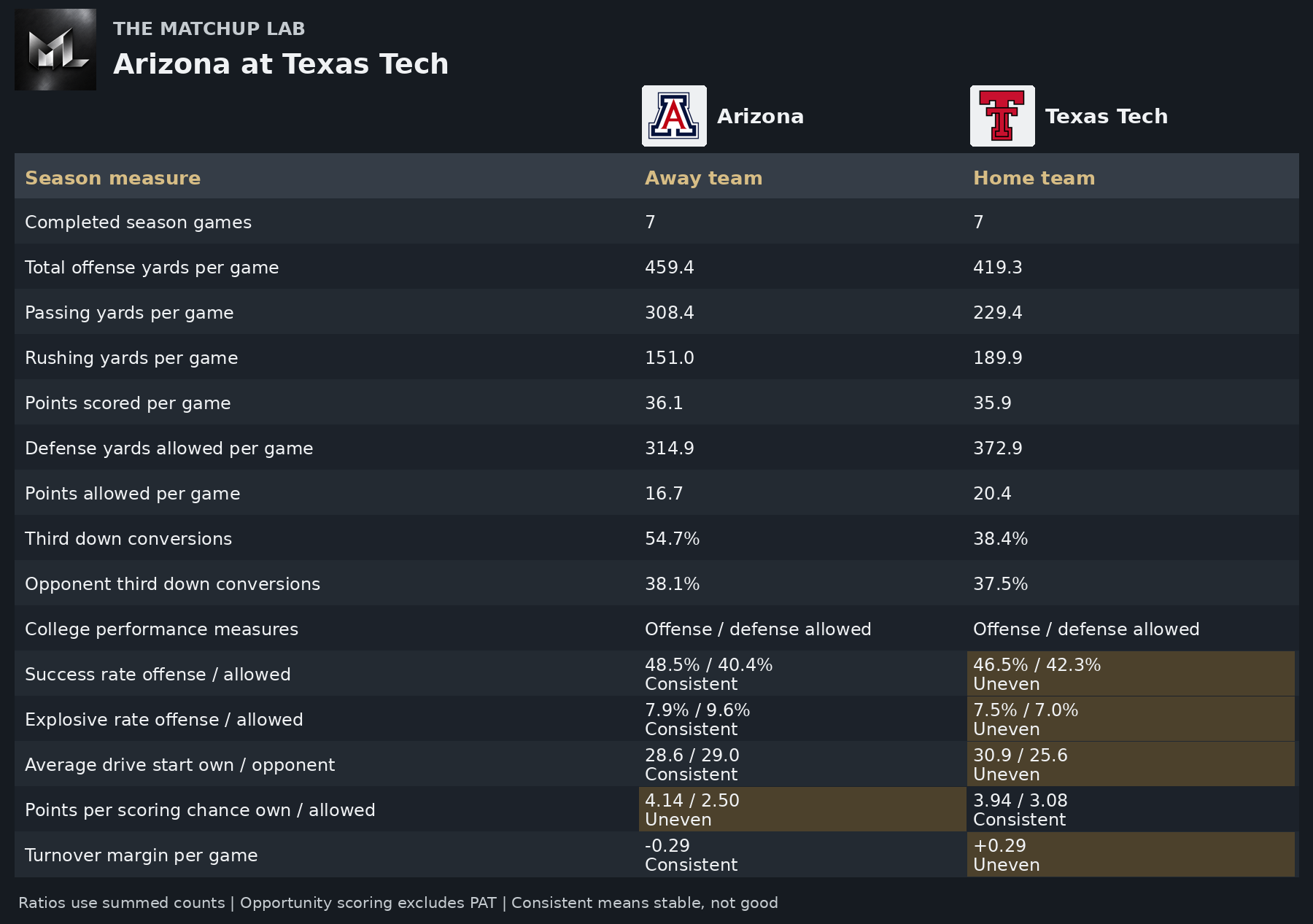
Arizona arrive with a much cleaner recent performance than Texas Tech. The Wildcats beat Iowa State 39-3, gained 477 yards and allowed 221 without giving the ball away. That is a strong example of the season they have been building, particularly through the passing game and their ability to keep possessions alive. It is still one game. Texas Tech's first defeat does not automatically make the next assignment easier, and Arizona have allowed a greater share of damaging long plays than they have created under the saved college definition.
The practical issue is whether Arizona can continue making ordinary passing gains before the Red Raiders force a difficult third down. The Wildcats have converted more than half their third-down attempts across the season. Texas Tech have been much less reliable there, and a three-for-fifteen performance against Cincinnati turned 400 yards into only 24 points. Arizona do not need every possession to contain an exceptional throw. They need enough early progress to keep a failed play from ending the drive. Tech need to interrupt that rhythm rather than waiting for a mistake that Arizona avoided last week.
Texas Tech's rushing contribution gives them a different way to answer. Their season offense has been more evenly divided between the ground and the air, and keeping that balance available would reduce the burden on a passing game facing repeated long downs. Three giveaways against Cincinnati made the task harder. Arizona's season turnover margin is slightly negative too, so the clean Iowa State game should be treated as a standard to repeat rather than proof that the issue has disappeared. Neither team can build a sensible plan around receiving the other's possessions for free.
Finishing inside scoring range is another meaningful separator. Arizona have allowed only 2.50 points per qualifying opportunity under the saved measure, while generating a much better return themselves. That figure excludes extra points and is distinct from total scoring. Tech must make their best drives count, because matching Arizona's raw yardage while ending with fewer useful possessions would repeat last week's frustration. The decisive contest is sustained Arizona passing against Tech's effort to create a longer, less comfortable down. Arizona need patience without carelessness; Texas Tech need progress without the three-giveaway surcharge.
Wisconsin at Iowa
Sat Oct 31 11:00 AM CDT
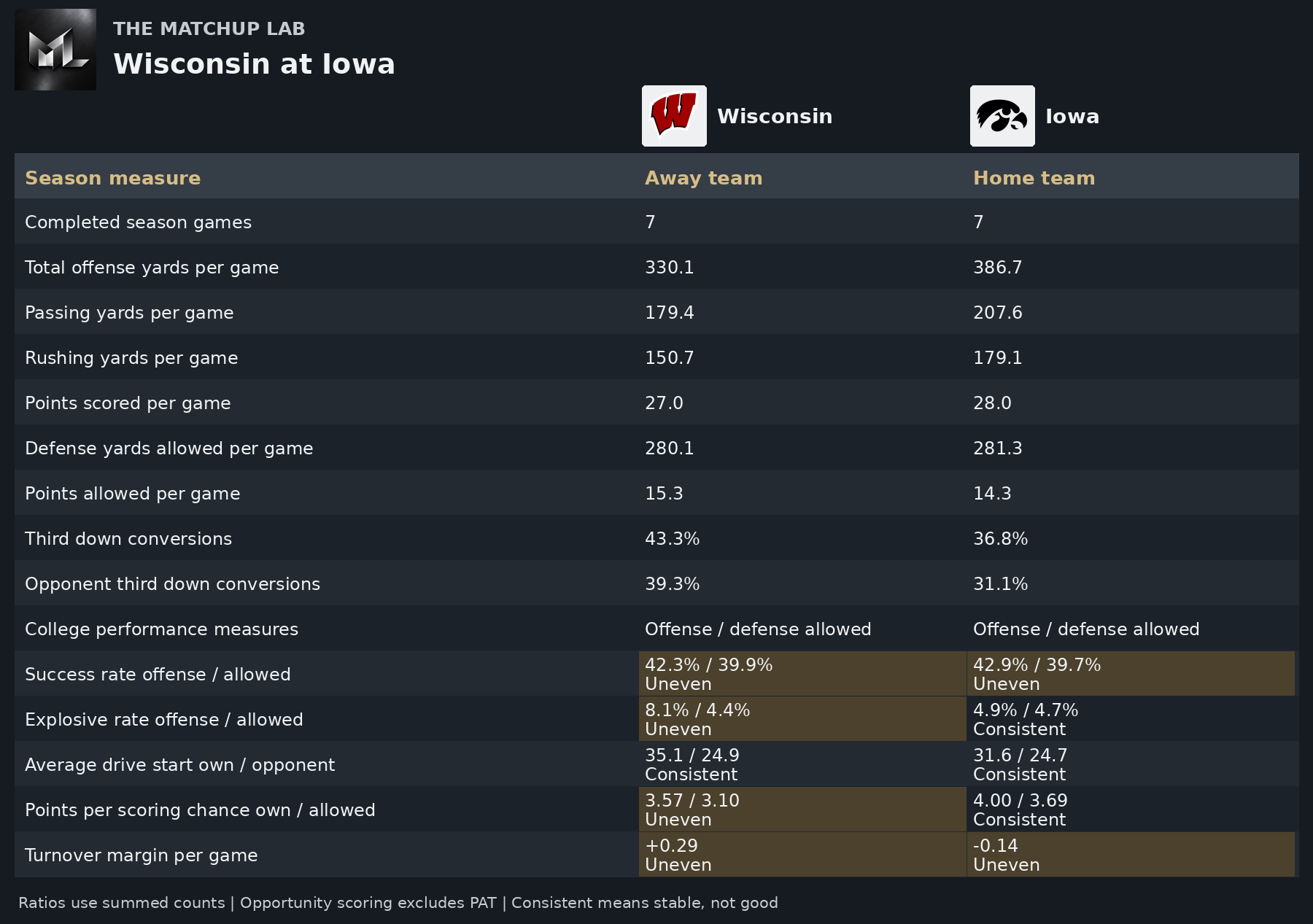
Wisconsin won last week with a performance that deserves both credit and scrutiny. The Badgers beat USC 24-7 while producing only 200 yards, including 58 through the air. They protected the ball, took it away twice and defended well enough to make that limited offense sufficient. Iowa have just experienced the reverse. The Hawkeyes allowed Minnesota only 209 yards, then lost 13-10 after giving the ball away four times. These teams do not need a lecture about the difference between moving the ball and making possessions useful.
The Badgers' season has benefited from a substantial advantage in average starting position. Their offense has typically begun around its own 35 while opponents have begun around their own 25. That includes the effects of the entire possession exchange, not simply defensive stops. Against an Iowa defense that has regularly ended drives on third down, Wisconsin need to preserve whatever distance advantage they earn. An avoidable sack or giveaway can turn a manageable field into the long journey their passing production has not consistently made easy.
Iowa's challenge is to make its own running contribution lead somewhere more productive. The Hawkeyes average more total yardage than Wisconsin, but their third-down offense has been less reliable and last week's four turnovers overwhelmed the defensive effort. The first correction is possession security. The second is arriving at third down with a realistic menu of options. Asking a good defense to keep repairing empty offensive series is possible for a while. It is a poor way to make that defense's work decisive across an entire afternoon.
The matchup should be assessed through how each offense handles an ordinary drive, rather than assuming that the latest low score forecasts another identical game. Wisconsin need more credible passing support for their rushing attack. Iowa need to turn defensive resistance into points without waiting for a spectacular play. The decisive stretch will be the possessions that start outside obvious scoring range. A team that can travel that distance cleanly and finish once inside it will have done something more durable than merely winning the yardage column. Neither side has earned permission to donate four possessions and complain about the final margin.
Michigan at Rutgers
Sat Oct 31 11:30 AM CDT
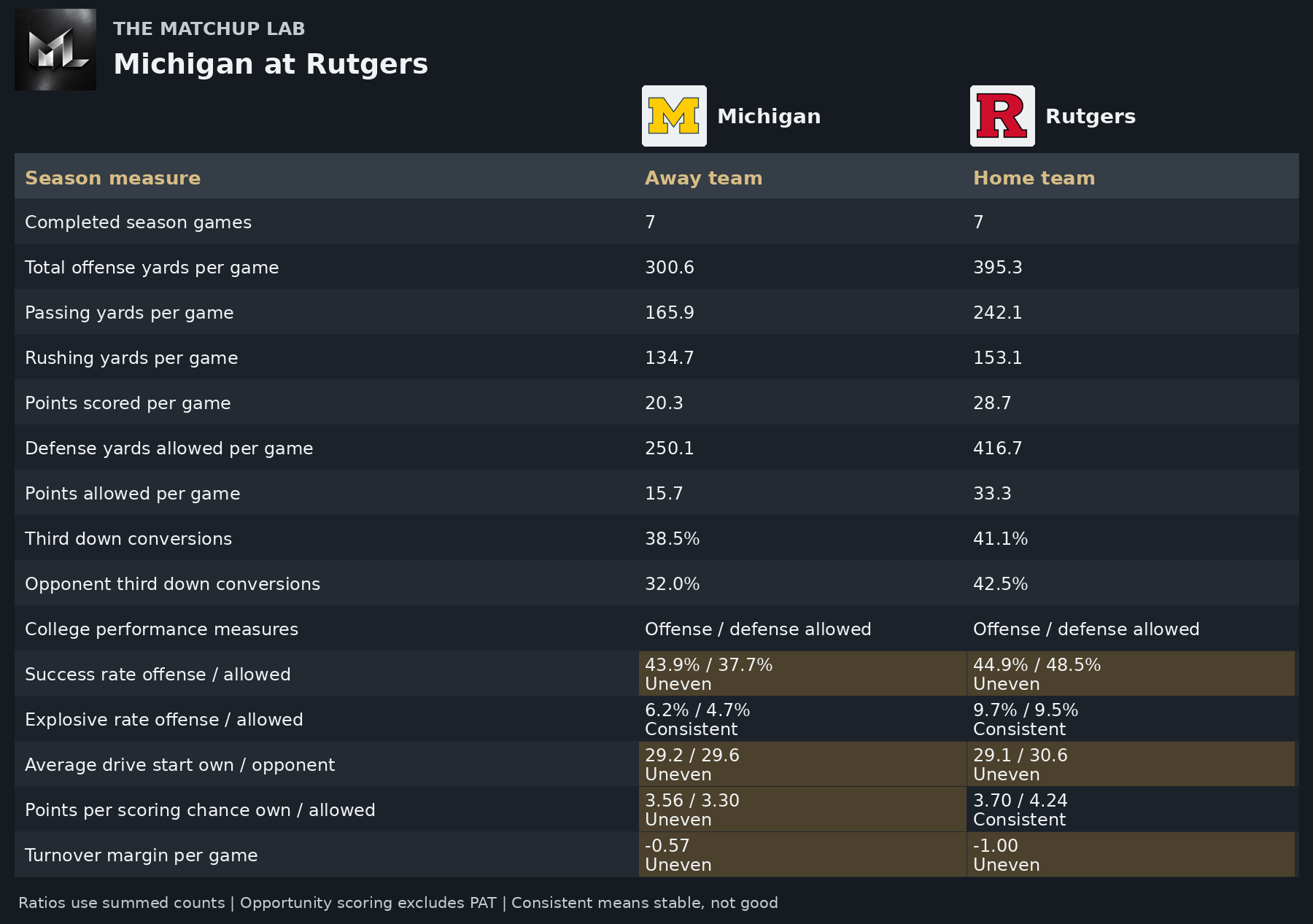
Michigan's defense has supplied a much stronger season than its record suggests, but the offense keeps making that distinction necessary. The Wolverines allow about 250 yards per game and have held opponents below their own offensive rate on ordinary plays. They are still 4-3 because their scoring has repeatedly fallen short of what that resistance requires. Six points against Indiana, with 57 rushing yards and two giveaways, is the latest example. Rutgers offer a different defensive assignment, but Michigan must actually use that opportunity rather than treating an opponent's allowance as points already earned.
The Scarlet Knights have allowed more than 400 yards and 33 points per game. Northwestern just gained 502 against them, ran for 283 and converted nine of thirteen third downs. Michigan's first task is to establish enough early running progress that its passing game does not spend the afternoon rescuing long situations. The Wolverines' season offense has not produced many easy scoring drives. A weak recent Rutgers defensive performance creates an opening for more sustained offense; it does not establish that Michigan have already solved their own limitations.
Rutgers can threaten with a broader passing contribution than Michigan have shown, but their own ball security has been costly. Three giveaways helped turn last week's game into a 42-14 defeat. Michigan also have a negative season turnover margin, so the visitors should not assume their defense will automatically receive extra possessions. If Rutgers can make the Wolverines drive the full field, they can test whether the visitors' improved opportunity turns into actual points. Giving Michigan a short field would remove part of the problem Michigan still need to prove they can solve.
The decisive interaction is Michigan's early-down offense against a Rutgers defense that has struggled to end possessions before they become scoring chances. Michigan need productive ordinary gains and a cleaner finish than their recent sequence of narrow games has supplied. Rutgers need to reduce the repeated openings, then make their own best possessions survive the ball-security test. A defensive win by Michigan would be credible given the season. Another afternoon in which the offense asks that defense to make six points sufficient would be a less convincing use of the matchup.
Auburn at Ole Miss
Sat Oct 31 11:45 AM CDT
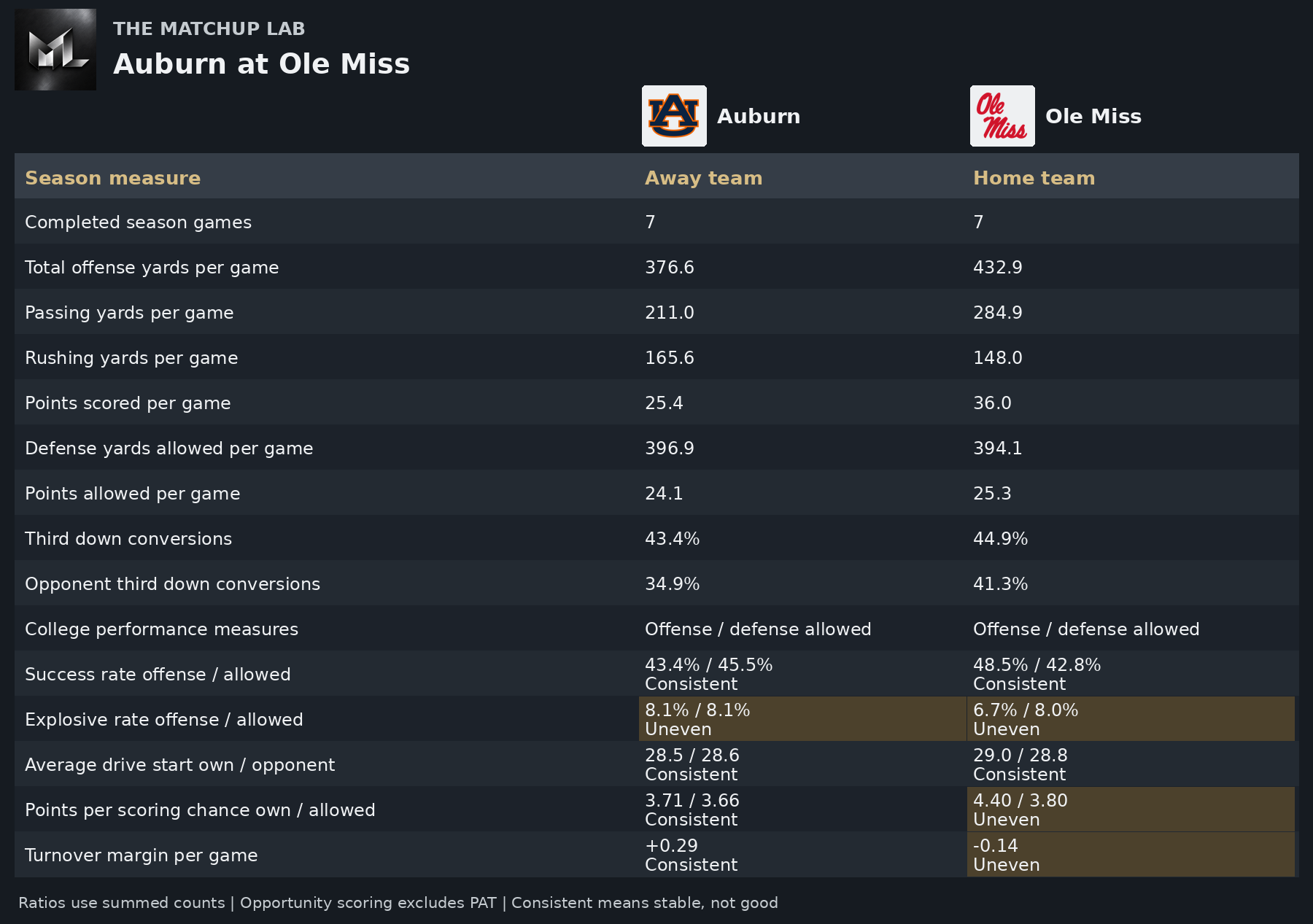
Ole Miss have enough passing production to make Auburn defend beyond the next running play. The Rebels average nearly 285 passing yards and 36 points, but their season has also included defensive concessions that turn productive afternoons into uncomfortable ones. Last week's 34-27 loss to Texas contained three takeaways and three giveaways. Those exchanges did not create a lasting advantage. Ole Miss need the passing game to build drives that remain valuable after the next possession, rather than repeatedly handing the opponent an answer.
Auburn's 38-17 loss to LSU is a direct warning about that defensive requirement. LSU gained 552 yards while neither team turned the ball over. Auburn cannot explain that gap away as a strange collection of extra possessions. The Tigers were beaten through the ordinary work of advancing and defending the ball. Ole Miss have a smaller season rushing contribution than LSU, but their passing volume can still expose a defense that allows early gains and lets the next down remain comfortable. Auburn need to make the Rebels work through more difficult situations before the field opens.
There is also a credible route for Auburn's offense. Ole Miss have allowed almost 400 yards per game and have been less successful at preventing damaging long gains than at creating them. Auburn's own balance between running and passing gives them a way to test that weakness without asking every possession to become a long passing sequence. Their 67 rushing yards against LSU were insufficient. A more useful ground contribution would help protect the ball and give the offense a chance to finish drives on its own terms instead of merely trying to keep pace.
The decisive matchup is Ole Miss's ability to sustain its passing advantage without inviting another turnover exchange, against Auburn's need to keep the game from becoming a succession of short defensive rests. The Rebels should expect their defense to make some of the offense's work stand up. Auburn should expect better ordinary-play resistance than the LSU game supplied, even if the opposition can still move the ball. Both teams have enough evidence to identify their problems. Repeating them and describing the result as a close game would not count as much progress.
Stanford at Louisville
Sat Oct 31 02:15 PM CDT
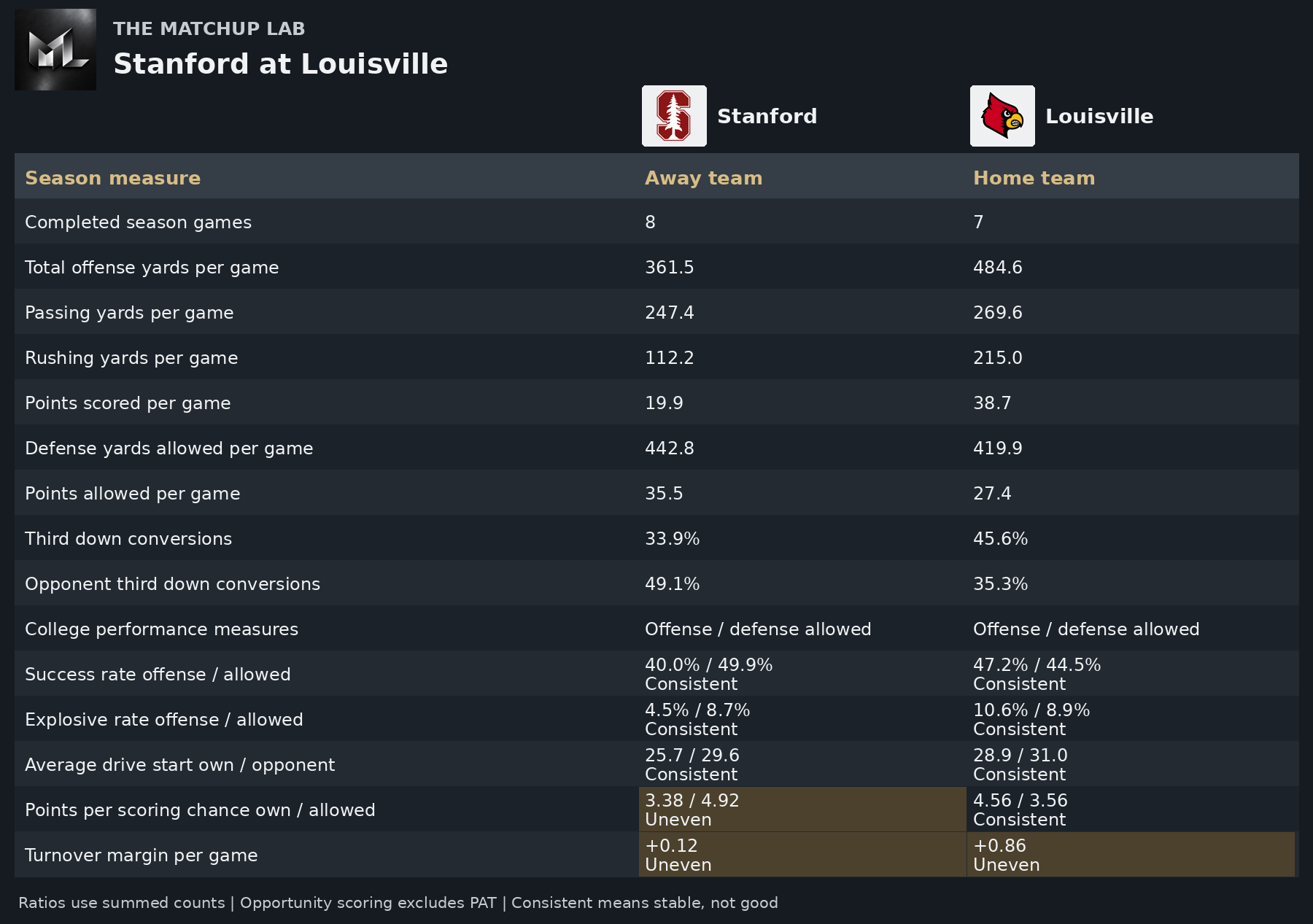
Louisville's offense has produced the kind of season that can survive a difficult possession. The defense has too often required another productive one immediately afterward. The Cardinals average almost 485 yards, with substantial contributions from both running and passing, yet three losses remain part of the assessment. Their most recent win over Syracuse included 462 yards allowed and three takeaways. The ball exchanges helped make 34 points sufficient. Louisville should welcome those plays without deciding that they provide a complete defensive plan for the next opponent.
Stanford's two most recent wins give the Cardinals a current reason to be attentive. The Cardinal followed a 34-7 result with a 31-28 win over NC State, gaining 477 yards in the latter without a turnover by either side. Their full season remains much weaker than that recent stretch. They have allowed almost 443 yards and 35.5 points per game, and opponents have converted nearly half their third downs. Louisville have the running volume and passing production to keep that defense occupied if they avoid making their own drives unnecessarily difficult.
The Cardinals' 215 rushing yards per game are especially relevant. A useful early running contribution can stop Stanford from treating every series as a known passing assignment. Louisville also need to finish once the drive has reached useful territory. Their season return from scoring opportunities is strong, but a favorable offensive matchup can be wasted by a penalty, a turnover or an empty possession that leaves a vulnerable defense back on the field. Their average starting position has not supplied a large shortcut. The offense generally still has real distance to travel.
The decisive question is whether Louisville can pair that offensive balance with more dependable defensive endings. Stanford's latest game showed that they can move and finish without being gifted extra possessions, so simply waiting for a mistake would be a lazy response to current evidence. Louisville need to make the Cardinal's long drives difficult while preserving the advantage their own offense can create. Stanford need to prevent the Cardinals from moving comfortably on both the ground and through the air. The season supports Louisville's offensive case. It also supports asking why that offense has already needed to repair so many afternoons.
Arizona State at BYU
Sat Oct 31 02:30 PM CDT
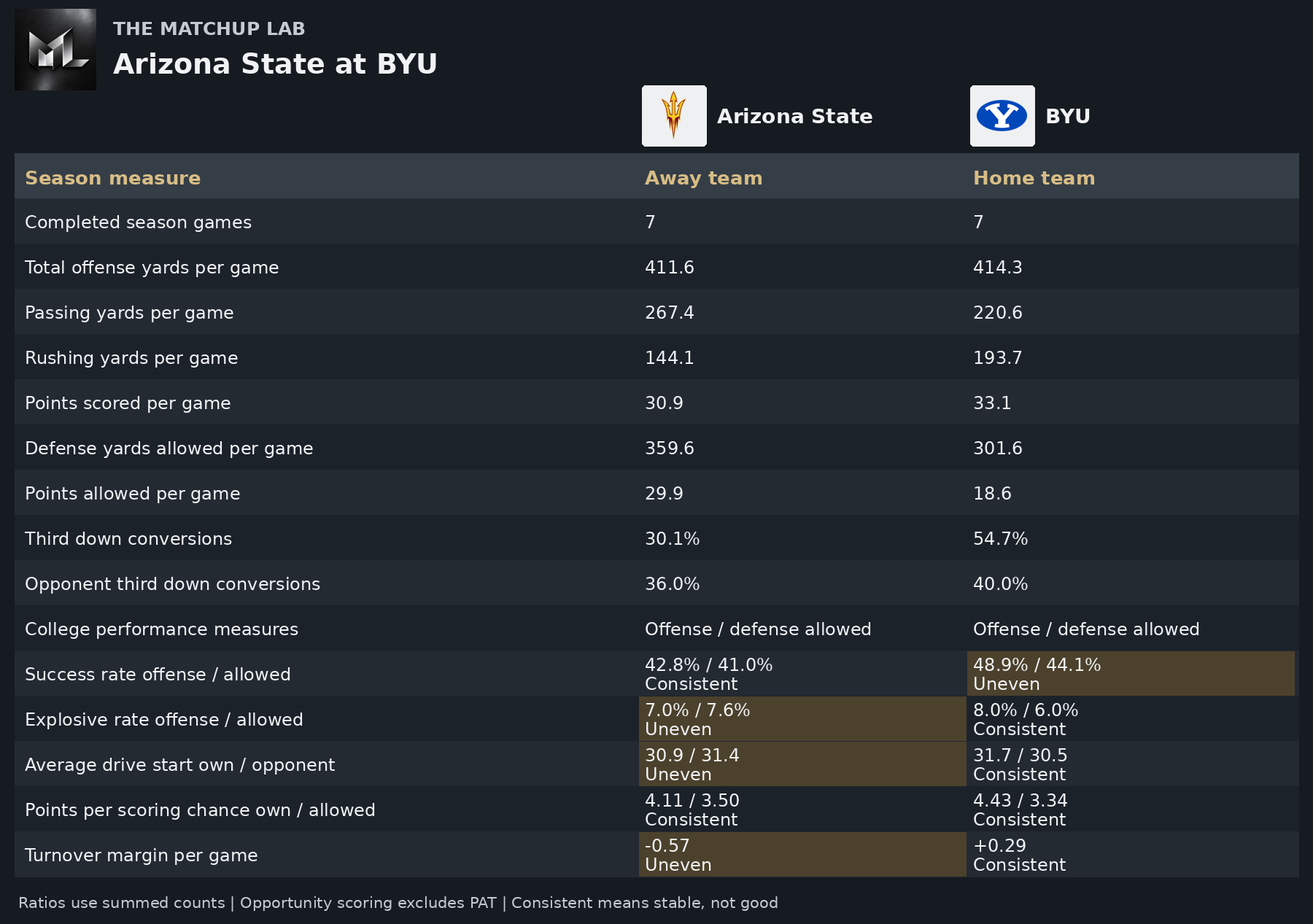
BYU's first defeat put a specific demand on the response. The Cougars scored 31 at UCF but allowed 463 yards, including enough sustained offense for the Knights to convert nine of sixteen third downs. BYU did not create a takeaway and lost the ball once. The season still shows a useful running contribution, good possession extension and a strong scoring return. The correction is to make that offense's productive work survive the opponent's next series. Arizona State arrive with a more controlled recent defensive performance than their wider season has consistently supplied.
The Sun Devils beat Kansas State 28-17 while allowing 278 yards and without a turnover by either team. That result provides a credible example of winning without an unusual ball exchange. It also needs to be placed beside a season containing several heavy defeats. Arizona State have converted only about thirty percent of third downs, leaving them vulnerable when an early play fails. BYU's defense should try to create those longer situations before Arizona State's passing production can make the drive comfortable. Letting the Sun Devils recover from repeated early setbacks would remove a genuine season weakness from the matchup.
BYU's own third-down record is much stronger, but it should not become an excuse to arrive there so often. The Cougars average nearly 194 rushing yards and can use that production to keep their passing options available. Arizona State have allowed fewer total yards than BYU gained in several of their better games, so the home offense must still earn the drive rather than projecting last week's defensive failure forward automatically. BYU need to protect the ball and turn early gains into a finishing chance before a promising series becomes another difficult conversion attempt.
The decisive interaction is Arizona State's ability to create uncomfortable downs against BYU's ability to sustain its balance and finish. The Cougars also need actual defensive stops after their own scores, not merely a better-looking offensive total. Arizona State need another clean possession game and a more reliable route through third down than their season average. BYU's 6-1 record remains valuable evidence of results, while the UCF loss remains useful evidence of what can break. Responding well means correcting that sequence, not simply producing another 31 points and hoping the defense has had a quieter afternoon.
Minnesota at Indiana
Sat Oct 31 02:30 PM CDT
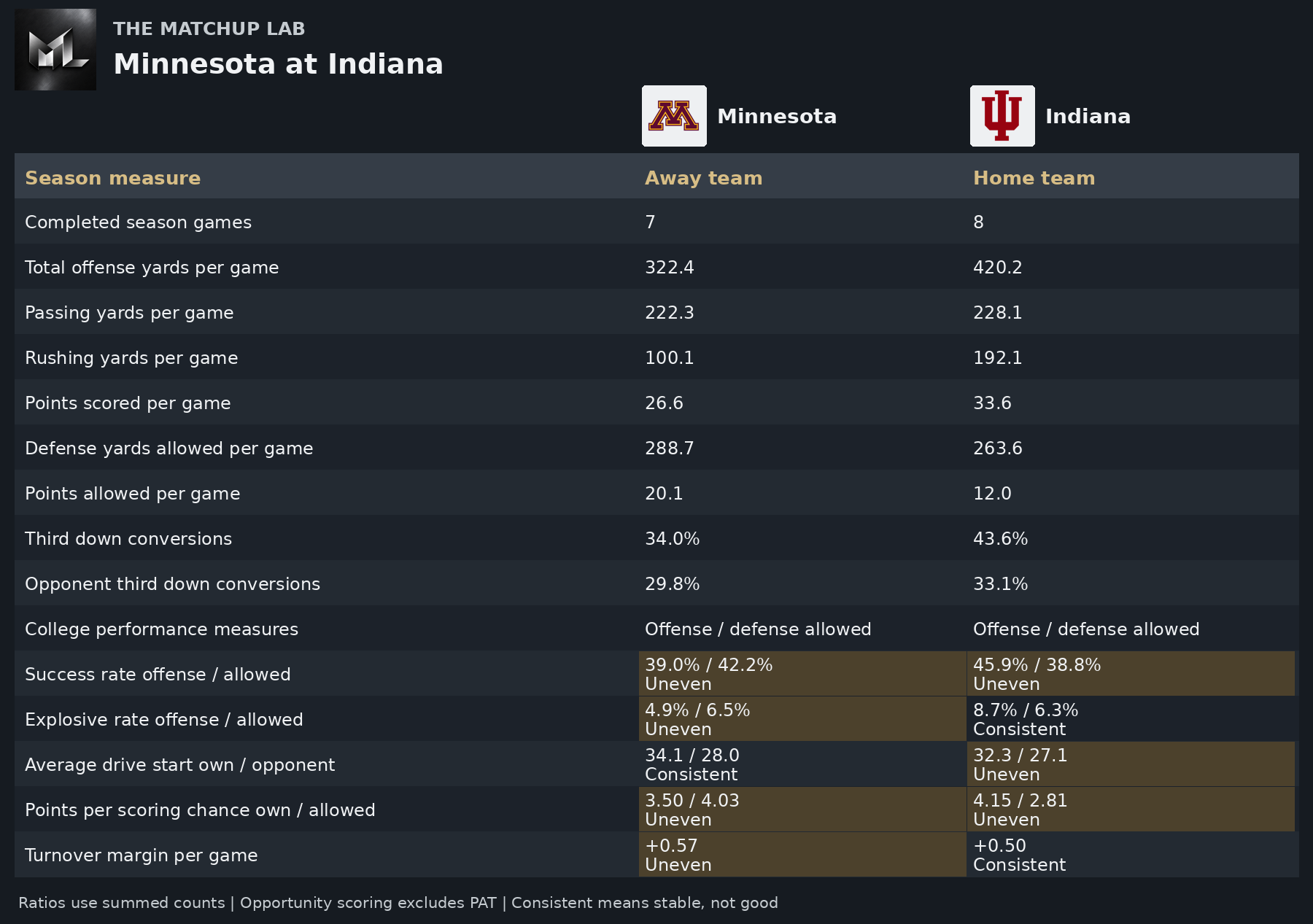
Indiana have won two very different kinds of game this season. Earlier comfortable scoring days built the large season margin; the latest 13-6 win over Michigan required the defense to make a narrow advantage last. That versatility matters, but it does not make the offensive performance beyond criticism. Indiana gained 212 yards and passed for 81. Minnesota have just won with an equally limited offensive total, so the Hoosiers should prepare to earn progress rather than expecting the game to resemble their earlier routs.
The Golden Gophers beat Iowa 13-10 after gaining 209 yards and converting two of fourteen third downs. Four takeaways were a substantial part of how that became a win. Their season offense has generally been less successful at sustaining ordinary plays than the defenses it has faced, while their defense has been more effective at ending third downs. Indiana need enough early running and passing progress to stop those defensive endings from becoming the defining feature of the afternoon. A useful first down is more valuable here than an impatient attempt to manufacture a quick score.
Minnesota's average starting position has been favorable, but Indiana should not treat that entire advantage as a measure of defensive stops. Returns, turnovers, penalties and the preceding possession all affect where an offense begins. The practical lesson is simpler. Indiana should not voluntarily make the field shorter through ball-security mistakes, especially against an opponent whose most recent offense needed considerable help. Minnesota, in turn, need to make their best possessions useful even if the supply of four takeaways does not reappear. Another two-for-fourteen day would put a large burden on that assumption.
The decisive contest is Indiana's ability to make its broader season offense reappear against Minnesota's pressure on third down. The Hoosiers have a credible defensive foundation and have allowed only twelve points per game, but they should demand more offensive support than last week provided. Minnesota need to produce a sustainable route into scoring range and avoid asking the defense to repeat an exceptional possession windfall. Indiana can win a hard, low-scoring game. Showing that they can create an easier offensive assignment before it becomes one would strengthen the season assessment considerably.
Northwestern at Oregon
Sat Oct 31 02:30 PM CDT
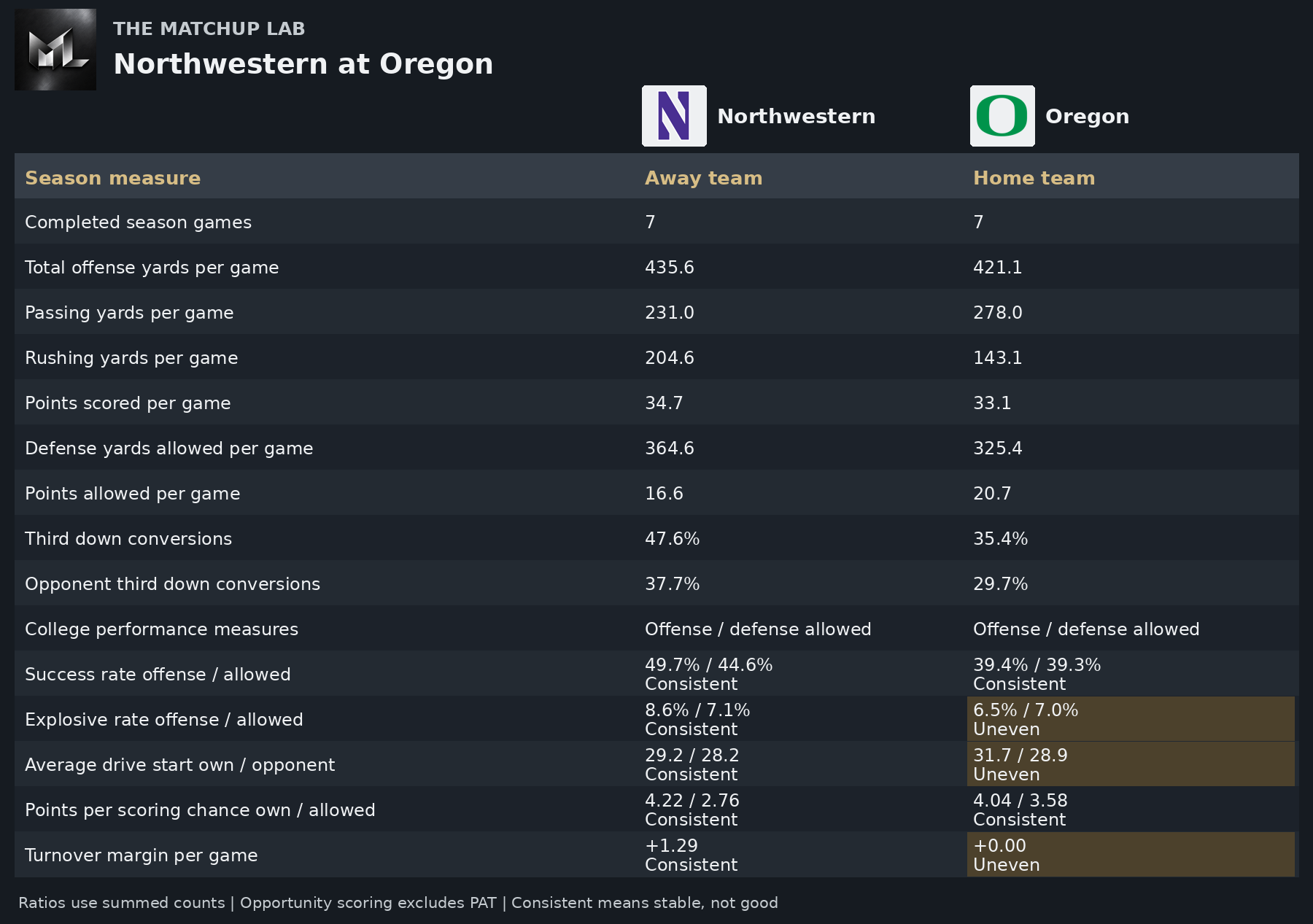
Northwestern's 6-1 season has been built through more than a favorable final score. The Wildcats have run for more than 200 yards per game, kept drives alive and produced a strong difference between what they earn and allow once possessions reach scoring range. Their 42-14 win over Rutgers supplied a clear recent example, with 502 yards, 283 on the ground and nine successful third downs in thirteen attempts. Oregon offer a more demanding defensive test. Northwestern need the same useful progression through a drive without assuming that Rutgers's resistance will travel west with them.
The Ducks' latest loss showed why total yardage alone cannot settle the assessment. Oregon gained 426 yards against Illinois and allowed 314, then lost 21-10. Four successful third downs in fifteen attempts left too many series unfinished. Across the season, Oregon's offense has been much less separated from opposing defenses on ordinary plays than its passing total might suggest. Northwestern should make those interruptions matter. Allowing one damaging gain after several useful stops would let Oregon escape precisely the longer sequence in which the Ducks have been less dependable.
Northwestern also need to scrutinize the help they have received from turnovers. Their season margin is strongly positive, and three takeaways helped last week's decisive result. That does not make the rushing and finishing advantages imaginary. It does mean the Wildcats should demonstrate that they can keep winning possessions when an opponent protects the ball. Oregon have an even season turnover margin and can make the visitors prove that longer route. The Ducks need to turn their own yardage into points rather than relying on another statistical argument about how much offense was available.
The decisive matchup is Northwestern's running balance and possession extension against Oregon's ability to force an empty series without immediately conceding a long gain. Northwestern need to protect the ball and make their scoring chances count. Oregon need better early-down results to reduce the number of long conversions their offense must attempt, then a more useful return when they reach dangerous territory. The Wildcats' record gives them the higher results position within our selected population. A road performance that works without another large takeaway advantage would provide a stronger explanation of why it should continue.
Florida International at Liberty
Sat Oct 31 02:30 PM CDT
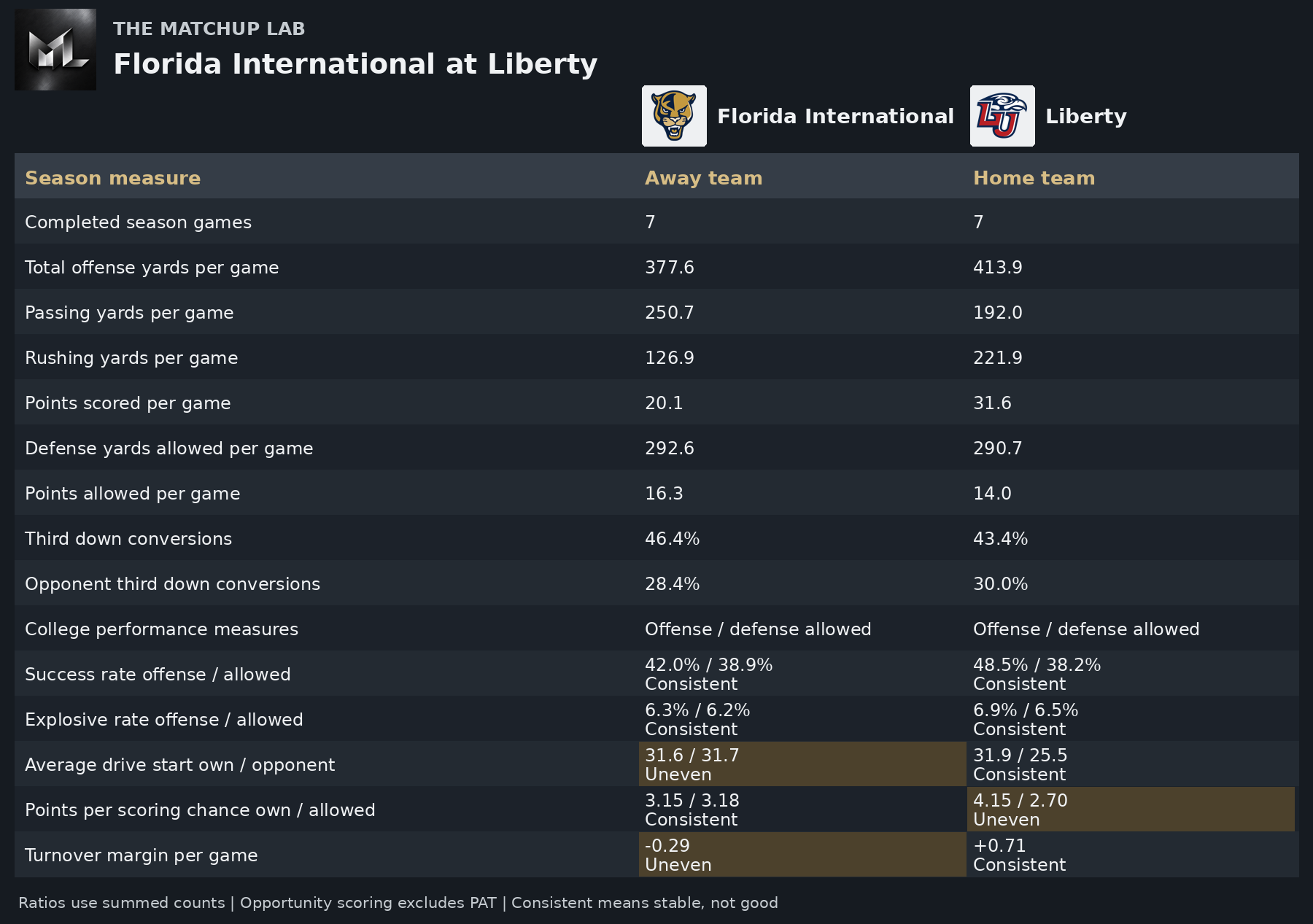
Liberty have made a strong season out of reducing what their opponents can do. The Flames allow fourteen points and about 291 yards per game, and their own offense has enough running production to keep a successful defensive series from being immediately wasted. The latest 34-6 win over Kennesaw State fits that wider pattern. Liberty ran for 215 yards, avoided a giveaway and took the ball away twice. Florida International's defense makes this a useful test of whether the Flames can keep that control when easy scoring possessions are less available.
FIU's season contains considerably better prevention than its results alone might suggest. The Panthers allow about 293 yards per game and have regularly stopped opponents on third down. Their difficulty has been getting enough points from their own possessions. They lost 26-23 to Middle Tennessee despite having another opportunity to play a competitive game. Liberty should not infer that a low opposing scoring average means no work is required. They need to make FIU's possessions difficult before the Panthers reach a point where one good finish changes the shape of the afternoon.
The Flames' ground game is the clearest practical tool for controlling their own side of that exchange. More than 220 rushing yards per game has allowed them to keep passing support inside a manageable task. Against a defense with a strong third-down record, the priority is to arrive there needing an ordinary gain. Liberty converted only three of ten against Kennesaw State even in a comfortable win. That is a useful detail to carry forward. A large final margin should not conceal the possessions that still ended before they needed to.
The decisive question is whether Liberty can sustain enough early progress to reach scoring territory without needing FIU to supply extra possessions. Their favorable starting-position and turnover figures are helpful season evidence, but neither provides a guarantee of the next short field. FIU need to make a good defensive afternoon count by finishing their own best drives and protecting the ball. Liberty need to keep the Panthers' scoring requirement difficult while giving their own defense enough support. A patient, balanced performance would say more about the Flames than simply expecting their latest comfortable result to repeat itself.
Florida vs Georgia
Sat Oct 31 02:30 PM CDT
Neutral site at Mercedes-Benz Stadium, Atlanta, Georgia. Away and home columns show administrative designations.
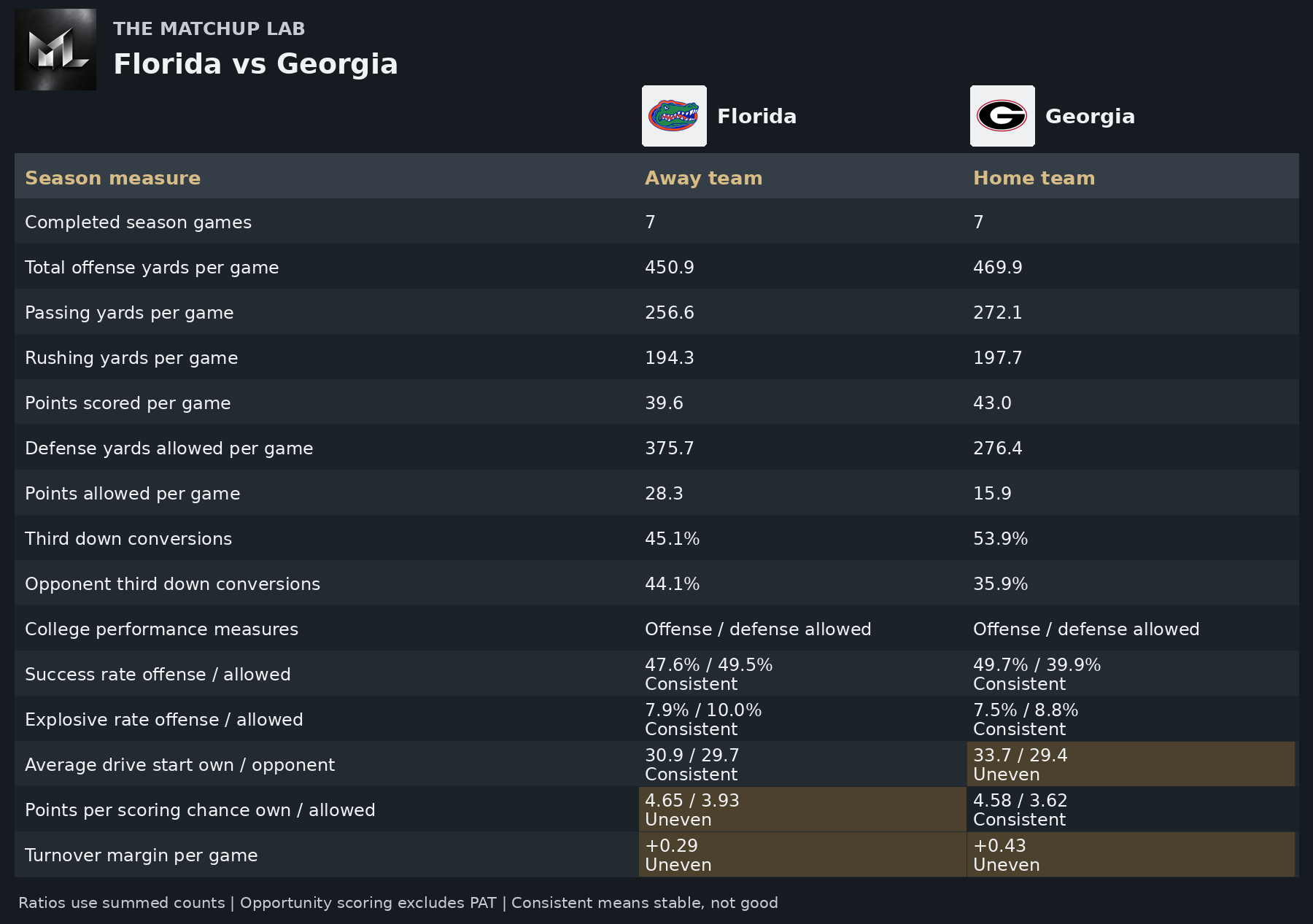
Georgia's season case remains much stronger than the final result of its last game. That is also why the Bulldogs should be dissatisfied with the way they lost it. Georgia gained 440 yards against Auburn and allowed 366, then lost 27-24 after giving the ball away three times without a takeaway. Their offense has been productive through both running and passing, and their defense has regularly limited the opponent's ordinary progress. Florida give them an immediate test of whether those advantages can survive a cleaner possession game.
The Gators' most recent win took a different route. Florida beat Texas 27-24 with 313 yards, no giveaway and one takeaway. That control mattered more than matching the largest offensive totals from earlier in the season. Florida's full defensive record has been much less convincing. Opponents have succeeded on ordinary plays at a higher rate than the Gators have, and the defense has allowed a substantial share of damaging long gains. Georgia have enough offensive balance to keep testing that resistance if they do not end their own possessions with another avoidable loss of the ball.
Florida's running contribution means Georgia cannot treat this as a simple contest between passing totals. The Gators average nearly 194 rushing yards and can keep their best passing opportunities alive by preventing early downs from becoming wasted plays. Georgia's defense needs to make its low season yardage allowance useful through actual drive endings. Florida, meanwhile, must make the Bulldogs work through more uncomfortable downs. Letting a balanced offense choose freely between a productive run and a comfortable pass would be an expensive way to discover whether the defense has improved.
The decisive interaction is Georgia's offensive execution against Florida's need to prevent repeated easy progress, with possession security running through both sides of the game. Georgia need to stop giving away the benefits of a productive afternoon. Florida need a more durable defensive answer than hoping the Bulldogs repeat their three-turnover loss. Both teams come from recent games that demonstrate how a small margin can depend on the use of possessions rather than a headline yardage total. The Bulldogs' 6-1 record is deserved evidence of results. Correcting the Auburn failure would make the next result more secure than merely pointing back to that record.
Utah at Cincinnati
Sat Oct 31 02:45 PM CDT
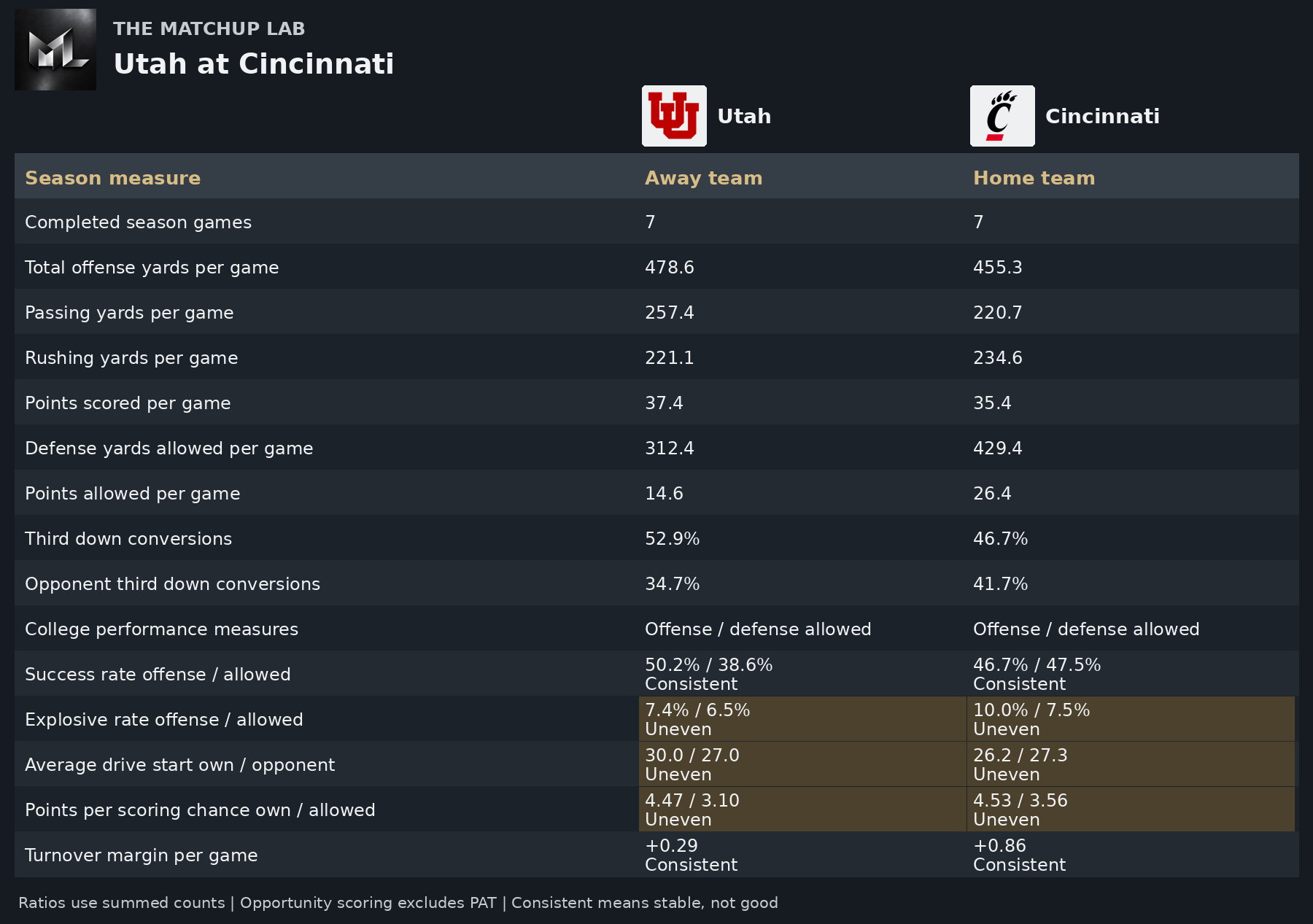
Utah's unbeaten season has become more demanding over the last three games. The Utes have won 41-24, 27-24 and 21-13, preserving their record while the scoring margin narrowed. That does not invalidate the early performances or their strong season defense. It does make the details of the Houston win useful. Utah gained 430 yards, ran for 226 and converted half its third downs, but two giveaways helped keep the game closer than the offensive production might suggest. Cincinnati have enough running strength to punish another inefficient use of possessions.
The Bearcats average nearly 235 rushing yards and just ran for 255 in a 37-24 win over Texas Tech. They did not need a dominant passing total to make that offense effective. Utah's first defensive task is to keep the ground game from creating comfortable follow-up downs. Cincinnati have also conceded more than 429 yards per game and have allowed ordinary-play success at a higher rate than they produce themselves. Utah should be able to find opportunities for sustained offense, but only if the visitors preserve the possession long enough to exploit them.
The Utes' own balance is a strong part of that case. Their season rushing contribution is substantial, and their third-down offense has regularly extended drives. Cincinnati should try to make Utah's passing decisions happen in less favorable situations rather than letting both parts of the offense remain available. The Bearcats forced three turnovers against Tech while losing the ball twice themselves. That exchange helped the final result, but it is not a reliable substitute for better resistance on ordinary plays. Utah should not cooperate by treating its early gains as permission to become careless.
The decisive matchup is Cincinnati's ability to keep running productively against Utah's ability to force the Bearcats away from that preferred rhythm. Utah need clean possessions and a better conversion of their offensive work into separation. Cincinnati need actual defensive endings to accompany the rushing production, rather than a succession of long answers after every Utah score. The unbeaten record puts the Utes ahead of all one-loss teams in our overall order. Protecting that position requires the same patient football that earned it, with fewer possessions handed back before the work is finished.
Virginia at Wake Forest
Sat Oct 31 02:45 PM CDT
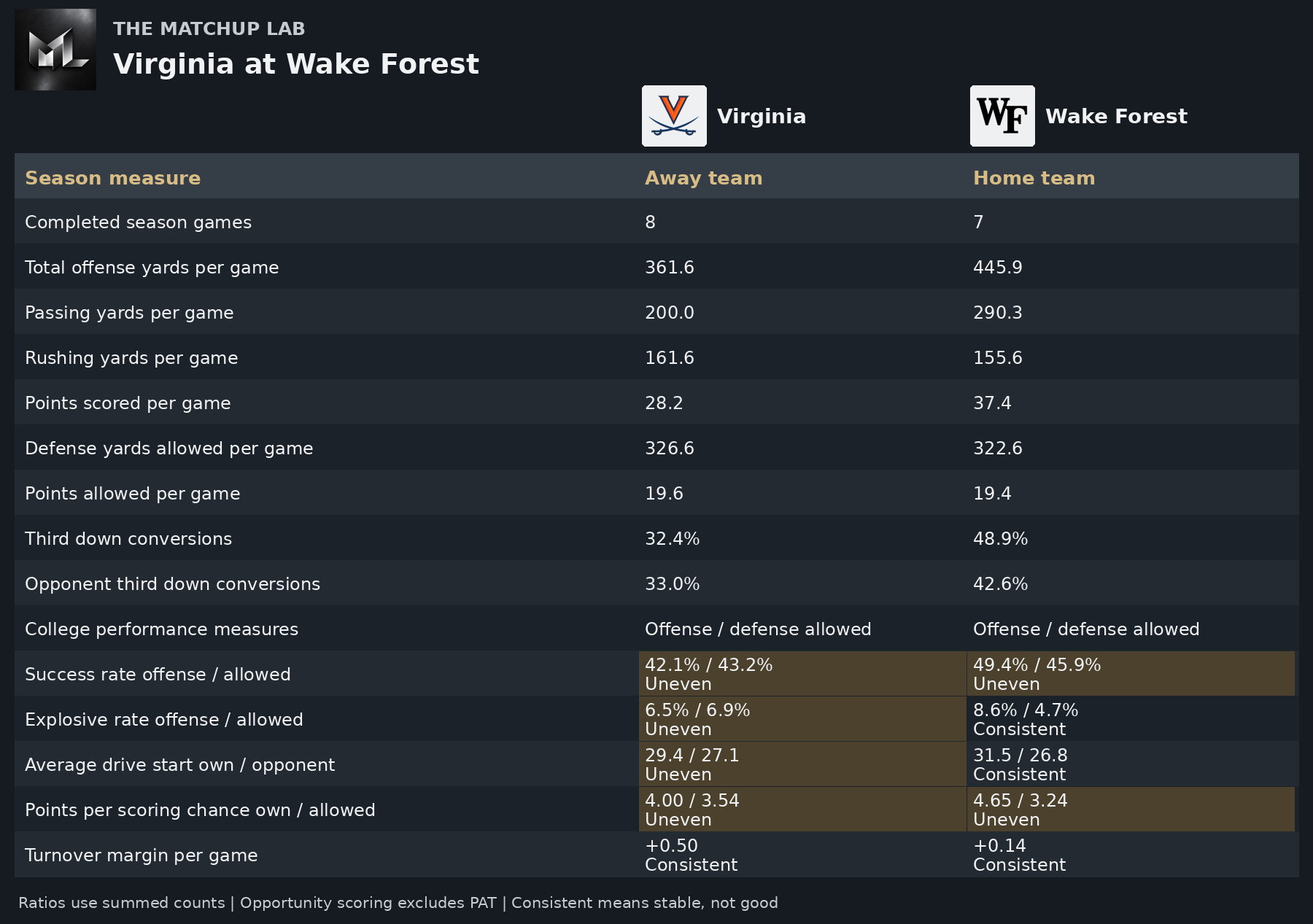
Wake Forest return from a bye with a 6-1 record and a season offense that has regularly made defensive mistakes expensive. The Demon Deacons average more than 290 passing yards and have paired that with a useful rushing contribution and a strong return from drives that reach scoring territory. Their last game, a 41-7 win over California, included 509 yards and no turnover by either team. That is a useful example of producing separation through the offense itself. Virginia's more restrained recent games offer a different kind of test.
The Cavaliers have lost their last two 23-13 and 19-16, with the offense unable to make enough of competitive defensive efforts. Against Duke, Virginia gained slightly more yardage, ran for 195 and still lost after two giveaways. Across the season, their third-down offense has struggled to extend drives. Wake Forest need to turn that weakness into actual stops before Virginia can make its running contribution establish control. A defense that waits until the opponent has reached scoring range has left itself a much smaller margin for error.
There is a particular reason to scrutinize the home defense despite the comfortable California result. Wake Forest have allowed opponents to convert more than forty percent of third downs across the season. The defense's suppression of damaging long plays has helped keep that from turning into a larger scoring problem, but repeatedly allowing a drive to continue still creates another opportunity for a mistake. Virginia should try to make Wake prove it can end a series without relying on the next failed attacking play. The Cavaliers must also protect the ball well enough to keep that test meaningful.
The decisive contest is Wake Forest's passing rhythm against Virginia's ability to make the field feel longer and the finishing chance less comfortable. The Demon Deacons need another balanced, clean offensive performance while improving the defensive endings that the season still calls into question. Virginia need enough early progress to avoid another long sequence of difficult third downs, then a better return from their best possessions. Wake's record and season scoring support a strong assessment. The useful next step is to repeat the substance of the California win against the opponent actually in front of them.
New Mexico at San José State
Sat Oct 31 03:00 PM CDT
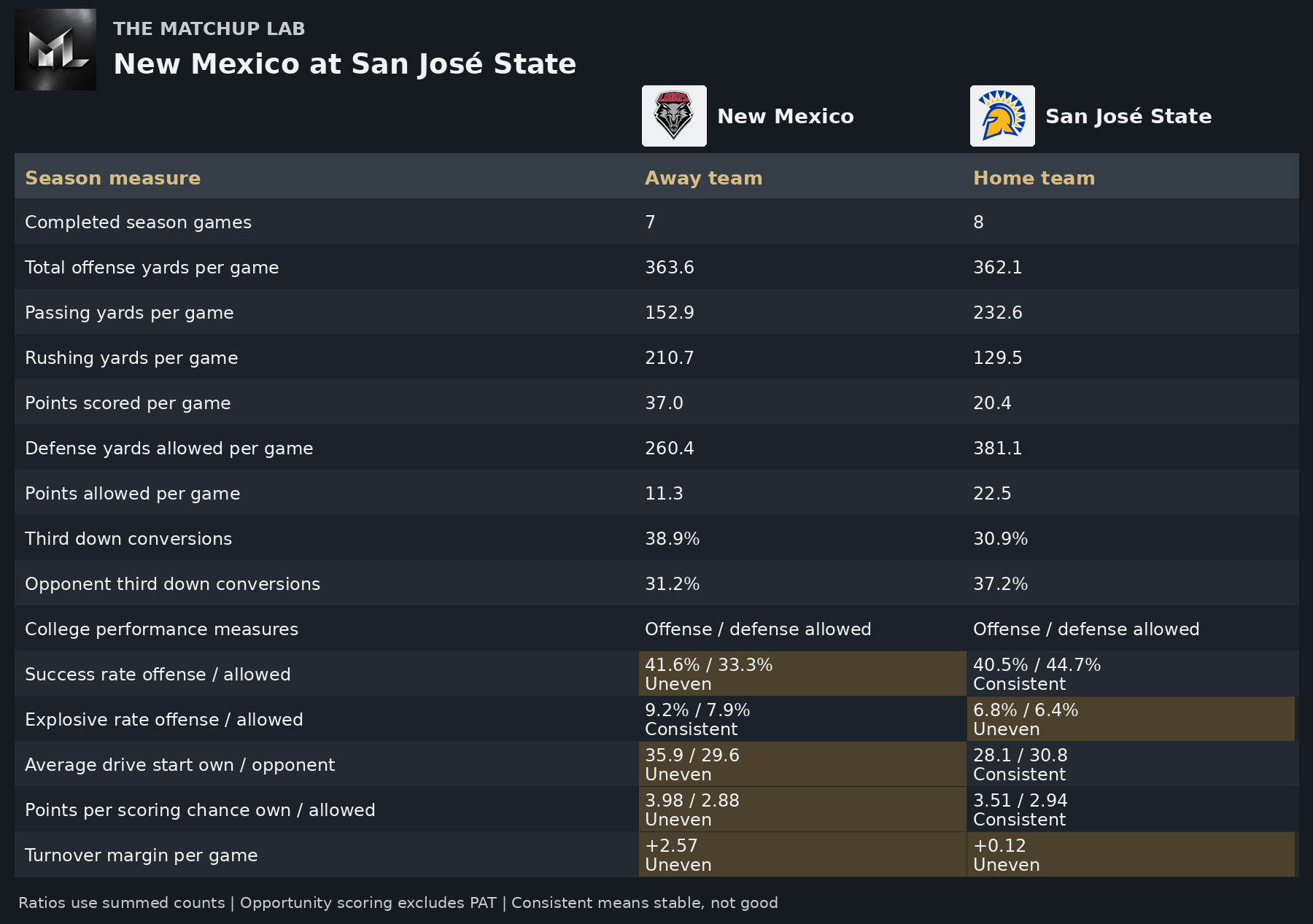
New Mexico's 6-1 record has a clear defensive foundation. The Lobos allow about 260 yards and eleven points per game, and opponents have found productive ordinary plays unusually difficult. Their own running game supplies most of the offense's yardage, giving them a practical way to make that resistance count. Last week's 21-16 win over North Dakota State was much narrower than several earlier results. New Mexico gained 279 yards, passed for 92 and needed its defensive work to make three touchdowns sufficient. San José State should expect a patient opponent, not necessarily an effortless one.
The Spartans' latest offensive performance gives the Lobos a direct target. San José State gained 204 yards against Nevada and converted one of fourteen third downs in a 28-13 loss. New Mexico should try to force the Spartans back into that uncomfortable passing burden by limiting early running progress. The Spartans have averaged more passing production than the Lobos, but that difference is not the same as a demonstrated ability to sustain possessions against this defense. They need useful early gains and clean execution before asking for another long conversion.
New Mexico also need a candid assessment of their own turnover return. A season margin above two and a half per game has provided a very large supply of extra possessions. The defense's low yardage allowance is independent evidence of quality, but the offense should not assume that another windfall will arrive. San José State did not give the ball away against Nevada and still lost. If the Spartans preserve that control, New Mexico must show that its rushing production can support enough full-length drives to create a workable scoring margin.
The decisive matchup is the Lobos' ground attack against the Spartans' ability to make New Mexico travel the field without help. New Mexico need to protect their own possessions and avoid allowing limited passing volume to become an obvious long-down problem. San José State need to stop another sequence of empty offensive series from exhausting the value of their better defensive possessions. The Lobos have earned their one-loss position in the overall order. A win built on clean, sustained offense would make that position less dependent on the unusually favorable ball exchanges that have helped them reach it.
Nevada at UCLA
Sat Oct 31 03:15 PM CDT
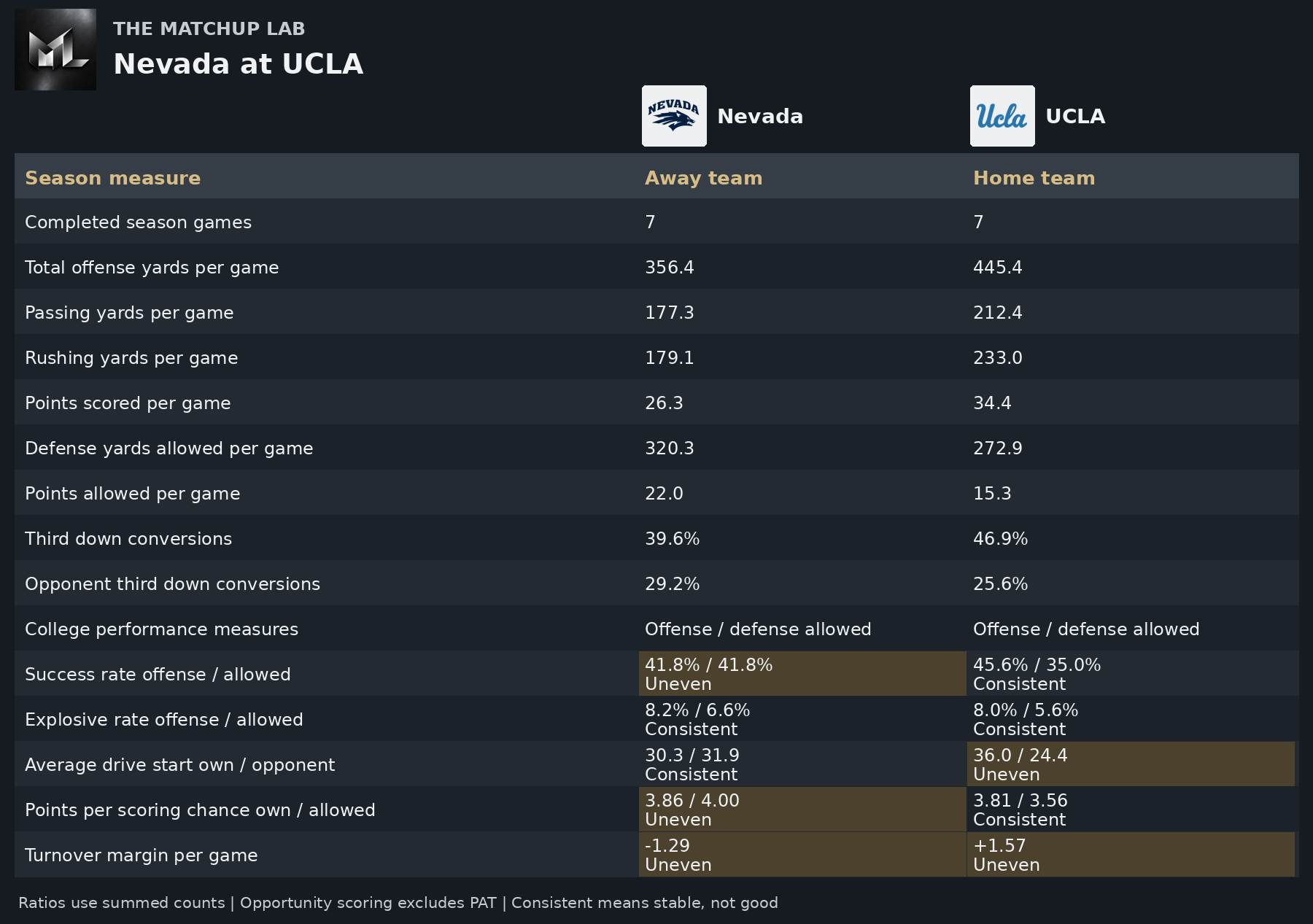
UCLA now lead the overall order within our calculated top 25. The Bruins are unbeaten, and their unchanged statistical calculation places them ahead of the other unbeaten teams at this cutoff. That distinction should be explicit. The overall position rewards the result record first; the statistical assessment still supplies a separate view of how the season has worked. UCLA's strong running game, low ordinary-play allowance and excellent defensive third-down record provide substantial support beyond the zero in the loss column.
The latest 28-10 win over Michigan State contained a convincing territorial performance. UCLA gained 443 yards, ran for 245 and allowed only 156. Two giveaways did not overturn those advantages, partly because the Bruins took the ball away three times themselves. That is a successful result with an obvious detail to improve. Nevada have just won 28-13 while limiting San José State to 204 yards and one successful third down in fourteen attempts. The Wolf Pack can make an offense work for a drive, even though their season has been less consistently productive.
The most important interaction is UCLA's early running progress against Nevada's ability to create a longer follow-up down. UCLA's offense has averaged 233 rushing yards, but their season finishing return is less dramatically separated from the opponents' return than some other parts of the table. The Bruins should expect to turn a favorable field into more than a series of partial advances. Their very large starting-position advantage is useful evidence about the possession exchange as a whole. It includes returns and turnovers as well as defensive stops, so it should not all be credited to one unit.
Nevada need to protect the ball better than their full-season turnover margin suggests and make UCLA drive without a shortcut. UCLA need to sustain the defensive standard while finishing their own possessions more cleanly. The decisive question is whether Nevada can keep the Bruins from combining useful early runs with another short field. If UCLA must repeatedly travel farther, their offensive execution still has to finish the journey. An unbeaten record earns the higher overall position under the saved rule. Keeping it requires attending to the two giveaways that a comfortable recent win made easier to overlook.
South Carolina at Oklahoma
Sat Oct 31 03:15 PM CDT
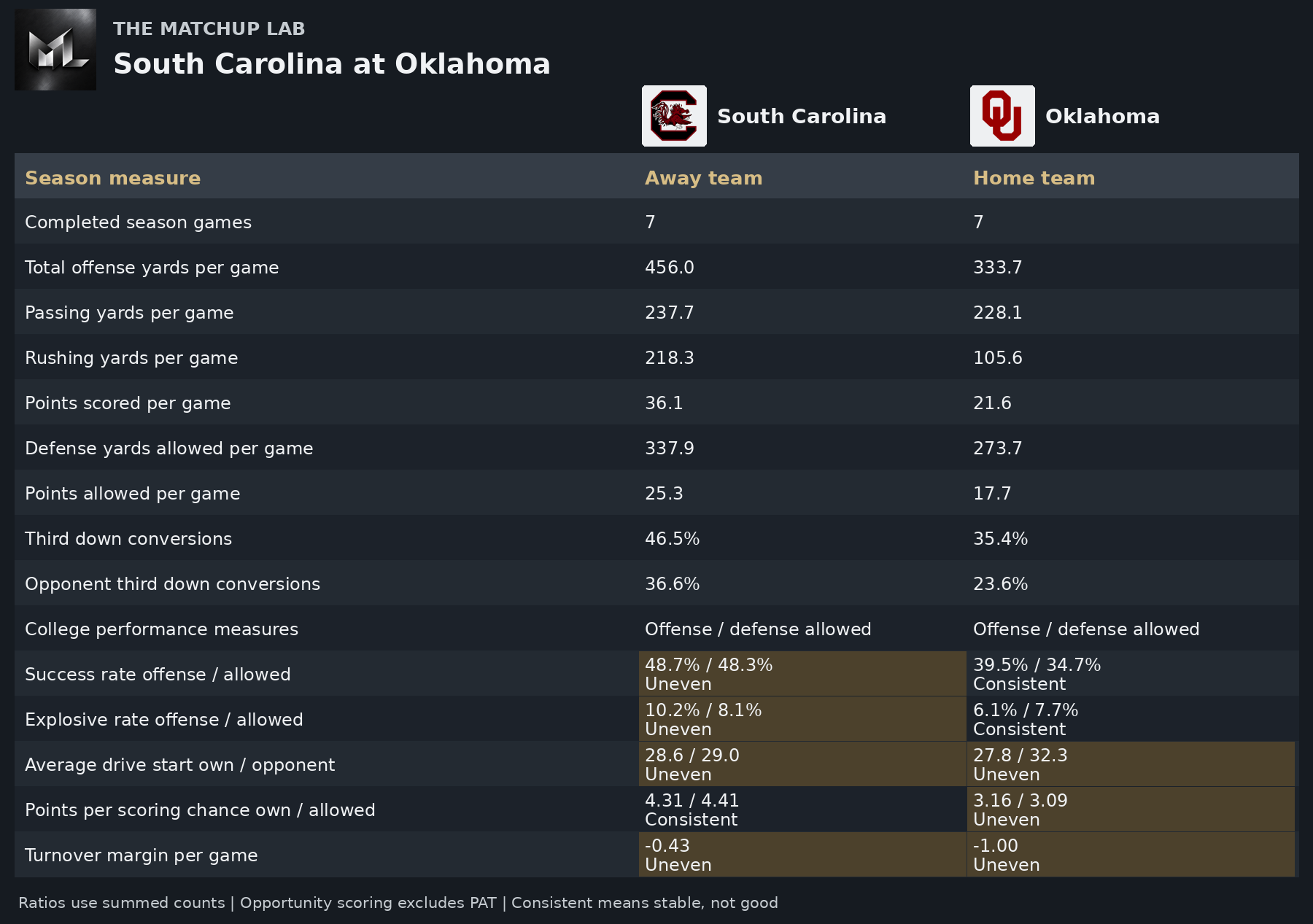
Oklahoma's defense has earned a better offensive partnership than it has often received. The Sooners allow about 274 yards and fewer than eighteen points per game, with a particularly strong record of stopping third downs. Their offense has averaged fewer than 334 yards and only 21.6 points. The latest 23-15 win over Mississippi State was a meaningful improvement in production, including 467 yards and a more useful running contribution. South Carolina now test whether that progress can survive an opponent whose offense has been much more balanced across the season.
The Gamecocks average more than 218 rushing yards and nearly 238 passing yards, leaving Oklahoma with more to defend than a single preferred route. South Carolina just beat Tennessee 27-24, although their 344 yards were below their wider season average. Oklahoma should try to make the Gamecocks' next play more predictable by preventing easy early running gains. The Sooners have repeatedly shown that they can finish a defensive series once the opponent reaches third down. The earlier work still matters if South Carolina can keep that down short or avoid it altogether.
Oklahoma's offense needs to make its own defensive stops count. The season's average field position has been unfavorable, with the Sooners starting deeper than their opponents. That is a description of the full possession exchange, not a claim that one unit caused it. Their negative turnover margin has made the problem harder. South Carolina's defense also allows a high return once opponents reach a qualifying scoring opportunity, creating a real opening for Oklahoma. The Sooners must first travel far enough to use it, rather than relying on one larger yardage total to declare that task solved.
The decisive contest is Oklahoma's ability to sustain its improved ground support against South Carolina's capacity to score through both parts of the offense. The Sooners need another clean, useful offensive afternoon and must avoid giving a productive opponent a shorter field. South Carolina need better resistance to completed drives, particularly if Oklahoma's defense limits the number of comfortable possessions available. Oklahoma's three losses keep it below the two-loss teams in the overall order, even with a stronger separate statistical position than its record alone implies. Turning that statistical case into another result is the assignment.
Oklahoma State at Iowa State
Sat Oct 31 06:00 PM CDT
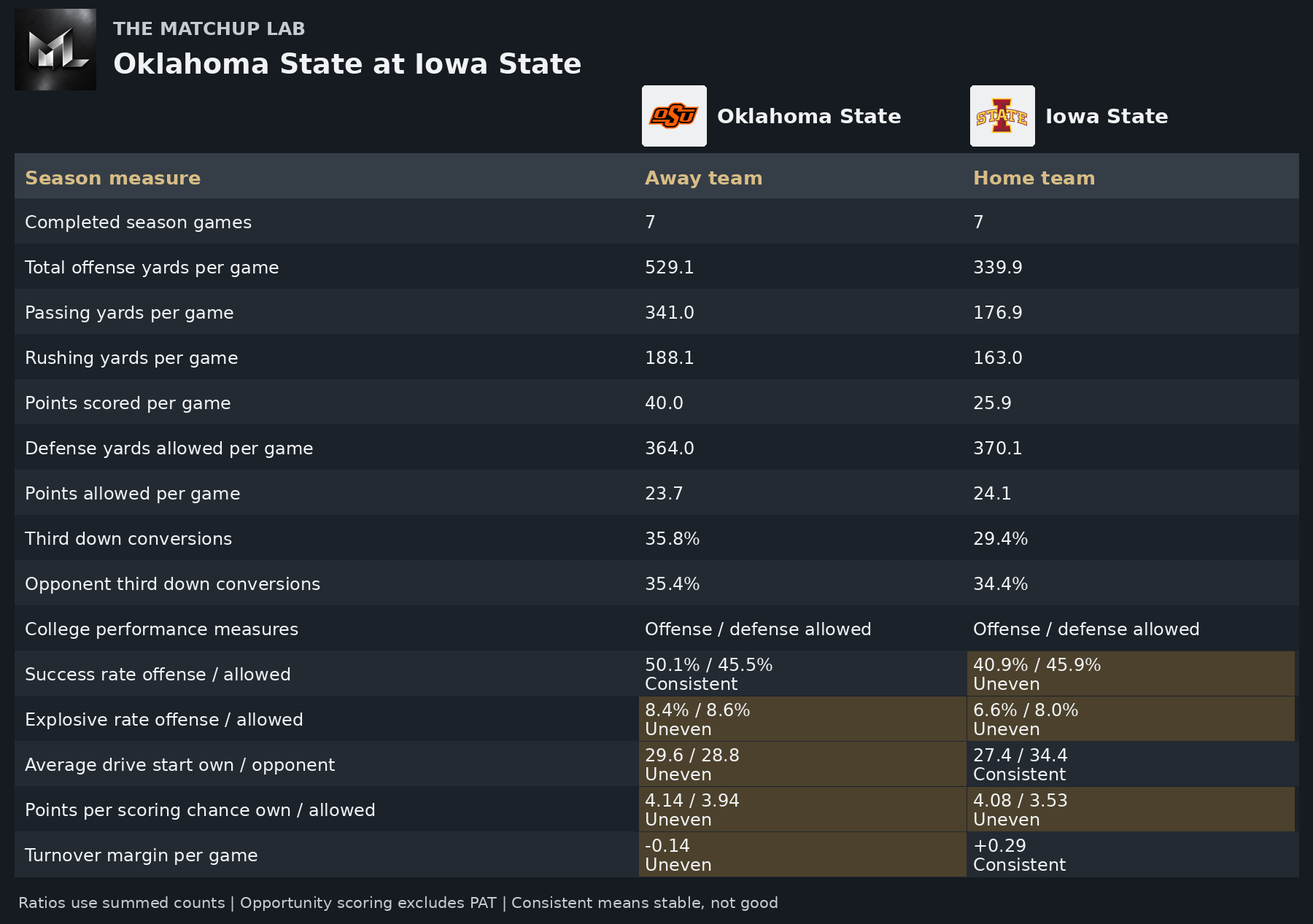
Oklahoma State's offense can make a game look easier than it has actually been. The Cowboys average more than 529 yards and 341 through the air, and they just produced 598 yards in a 57-24 win over Colorado. That was a substantial demonstration of attacking capacity. It also came with three takeaways and no giveaway, a much more favorable exchange than their slightly negative season turnover margin. Iowa State need to make the visitors earn their possessions rather than supplying the conditions for another rapid separation.
The Cyclones' latest loss left very little room for an optimistic reading of the offense. Iowa State gained 221 yards, ran for 52 and converted three of fourteen third downs against Arizona in a 39-3 defeat. Their season offense has also been less effective at ordinary progress than the defenses it has faced. Oklahoma State should try to make that weakness decide more series. Allowing an isolated long gain to undo several useful stops would give Iowa State a route around the sustained work that has been its larger problem.
For the Cowboys, the question is how well a large passing total survives an uncomfortable down. Their season third-down conversion rate is below 36 percent, and the return from scoring opportunities is only modestly better than the return they allow. A productive attack can still leave points unused. Iowa State have generally forced opponents to start farther from the goal than their own offense, so field position could make Oklahoma State travel through more of those situations. The Cowboys need useful running support and possession security, not merely the expectation of another 400-yard passing day.
The decisive interaction is Oklahoma State's ability to turn passing production into complete, repeatable drives against Iowa State's effort to lengthen the field and interrupt the next down. The Cyclones need to create enough early offensive progress to stop a defensive stand from being followed by another immediate punt. Oklahoma State need to make their defense's better possessions stand up without relying on three donated chances. The Colorado performance deserves credit because the offense did substantial work itself. Repeating that work under a less generous possession exchange would provide a stronger test of how much the season has improved.
Miami at North Carolina
Sat Oct 31 06:30 PM CDT
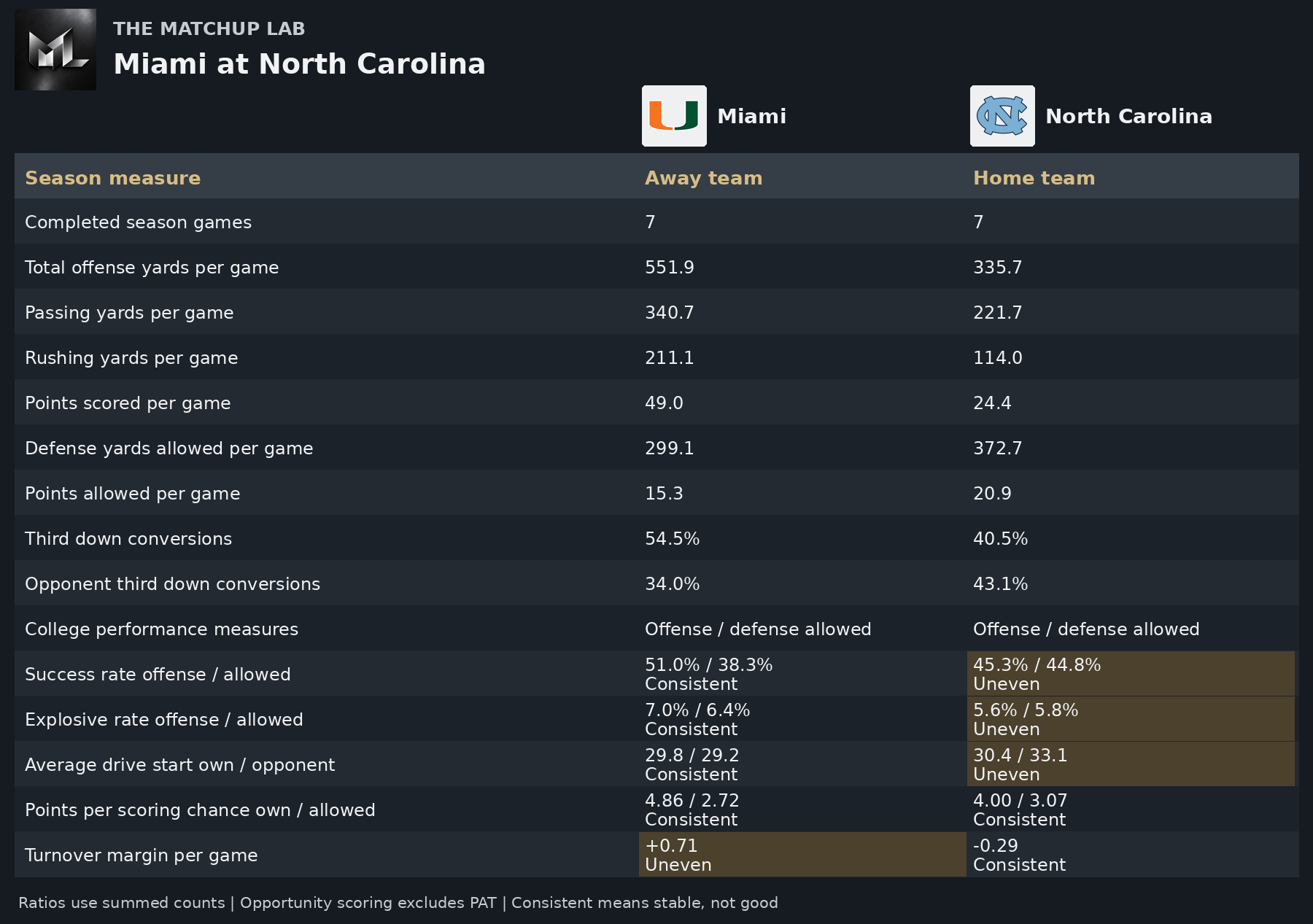
Miami have scored at least 33 points in every game and remain unbeaten. The Hurricanes' offense has produced more than 550 yards per game, with enough running support that the passing game has not carried the season alone. Their latest 52-23 win over Pittsburgh included 387 passing yards, ten successful third downs in fifteen attempts and no giveaway. Those are strong details to bring into a road assignment. North Carolina's narrower recent games make it useful to ask how Miami will respond if the opponent keeps the finishing chances less comfortable.
The Tar Heels lost 31-30 to Syracuse without a turnover by either team. That result cannot be explained as a simple ball-security accident. North Carolina allowed 455 yards and eight successful third downs in nineteen attempts, while their offense could not make its thirty points sufficient. Across the season, the Tar Heels have allowed much more yardage than their low-twenties scoring average might suggest. Miami need to exploit that opening patiently. A series of useful early gains can keep the entire offense available without demanding a difficult throw just because recent games have supplied so many points.
There is still a defensive demand for the Hurricanes. Pittsburgh gained 403 yards last week, and Miami's previous 43-35 win over Florida State required a high offensive return. The season defense has been substantially better than either of those yardage or scoring sequences in isolation, but the latest wins should not become permission to concede another extended answer. North Carolina's passing production is the larger part of its offense. Miami should make the Tar Heels' early gains difficult enough that third down asks for a real conversion rather than a routine completion.
The decisive matchup is Miami's ability to maintain a broad, clean attack against North Carolina's attempt to make the drive end short of a touchdown. The Hurricanes need to preserve the ball and support their offense with more decisive defensive endings. The Tar Heels need to finish their own best possessions and avoid asking their defense to survive the same long series repeatedly. Miami's unbeaten record places them above every one-loss team in the overall order. UCLA lead the unbeaten group on the separate statistical tiebreak at this cutoff.
Ohio State at USC
Sat Oct 31 06:30 PM CDT
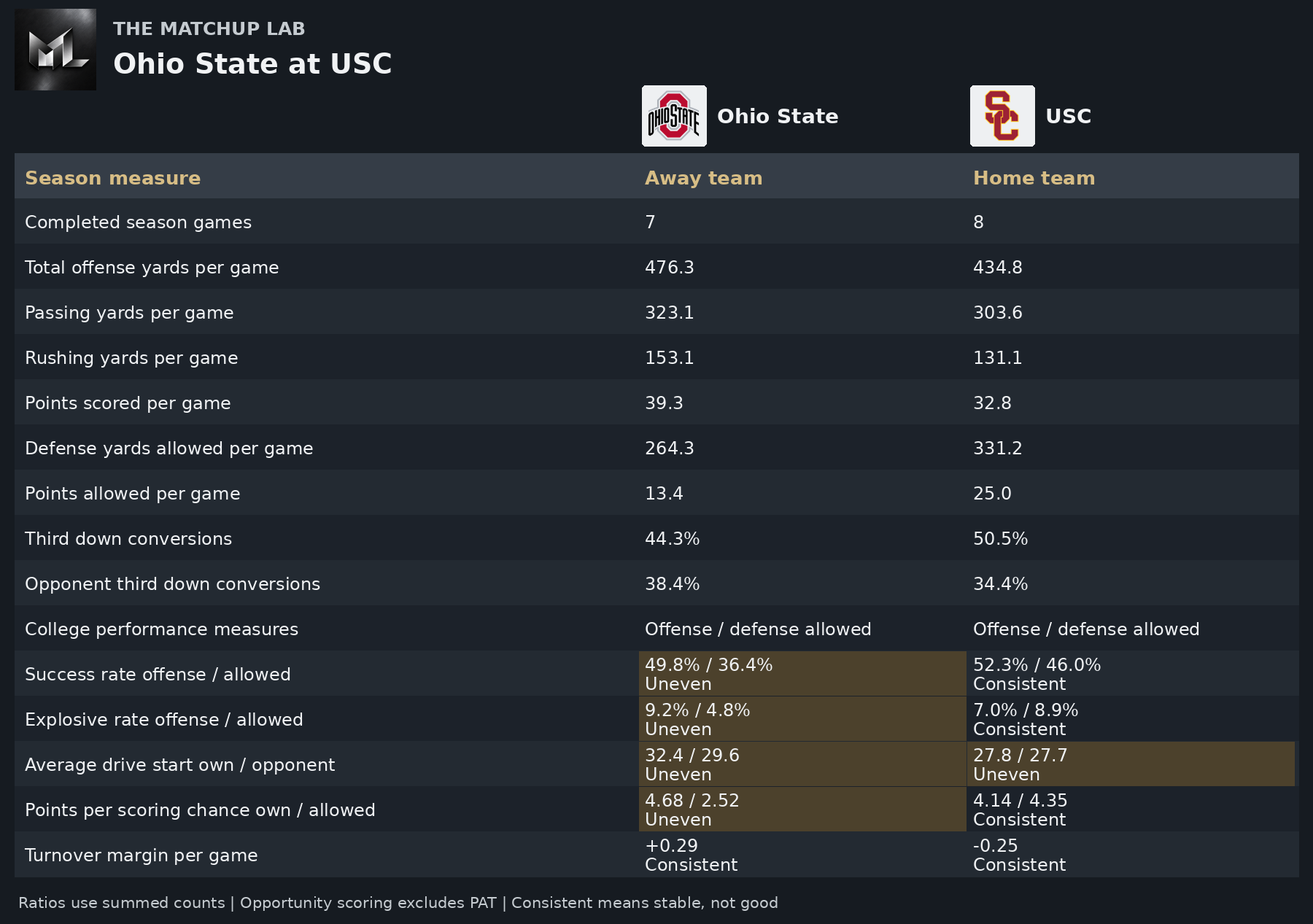
Ohio State's 6-1 season contains a strong defensive case and a useful warning from its latest win. The Buckeyes beat Indiana 19-15 despite being outgained 369-313, rushing for 78 yards and allowing eight third-down conversions in sixteen attempts. Two takeaways were offset by two giveaways. The result was valuable, but it did not supply a model of comfortable offensive control. After a bye, USC give Ohio State a chance to show that the broader passing production and defensive resistance can return together rather than taking turns carrying the afternoon.
USC's most recent defeat exposed a more severe version of the same balance problem. The Trojans finished with minus-seventeen rushing yards against Wisconsin, lost the ball twice and scored seven points. Their passing game still produced 258 yards, which demonstrates why a passing total cannot be read apart from the possessions around it. Ohio State should try to keep USC in that uncomfortable assignment by making early running attempts unproductive. The Trojans' season offense has regularly extended third downs, so the visitors need to finish the series once they have created the difficult situation.
On the other side, Ohio State's offensive balance is more important than trying to match a passing average. The Buckeyes have a strong advantage between the rate of damaging long plays they create and allow. USC's defense has conceded those gains more often than its offense has created them under the saved definition. Useful early running support can preserve the conditions for a better passing opportunity. If Ohio State repeatedly arrive at a long down, they will have made that advantage more difficult to use. Their own recent 78 rushing yards are a reason to demand improvement.
The decisive interaction is USC's protection of its offense from another one-dimensional afternoon against Ohio State's ability to turn defensive control into a sustainable scoring margin. USC need cleaner possessions and some credible ground support. Ohio State need to avoid the giveaways and long conversion burden that kept the Indiana game so tight. The Buckeyes remain very high in the separate statistical assessment, while their one loss places them behind the unbeaten teams in overall order. A road win built on both sides doing their ordinary work would be more convincing than another final score that required one unit to rescue the other.
Mississippi State at Texas
Sat Oct 31 06:30 PM CDT
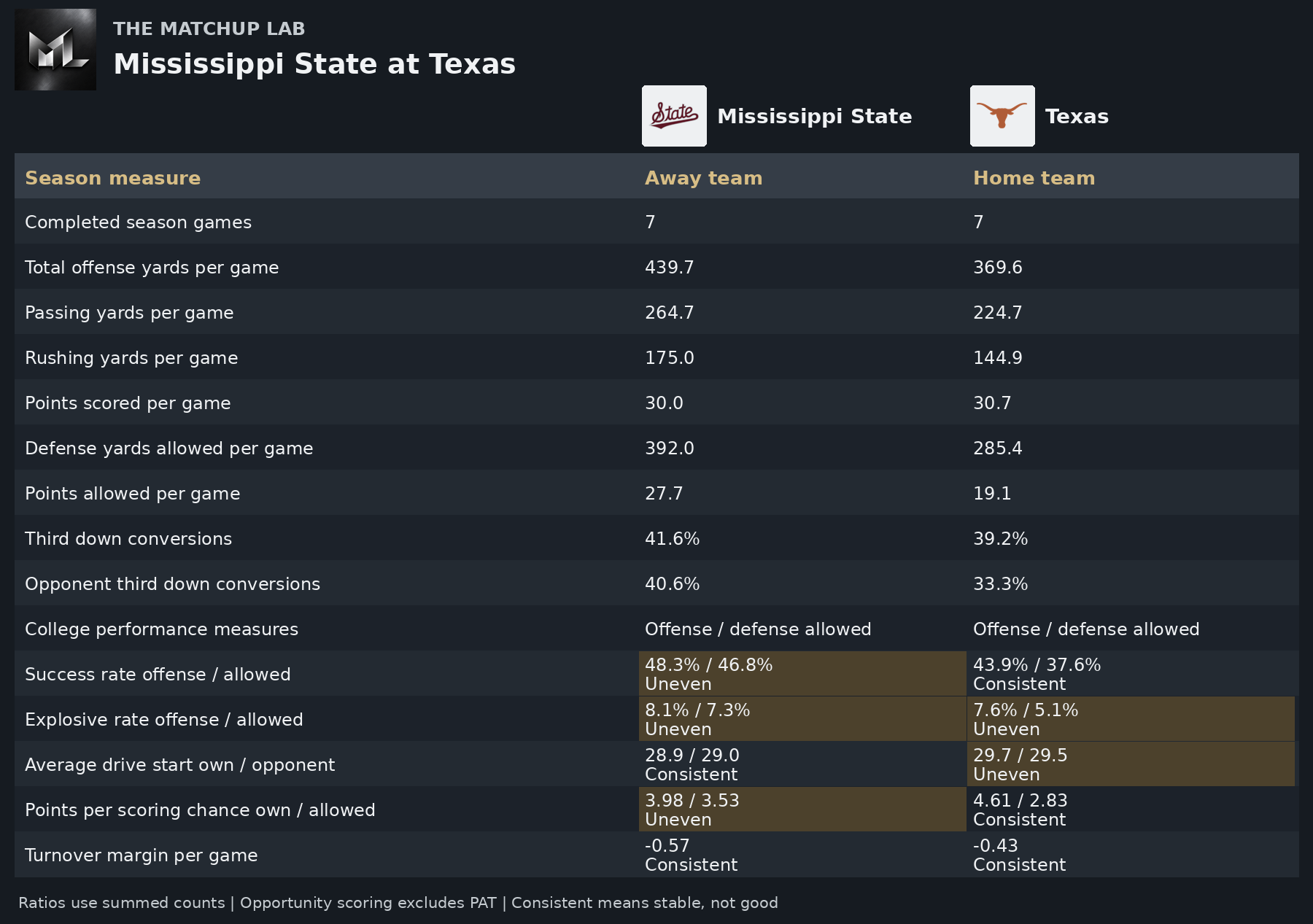
Texas have spent much of the season making defensive resistance carry a modest offensive margin. The Longhorns average fewer than 370 yards but have held opponents below 286, with a strong separation once possessions reach scoring territory. Their latest 34-27 win over Ole Miss added a more useful rushing performance, with 207 yards on the ground. Three giveaways prevented it from becoming a cleaner afternoon, even though three takeaways restored the possession balance. Mississippi State need to make Texas earn its next advantage without receiving that sort of help.
The Bulldogs' recent offense has not resembled its stronger early season. Mississippi State have scored 23, zero and fifteen in the last three games, and their latest defeat to Oklahoma included one successful third down in eleven attempts. Texas should target that inability to sustain the next down. The Bulldogs still average nearly 440 yards across the season, so dismissing their offense as incapable would be careless. The task is to make the current difficulties persist by stopping useful early progress, rather than assuming an earlier low score will repeat itself automatically.
Texas's own offense needs to keep the ground contribution from last week available. A series of productive runs can reduce how often the passing game has to rescue a difficult situation. Mississippi State have allowed ordinary-play success only slightly below their own attacking rate, and opponents have gained 392 yards per game. There is room for sustained offense if Texas preserve the possession. The Longhorns' negative season turnover margin is a reminder that ball security remains part of the evaluation even after a win in which both teams lost the ball three times.
The decisive contest is Texas's ability to use its defensive advantage without making the offense's job harder through another giveaway. Mississippi State need a far better sequence through third down and must keep the Longhorns from turning early runs into comfortable passing choices. Texas need to make a good defensive possession lead to useful offensive work, then finish once inside scoring range. The separate statistical assessment rates their season more strongly than the two losses alone might suggest. The overall order still places them behind every one-loss team in our selected population. Another disciplined result would strengthen both the record and the explanation behind it.
Washington at Nebraska
Sat Oct 31 07:00 PM CDT
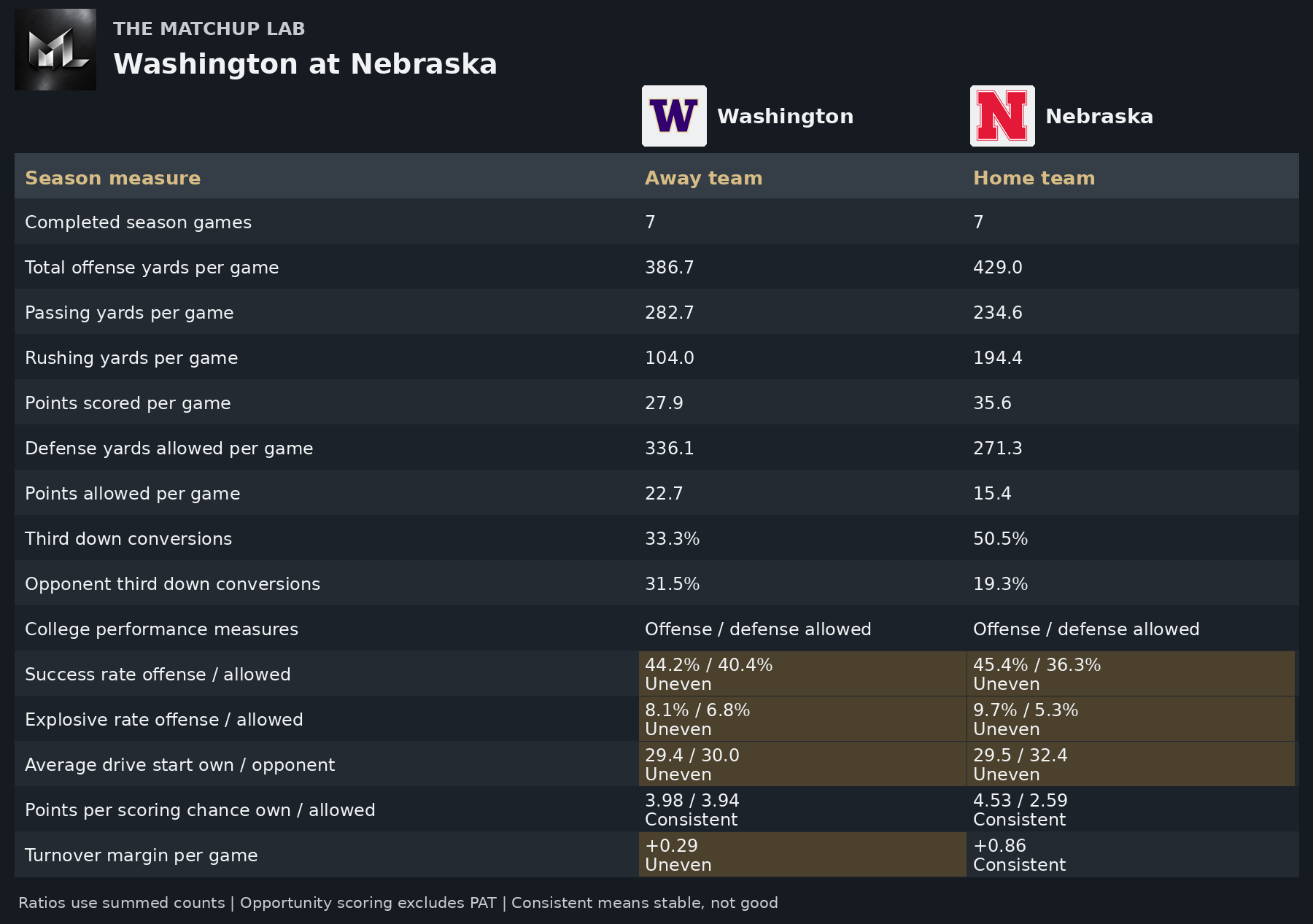
Nebraska's season defense has done a remarkable job of ending third downs. Opponents have converted fewer than one in five attempts, and the wider yardage and scoring allowances support a strong assessment. The offense has not made that work sufficient in the last two games. Nebraska lost 20-17 and 17-14, with the latest defeat to Oregon producing only 242 yards. The defense also allowed 242. After a bye, Washington give the Cornhuskers a direct test of whether they can turn that defensive platform into a more useful offensive afternoon.
The Huskies' last game was productive and careless at the same time. Washington gained 488 yards and beat Purdue 38-26 despite giving the ball away five times. Their season passing contribution is substantial, but that turnover count is not a detail to carry forward against this defense. Nebraska should try to make Washington work through a longer series of ordinary plays before a scoring chance appears. If the visitors keep arriving at third down needing a difficult gain, they will be testing the strongest recurring part of the Nebraska season.
The Cornhuskers need a better running contribution than the 78 yards they managed against Oregon. Their full-season offense is much more balanced, and that balance can stop Washington from focusing every important down on the pass. Nebraska's average starting position has actually been deeper than its opponents' starting position, despite the strong defensive conversion record. That includes the full possession exchange and cannot be assigned to defensive stops alone. The practical consequence is that the offense still needs to demonstrate that it can travel the field, rather than waiting for the defense to supply a shortcut.
The decisive matchup is Nebraska's effort to restore early offensive progress against Washington's need to keep its passing production attached to secure possessions. Nebraska must make its best drives end more usefully while retaining the defense's standard. Washington must show that the Purdue win does not require another five-turnover escape act. The Huskies have enough passing ability to threaten, and the Cornhuskers have enough defensive evidence to resist it. The game becomes more favorable for whichever offense can make ordinary progress repeatable before the next important third down, rather than asking one exceptional play to repair the entire series.
LSU bye assessment
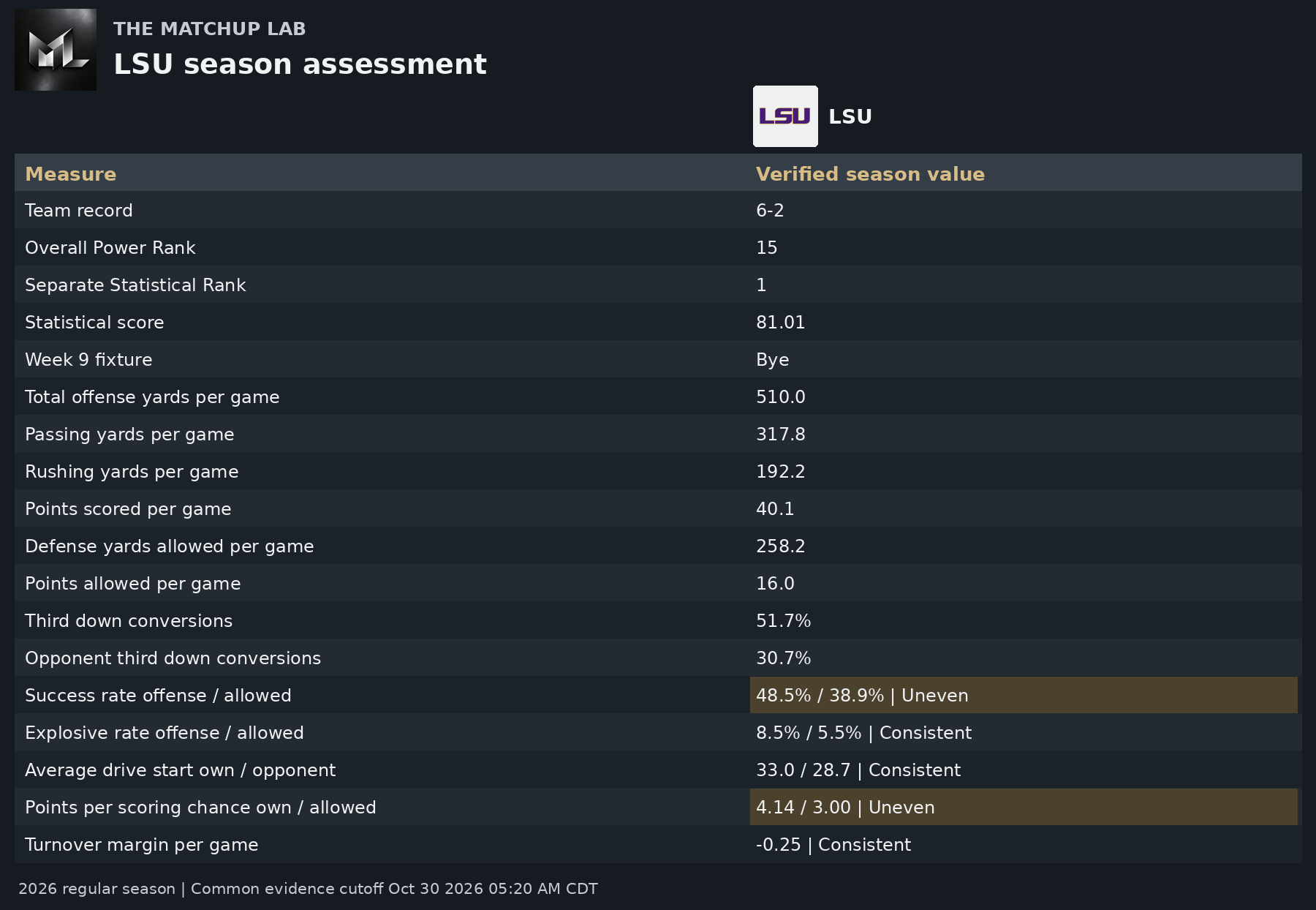
LSU lead the separate Statistical Rank, but their two completed losses place them fifteenth in the overall order within our selected top 25. Those labels answer different questions. The calculation recognizes a season averaging 510 yards and allowing about 258, with a substantial advantage in extending third downs and limiting opponents. The results order also preserves the defeats. A strong explanation of how LSU have played does not remove either loss from the record.
The 38-17 win over Auburn was a convincing example of the attacking case. LSU gained 552 yards, passed for 387 and allowed 271, without either team losing a possession through a turnover. That matters because the separation did not need a large supply of extra opportunities. Across the season, however, LSU's turnover margin remains slightly negative, and their finishing return has varied enough that the overall production has not always created a safe final margin.
There is no Week 9 game in the reconciled schedule. The bye is an opportunity to preserve the defensive standard while making the offense's productive possessions less vulnerable to an empty finish. The season deserves a high statistical assessment and a demanding results assessment at the same time. LSU should want the next opponent to face the balance shown against Auburn, without needing another enormous yardage total just to make the record look as convincing as the underlying performance.
Alabama bye assessment
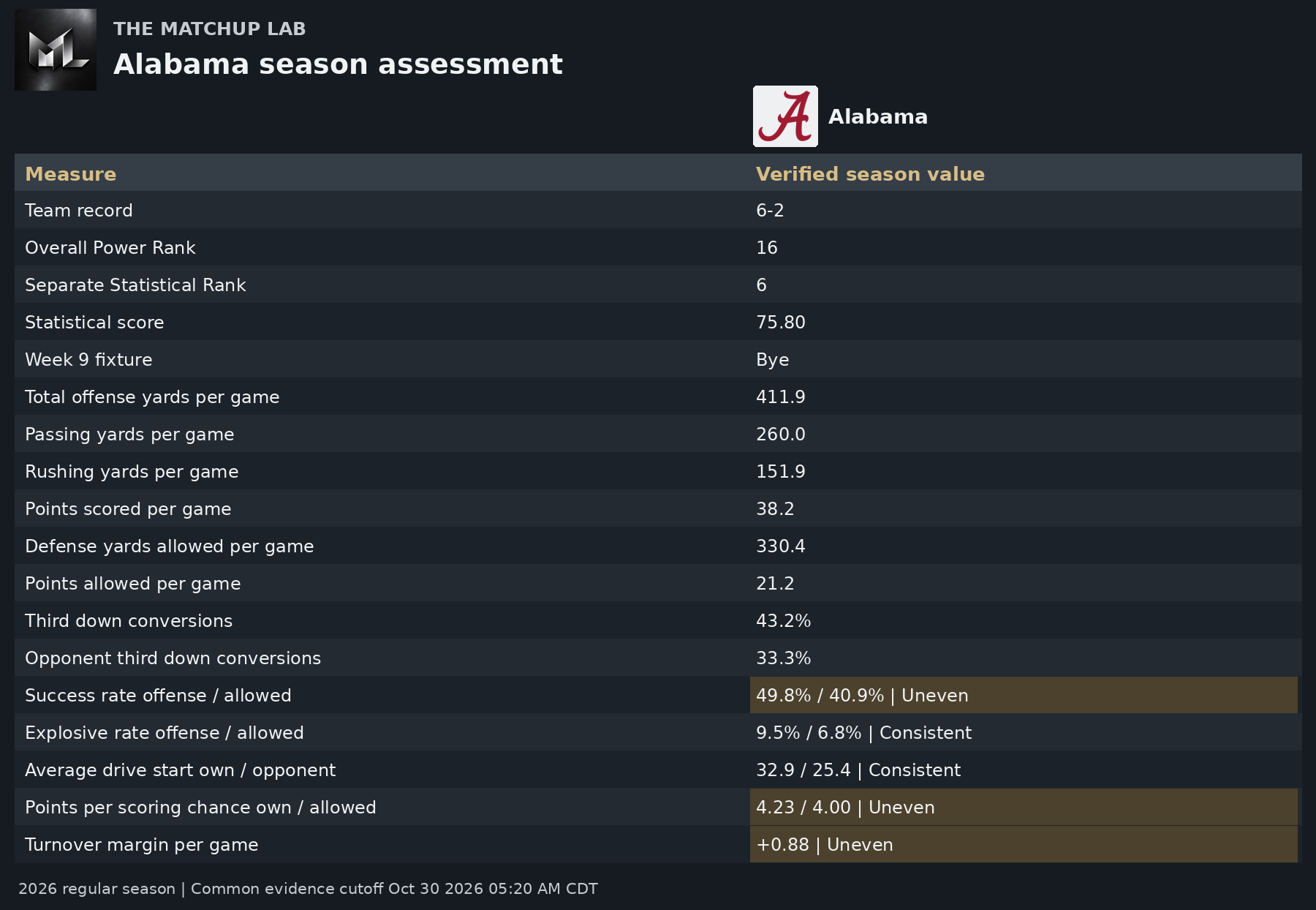
Alabama enter the bye 6-2, with a strong separate statistical position and two losses that remain controlling in the overall order. The latest 31-20 win over Texas A&M stopped a two-game losing sequence and supplied better defensive resistance. Alabama allowed 278 yards and took the ball away three times. The offense passed for 311, but its 68 rushing yards made the afternoon much less balanced than the season averages suggest.
The defense and passing game deserve credit for making that combination work. They also leave an obvious assignment. Alabama need more dependable ground support so that a passing opportunity does not have to rescue every difficult possession. Their season advantage in average starting position is substantial, and their positive turnover margin has helped. Those are useful benefits of the full possession exchange. They should not become an expectation that every future offense will be handed a shorter field.
Alabama have no Week 9 fixture in the reconciled slate. Their season scoring-opportunity return is only narrowly above what the defense allows under the saved measure, despite much stronger advantages elsewhere. A more reliable finish and a steadier running contribution would make the next recovery less dependent on another three-takeaway day. The bye does not require a new verdict on the team's ceiling. It requires attention to the ordinary offensive work that the latest win still did not consistently provide.
Tennessee bye assessment
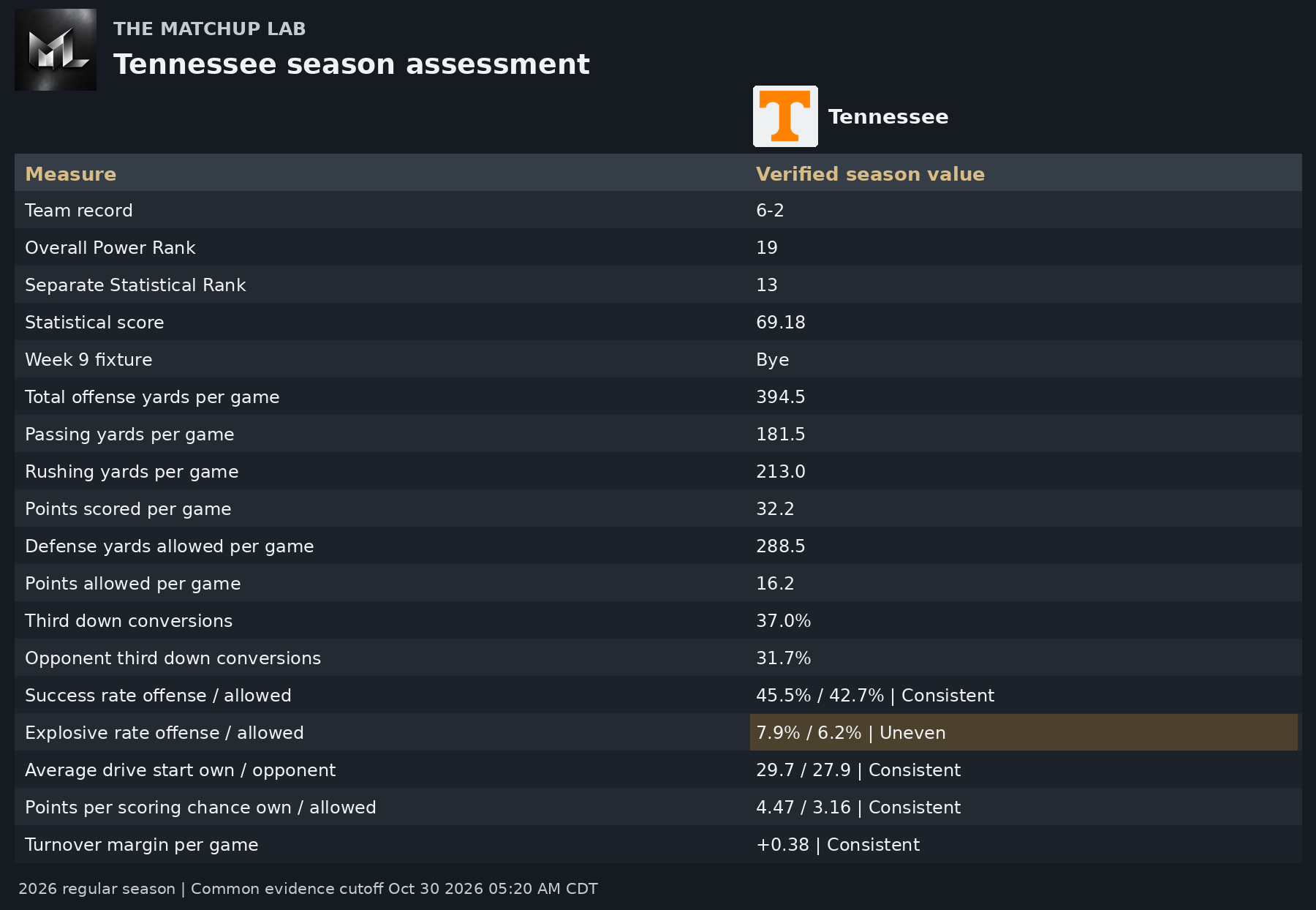
Tennessee's 6-2 season has a credible defensive foundation and a narrower offensive margin than several comfortable earlier scores suggested. The Volunteers allow about 289 yards and sixteen points per game. Their own offense is more productive on the ground than through the air, and that running contribution has helped keep difficult games within reach. The latest 27-24 loss to South Carolina showed how little room remains when the passing game supplies only 136 yards and the defense cannot quite make another modest scoring total sufficient.
Neither team received a large turnover advantage in that game. Tennessee gave the ball away once and took it away once. The loss therefore deserves a direct assessment of the football rather than an explanation built around an unusual possession exchange. The Volunteers ran for 184 yards but converted only six of fifteen third downs. Their season offense has been less successful at extending those situations than their strongest scoring days might imply.
There is no Week 9 game on the reconciled schedule. The useful work is to make early gains support a more dependable passing contribution and a cleaner route through the next down. Tennessee's defensive resistance and finishing advantage remain substantial assets. They would become more valuable if the offense required fewer difficult conversions to make them count. The two losses keep the Volunteers behind every one-loss team in the overall order. The separate statistical assessment still recognizes the stronger parts of the season without pretending that those results did not happen.
Kentucky bye assessment
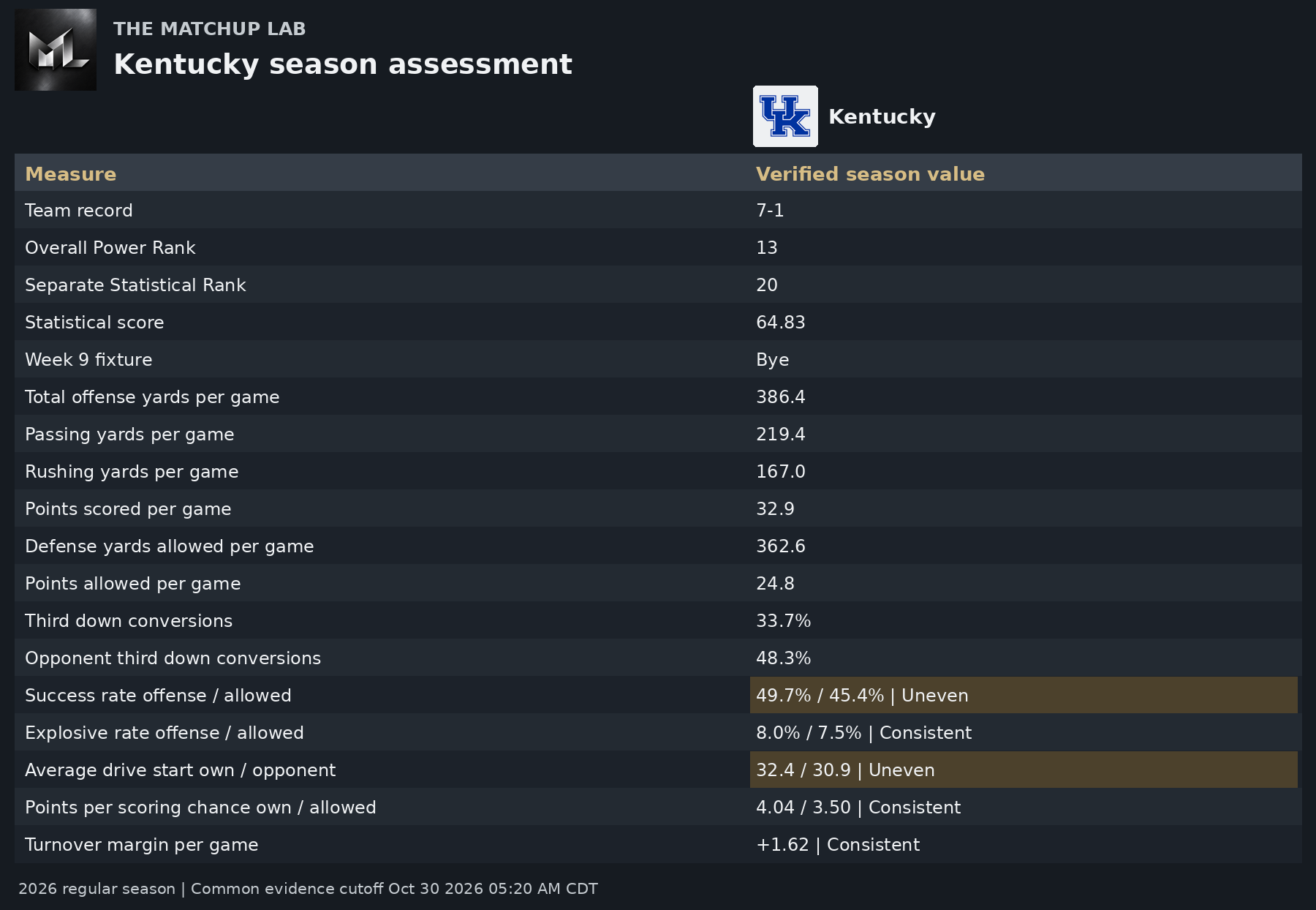
Kentucky's 7-1 record puts it ahead of every two-loss team in the overall order, even though the separate statistical assessment is less emphatic. That difference is deliberate. The Wildcats have earned seven results, while the calculation also examines an offense and defense that have not been separated by the same margins as several lower-placed two-loss teams. Kentucky do not need to apologize for winning. They do need to examine how dependable the route to those wins has been.
The 34-17 victory over Vanderbilt supplied a useful improvement. Kentucky gained 376 yards, allowed 262, converted eight of thirteen third downs and avoided a giveaway while taking the ball away twice. The full season still contains a warning on those possession-extending downs. Kentucky's offense has converted about one-third of its attempts, while opponents have converted nearly half. A strong turnover return has helped absorb that imbalance, but another favorable exchange is not something the next opponent owes them.
Kentucky have no Week 9 fixture in the reconciled slate. The bye should preserve the cleaner offensive work from the Vanderbilt game while addressing the repeated defensive extensions. Better third-down resistance would make an existing scoring advantage less dependent on receiving extra possessions. The current record deserves its position under the results-first rule. Making the ordinary drive work more convincing would narrow the gap between that position and the separate statistical view of the season.
Every covered official game
- Notre Dame vs Navy · 2026-10-31T16:00:00.000Z
- Arizona at Texas Tech · 2026-10-31T16:00:00.000Z
- Wisconsin at Iowa · 2026-10-31T16:00:00.000Z
- Michigan at Rutgers · 2026-10-31T16:30:00.000Z
- Auburn at Ole Miss · 2026-10-31T16:45:00.000Z
- Stanford at Louisville · 2026-10-31T19:15:00.000Z
- Arizona State at BYU · 2026-10-31T19:30:00.000Z
- Minnesota at Indiana · 2026-10-31T19:30:00.000Z
- Northwestern at Oregon · 2026-10-31T19:30:00.000Z
- Florida International at Liberty · 2026-10-31T19:30:00.000Z
- Florida vs Georgia · 2026-10-31T19:30:00.000Z
- Utah at Cincinnati · 2026-10-31T19:45:00.000Z
- Virginia at Wake Forest · 2026-10-31T19:45:00.000Z
- New Mexico at San José State · 2026-10-31T20:00:00.000Z
- Nevada at UCLA · 2026-10-31T20:15:00.000Z
- South Carolina at Oklahoma · 2026-10-31T20:15:00.000Z
- Oklahoma State at Iowa State · 2026-10-31T23:00:00.000Z
- Miami at North Carolina · 2026-10-31T23:30:00.000Z
- Ohio State at USC · 2026-10-31T23:30:00.000Z
- Mississippi State at Texas · 2026-10-31T23:30:00.000Z
- Washington at Nebraska · 2026-11-01T00:00:00.000Z