
THE MATCHUP LAB · NFL
Game Center
Scores, statistics and the story behind the game.
Checking for updates…
Complete NFL Week 10 recap and all 32 team assessments
George Pickens caught three touchdowns. Dak Prescott threw five. Dallas got within six when Ryan Flournoy scored with 3:42 left. Nineteen seconds of game clock later, Brock Purdy had found Christian McCaffrey for a 66-yard touchdown, their second scoring connection of at least 66 yards. The 49ers added the two-point conversion. Dallas scored and converted a two-pointer of its own in the final minute and still finished six points short. For a defense trying to buy its quarterback one last possession, making a tackle after the catch was worth as much as getting a sack.
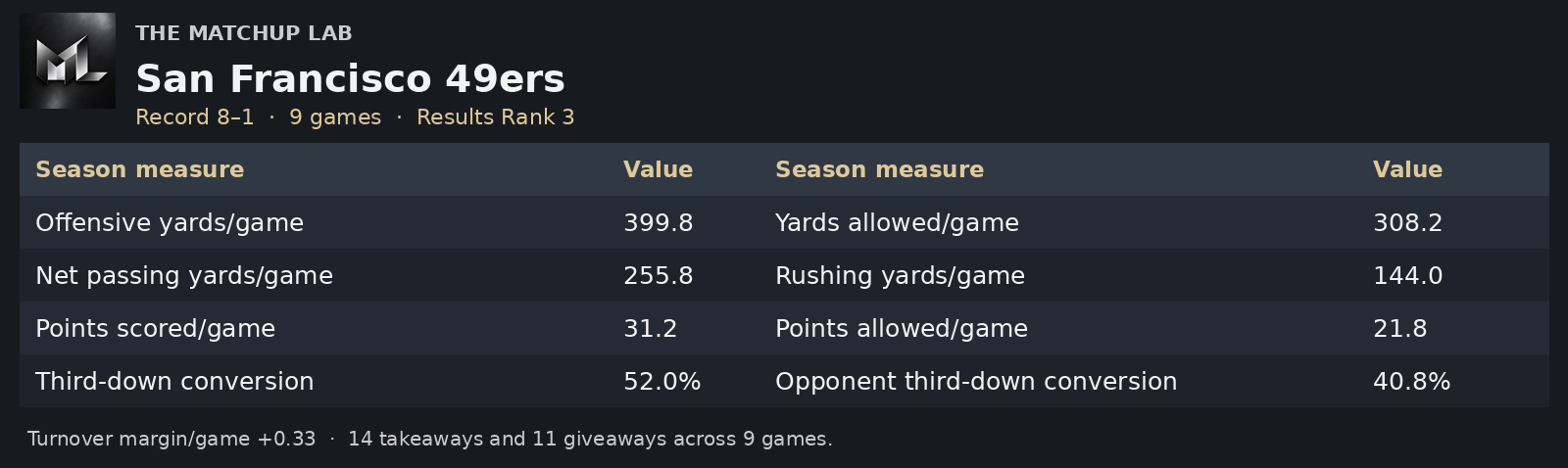
McCaffrey gained 161 yards on just four catches. Dallas had to honor the handoff, too, as San Francisco ran for 214 yards. That combination helps explain how the 49ers average 399.8 yards and convert 52 percent of their third downs. It also took an extraordinary offensive day to cover for 40 points allowed. Minnesota comes to Mexico City conceding 14 points per game. If it keeps the first receiver in front of the pursuit, San Francisco should expect to earn those third-down conversions again.
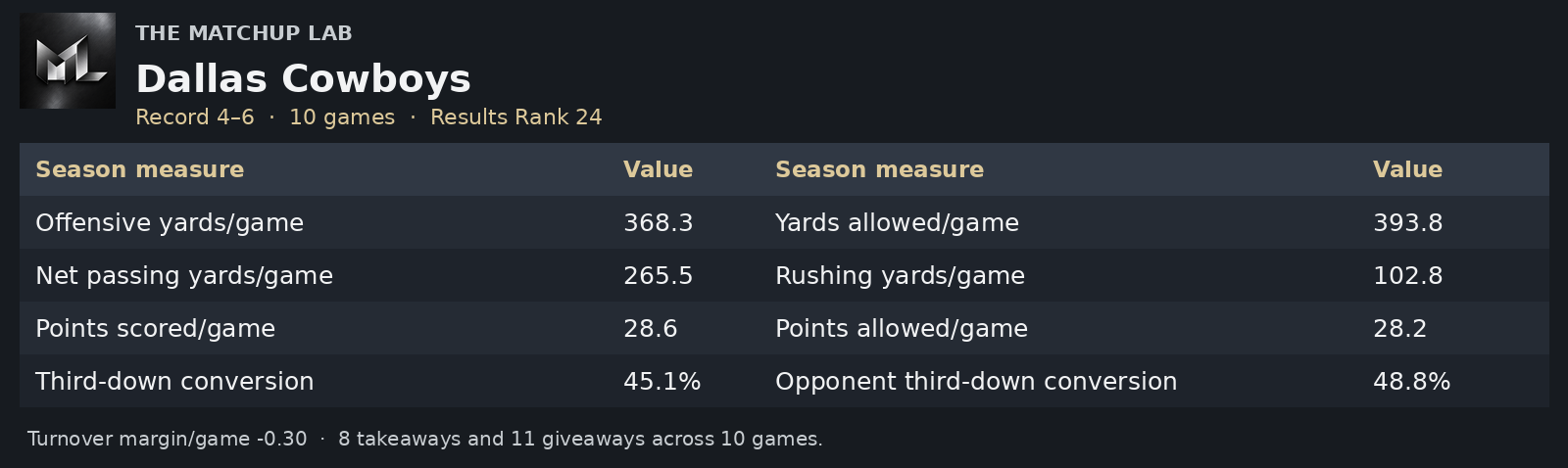
Prescott and Pickens produced the kind of afternoon most teams build a comfortable lead around. Dallas scored touchdowns on all three trips inside the 20 and converted seven third downs. Giving up 584 yards made all of it insufficient. Over ten games opponents average 393.8 yards and convert 48.8 percent of third downs. Tennessee’s offense has had trouble staying on the field. Finishing a tackle on first down would force the Titans to confront that weakness.
Sun Nov 15 · 3:25 p.m. Central | Results Rank 2 and 22
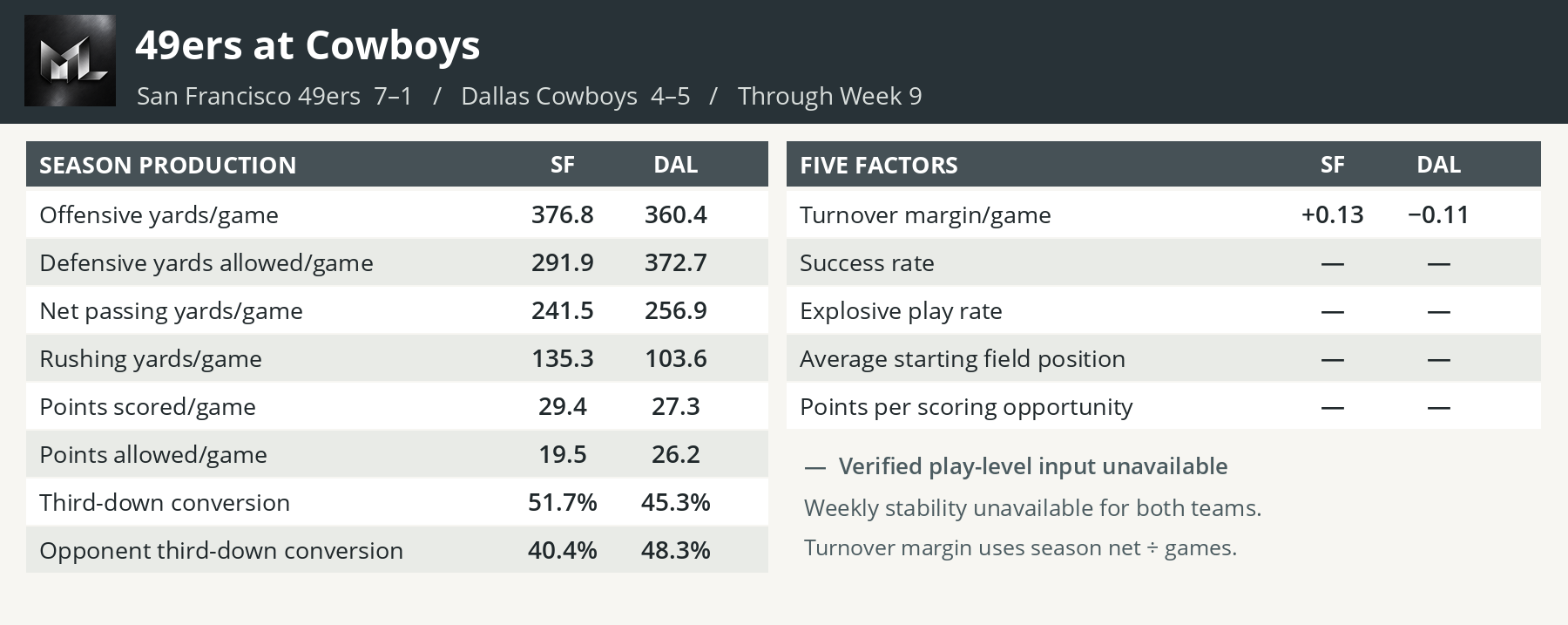
A third down in Dallas will tell two stories at once. San Francisco has converted 51.7 percent of them. Dallas has allowed 48.3 percent. When the 49ers face third and four, they can lean on an offense that averages 135.3 rushing yards as well as 241.5 net passing yards. If Dallas commits extra bodies inside, it helps San Francisco define the throw. If it plays the pass with a light front, a handoff remains a credible way to earn another set of downs.
The Cowboys have the offense to make that a competition rather than a procession. They average 256.9 net passing yards, score 27.3 points and convert 45.3 percent of third downs. Their 27–23 win over Indianapolis was a reminder that they can finish a tight game. San Francisco, however, gives up 291.9 yards and 19.5 points a game. Dallas will have fewer easy routes to its usual scoring level if it spends its early downs searching for one deep completion and leaves its passing game in a series of obvious situations.
The 49ers arrive from a 38–17 win over Las Vegas. Their season scoring average of 29.4 is a more reasonable challenge for the Cowboys than simply assuming Sunday will demand 38. Even that average asks Dallas to change something on defense, where it allows 372.7 yards per game. A single early third-down stop would do more than save yards. It would let Dallas run its offense before the score starts choosing plays for it. San Francisco’s answer is patience. If the Cowboys give up a modest gain guarding against the long one, the 49ers have the conversion record to turn modest gains into points.
At 55.5 the early total was the highest on the schedule. A good defensive afternoon here need not look like a shutout. Turning two potential touchdowns into field goals would save eight points, more than twice the 3.5 points San Francisco gave on Tuesday.
Complete NFL Week 9 recap and all 32 team assessments
Week 9 win 38–17 against Las Vegas Raiders
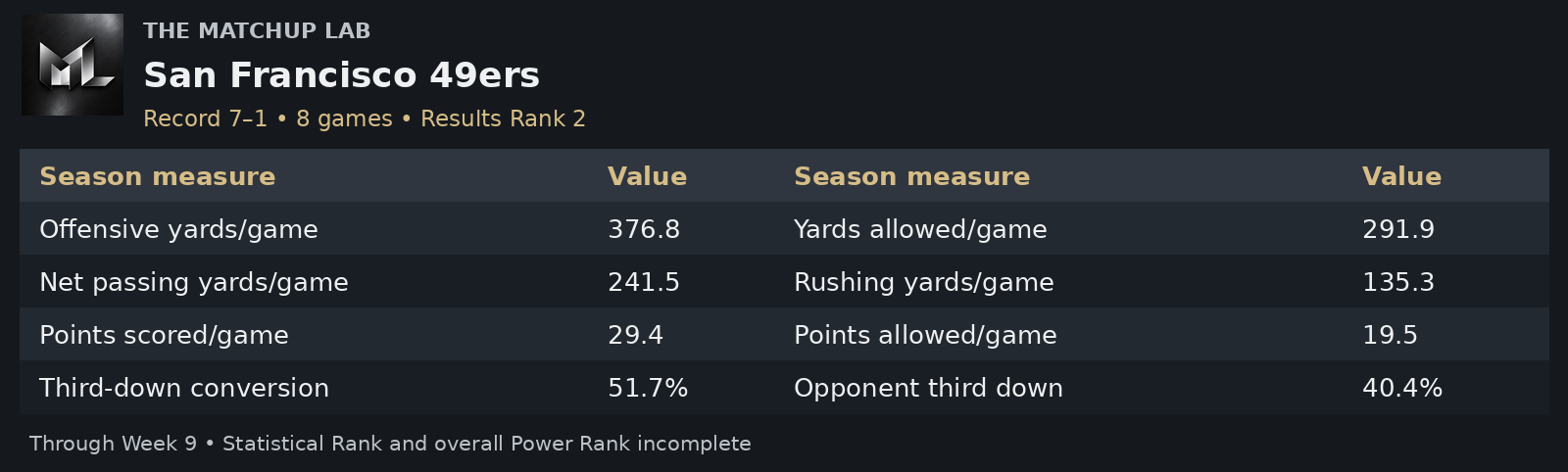
San Francisco returned from its break with a 38–17 win over Las Vegas and moved to 7–1. The shape of the season supports that record. The 49ers average 376.8 yards and 29.4 points while allowing 291.9 yards and 19.5 points. Their 51.7 percent third-down conversion rate gives the offense a strong way to keep possessions alive, and 135.3 rushing yards per game means that production is not confined to the passing totals. The earlier loss to Atlanta still belongs in the assessment, but the response against the Raiders was emphatic.
Dallas offers a particularly relevant next test because its defense allows opponents to convert 48.3 percent of third downs. San Francisco's ability to continue drives should put that weakness under scrutiny. The Cowboys also score 27.3 points per game, so the 49ers cannot evaluate the matchup solely through what their offense might produce. Sustaining possessions and limiting Dallas's scoring chances are complementary tasks, with neither guaranteed by the difference in records.
Week 9 win 27–23 against Indianapolis Colts
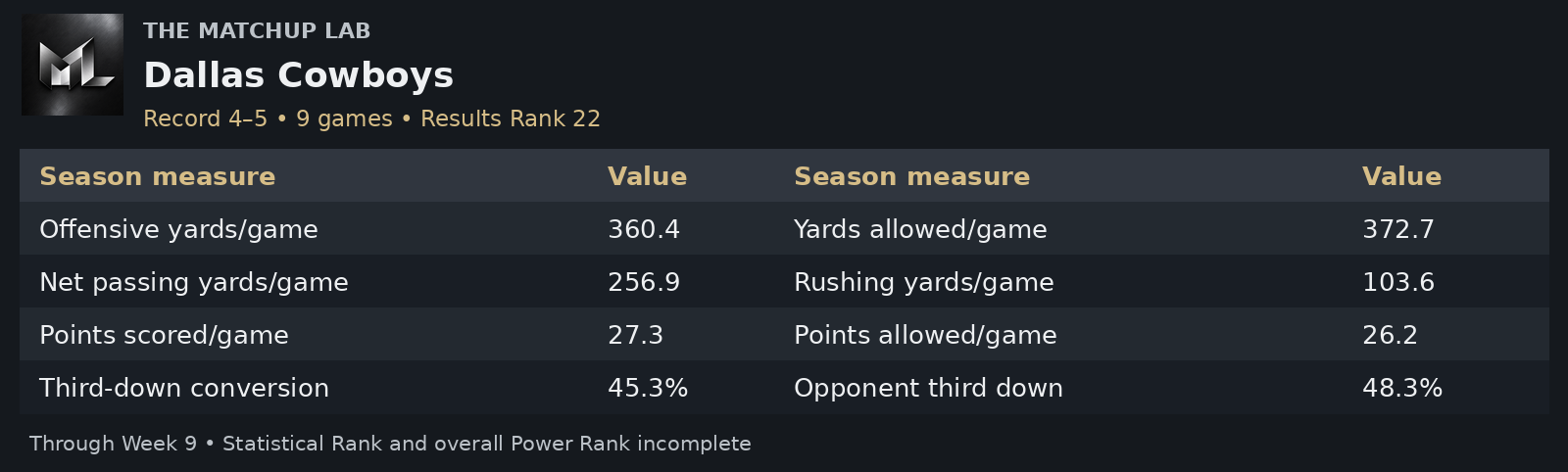
Dallas has enough offense to keep giving itself chances, but a 4–5 record shows how often those chances remain uncomfortable. The Cowboys beat Indianapolis 27–23 after scoring 30 in a loss to Arizona and 38 in a win over Philadelphia. Their season average of 27.3 points is supported by 360.4 yards and a 45.3 percent third-down conversion rate. The defense allows 372.7 yards per game and opponents convert 48.3 percent of third downs. That leaves Dallas asking its offense to answer repeated opportunities rather than enjoy frequent defensive stops.
San Francisco is next with a 51.7 percent third-down conversion rate and 29.4 points per game. That is a direct examination of Dallas's most obvious defensive weakness. The Cowboys should be capable of contributing points themselves, but matching every productive 49ers possession would create another demanding afternoon. Their best route to a more convincing performance is to end drives before the scoreboard requires another response. The Indianapolis win supplied a result; it did not settle that season-long defensive question.
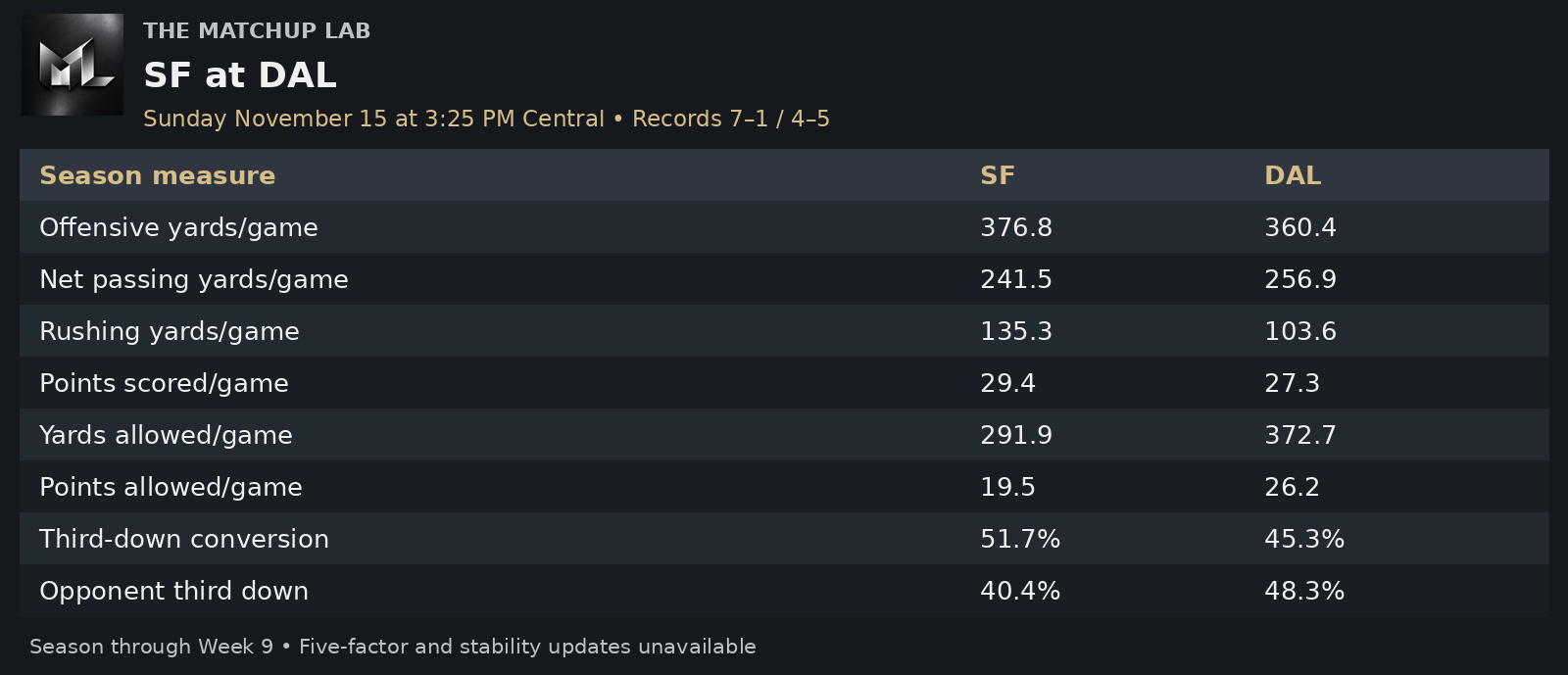
San Francisco takes its 7–1 record to Dallas on Sunday afternoon, November 15, with the Cowboys at 4–5. The clearest numerical matchup is on third down. The 49ers convert 51.7% of their opportunities, while Dallas allows opponents 48.3%. San Francisco also averages 376.8 yards and 29.4 points per game. Against a Cowboys defense conceding 372.7 yards and 26.2 points, those figures place a substantial burden on Dallas to end possessions before they become repeated scoring chances.
Dallas has enough offensive production to make the other side of the matchup relevant. The Cowboys average 27.3 points and 256.9 net passing yards per game and convert 45.3% of third downs. San Francisco allows 19.5 points and 291.9 yards, so maintaining that Dallas production will be a tougher task than its own averages imply. The 49ers' 135.3 rushing yards per game also give them a substantial complement to their passing offense. Dallas's route is to keep scoring while improving its defensive stops; San Francisco can lean on a stronger balance between production and prevention.
The recent results also discourage reading the records as a complete forecast. San Francisco beat Washington 23–17, lost 29–20 at Atlanta and then, after its bye, beat Las Vegas 38–17. Dallas has scored at least 27 in each of its last three, beating Philadelphia 38–21, losing 33–30 to Arizona and beating Indianapolis 27–23. Its offense has therefore supplied points even when the result has gone against it. Dallas needs that contribution to survive a stronger defensive matchup while reducing the opponent's possession extensions. San Francisco needs to preserve its offensive balance and avoid giving Dallas enough scoring freedom to offset the larger season differences.