
Data and reporting context from SportsDataverse college play-by-play research and official competition schedules. Team and matchup assessments are original analysis by The Matchup Lab.
2026 regular season · Week 7 · Season evidence through October 16 2026 at 4 AM Central · Fixtures checked October 16
College Football Week 7 Preview

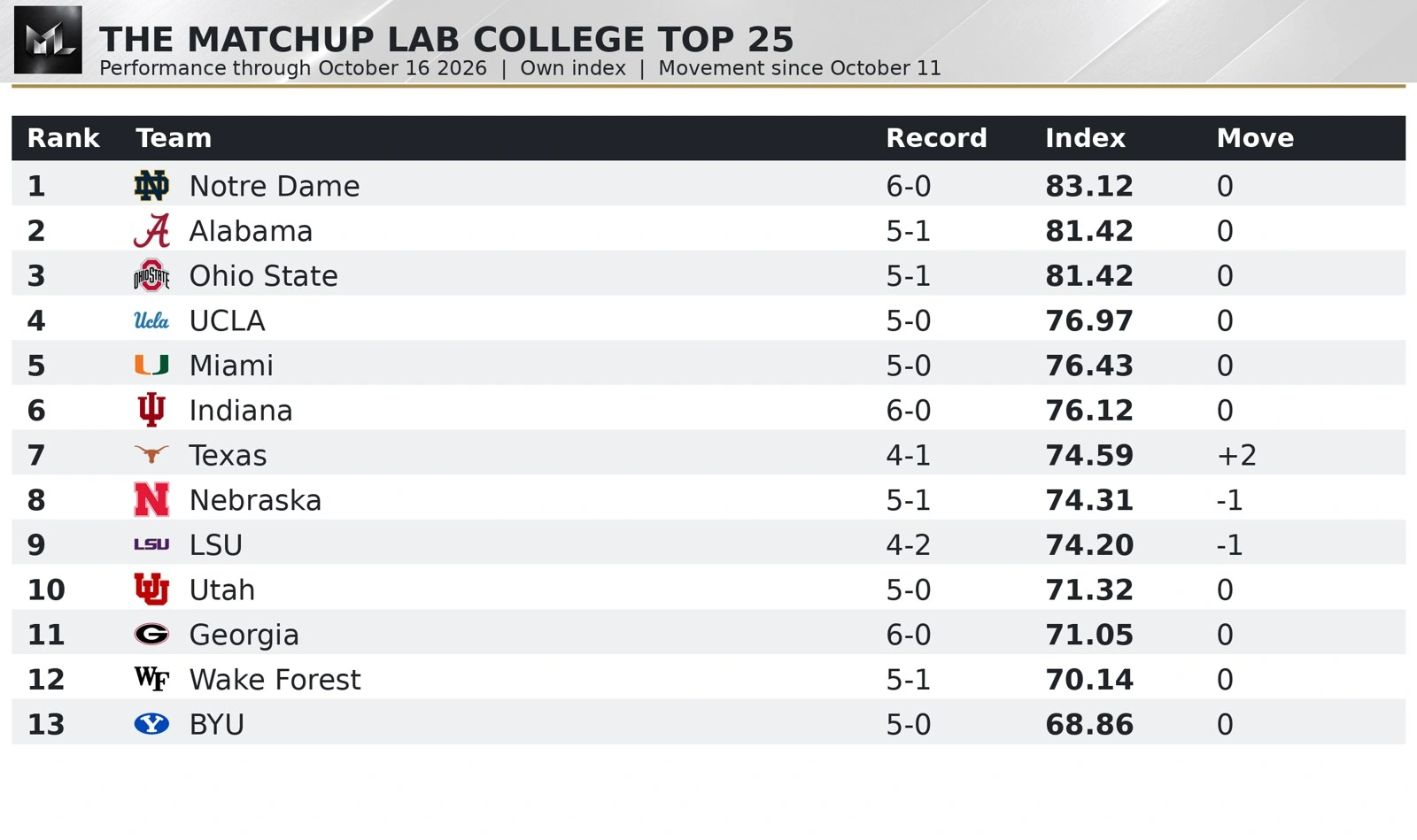
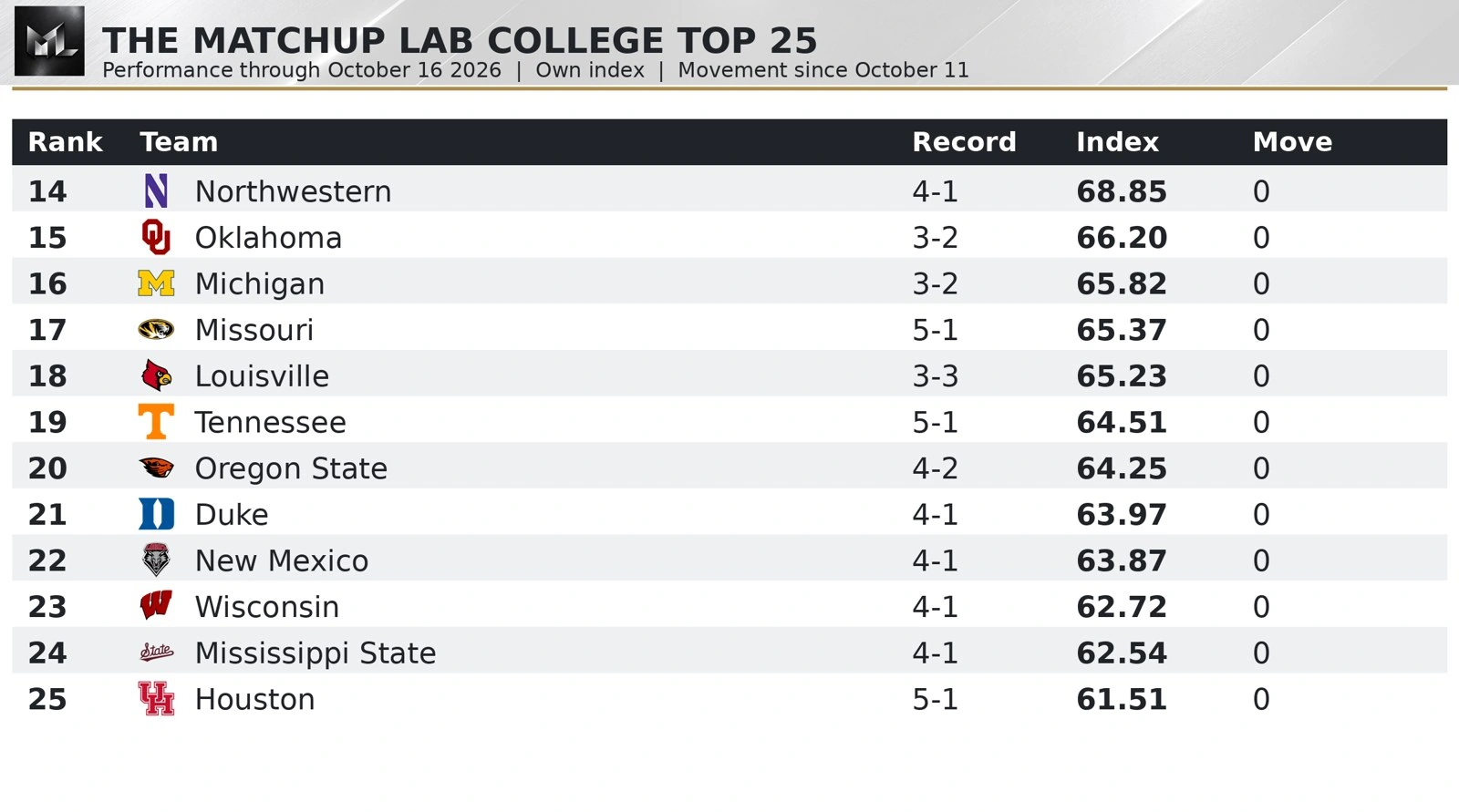
Our current performance top 25
How our college rankings are calculated
Our college index has two parts. Thirty percent comes from a five-part performance score. Within that score, useful ordinary plays and their scoring value receive forty percent, unusually valuable plays twenty-five percent, finishing scoring chances fifteen percent, starting field position ten percent and turnovers ten percent. The ordinary-play component combines success-rate margin at sixty percent and expected-points value per play margin at forty percent. Offense is compared with what the defense allows.
The other seventy percent comes from the saved opponent-adjusted calculation. It compares the scoring value of each team's plays with its opponent's in every completed game, then fits the whole network together. An opponent's other performances therefore matter. Game margins are capped before fitting, two neutral games restrain the estimate, and non-FBS opponents receive the measured non-FBS baseline rather than an invented individual rating. Category values are standardized across all 138 FBS teams and capped at two and a half standard deviations. The final index is fifty plus fifteen times the combined score.
Scoring-chance estimates include eight neutral opportunities on each side. Turnover value is divided by games played plus two. These safeguards reduce the effect of a handful of possessions. They do not erase schedule differences or make the index a betting probability. Ranks use the unrounded index. Movement compares this run with the verified October 11 calculation using the same model. Only completed regular-season games through October 16 at 4 AM Central enter the season evidence.
In the tables, a successful scrimmage play has positive expected-points value. A valuable explosive play meets the saved threshold of at least 2.4 expected points on a pass or 1.8 on a run. Kneels are excluded. These are the established college definitions, not the yardage thresholds used in our NFL work. Starting field position in the reader tables is the offense's own yard line. Scoring chances include drives reaching the opponent's forty or producing a touchdown or field goal. Their points exclude extra points, so a touchdown counts as six.
Consistent and Uneven describe the observed range, not the quality of the performance. The saved checks flag weekly success-rate ranges above ten percentage points, explosive-rate ranges above eight points, game-average starting-position ranges above ten yards, scoring-chance ranges above two points and net-turnover ranges above two per game. Offense and defense are assessed separately. A steady weakness can be Consistent. Season rates use their actual totals and denominators. Third-down percentages are conversions divided by attempts, not an average of game percentages.
Short fields can come from returns, penalties, takeaways or ordinary defensive stops. A starting-position average does not identify which one caused it. The matchup analysis keeps that distinction and does not credit a defense for every favorable offensive start. Current quarterback and injury decisions remain separate from the index. No unverified absence or presumed starting quarterback has been inserted into these assessments.
The Week 7 picture
The record has earned a hearing. It has not earned the right to end the discussion. Notre Dame leads our current performance index, Alabama and Ohio State are almost inseparable behind it, and unbeaten UCLA arrives with both a strong defense and a turnover surplus that deserves separate scrutiny. Georgia has just beaten Alabama and still has work to do before its underlying season performance catches our leaders.
This is our own current top 25, selected after recalculating the full 138-team FBS field through the Friday morning cutoff. All 25 have a Week 7 game. Five meetings pair two of our selected teams, leaving twenty matchup sections. Each selected team receives its own season assessment. Opponents outside the selected 25 appear only to explain those games.
Ohio State at Indiana tests whether two productive offenses can still stay comfortable when the ordinary gains get smaller. Notre Dame at BYU brings our leading team to an opponent that can keep the ball and finish possessions without needing an interception to start the conversation. Alabama at Tennessee and Wisconsin at UCLA should expose the difference between controlling a game and surviving the possessions that threaten to undo it.
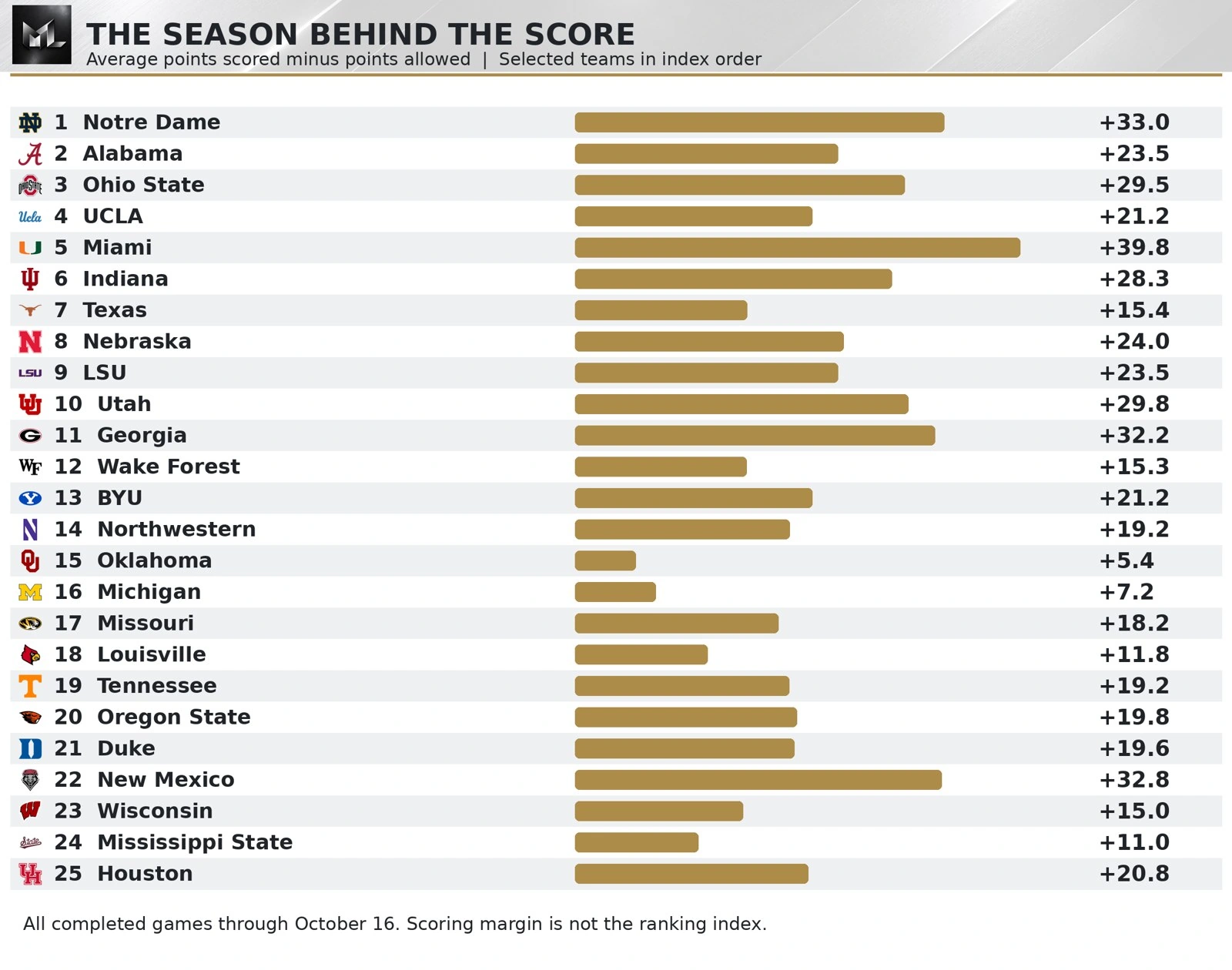
Records show what happened. The season statistics help explain how a team can win by thirty and then lose by twenty. Neither a strong record nor an attractive index removes the need to examine the opponent, the available players and the way the next game actually develops.
Week 7 schedule and betting lines
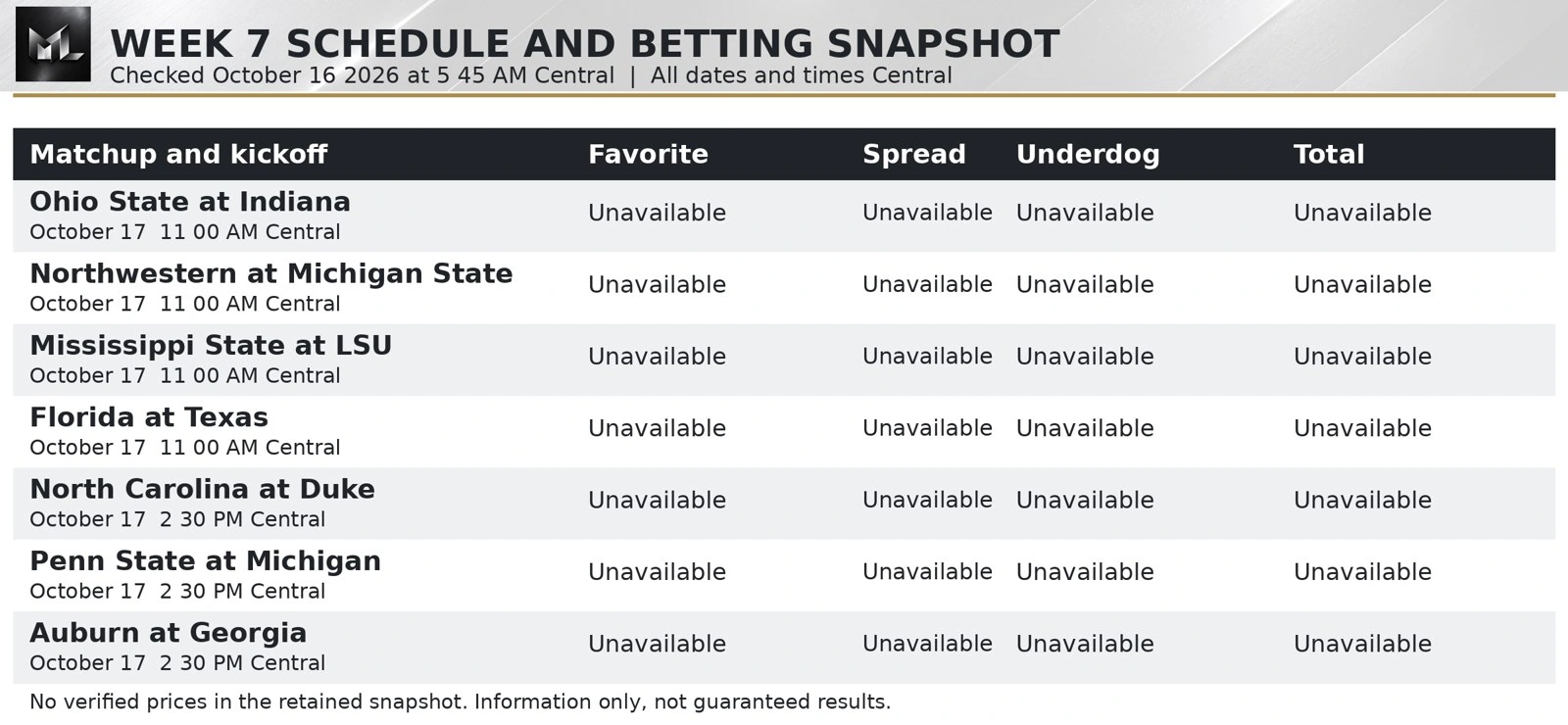
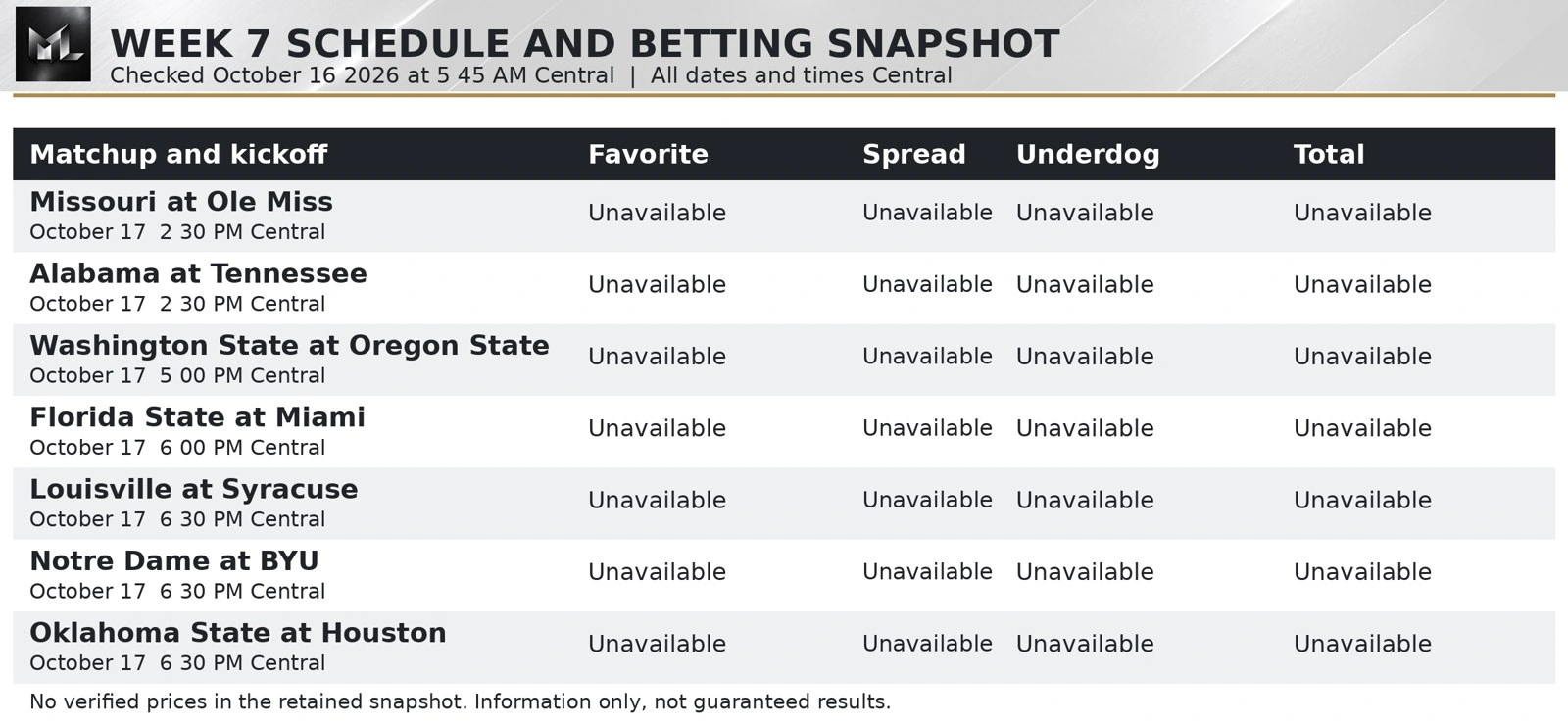
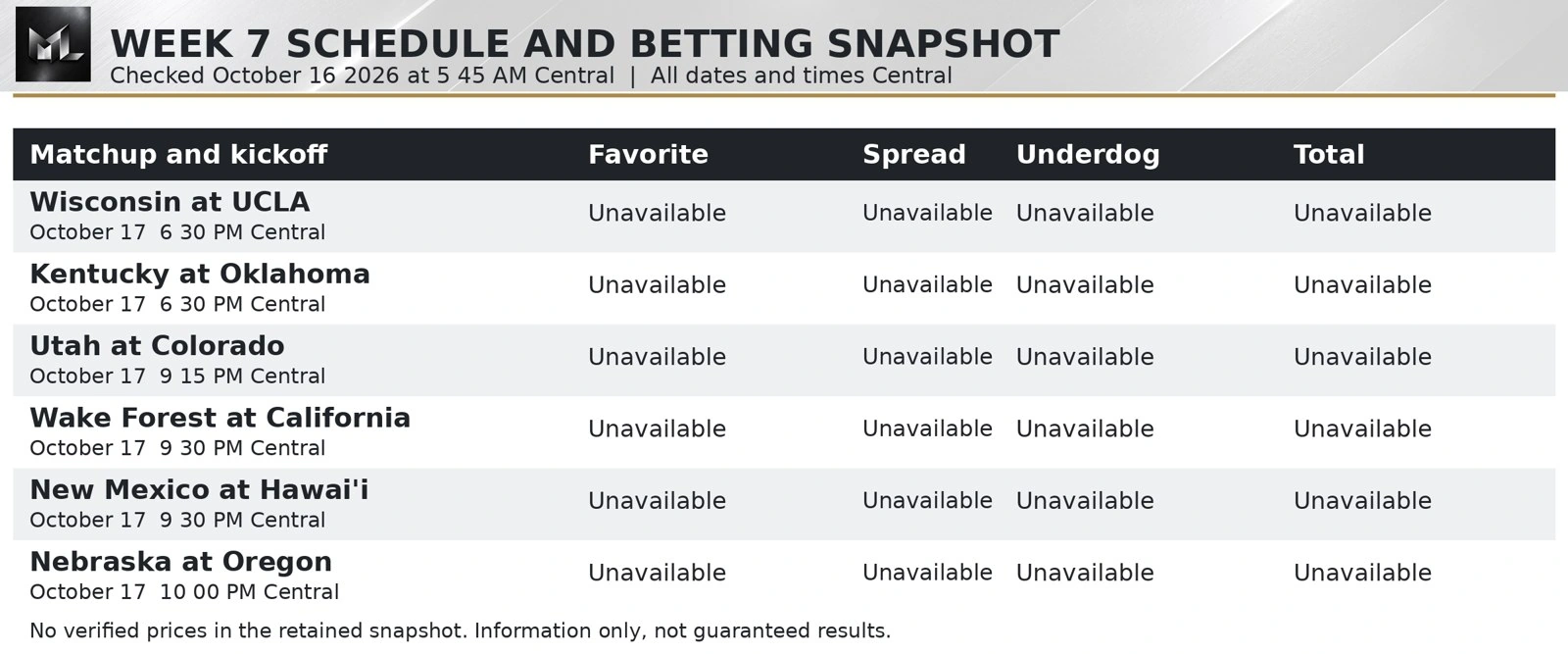
Betting-source check recorded October 16 2026 at 5 45 AM Central. Verified current spreads and totals were unavailable in the retained source snapshot for these twenty games. Unavailable is not a zero price or a claim that no market exists anywhere. It means this edition does not have a checked price to print. No favorite, spread, total or betting result has been inferred.
Spreads and totals reflect their stated observation time and can change before kickoff. They are information, not a guarantee of results. When recap results are compared with a recorded preview price, they are graded against that specific snapshot, not an asserted closing line.
Every covered game
- Ohio State at Indiana · Saturday October 17 2026 at 11 00 AM Central
- Northwestern at Michigan State · Saturday October 17 2026 at 11 00 AM Central
- Mississippi State at LSU · Saturday October 17 2026 at 11 00 AM Central
- Florida at Texas · Saturday October 17 2026 at 11 00 AM Central
- North Carolina at Duke · Saturday October 17 2026 at 2 30 PM Central
- Penn State at Michigan · Saturday October 17 2026 at 2 30 PM Central
- Auburn at Georgia · Saturday October 17 2026 at 2 30 PM Central
- Missouri at Ole Miss · Saturday October 17 2026 at 2 30 PM Central
- Alabama at Tennessee · Saturday October 17 2026 at 2 30 PM Central
- Washington State at Oregon State · Saturday October 17 2026 at 5 00 PM Central
- Florida State at Miami · Saturday October 17 2026 at 6 00 PM Central
- Louisville at Syracuse · Saturday October 17 2026 at 6 30 PM Central
- Notre Dame at BYU · Saturday October 17 2026 at 6 30 PM Central
- Oklahoma State at Houston · Saturday October 17 2026 at 6 30 PM Central
- Wisconsin at UCLA · Saturday October 17 2026 at 6 30 PM Central
- Kentucky at Oklahoma · Saturday October 17 2026 at 6 30 PM Central
- Utah at Colorado · Saturday October 17 2026 at 9 15 PM Central
- Wake Forest at California · Saturday October 17 2026 at 9 30 PM Central
- New Mexico at Hawai'i · Saturday October 17 2026 at 9 30 PM Central
- Nebraska at Oregon · Saturday October 17 2026 at 10 00 PM Central
Ohio State at Indiana
Saturday October 17 2026 at 11 00 AM Central · 5-1 and 6-0
Ohio State assessment
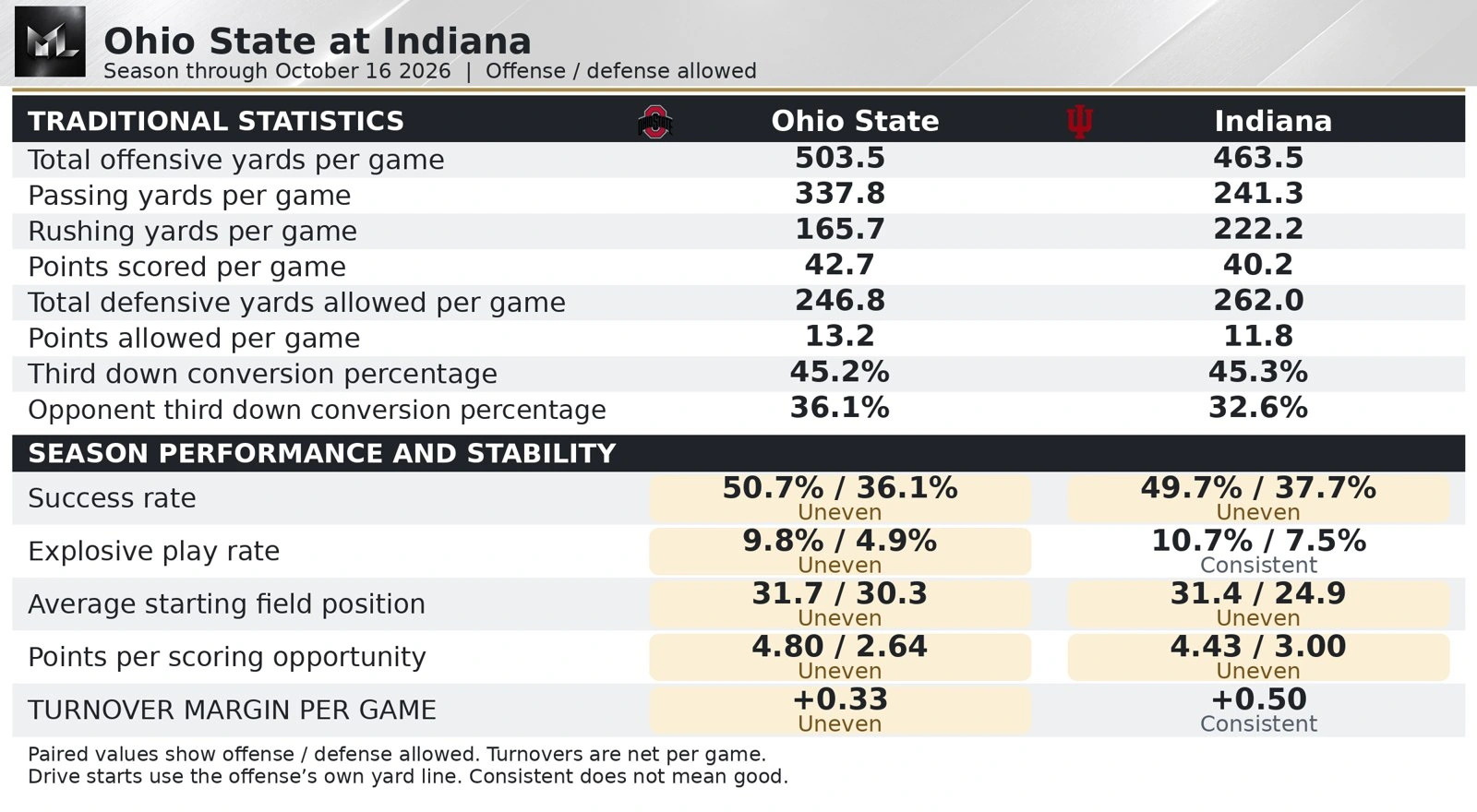
Ohio State has the more complete season argument than a 5-1 record alone suggests. Its offense averages 503.5 yards, while its defense allows 246.8. The useful distinction is that this has not required a spectacular turnover surplus. At plus 0.33 per game, the Buckeyes have earned much of their separation by making normal possessions productive and making the opponent's normal possessions difficult. A defense allowing successful plays on 36.1 percent of the measured sample should make Indiana work harder for its familiar running rhythm.
The Buckeyes still have to prove that their passing volume travels into a game where the defense can close drives. Indiana allows 11.8 points a game and converts almost the same share of third downs as Ohio State. Repeatedly turning first down into a long passing sequence would give away the balance that makes Ohio State dangerous. The 45-16 Maryland result is good evidence of scoring capacity, not proof that every scoring chance against Indiana will end the same way.
Indiana assessment
Indiana's 20-17 win at Nebraska matters because it came with 328 offensive yards, well below its 463.5 season average. The Hoosiers found a way through a tighter game without making the season's larger strengths disappear. Their 222.2 rushing yards per game and 49.7 percent successful-play rate provide a credible means of protecting possessions against Ohio State. The task is to keep the run useful before the defense can dictate an obvious passing down.
The concern is the space between territorial control and sudden damage. Indiana allows more valuable explosive plays than Ohio State, and Ohio State can punish a defense that repeatedly sends extra help toward the run. Indiana also begins opponents deeper in their territory on average. Sustaining that advantage would lengthen the Buckeyes' job, but it cannot be assumed to come from takeaways alone. Ohio State needs patient gains without cheap losses. Indiana needs a running game that still creates options when the first easy lane closes. Third-down comfort, rather than the unbeaten label, is the decisive test.
Northwestern at Michigan State
Saturday October 17 2026 at 11 00 AM Central · 4-1 and 2-4
Northwestern assessment
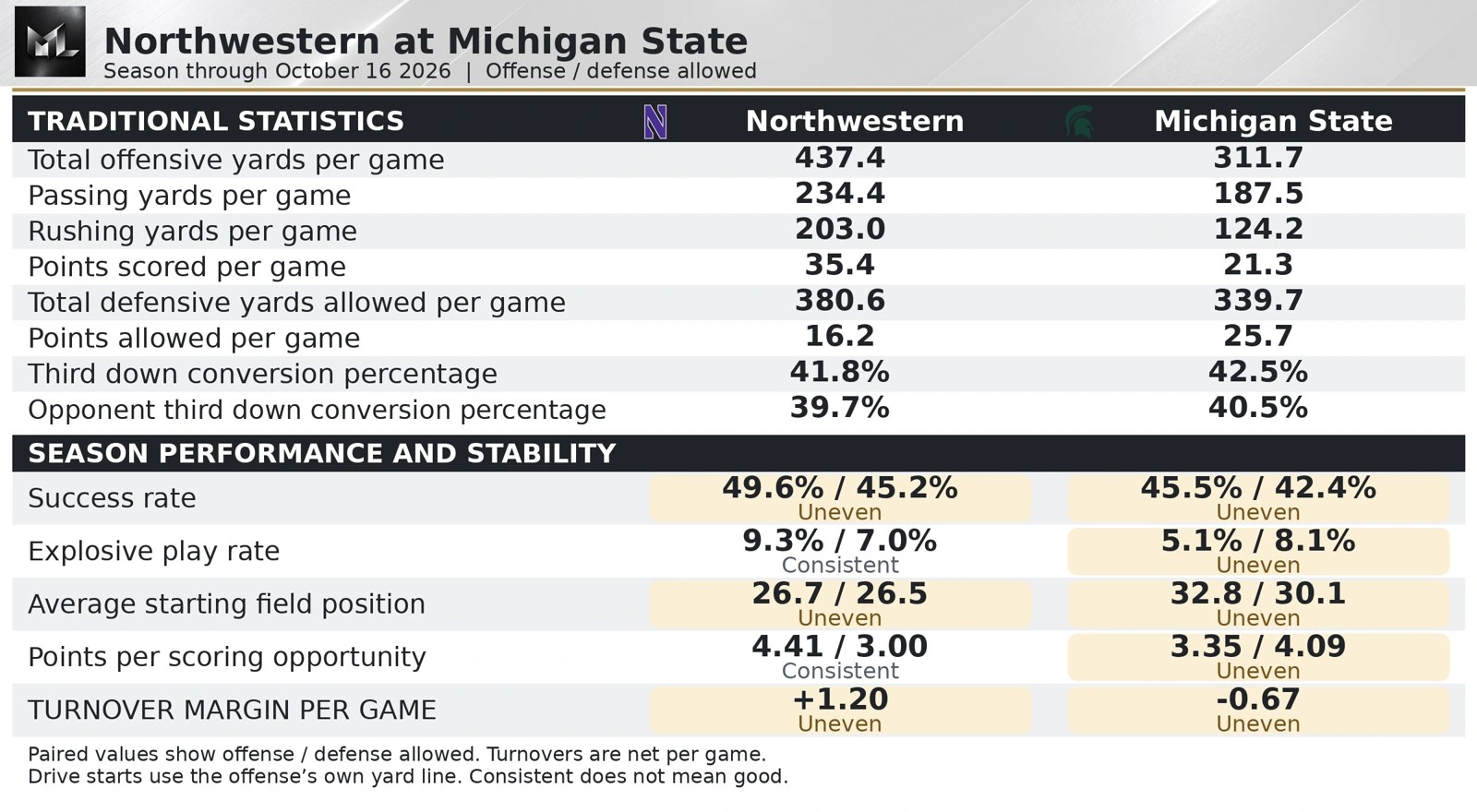
Northwestern's 4-1 start has more offensive substance than a team living entirely on a fortunate scoreline. The Wildcats average 203 rushing yards and 437.4 total yards, with useful plays on 49.6 percent of the measured offensive sample. Against Michigan State, that makes first down the place to apply pressure. A reliable five- or six-play sequence would force the Spartans to defend more choices than their season's modest offensive production can comfortably chase.
The warning comes on the other side. Northwestern allows 380.6 yards per game despite conceding only 16.2 points. That gap is a reason to examine how possessions finish, rather than declare that yards never matter. Opponents average three points per scoring chance before extra points, and Northwestern carries a plus 1.20 turnover margin per game. Both can protect a defense that permits movement. Neither entitles it to dismiss the next drive after an opponent crosses midfield.
Michigan State has struggled to turn its ordinary gains into a dangerous offense. Its 5.1 percent explosive rate leaves little room for stalled series, while its 21.3 scoring average offers limited cover when it loses the ball. Northwestern should make the Spartans assemble sustained drives instead of gifting the one short possession that changes the game's tone. The Wildcats' own starting field position is not unusually favorable, so offensive patience will matter if Michigan State avoids giveaways.
The 45-14 victory over Ball State was useful evidence of capacity, but it did not test Northwestern's defense against every kind of pressure. Michigan State's latest 38-37 defeat at least shows that its offense can turn a game into a scoring contest. Northwestern needs to make that an expensive ambition. The decisive matchup is its rushing consistency against a defense allowing successful plays on 42.4 percent of the sample. Michigan State must first protect possession, then force Northwestern to defend another meaningful down instead of waiting for its own offense to make the game comfortable.
Mississippi State at LSU
Saturday October 17 2026 at 11 00 AM Central · 4-1 and 4-2
Mississippi State assessment
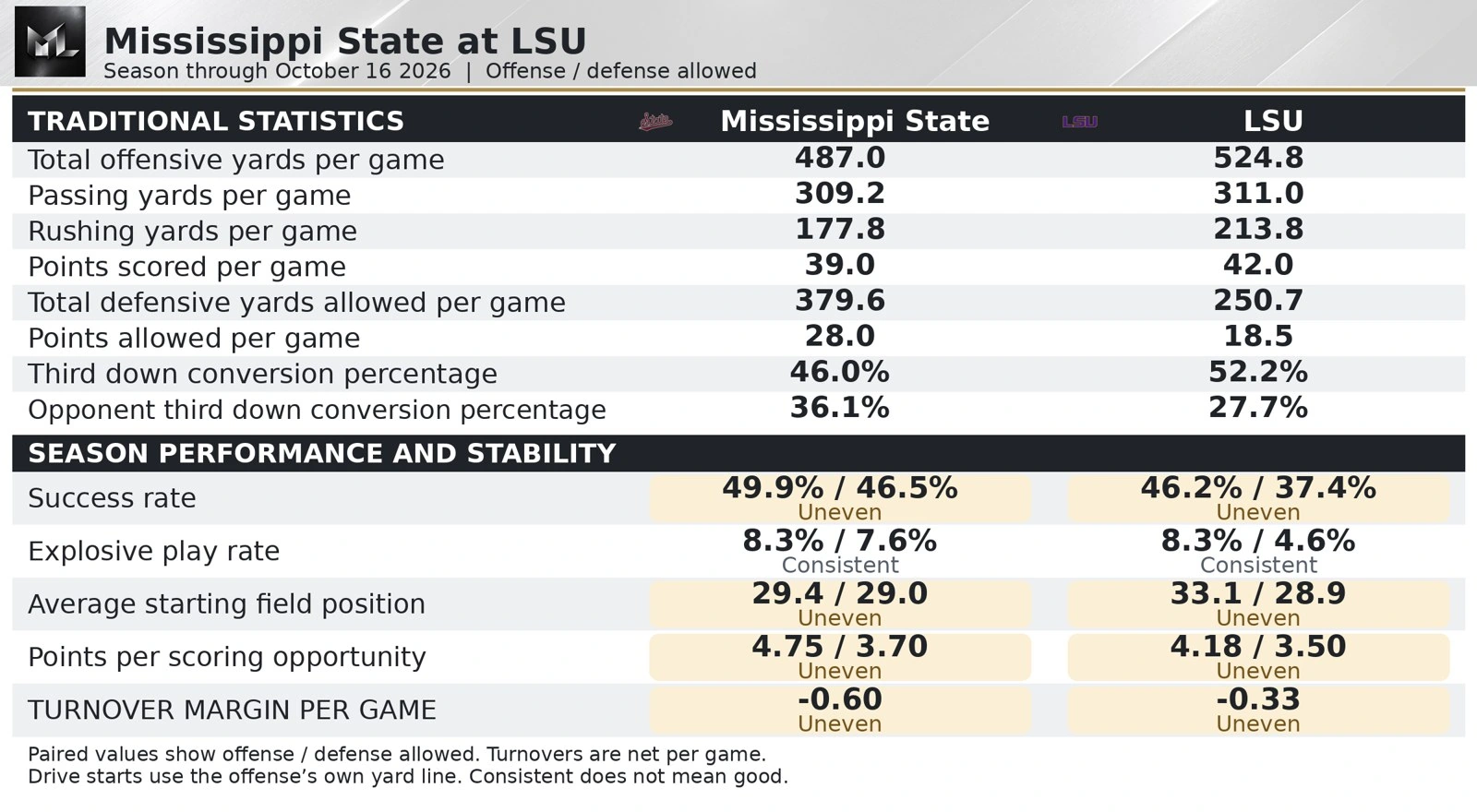
Mississippi State's offensive averages remain attractive after its idle week. The Bulldogs produce 487 yards and 39 points per game, and their 46 percent third-down conversion rate gives them a route to long possessions. The problem is that the last completed test was Alabama's 56-23 win. A strong season average has to survive better resistance before it can explain away that game. LSU's defense permits only 250.7 yards and converts opponent third downs into stops at a much better rate than Mississippi State usually faces.
The Bulldogs must make their passing production part of a functioning sequence rather than a rescue service. Their negative turnover margin takes possessions away from an offense that can otherwise create scoring chances. They also allow 28 points and successful plays on 46.5 percent of the sample. If LSU gets comfortable before third down, Mississippi State may need nearly all of its offensive average merely to remain involved.
LSU assessment
LSU's 4-2 record is a poor summary of how much useful football it has played, but losing 35-34 at Kentucky was still a loss. Its offense averages 524.8 yards and converts 52.2 percent of third downs. The defense allows only 27.7 percent on third down. Those are meaningful repeatable advantages. The Tigers should not need the next game to become another exercise in explaining why large statistical strengths did not produce the required result.
The place to improve is the return from scoring territory. LSU averages 4.18 points before extra points per scoring chance, compared with Mississippi State's 4.75. That does not forecast this matchup's outcome, but it identifies why another afternoon of movement might leave the score uncomfortably close. LSU also has a negative season turnover margin despite favorable average starts. It needs to preserve the possessions its offense creates. Mississippi State needs early-down answers that prevent LSU's third-down defense from controlling the game. The decisive question is whether LSU can combine its usual drive success with cleaner possession and better finishing, rather than presenting the box score as an appeal after the final whistle.
Florida at Texas
Saturday October 17 2026 at 11 00 AM Central · 4-2 and 4-1
Texas assessment
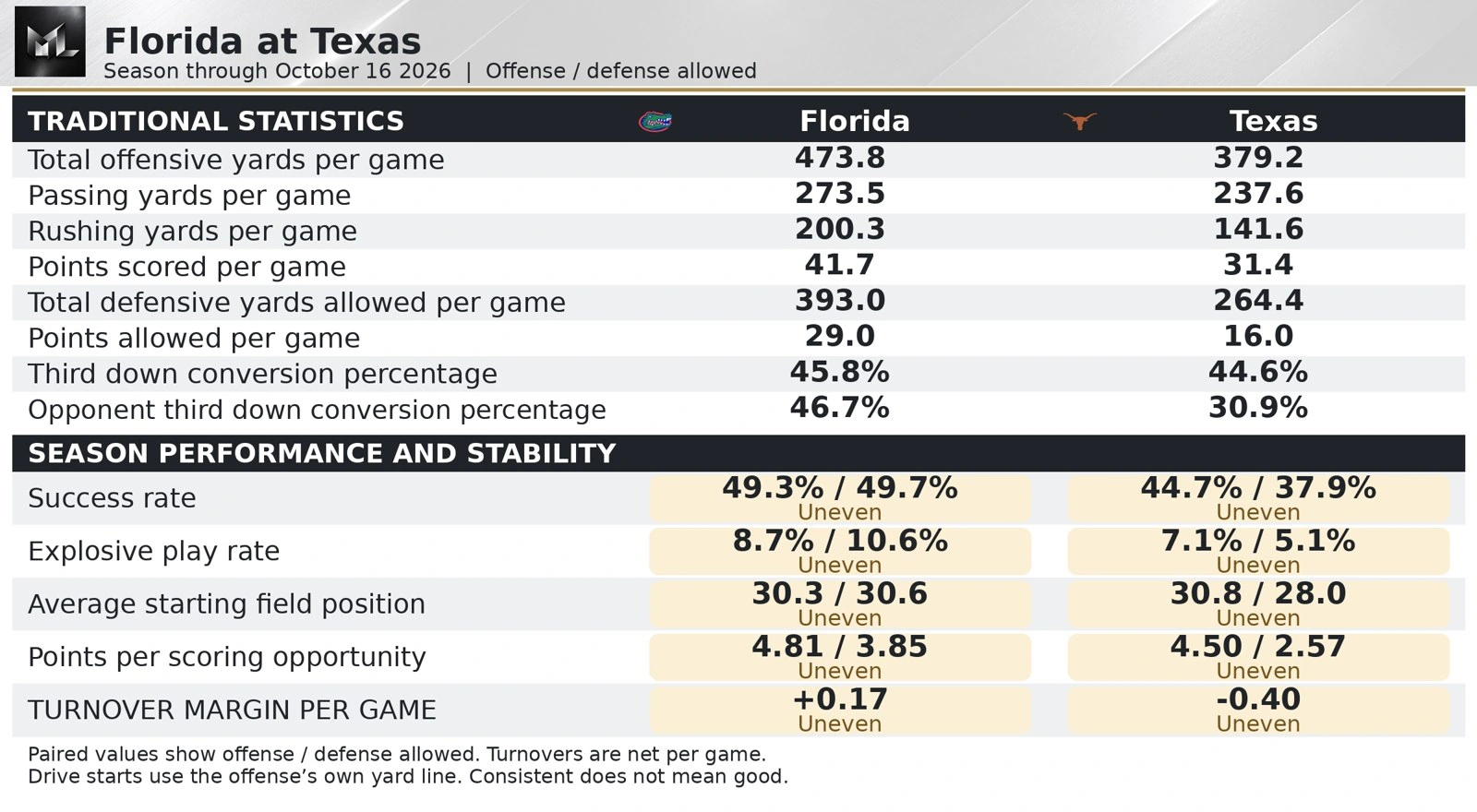
Texas does not need to abandon its defensive identity after losing 27-24 to Oklahoma. The Longhorns allow 264.4 yards and 16 points per game, and opponents convert 30.9 percent of third downs. Those numbers give them a solid way to keep Florida's scoring average from dictating this game. The harder question is whether the offense can make the defense's work feel worthwhile before another close finish arrives.
At 379.2 yards per game, Texas has less room for careless possessions than Florida's 473.8-yard offense. The Longhorns' 44.7 percent successful-play rate is useful, but it does not automatically provide the extra first down after a penalty or a sack. Against a defense allowing 46.7 percent of third-down attempts, Texas should seek manageable situations rather than assume the opponent will eventually make a mistake. Florida has allowed more valuable explosive plays than it creates, so there is also a reason to test space without making every drive depend on the deep throw.
Florida's 4-2 record includes a 38-19 loss to South Carolina in its latest game. Its 41.7-point average should therefore be treated as a statement of capacity, not a promised level. Texas can challenge the Gators to sustain movement against a defense allowing successful plays on just 37.9 percent of the measured sample. Keeping Florida outside scoring territory would reduce the importance of its strong 4.81-point return per opportunity.
Texas has been effective at denying useful points once opponents threaten, allowing 2.57 before extra points per chance. It should aim to make that the second line of protection, not the first thing the game asks of it. The offense also needs to improve a negative turnover margin. The decisive matchup is Texas's ability to exploit Florida's defensive third downs while keeping its own possessions intact. Florida needs ordinary gains that prevent the Longhorns from making every series a difficult passing examination. A defensive reputation will help Texas only if the offense supplies enough complete drives to support it.
North Carolina at Duke
Saturday October 17 2026 at 2 30 PM Central · 3-2 and 4-1
Duke assessment
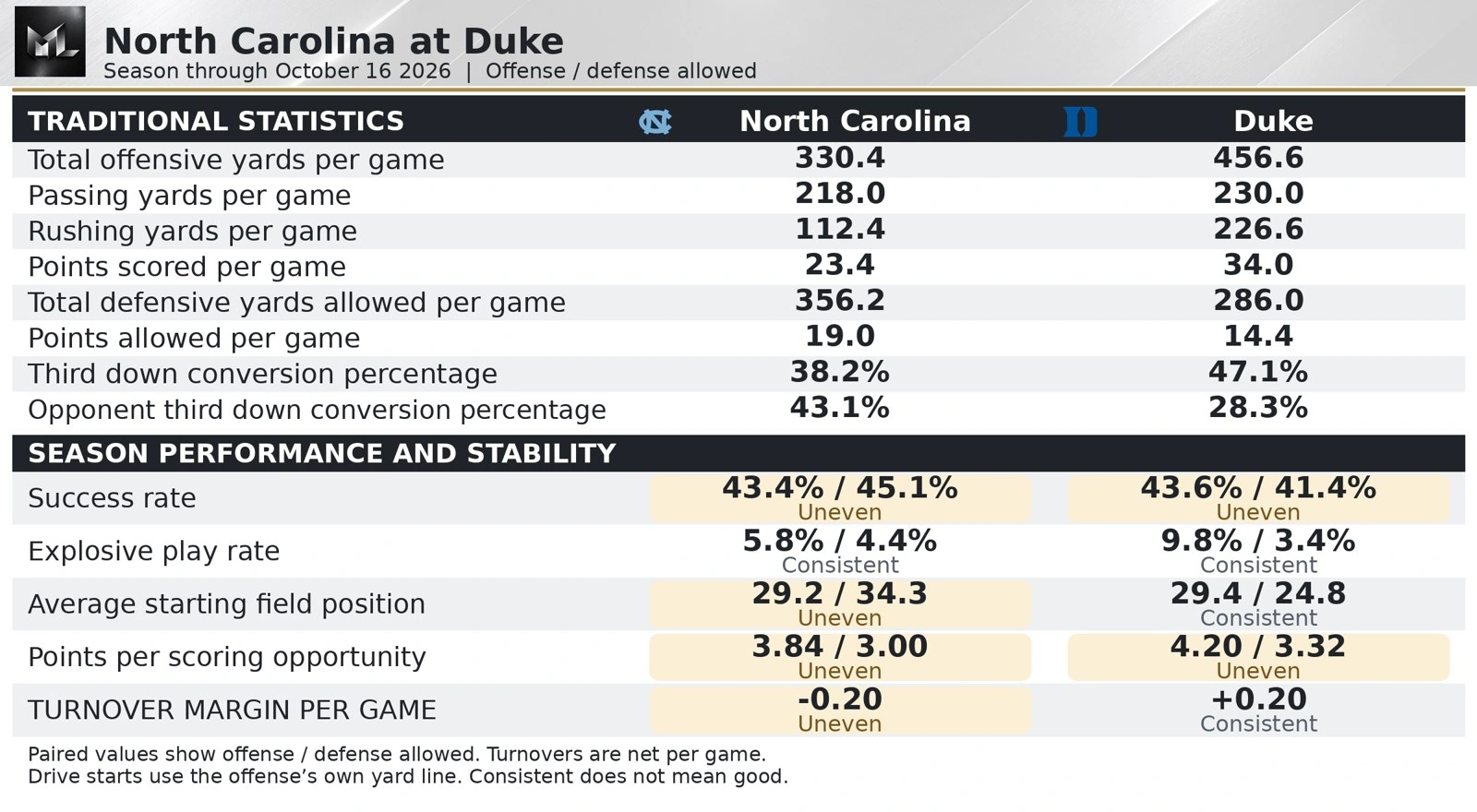
Duke has a sound season platform and an immediate reason to be annoyed with it. A 28-25 loss at Georgia Tech came despite 418 yards, close enough to its 456.6 season average to make simple offensive inactivity an incomplete explanation. The Blue Devils still rush for 226.6 yards per game and convert 47.1 percent of third downs. Against North Carolina, those strengths offer a way to control possession without asking one long pass to carry the entire afternoon.
The Tar Heels allow 43.1 percent on third down, so Duke should be able to keep its rushing threat connected to a wider set of choices. The important condition is that the early gains remain useful. Duke's successful-play rate is only 43.6 percent despite the large yardage average. That makes the valuable explosive plays consequential. North Carolina allows relatively few of those, so a plan built around waiting for the large gain could leave Duke doing more work on third down than it intends.
Duke's defense is the steadier part of the season argument. It allows 14.4 points per game, 28.3 percent on third down and valuable explosive plays on only 3.4 percent of the measured sample. North Carolina's 330.4-yard offense has a difficult assignment if it must repeatedly travel from deep territory. Duke's opponents have started at their own 24.8 on average. That advantage matters even though the average alone cannot tell us whether a particular possession began after a punt, return or turnover.
North Carolina's latest 21-17 win over Pittsburgh shows why Duke cannot confuse modest production with an automatic result. The Tar Heels can remain in a game by restricting the damage and taking the points a limited number of chances provide. Duke needs to make sustained rushing pressure produce useful scoring opportunities, then protect them. North Carolina needs to remove the explosive rescue and force Duke to complete the patient version of its offense. The decisive question is whether Duke can turn its stronger defensive baseline into a game where it controls both the number and the quality of meaningful possessions.
Penn State at Michigan
Saturday October 17 2026 at 2 30 PM Central · 3-3 and 3-2
Michigan assessment
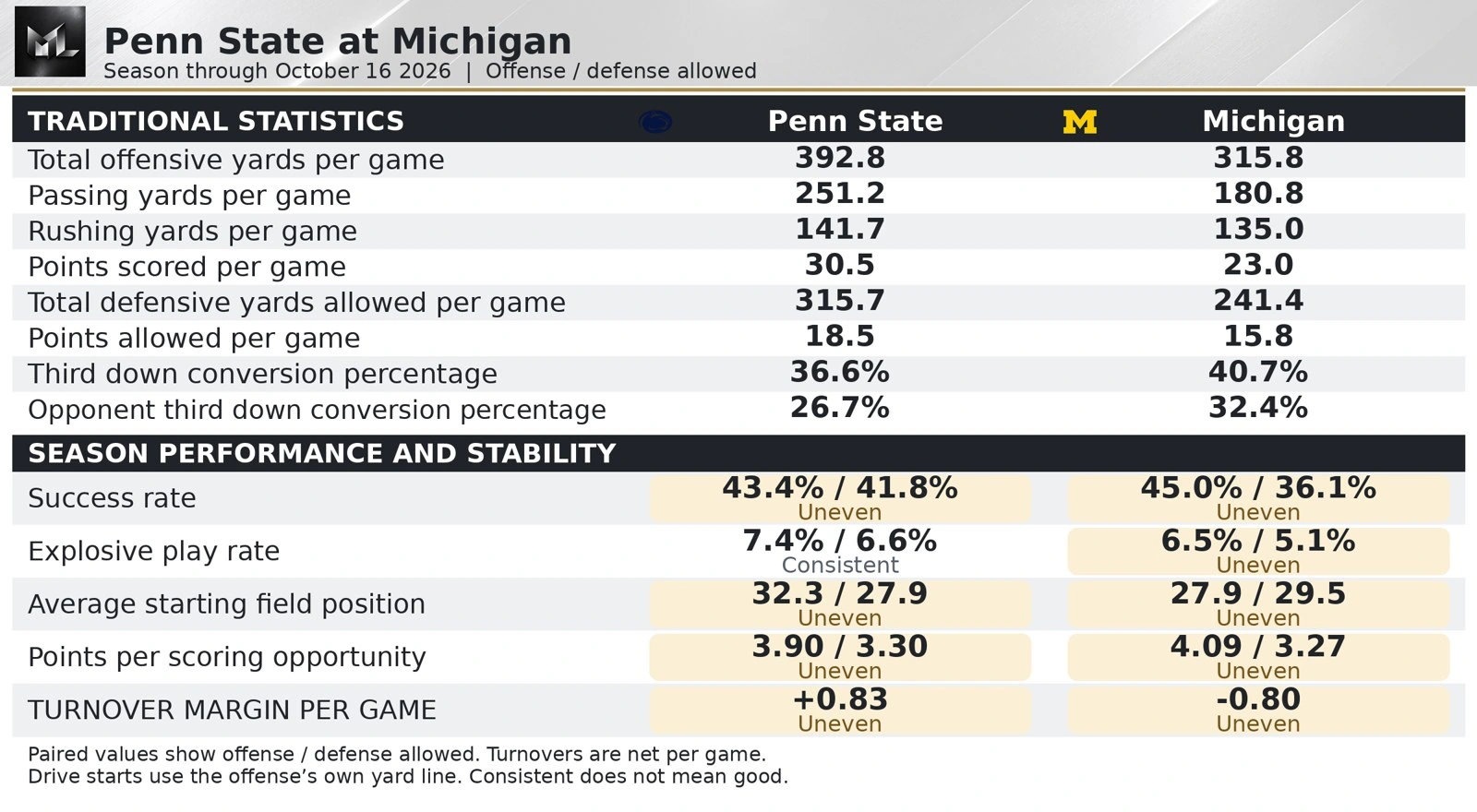
Michigan's season starts with a defense that deserves better offensive company. The Wolverines allow 241.4 yards and 15.8 points per game, and just 36.1 percent of the measured defensive plays have been successful for the opponent. Those are credible foundations for facing Penn State. They are also the reason a 3-2 record cannot be reduced to a claim that Michigan has no useful football to offer.
The offense has offered too little of it at the same time. Michigan averages 315.8 yards and 23 points, and its latest completed game produced only 180 yards in a 20-14 loss to Minnesota. A week without a game changes neither the season sample nor the nature of that concern. Penn State allows only 26.7 percent on third down. Michigan has to make first and second down productive enough that it does not spend the afternoon asking its least comfortable situations to rescue the drive.
Ball security is especially important here. Michigan averages minus 0.80 turnovers per game, while Penn State averages plus 0.83. Those are observed margins rather than a schedule for Saturday, but they show how Michigan could make an already limited offense's task smaller still. Starting at its own 27.9 on average has also left the Wolverines substantial distance to cover. A defense can keep earning stops without making every offensive drive short.
Penn State's 3-3 season has its own gap between respectable defensive numbers and sufficient results. Its offense converts only 36.6 percent of third downs and lost 31-23 to USC in the last game. Michigan should make the Nittany Lions earn their points through repeated execution instead of handing them the short possession that neutralizes the defensive work. The decisive matchup is Michigan's early-down offense against Penn State's third-down trap. Michigan needs useful gains and secure possession before it needs an elaborate explanation. Penn State needs to make its takeaways additive, rather than the only efficient route to offense.
Auburn at Georgia
Saturday October 17 2026 at 2 30 PM Central · 3-2 and 6-0
Georgia assessment
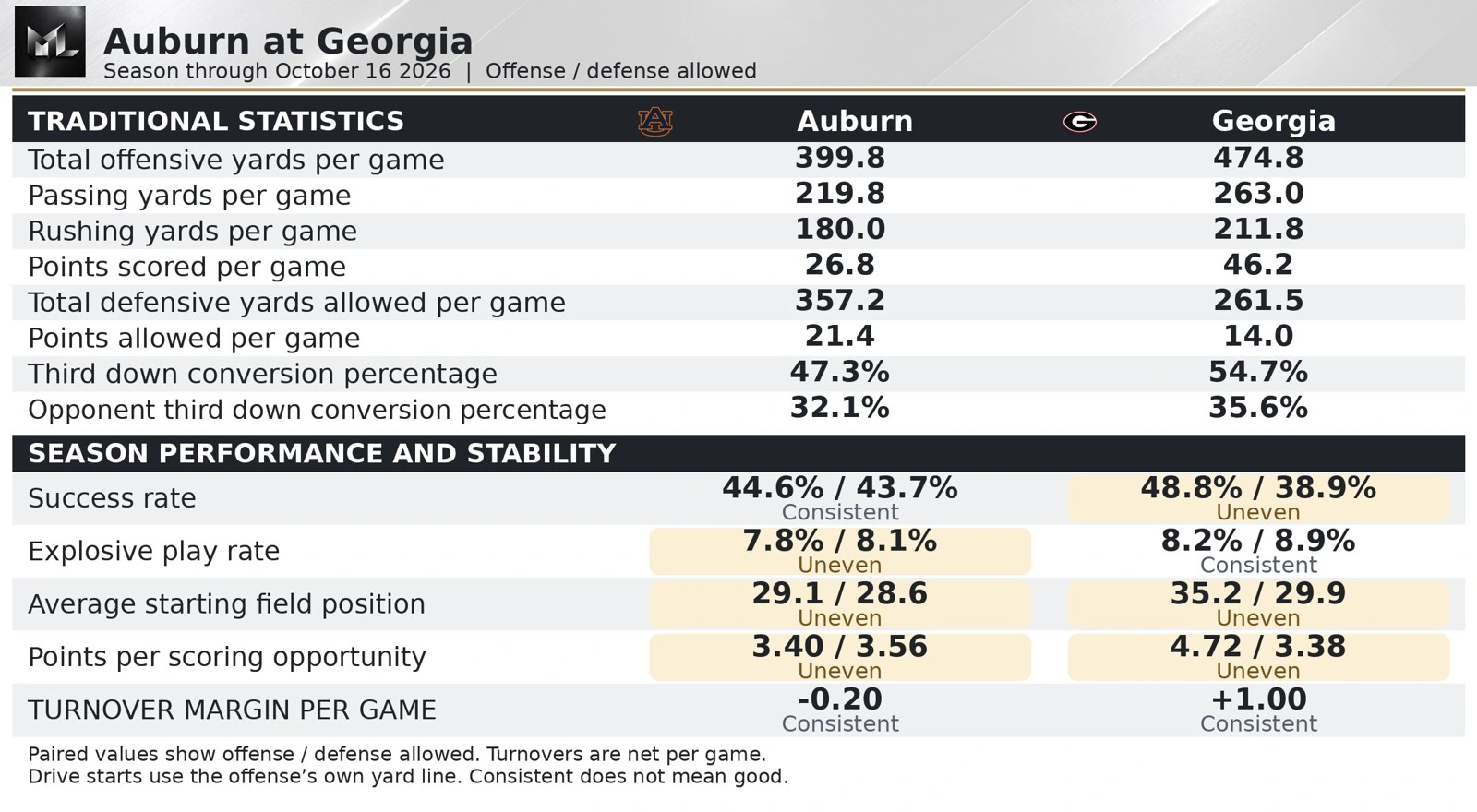
Georgia's 20-17 win at Alabama is a result worth keeping and a reason to continue examining the details. The Bulldogs gained 455 yards, close to their season average, but scored far below their 46.2 points per game. That makes the win evidence of surviving a harder scoring environment rather than proof that every part of the offense worked at its usual level. Auburn presents another opportunity to make drives worth more before the final possessions become a referendum on one decision.
Georgia's strongest route is the relationship between its rushing threat and its third-down conversion rate. It averages 211.8 rushing yards and converts 54.7 percent of third downs. Auburn allows only 32.1 percent there, so the Bulldogs should avoid treating that advantage as something they can call upon after wasting the first two downs. Keeping the field open with useful early gains would make Auburn defend the complete offense instead of specializing against the long pass.
There is also a defensive warning inside Georgia's excellent scoring average. The Bulldogs allow valuable explosive plays slightly more often than they create them. Their 14 points allowed per game therefore should not be interpreted as a guarantee that Auburn cannot change the field quickly. Auburn's own offensive return from scoring chances has been modest at 3.40 points before extra points. Georgia can make that difficulty matter by requiring long drives and tackling before a routine gain becomes an escape.
The Bulldogs start at their own 35.2 on average and have a plus 1.00 turnover margin per game. Both give them useful leverage, but neither proves that the next possession will begin kindly. Auburn's latest completed game was a 24-14 loss to Tennessee, and its season has not consistently converted movement into enough scoring. Georgia needs to preserve its possession and finish the chances its offense earns. Auburn needs clean drives that make Georgia defend another down without offering an easy short field. The decisive test is whether Georgia can make its considerable rushing and conversion strengths produce a more comfortable scoring return.
Missouri at Ole Miss
Saturday October 17 2026 at 2 30 PM Central · 5-1 and 4-1
Missouri assessment
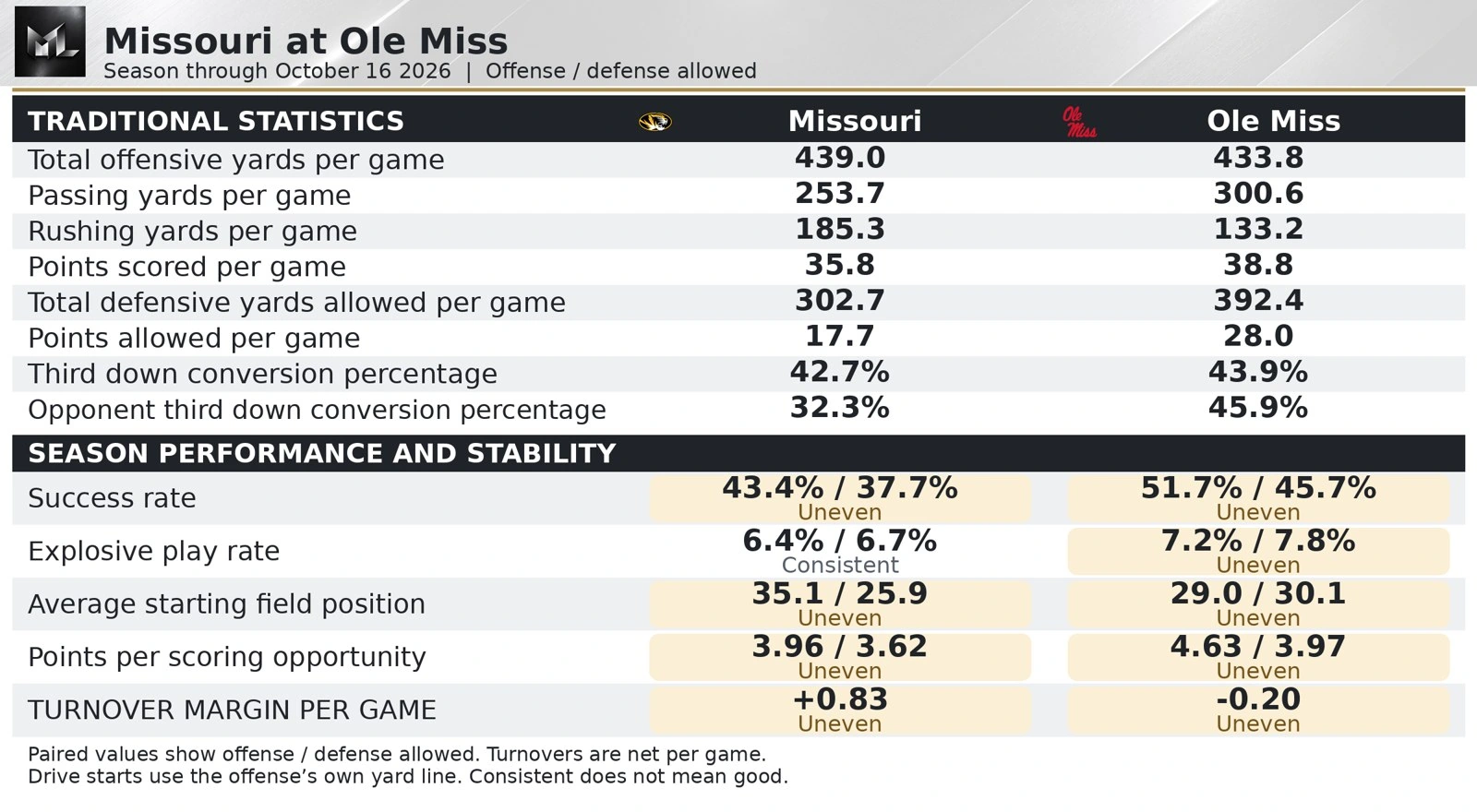
Missouri can take something concrete from holding Texas A&M to six points. The 27-6 win fits a season in which the Tigers allow 302.7 yards, 17.7 points and successful plays on 37.7 percent of the measured sample. That is useful defensive work, not merely a winning record looking for supporting numbers. Against Ole Miss, the first task is to keep that ordinary-play resistance intact when the opponent offers a more productive passing game.
Ole Miss averages 300.6 passing yards and 38.8 points. Missouri should not make containing that offense synonymous with conceding nothing. The practical objective is to keep gains small enough that the next down remains necessary. The Tigers allow 32.3 percent on third down, while Ole Miss converts 43.9 percent. Reaching those situations with the offense still needing real yardage would make Missouri's season strengths relevant. Letting the first two downs surrender the field would bypass them.
Missouri's own offense has benefited from very favorable average starting positions. It begins at its own 35.1 while opponents begin at their 25.9. Returns, penalties, turnovers and ordinary stops need to be distinguished before assigning credit for any specific short field. Whatever their source, those yards reduce the distance a 439-yard offense has to travel. Ole Miss can change the game by making Missouri repeatedly drive from deeper territory, where its 3.96-point return per scoring chance offers less margin than the Rebels' 4.63.
The 52-17 Ole Miss win over Vanderbilt should not make Missouri assume a shootout is compulsory. The Rebels still allow 392.4 yards per game and 45.9 percent on third down. Missouri has an opening for sustained possessions if it keeps the ball secure and resists chasing the opponent's last big play. The decisive matchup is the Tigers' defensive patience against Ole Miss's early-down passing success. Missouri needs another series of stops that make the field feel long. Ole Miss needs to produce that passing rhythm without creating the extra possessions that have helped Missouri control its season.
Alabama at Tennessee
Saturday October 17 2026 at 2 30 PM Central · 5-1 and 5-1
Alabama assessment
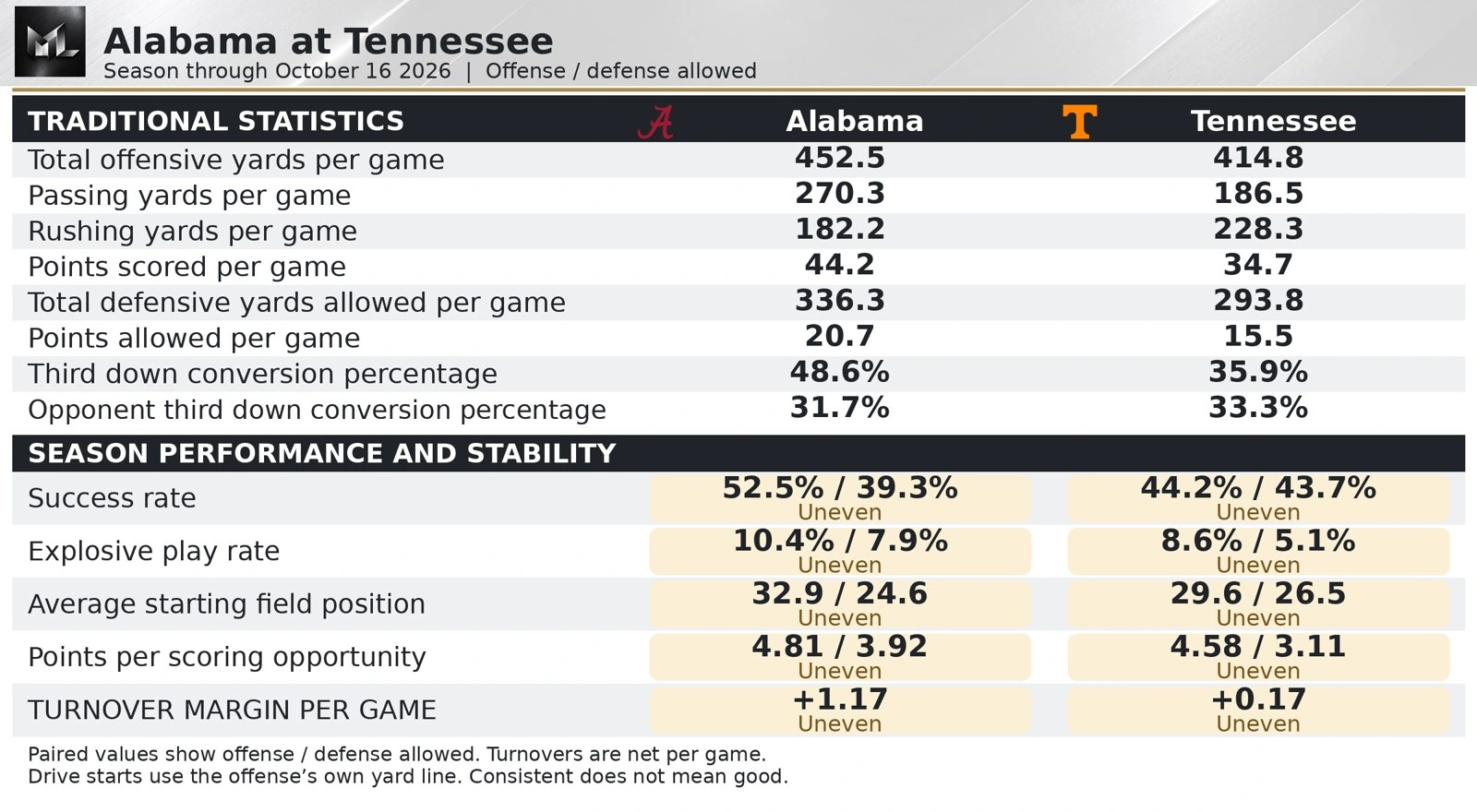
Alabama remains second in our index because one three-point loss does not remove the rest of its season. It has been successful on 52.5 percent of the measured offensive plays, averages 452.5 yards and converts 48.6 percent of third downs. The 20-17 Georgia defeat does, however, make the offense answer a specific question. Can it keep useful early gains connected to scoring when a defense refuses to make the final part of the drive easy?
Tennessee allows 15.5 points per game and only 3.11 before extra points per scoring chance. Alabama cannot assume that moving the ball against that defense will be enough. Its favorable average starts and plus 1.17 turnover margin have supplied leverage, but repeated full-field drives would ask more of the offense. The Crimson Tide need to make their rushing balance create manageable choices before third down, rather than use their strong conversion average as permission to waste the earlier ones.
Tennessee assessment
Tennessee's 228.3 rushing yards per game give it a direct way to challenge Alabama without turning every possession into a passing contest. The concern is how much pressure a stalled run puts on what follows. The Volunteers convert only 35.9 percent of third downs, and their successful-play margin is much narrower than the 5-1 record might suggest. Alabama can make that weakness visible by preventing the first run from creating a comfortable second down.
The Volunteers deserve credit for allowing relatively few valuable explosive plays and for holding Arkansas to seventeen points in their latest 24-17 win. They still have to contain an Alabama offense with a much larger explosive rate than most ordinary series can tolerate. Tennessee needs to finish tackles before a good defensive call becomes a large gain. Alabama needs to make its offensive efficiency show up near the goal line as well as between the twenties. The decisive matchup is Tennessee's early rushing success against Alabama's ability to force an obvious passing situation. Neither record tells us which side will control that exchange.
Washington State at Oregon State
Saturday October 17 2026 at 5 00 PM Central · 1-5 and 4-2
Oregon State assessment
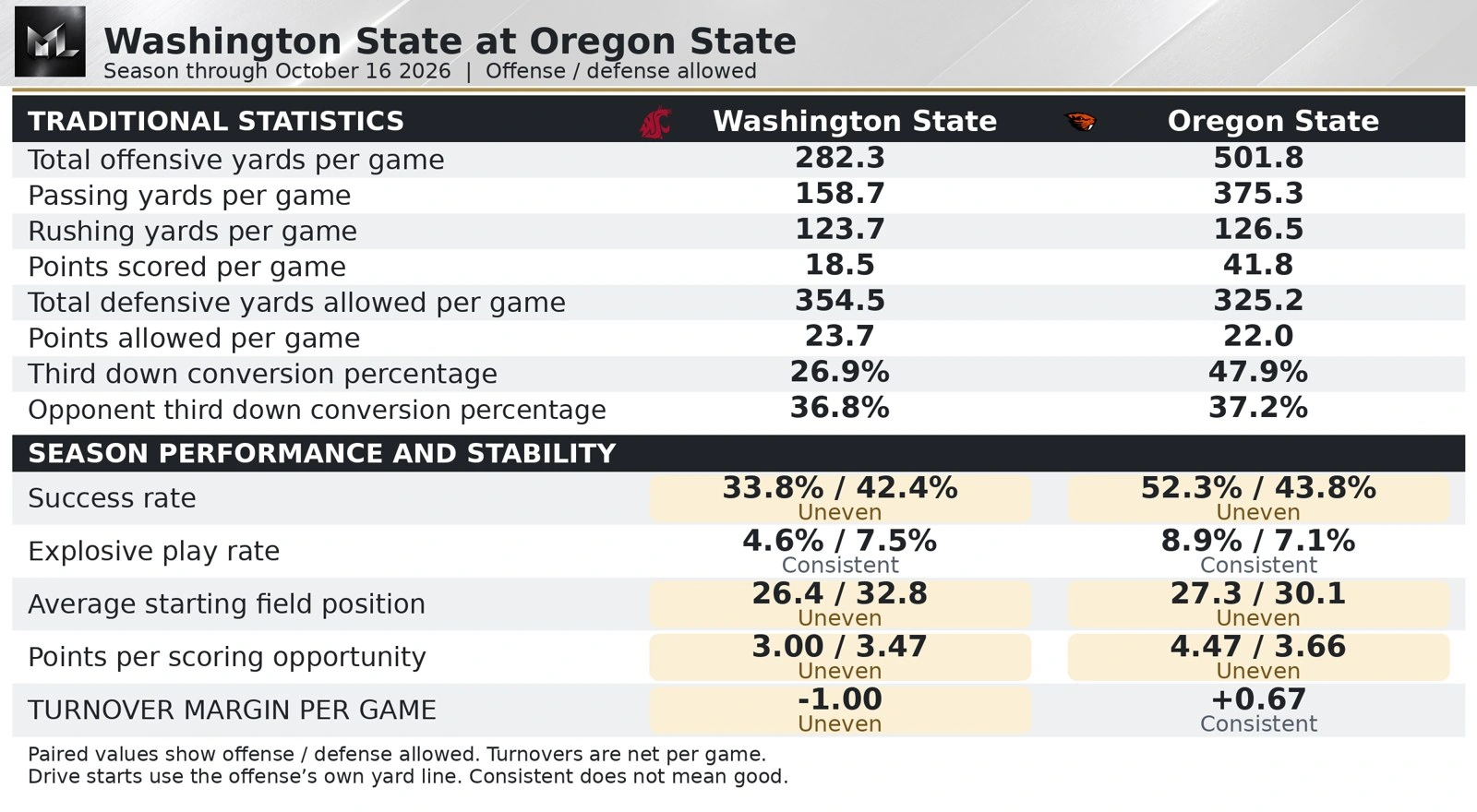
Sixty-six points are a productive way to end an argument with San Diego State. They are a poor reason to stop looking at the season. Oregon State's 66-14 win came with 651 yards, well above an already substantial 501.8-yard average. The Beavers have genuine offensive capacity, especially through the air, but the next game should be assessed against the repeated evidence rather than by reserving last week's scoreboard.
Washington State's offense gives Oregon State a clear defensive task. The Cougars average 282.3 yards, convert 26.9 percent of third downs and have successful plays on only 33.8 percent of the measured sample. Oregon State should make them assemble enough ordinary gains to earn scoring territory. A cheap explosive gain or an unnecessary lost possession would let Washington State avoid the part of the game in which it has struggled most.
The Beavers also have room to become more complete. They allow 325.2 yards and 22 points per game, and opponents convert 37.2 percent of third downs. Those averages leave a route for an underperforming offense to stay on the field if the first tackle is missed or the needed yardage stays small. Oregon State should use its own passing production to build sustained pressure, then ask its defense to end the next series without requiring another huge offensive answer.
Washington State has averaged minus 1.00 turnover per game and lost its latest game 17-16 at Utah State. That combination explains why merely keeping this game close would not solve its offensive problem. Oregon State must protect possession even if it expects more scoring chances. Its average starts have actually been slightly worse than the opponent's, so clean, patient travel still matters beneath the large point totals. The decisive matchup is the Beavers' passing rhythm against a defense allowing valuable explosive plays on 7.5 percent of its sample. Oregon State needs another efficient offense with fewer defensive invitations. Washington State needs secure possessions that force the Beavers to defend the whole drive.
Florida State at Miami
Saturday October 17 2026 at 6 00 PM Central · 3-3 and 5-0
Miami assessment
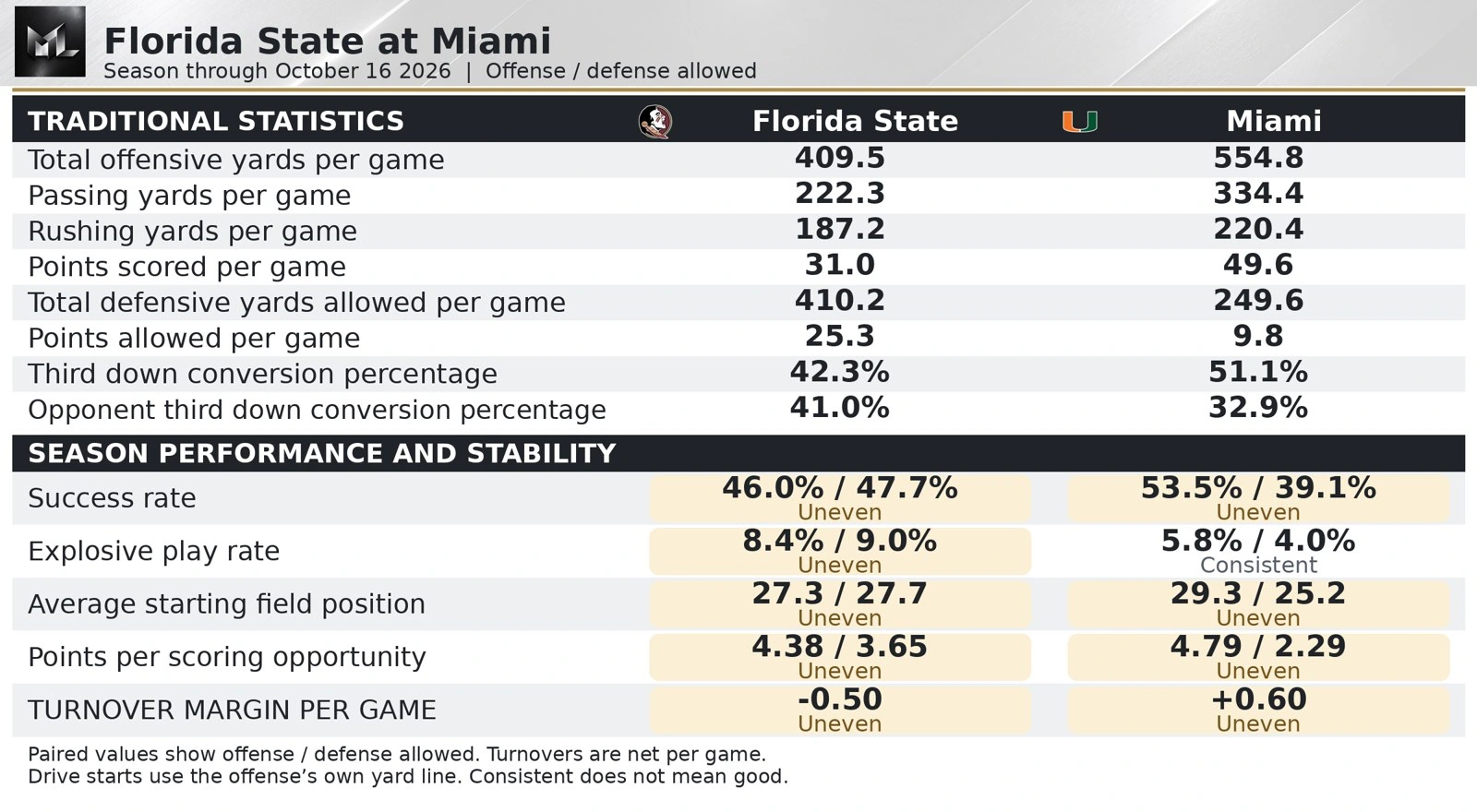
Miami has earned the right to be judged as a complete team. Through five games it averages 554.8 yards and 49.6 points while allowing 249.6 yards and 9.8 points. Those are large gaps supported by useful-play rates on both sides, rather than by an extravagant turnover surplus alone. Florida State needs to make the Hurricanes demonstrate the patient version of that offense before it starts worrying about every possible large score.
Miami's comparatively modest 5.8 percent valuable-explosive rate is instructive. The offense has been productive without needing an unusually high share of huge-value plays. Its 53.5 percent successful-play rate and 51.1 percent third-down conversion rate instead point toward repeated movement. Florida State has allowed successful plays on 47.7 percent of the measured sample. If that remains the shape of the game, Miami can keep creating scoring chances without waiting for a defender to fall down.
The Hurricanes' defense has been particularly effective after opponents reach threatening territory, allowing 2.29 points before extra points per chance. It should aim to make that protection unnecessary as often as possible. Florida State can rush for useful yardage and has created valuable explosive plays more often than Miami, so a low season scoring allowance should not make the secondary or the tackling casual. One long gain can change the possession even when it does not change the entire season assessment.
Florida State's 44-20 loss at Louisville supplied another warning about allowing too much movement. Its season yardage allowed slightly exceeds its offensive production, and a negative turnover margin makes that trade less forgiving. Miami should protect the ball, maintain its run-pass balance and require the Seminoles to create their own field position. Florida State needs to remove the easy first-down gain and make Miami finish longer sequences under pressure. The decisive matchup is Miami's ordinary offensive efficiency against a defense that has too often permitted it. The Hurricanes' job is to make their strong baseline visible without treating the rivalry as a substitute for execution.
Louisville at Syracuse
Saturday October 17 2026 at 6 30 PM Central · 3-3 and 2-3
Louisville assessment
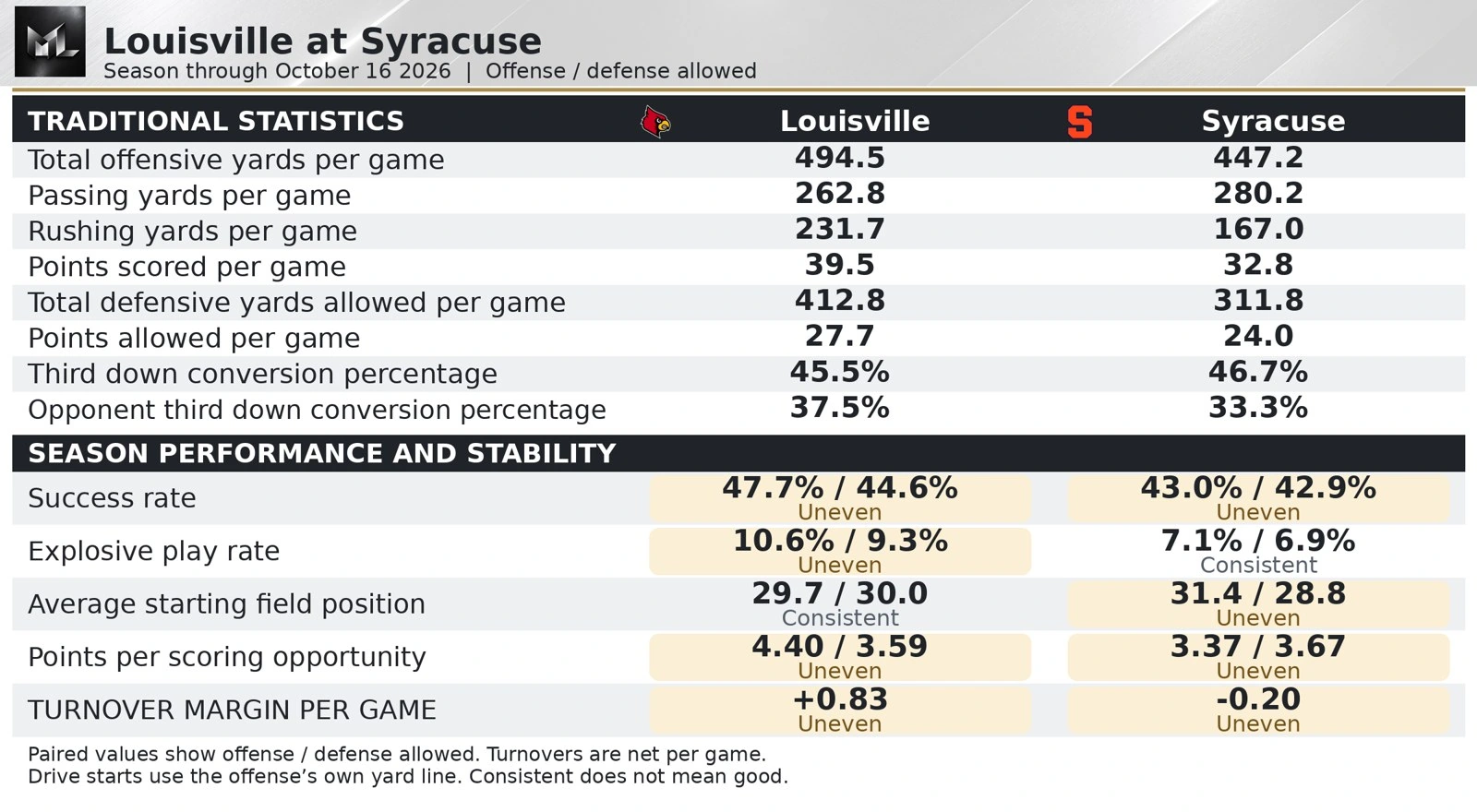
Louisville's 3-3 record and top-25 performance position are not a contradiction to be hidden. They describe different parts of the season. The Cardinals average 494.5 yards and 39.5 points, with 231.7 rushing yards supporting a passing game that can also move the field. They have also allowed 412.8 yards and valuable explosive plays on 9.3 percent of the defensive sample. Plenty has happened in these games. Not all of it has helped Louisville.
The latest 44-20 win over Florida State showed the offensive ceiling, with 537 yards. Syracuse should test whether that production can be repeated against a defense allowing only 311.8 yards and 33.3 percent on third down. Louisville has a practical advantage if it can keep the running game useful early. Reaching third down with several options would prevent Syracuse from treating its stronger stopping rate as the entire defensive plan.
The other side is less comfortable. Syracuse averages 447.2 yards and 280.2 through the air. Louisville cannot make a plan out of assuming its own next scoring drive will erase whatever the defense permits. The Cardinals' plus 0.83 turnover margin has been helpful, but a takeaway is not a scheduled stop. A defense that reduces the opponent's ordinary passing gains could earn field position without depending on one. The near-even average starts for Louisville and its opponents reinforce that there is still room to win territory through repeated possessions.
Syracuse lost 28-25 to Virginia despite 430 yards in its last game. That makes its 3.37-point return from scoring chances an important target for Louisville. Keeping the Orange working near the goal line is useful only if the Cardinals first prevent the sudden score that skips that stage. Louisville needs sustained rushing pressure and fewer explosive defensive concessions. Syracuse needs to make its passing production produce points without offering extra possessions. The decisive test is whether Louisville's defense can support its offense for a whole game, rather than asking a good scoring total to settle every question.
Notre Dame at BYU
Saturday October 17 2026 at 6 30 PM Central · 6-0 and 5-0
Notre Dame assessment
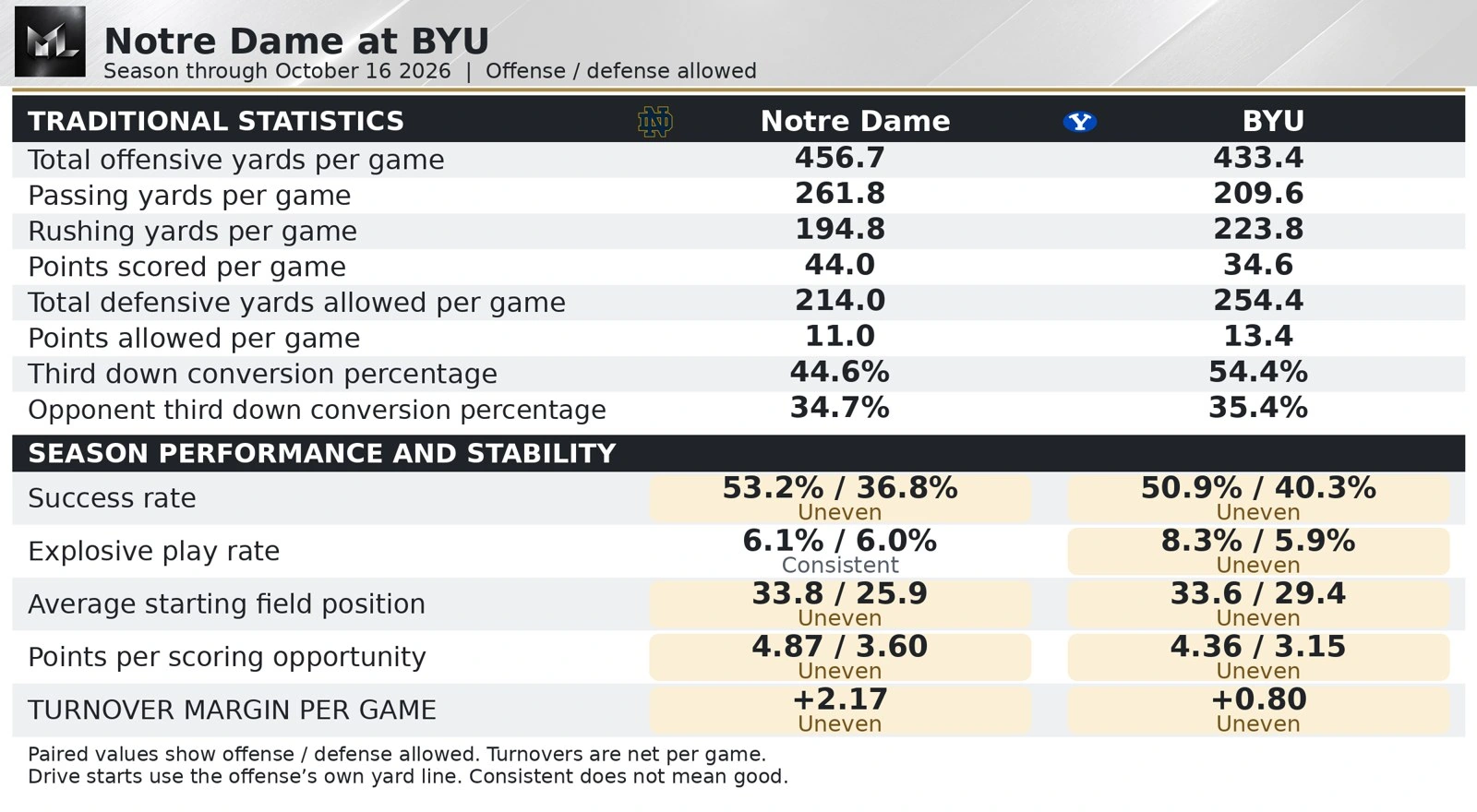
Notre Dame's lead in our index rests on more than the 58-7 Stanford result. The Irish allow 214 yards and eleven points a game, with opponents successful on 36.8 percent of the measured sample. Their offense has the opposite habit, successful on 53.2 percent. That difference gives Notre Dame a way to control ordinary possessions even if the next game never resembles the most recent one.
The separate warning is its plus 2.17 turnover margin per game. That has supplied a substantial advantage and cannot be treated as a promise. BYU should test the Irish on longer fields and complete possessions, where an offense averaging 456.7 yards still has to finish what it starts. Notre Dame averages 4.87 points before extra points per scoring chance. Keeping that return strong without requiring another exceptional turnover afternoon is the worthwhile test.
BYU assessment
BYU's five wins have an offensive structure that can challenge Notre Dame. The Cougars rush for 223.8 yards per game, convert 54.4 percent of third downs and have been successful on 50.9 percent of the measured offensive plays. That creates a credible route to keeping possession and making a good defense defend again. The first task is to preserve those useful early gains when Notre Dame reduces the available space.
The Cougars gained 506 yards in their 24-10 win over Iowa State. That is evidence of movement, but it also shows why simply predicting a repeat yardage total would miss the scoring question. Against Notre Dame, a long drive that ends without useful points could be difficult to replace. BYU allows only 13.4 points per game and has limited valuable explosive plays, so it need not make the game frantic. Notre Dame needs disciplined possessions that survive without the turnover bonus. BYU needs ball security and the conversion rate to remain useful against better early-down resistance. The decisive matchup is the Cougars' ability to keep their rushing threat alive long enough to choose the next play, rather than merely react to Notre Dame's defense.
Oklahoma State at Houston
Saturday October 17 2026 at 6 30 PM Central · 4-1 and 5-1
Houston assessment
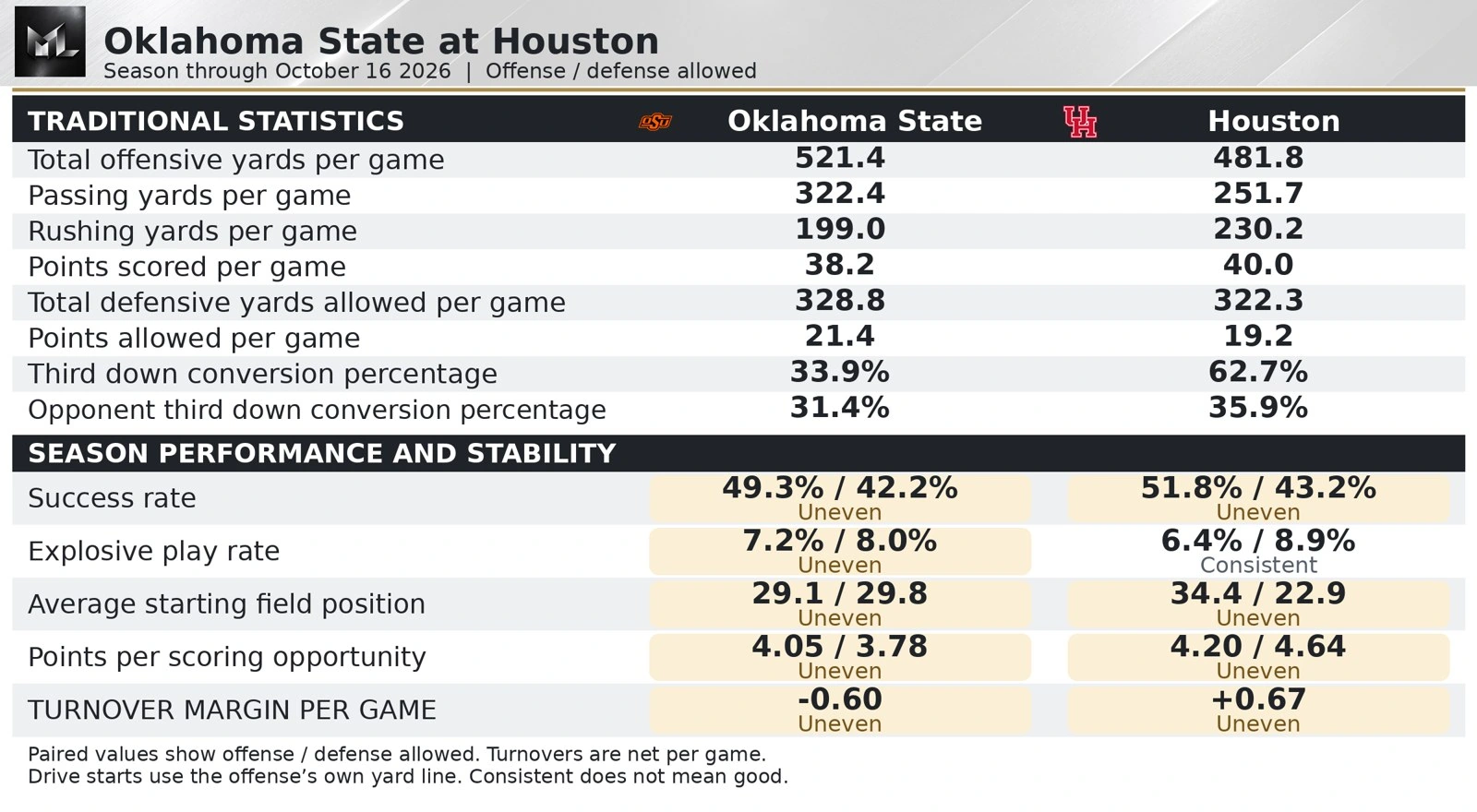
Houston reaches our selected 25 with a season that should make the opponent prepare for repeated first downs. The Cougars average 481.8 yards, rush for 230.2 and convert 62.7 percent of third downs. That last figure is a formidable observed rate, not an entitlement to convert the next attempt. Oklahoma State allows 31.4 percent on third down, so Houston has to preserve the quality of the situations that produced its success instead of merely quoting the percentage.
The 35-16 win at Kansas State, with 475 yards, fits the broader offensive picture. Houston can use the run to keep enough choices open that its passing game does not have to operate only from a disadvantage. It has also enjoyed an unusually large difference in average starts, beginning at its own 34.4 while opponents begin at their 22.9. That is valuable territory. It should be earned again, with returns, penalties, turnovers and ordinary stops kept distinct when explaining each possession.
Houston's vulnerability is what happens when the defense does allow a threat. Opponents average 4.64 points before extra points per scoring opportunity, higher than Houston's own 4.20. The defense has also allowed valuable explosive plays more often than the offense creates them. Oklahoma State's 521.4 yards per game are therefore a meaningful challenge, even though the Cowboys convert only 33.9 percent on third down. Houston should try to make that limitation matter by forcing the extra down before the field disappears.
The Cowboys' negative turnover margin provides an opportunity, not a guaranteed possession. Houston cannot assume another short field will cover a defensive lapse. It needs to make its rushing consistency and third-down quality carry the offense while reducing the sudden gains it permits. Oklahoma State needs secure early-down production that avoids an unfavorable conversion contest. The decisive matchup is Houston's ability to make the Cowboys sustain drives against a defense that has sometimes been too generous once scoring territory is reached.
Wisconsin at UCLA
Saturday October 17 2026 at 6 30 PM Central · 4-1 and 5-0
Wisconsin assessment
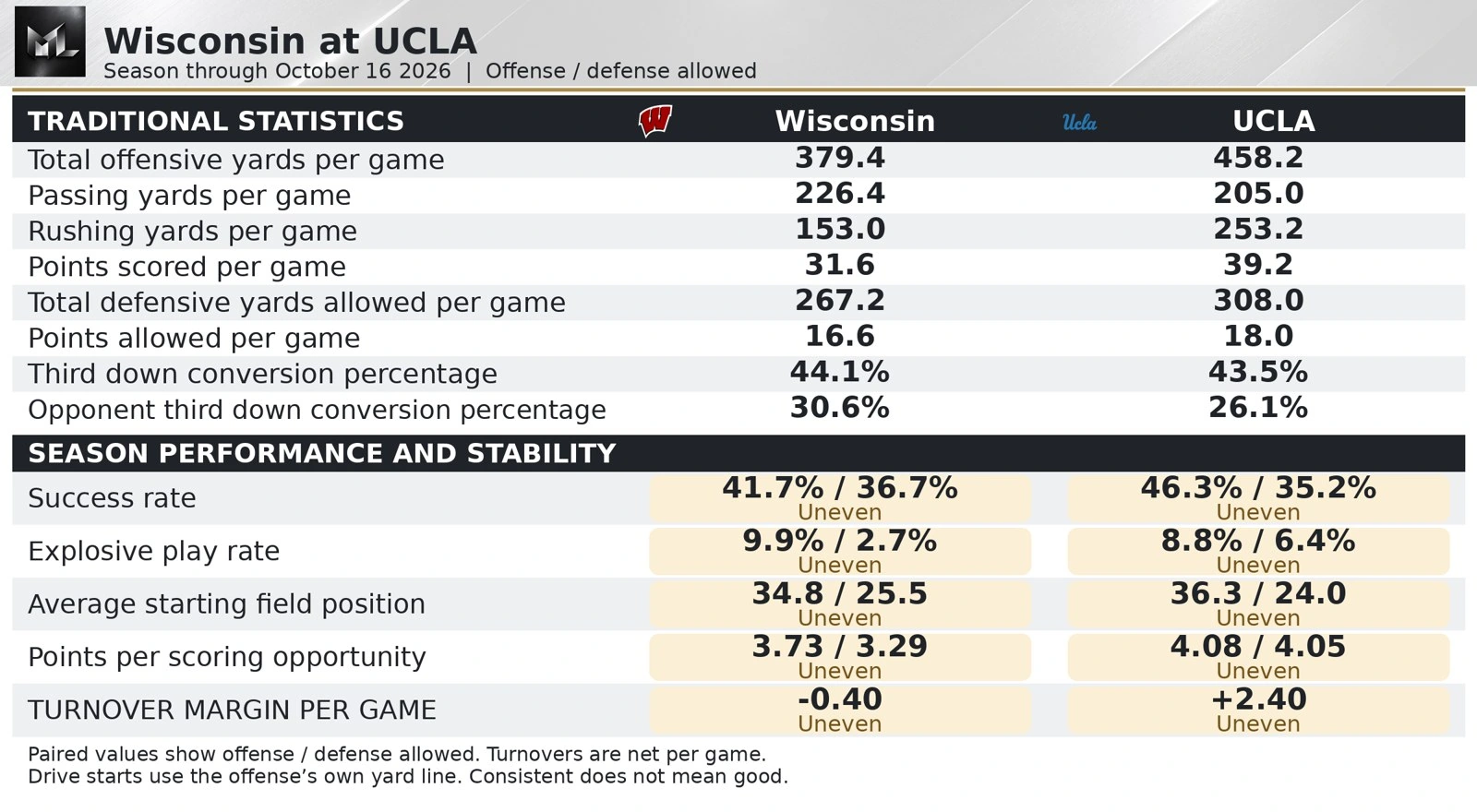
Wisconsin's defense has supplied a credible reason to trust its 4-1 season. It allows 267.2 yards and valuable explosive plays on only 2.7 percent of the measured sample. That is a useful starting point against UCLA's 253.2 rushing yards per game. The Badgers can keep the game manageable by finishing ordinary tackles, limiting the sudden field change and requiring UCLA to repeat its gains.
The offense needs to make that defense's work count. Wisconsin averages 379.4 yards but only 3.73 points before extra points per scoring chance. UCLA allows just 26.1 percent on third down, making it important that Wisconsin's earlier plays remain useful. A season offensive successful-play rate of 41.7 percent leaves less room for waste than its 31.6-point scoring average might imply. The Badgers also carry a negative turnover margin into a game against a team that has repeatedly profited from extra possessions.
UCLA assessment
UCLA's 17-15 win at Oregon showed that an unbeaten season can survive a game played below its usual scoring pace. It did not make the source of that survival irrelevant. The Bruins average plus 2.40 turnovers per game and begin at their own 36.3 while opponents begin at their 24.0. Those are enormous advantages. Their defense's 35.2 percent successful-play rate allowed is a strong separate reason for the 5-0 record, but the offense should still be examined on a field that starts less kindly.
Scoring-chance returns are almost even between UCLA and its opponents. That makes the number and location of the chances especially important. Wisconsin can threaten the Bruins' usual game by preserving the ball and removing the explosive rescue. UCLA needs its rushing volume to become useful gains rather than merely more attempts, particularly against a defense that has kept big-value plays scarce. The decisive matchup is UCLA's running consistency against Wisconsin's prevention of sudden damage. The Badgers need complete, secure possessions. The Bruins need to demonstrate control even if the turnover column stops doing so much of the talking.
Kentucky at Oklahoma
Saturday October 17 2026 at 6 30 PM Central · 5-1 and 3-2
Oklahoma assessment
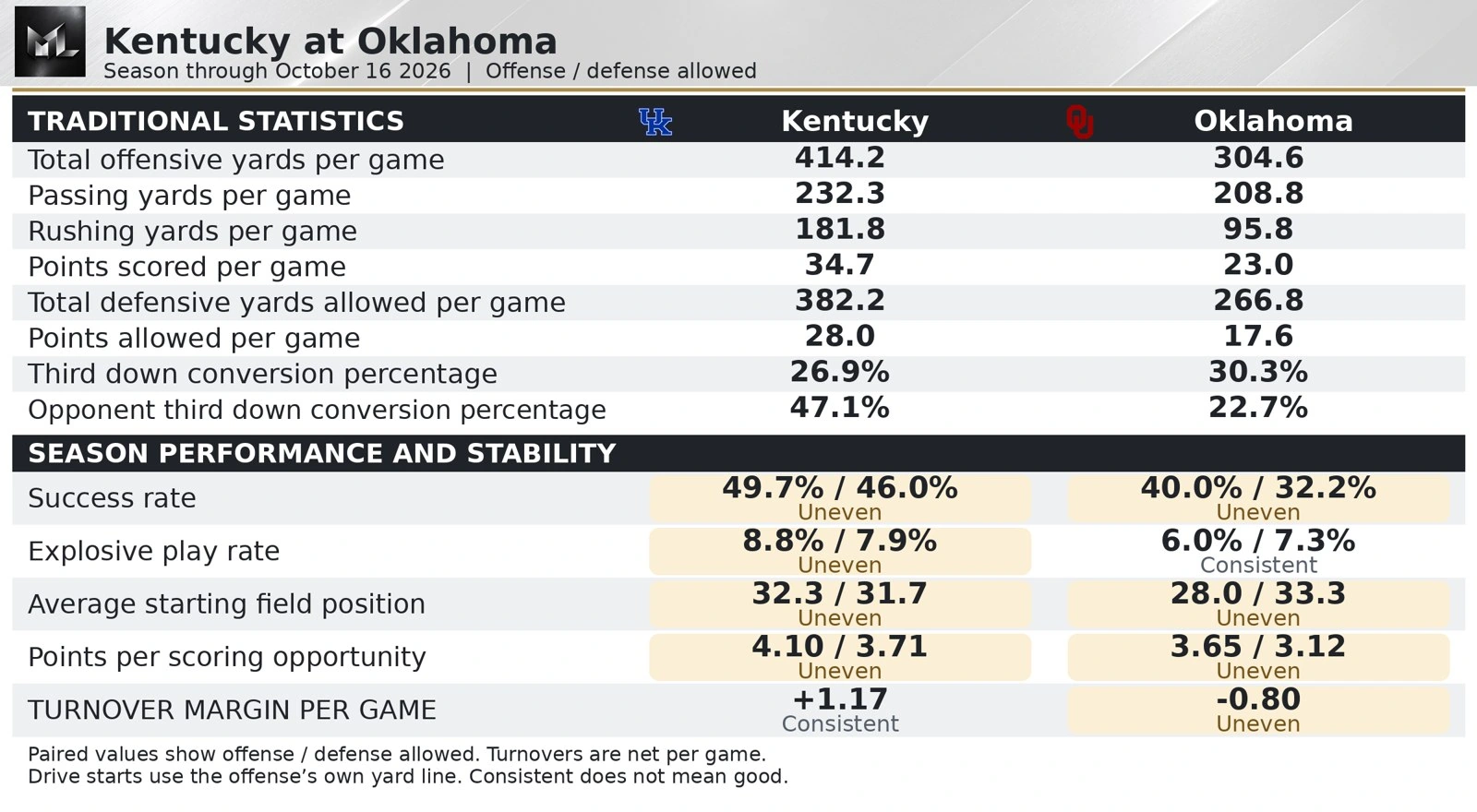
Oklahoma beat Texas 27-24 with 238 offensive yards. That is a result to keep and a performance to examine, especially when the season offense averages only 304.6 yards and 23 points. The Sooners have a defensible place in our selected 25 because their opponent-adjusted work and their defense have been substantially stronger than the simplest record or scoring average would explain. The offense still has to provide more than a request for the defense to do it again.
Kentucky presents an opportunity to build a better offensive sequence. The Wildcats allow 47.1 percent on third down. Oklahoma converts only 30.3 percent, so the matchup asks the Sooners to turn a favorable defensive weakness into actual extra possessions. The first step is to make their 95.8 rushing yards per game more useful as a threat. It need not become an enormous rushing total, but it needs to prevent every meaningful down from announcing the pass.
Oklahoma's own defense allows successful plays on only 32.2 percent of the measured sample and permits just 22.7 percent on third down. Kentucky's 26.9 percent offensive conversion rate makes that a difficult route for the Wildcats. Oklahoma should make them earn the additional down, rather than surrendering a valuable explosive play or giving the ball back after a preventable offensive error. Its minus 0.80 turnover margin per game has made a limited offense work with even less room.
Kentucky is just outside our selected group, despite winning 35-34 over LSU. Its plus 1.17 turnover margin and 35-point latest result are reasons to respect the threat, not to insert it into our rankings by reputation or last week's headline. Oklahoma needs a cleaner possession game and better ordinary offensive gains. Kentucky needs to keep its early-down movement from becoming another long conversion attempt against an excellent stopping defense. The decisive question is whether Oklahoma can use the third-down opportunity in front of it without requiring another statistically cramped victory to look like an offensive plan.
Utah at Colorado
Saturday October 17 2026 at 9 15 PM Central · 5-0 and 2-3
Utah assessment
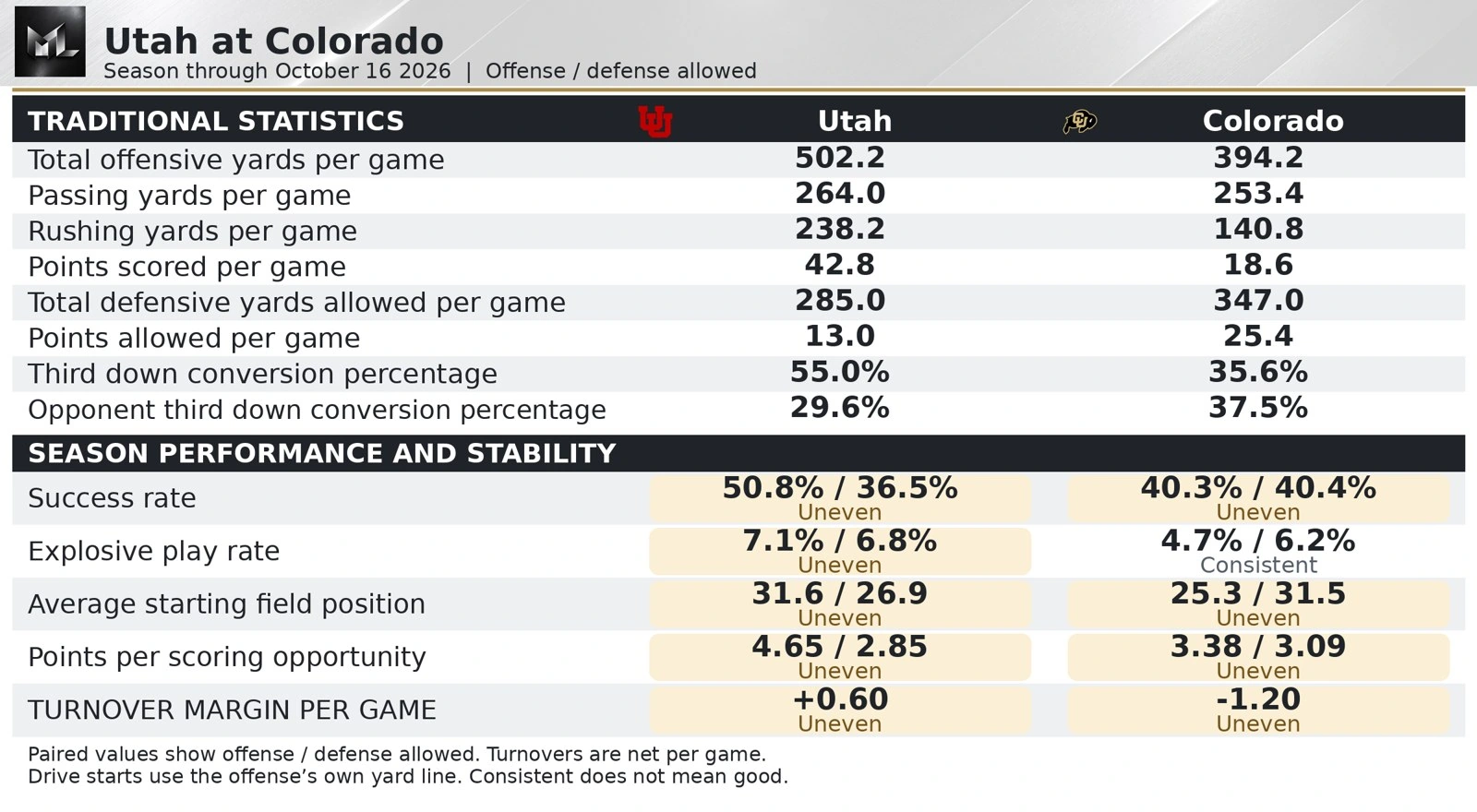
Utah's unbeaten season has a productive balance. The Utes average 502.2 yards, including 238.2 on the ground, while allowing 285 yards and thirteen points. Their offense converts 55 percent of third downs, and the defense permits only 29.6 percent. Those figures provide several routes to control a game against Colorado. They should also keep Utah from treating the next contest as a need to manufacture something spectacular.
Colorado has struggled to turn movement into sufficient scoring. It averages 394.2 yards but only 18.6 points, with a 3.38-point return before extra points per scoring chance. Utah's defense has allowed only 2.85 in those situations. If the Utes first require the Buffaloes to make a full drive, they can bring that defensive strength into play. A careless long gain or a short field after a lost possession would let Colorado skip some of the work its offense has found difficult.
Utah's latest 41-24 win over Kansas supplied 545 offensive yards. The concern is not a lack of capacity. It is maintaining the useful-play rate that makes the offense work when the opponent prevents the easiest explosive option. Colorado has kept its own successful-play and allowed rates almost level, so it can make individual series uncomfortable even though the season scoring gap is unfavorable. Utah should keep its rushing and passing threats connected rather than use the favorable comparison as permission for impatient decisions.
The Buffaloes' minus 1.20 turnover margin per game has been costly. Utah's positive margin offers a chance to compound that problem, but it should remain an addition to the plan. The Utes do not need to predict the next giveaway to explain why their third-down balance is strong. Colorado needs secure possessions and a better return from the opportunities it creates. Utah needs useful first downs, clean exchanges and patient finishing. The decisive matchup is the Utes' sustained rushing pressure against Colorado's ability to force a drive to earn every first down before it earns points.
Wake Forest at California
Saturday October 17 2026 at 9 30 PM Central · 5-1 and 3-3
Wake Forest assessment
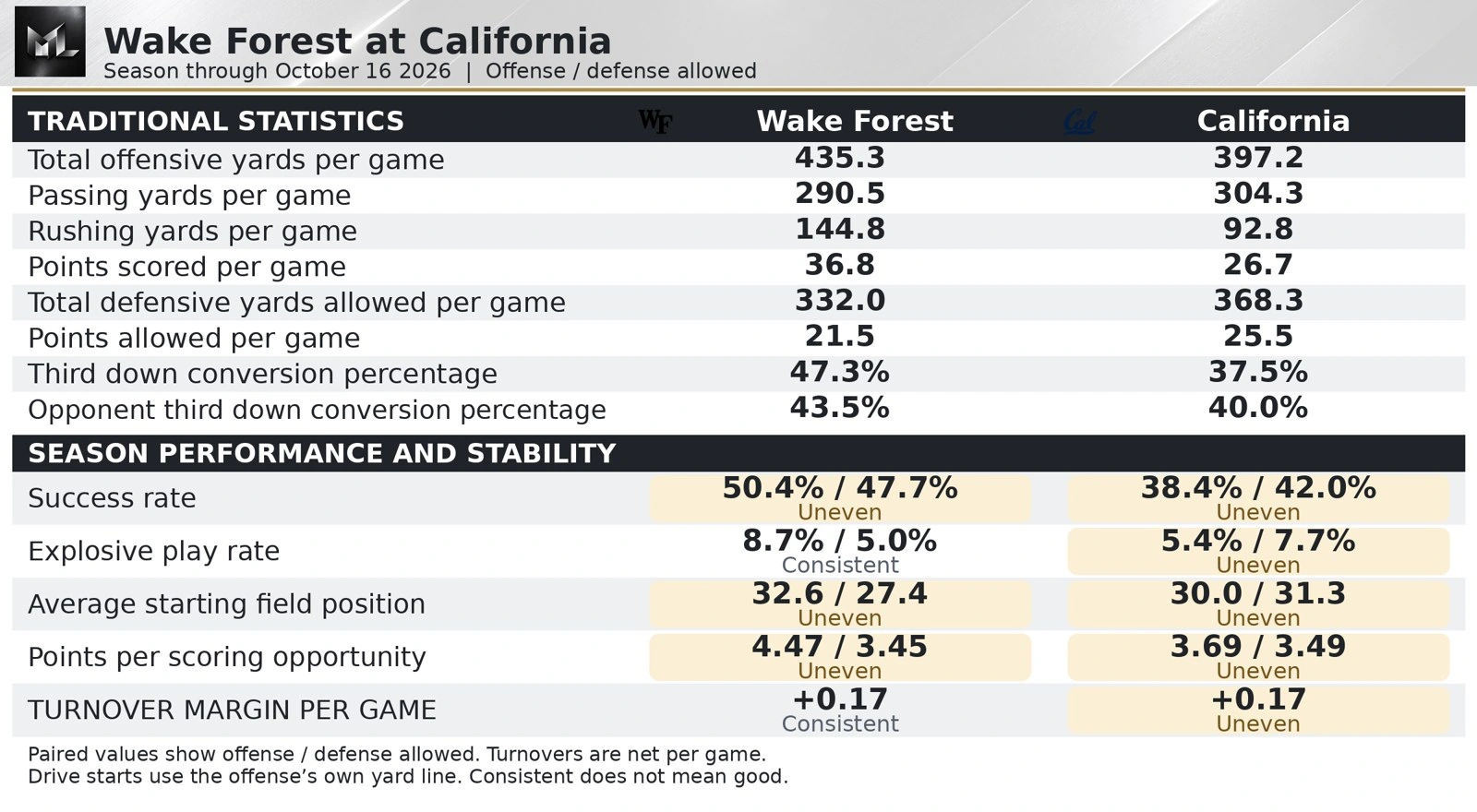
Wake Forest's 38-14 win at NC State looked convincing on the scoreboard, but its 387 offensive yards were below its season average. That is a useful reminder that the result is the subject of one game, not the definition of the whole team. The Demon Deacons average 435.3 yards and 36.8 points, with a productive passing game and a 50.4 percent successful-play rate. They have a sound route to repeated movement against California if they keep ordinary completions connected to manageable next downs.
California averages 304.3 passing yards, so Wake Forest's defensive third downs deserve attention. Opponents convert 43.5 percent against the Demon Deacons. That is a meaningful weakness inside a 5-1 season. California can use enough short and intermediate gains to make another possession feel longer than the raw defensive yardage average suggests. Wake Forest should make the Bears earn extra downs from real distance instead of repeatedly offering the easiest version of their passing offense.
The Demon Deacons have been much better at limiting valuable explosive plays than at ending every series quickly. Their 5.0 percent allowed rate gives them a way to prevent California's passing volume from becoming sudden scores. That approach still requires patient tackling and a willingness to defend the next play without assuming a stop has already been earned. Wake Forest's plus 0.17 turnover margin also leaves little support for a plan built around a timely interception arriving on demand.
California won its latest game 25-20 over Virginia Tech, but its season successful-play rate remains only 38.4 percent. Wake Forest can test whether that offense has enough repeatable production when its large yardage totals do not come with a favorable field. The Demon Deacons start about five yards farther forward than their opponents on average. They need to use that territory to finish drives, while tightening the conversions they allow. California needs passing volume that actually extends possessions and produces points. The decisive matchup is Wake Forest's ability to turn its prevention of explosive damage into complete stops, rather than making its offense answer one more drive.
New Mexico at Hawai'i
Saturday October 17 2026 at 9 30 PM Central · 4-1 and 1-5
New Mexico assessment
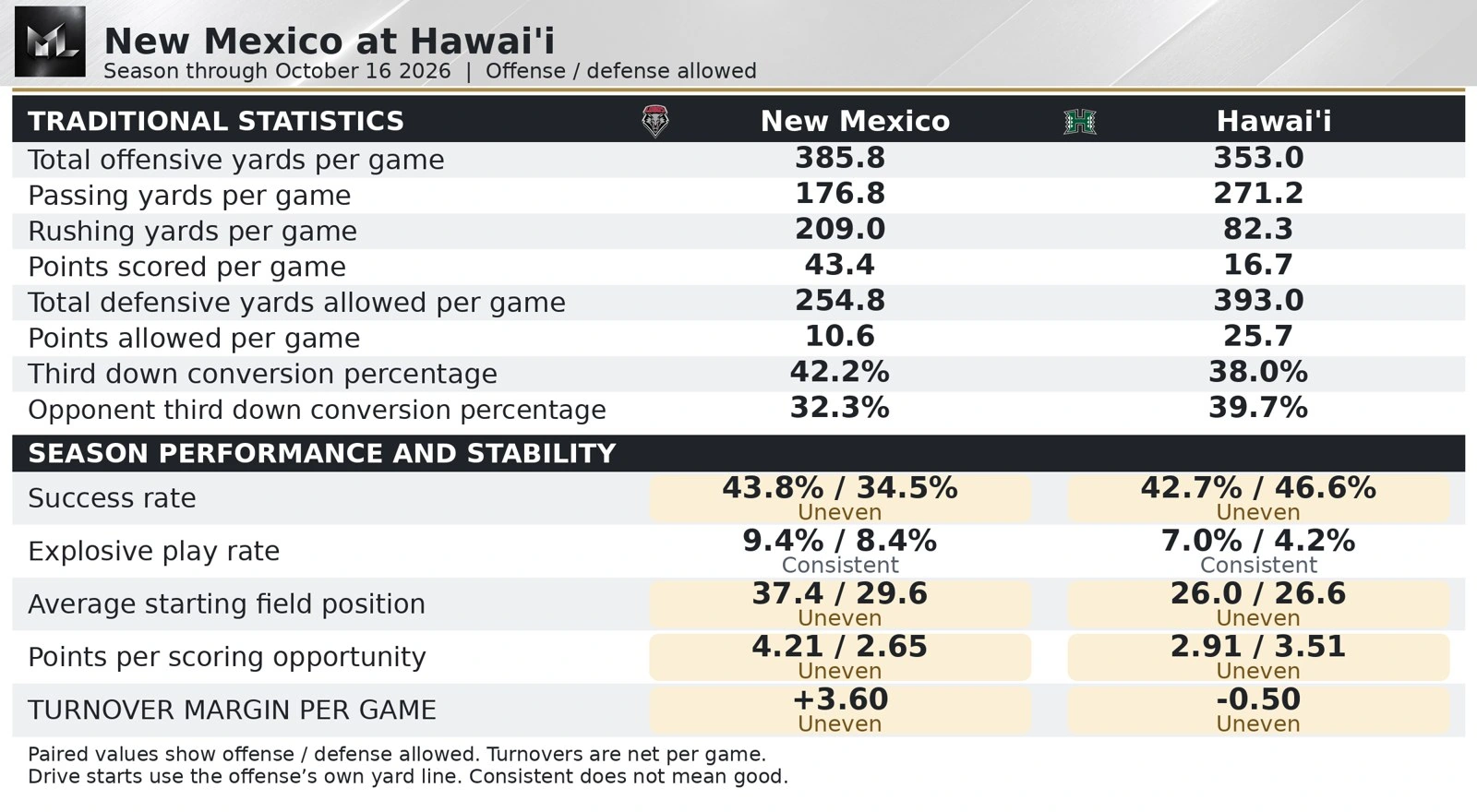
New Mexico's 4-1 season has a defensive foundation worth distinguishing from its extraordinary turnover column. The Lobos allow 254.8 yards and 10.6 points per game, with opponents successful on 34.5 percent of the measured sample. Those are substantial strengths. A plus 3.60 turnover margin per game is a separate and unusually large benefit. It should never be penciled into the next game as if the schedule includes another three or four extra possessions.
The latest 61-7 win over UTEP came with 493 yards, well above New Mexico's 385.8 average. Hawai'i should be assessed against the repeated offensive evidence, not against a requirement to surrender the same score. The Lobos rush for 209 yards per game and create valuable explosive plays on 9.4 percent of the measured sample. Hawai'i has limited those plays relatively well, making sustained useful rushing gains important if the spectacular option does not appear early.
New Mexico also begins at its own 37.4 on average. That territory makes an offense's work shorter, but the average cannot assign every favorable start to defensive takeaways. Returns, penalties and ordinary stops have to be distinguished. A game with fewer giveaways and deeper offensive starts would ask the Lobos to show that their running production can still build enough scoring chances. Their 4.21-point return before extra points per opportunity is useful without explaining every one of the 43.4 points they score per game.
Hawai'i's offense averages only 82.3 rushing yards, placing considerable work on a passing game that has not consistently turned movement into points. New Mexico should make the Rainbow Warriors complete a full sequence rather than create their best chance through its own mistake. Hawai'i needs secure possession and a better return in scoring territory. The Lobos need their defensive stops and useful runs to remain sufficient if the turnover margin becomes ordinary. The decisive matchup is New Mexico's rushing patience against Hawai'i's prevention of the large gain. The next giveaway should be welcome assistance, not the premise of the forecast.
Nebraska at Oregon
Saturday October 17 2026 at 10 00 PM Central · 5-1 and 3-2
Nebraska assessment
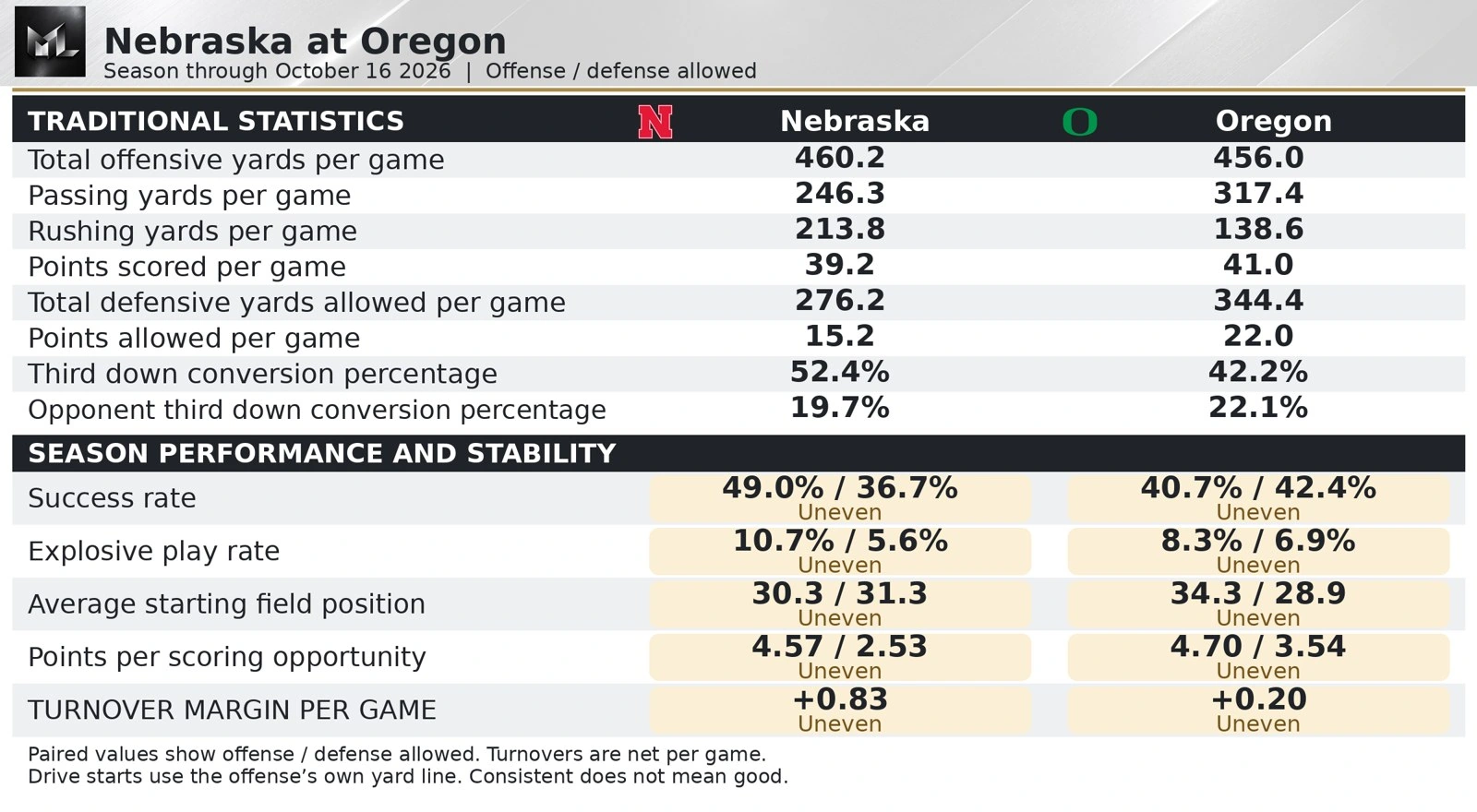
Nebraska's 20-17 loss to Indiana did not erase a strong season. The Cornhuskers average 460.2 yards and allow 276.2, with useful offensive plays occurring much more frequently than those they concede. The immediate problem is making that quality produce the needed scoring return against another opponent capable of changing a game quickly. Oregon's passing production offers a different test from simply replaying the result Nebraska would like back.
The third-down comparison is unusually sharp. Nebraska converts 52.4 percent while allowing only 19.7 percent. Oregon's defense allows 22.1 percent. The sensible aim for Nebraska is therefore to make its 213.8 rushing yards per game useful before the conversion attempt arrives. Repeatedly reaching third down against an opponent that has excelled there would allow Oregon to attack the game on its preferred terms, regardless of Nebraska's own strong season percentage.
Oregon averages 317.4 passing yards and 41 points, but its latest 17-15 loss to UCLA produced only 272 total yards. The Ducks can generate large totals without showing that every ordinary series has been reliable. Their measured offensive successful-play rate is slightly below the rate their defense allows. Nebraska should make that limitation matter by tackling before an explosive play replaces three or four ordinary gains. Its own 5.6 percent valuable-explosive rate allowed offers evidence that it can do so.
The Cornhuskers' season average starts have actually been a yard behind those of their opponents. Their offensive production has therefore not been explained solely by unusually short fields. They need to preserve that ability to travel while protecting the positive turnover margin that has helped them. Oregon needs a passing rhythm that remains functional after Nebraska makes the first easy gain smaller. The decisive matchup is the Cornhuskers' early rushing success against Oregon's ability to force the extra down. Nebraska needs complete offensive series and the same defensive resistance after a frustrating result. Oregon needs to make its passing yardage serve the next first down, not merely decorate a season average.