Formula 1 Weekly Review and Outlook
November 2 2026
Verstappen wins the close finish; Antonelli keeps the commanding season
Mexico supplied a finish separated by less than a second and a championship table separated by far more. Max Verstappen beat Lewis Hamilton by 0.799 seconds after 71 laps. Kimi Antonelli finished third, 4.006 seconds behind the winner, and retained 380 championship points against Verstappen's 261 and Hamilton's 259. The race therefore sharpened the contest behind the leader without overturning the season's central distinction: Antonelli has repeatedly turned competitive weekends into podiums. The official calendar records sixteen podium finishes and nine victories across nineteen completed Grands Prix. Those are counted Grand Prix outcomes, not a new performance index or an attempt to reconstruct every championship point from race results alone.
The complete driver championship
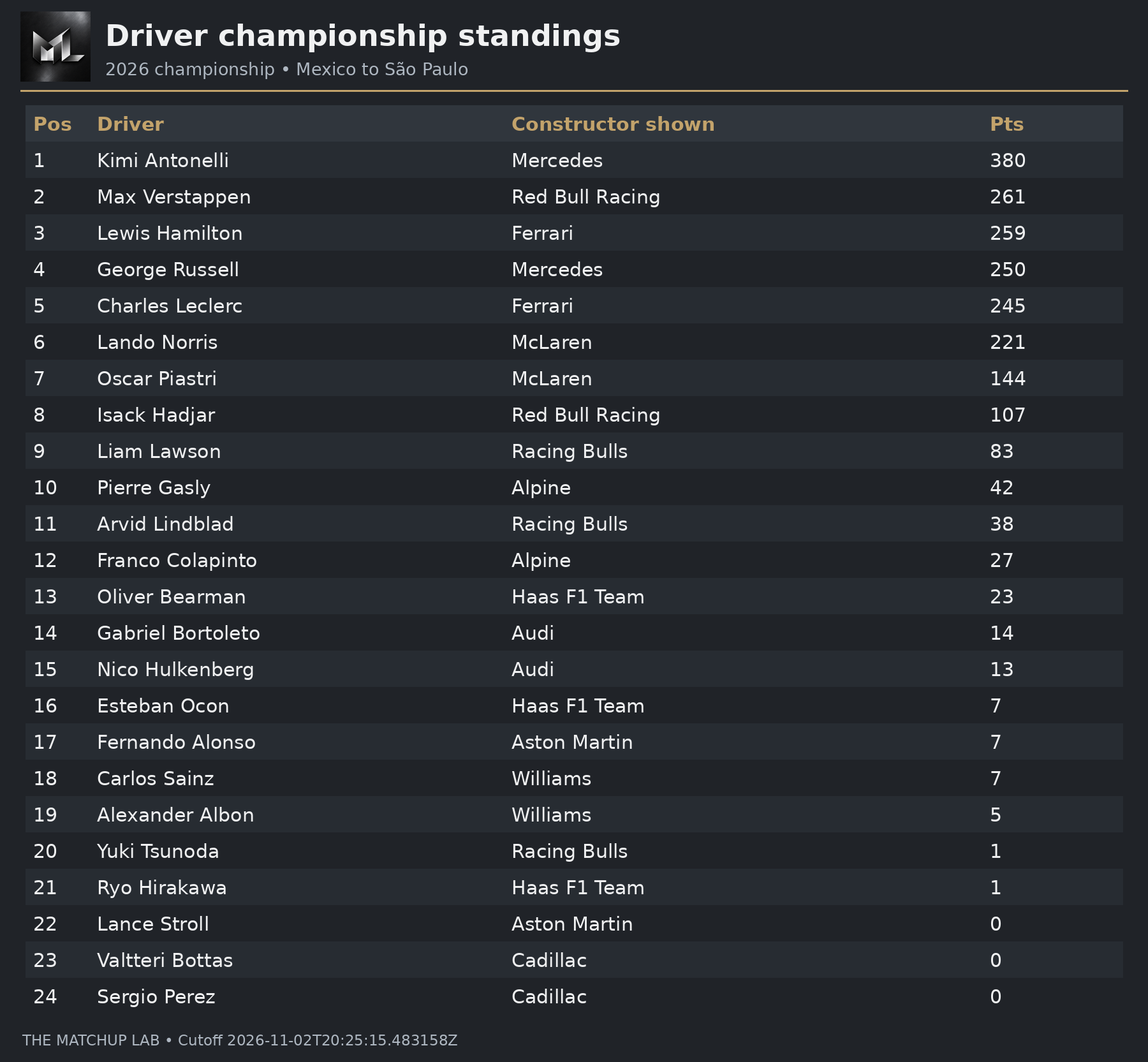
Official championship positions and points. All twenty four retained driver rows remain visible, including drivers absent from the Mexico race classification. These are not Statistical, Power or Results model ranks.
The constructor championship
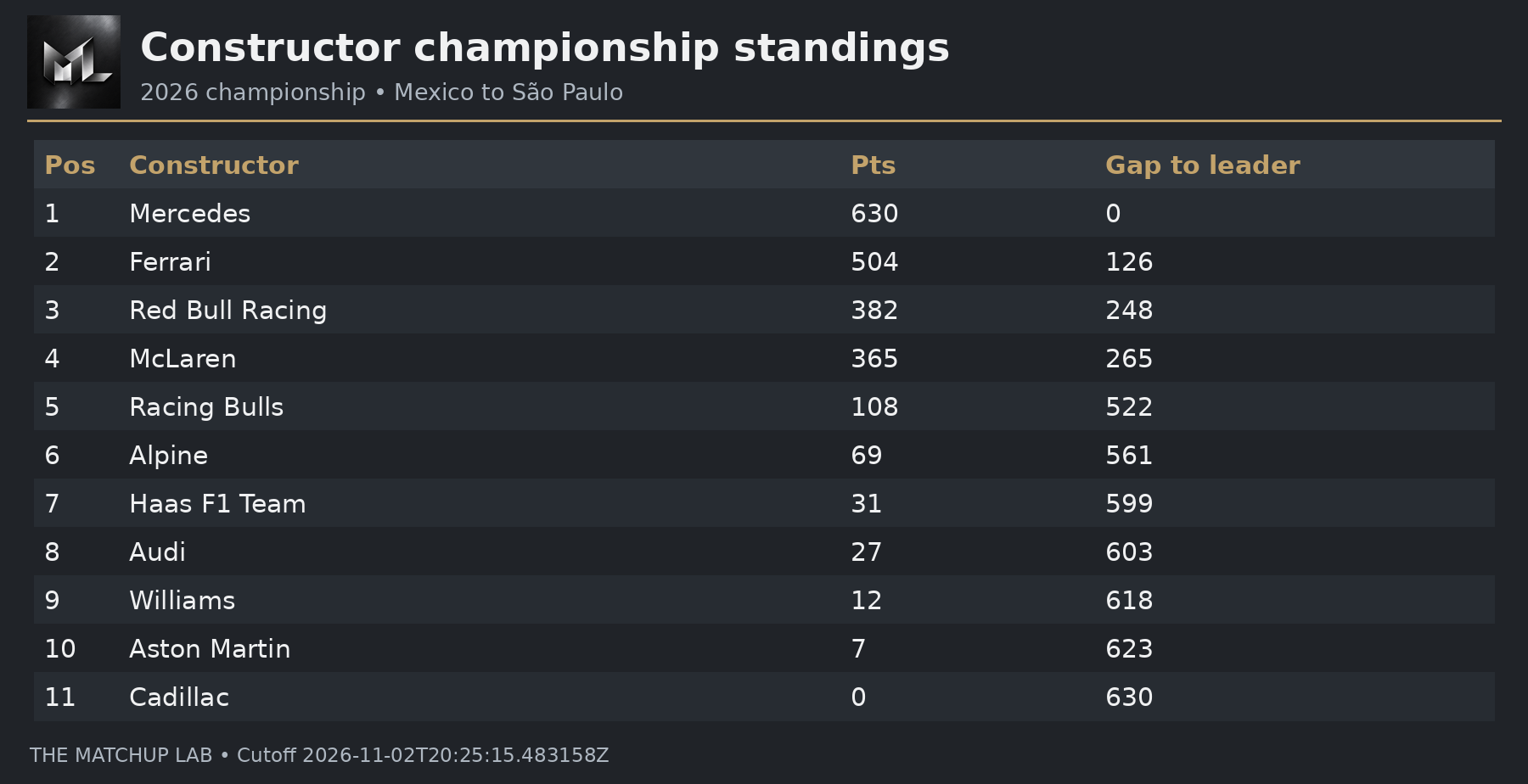
Mercedes leads the constructors on 630 points, Ferrari has 504, and Red Bull Racing's 382 leaves it seventeen ahead of McLaren. Ferrari's second and fourth places in Mexico produced thirty race points, compared with twenty seven for Red Bull and twenty three for Mercedes. That is a useful measure of this particular Sunday. It is not a substitute for the separately verified championship standings. The next race weekend is São Paulo on November 6–8, where the official schedule lists three practices, qualifying and Sunday's race. Its circuit and timetable give the outlook a concrete setting without requiring a weather forecast, an invented tyre allocation or a promised strategy.
Mexico in full
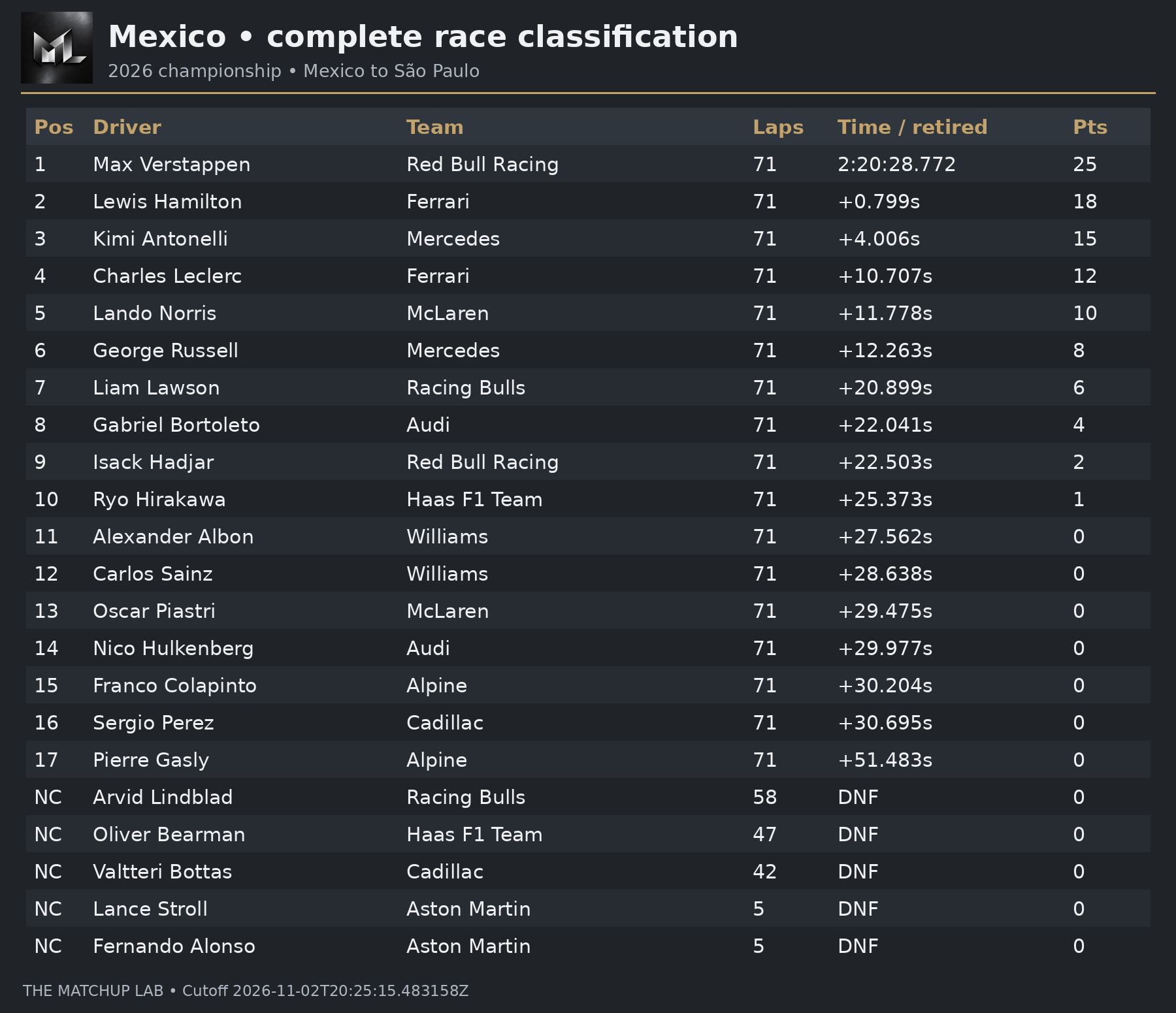
NC and DNF labels retain the official classification. No cause of retirement, collision or race-control event is inferred. All listed final-time gaps are measured from the winner; the winner's time is elapsed race time.
Qualifying and the actual starting grid
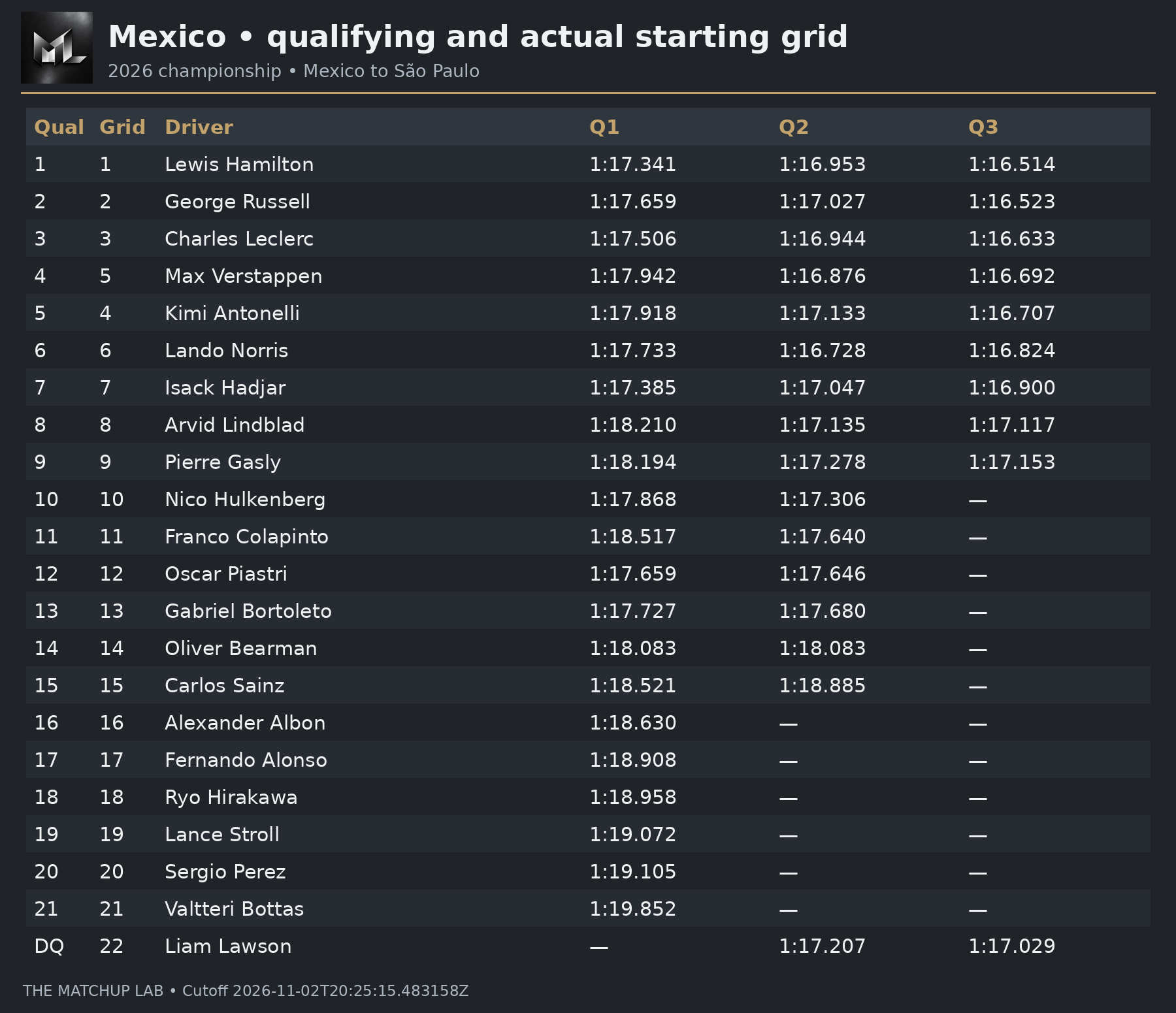
The complete qualifying order and separately published grid are retained. DQ is the published qualifying label. Blank segment times are shown as unavailable, not zero laps or a fabricated time. No cause of a grid difference or disqualification is asserted.
Best laps, with their proper limits
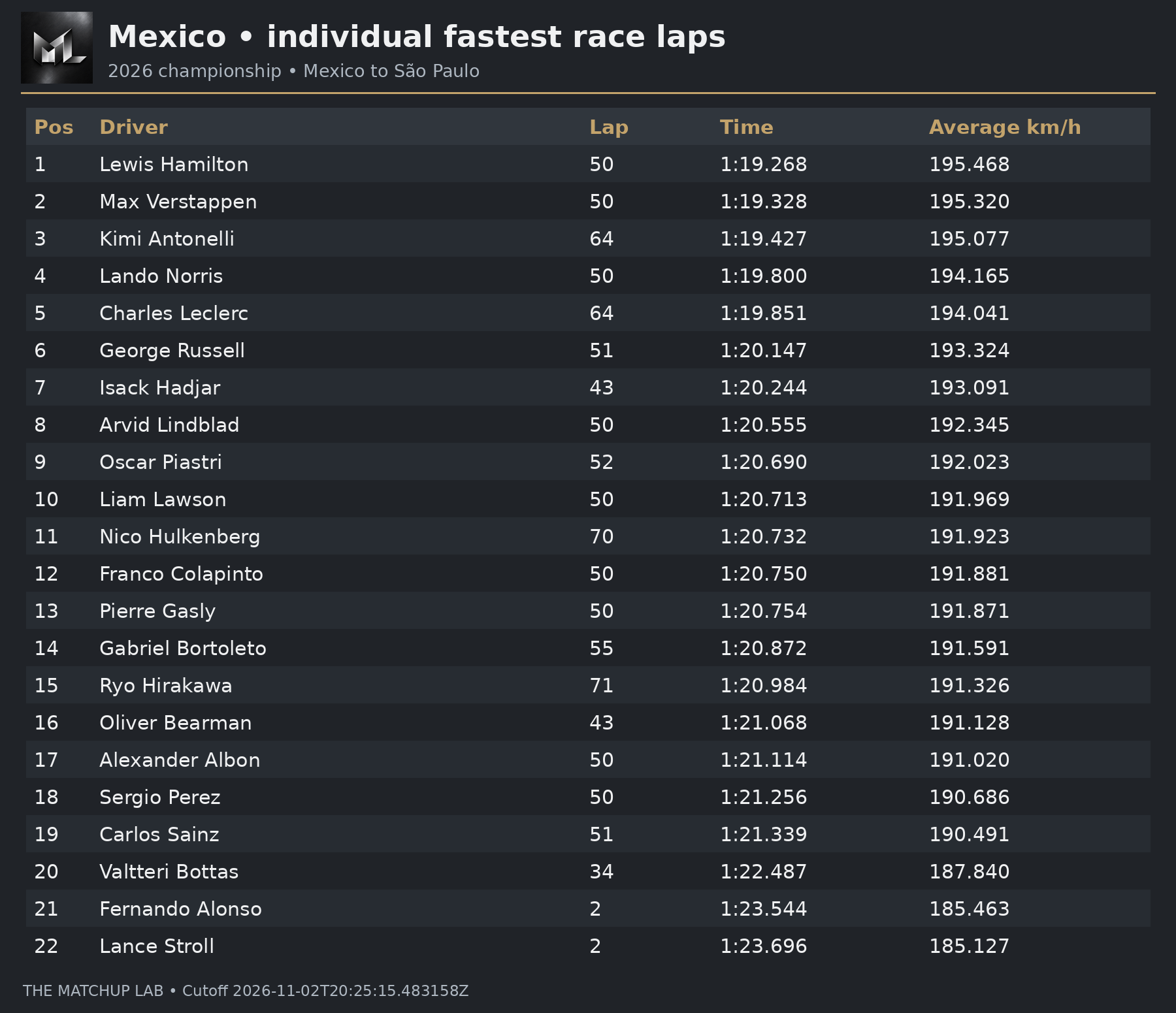
These are each driver's best listed individual race laps. They are not average whole-race pace, stint averages or a tyre-adjusted comparison. No fastest-lap championship bonus is inferred from this table.
A season measure that can be reproduced
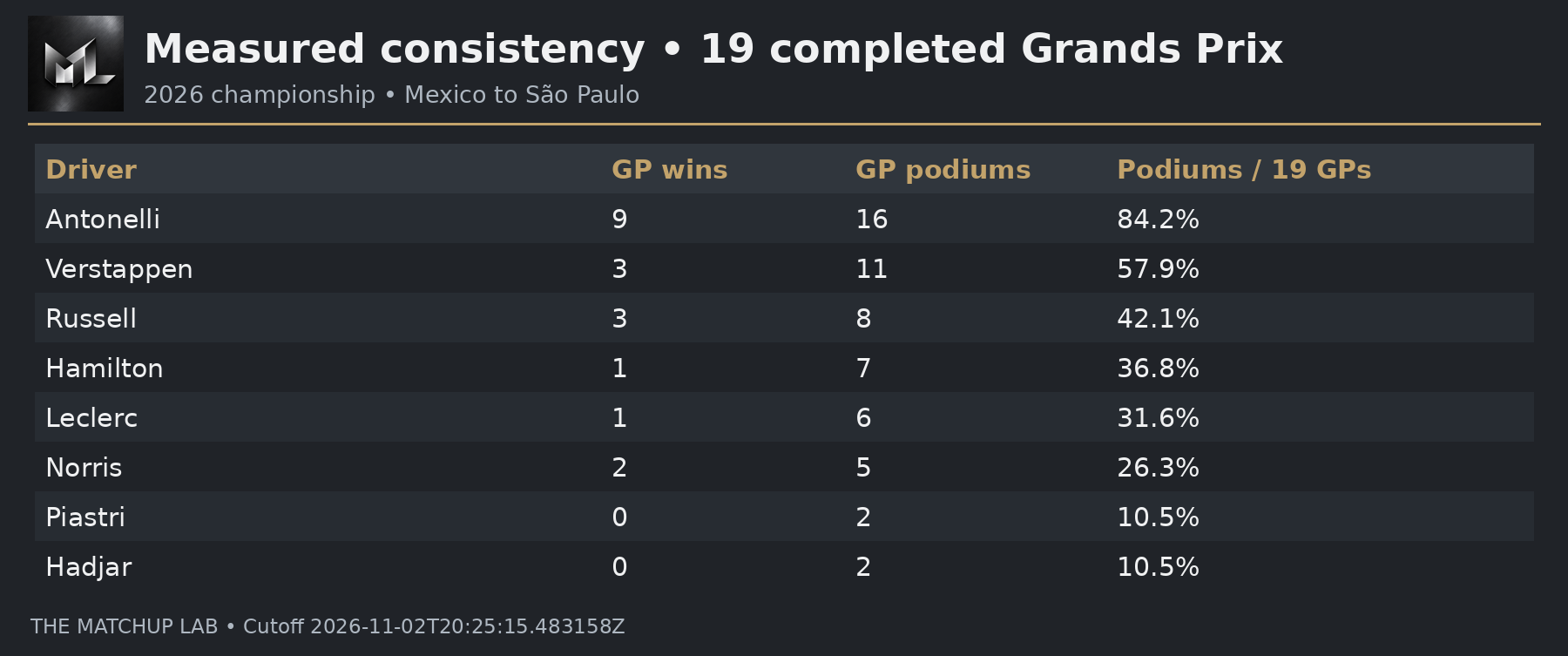
All nineteen completed Grand Prix podium triplets reconcile to 57 podium positions and nineteen wins. The denominator is championship Grands Prix completed, not individual driver starts or sprint races.
This edition uses one common evidence cutoff of 2026-11-02T20:25:15.483158Z. Complete official Mexico race, qualifying, starting-grid and fastest-lap tables are retained alongside all twenty four championship driver rows, all eleven constructors and the current championship calendar. Detailed timing is a published post-session snapshot, not live telemetry. The pit-stop table contains thirty four rows but skips stop ordinals for three drivers; complete stop counts and cumulative strategy comparisons are therefore unverified. Retirement and disqualification labels are preserved without inventing causes. No football-style Statistical, Power or Results index is applied.
Mercedes
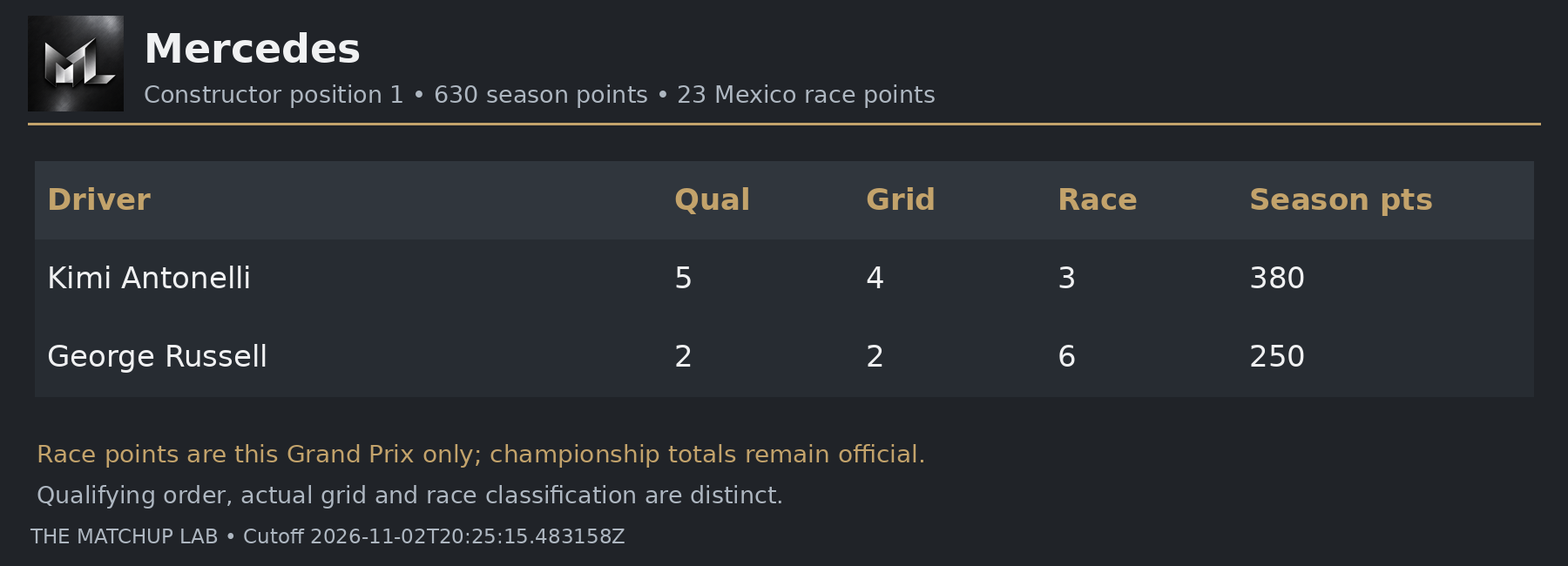
Mercedes leaves Mexico with the strongest championship position and a race that still offers room for improvement. Antonelli finished third and George Russell sixth, yielding twenty three race points. The constructor total is 630, a lead of 126 over Ferrari. Antonelli's 380 points and Russell's 250 are separately verified driver standings, not a reason to assume the current team allocation will explain every historical point for every constructor. The team's season advantage rests on repeated results: the calendar's nineteen completed Grand Prix podiums include sixteen appearances for Antonelli and eight for Russell, with nine and three victories respectively.
Mexico qualifying put Russell second, only 0.009 seconds behind Hamilton's pole lap, while Antonelli was fifth in qualifying and fourth on the published starting grid. Their third and sixth race finishes show why qualifying and grid must remain separate labels. Russell's listed first pit visit took 33.926 seconds on lap 33; that is a recorded timing entry, not proof of the reason for the delay or its net effect on the race. The useful São Paulo question is whether Mercedes can turn its pace into a stronger combined finish while retaining the consistency that has built the lead. A large points margin does not make the next race unimportant. It makes the distinction between protecting a season and maximizing a weekend especially clear.
Ferrari
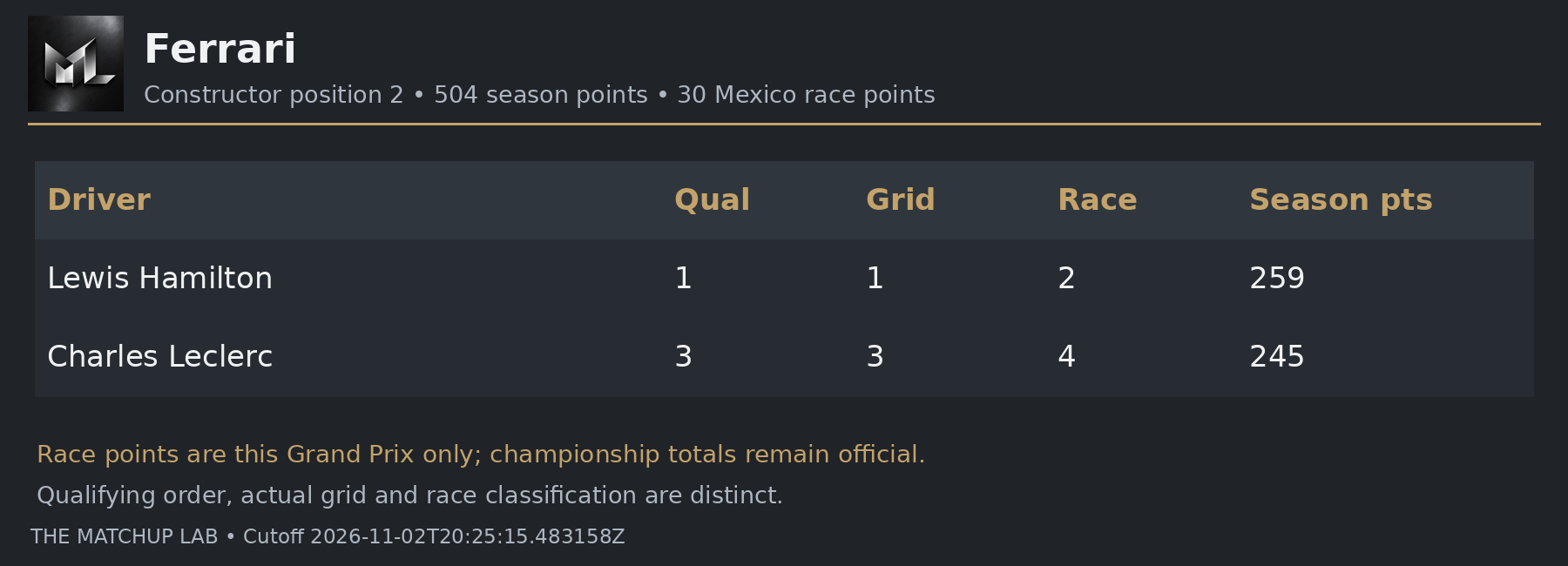
Ferrari's Mexico weekend began with the narrowest front-row advantage and ended just short of victory. Hamilton took pole in 1:16.514, 0.009 seconds ahead of Russell, and finished second by 0.799 seconds. Charles Leclerc qualified third, started third and finished fourth. Eighteen and twelve race points produced thirty for Ferrari, the largest constructor return from this race. The season table is less close at the top: Ferrari's 504 points leave it 126 behind Mercedes and 122 ahead of Red Bull Racing. Hamilton is third in the driver standings on 259, two behind Verstappen, while Leclerc is fifth on 245.
Hamilton also set the fastest listed race lap, 1:19.268 on lap 50, 0.060 seconds quicker than Verstappen's best. Pole, fastest lap and a close second demonstrate several different kinds of pace; none alone establishes where the race was won or lost. The retained pit timing does not provide tyre compounds or a complete race-control timeline, so a detailed strategic explanation would go beyond the evidence. São Paulo offers Ferrari another opportunity to combine its two drivers' scoring strength. Hamilton has seven Grand Prix podiums in the nineteen-race calendar and Leclerc six. The immediate ambition is to make that combined threat decisive on Sunday, while recognizing that a stronger single-race return has not erased Mercedes' accumulated championship advantage.
Red Bull Racing
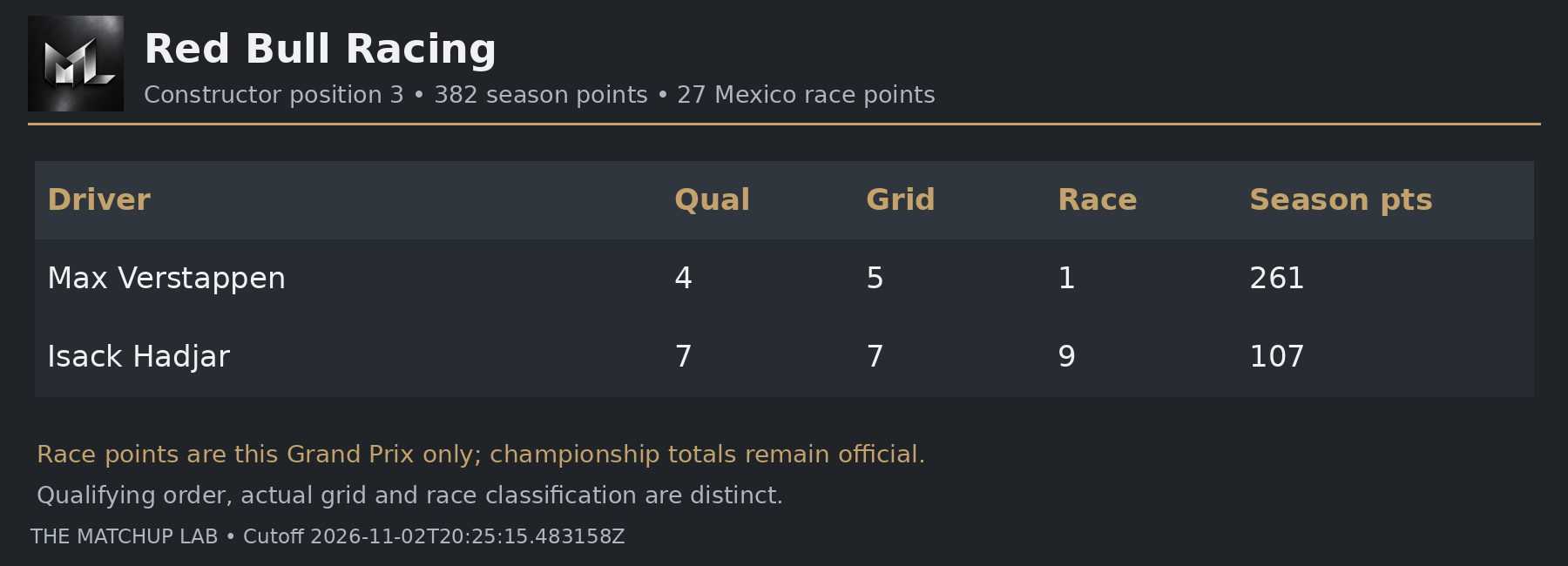
Verstappen's Mexico victory gave Red Bull Racing twenty five points before Hadjar's ninth place added two more. The resulting twenty seven-point race return helped the constructor retain third on 382, seventeen ahead of McLaren. Verstappen moved through a weekend in which the official qualifying table placed him fourth but the starting grid placed him fifth. The race result is first. Those labels show a gain of four classified places from the published grid without supplying the cause of the grid difference or claiming that every gain was an on-track overtake. His season total is 261, only two ahead of Hamilton and 119 behind Antonelli.
Hadjar qualified and started seventh, then finished ninth, 22.503 seconds behind his teammate. His 107 championship points are eighth in the driver table, and the calendar records two Grand Prix podiums. Verstappen has eleven podiums and three victories from the same nineteen completed Grands Prix. That difference explains why the team's next assessment needs both drivers: the winner supplied most of Mexico's reward, while the second car still contributed points in a close constructors' comparison. São Paulo should be judged by the combined result rather than by the assumption that a Mexico win guarantees another. The verified evidence supports a strong latest performance and a narrow advantage over McLaren. It does not certify a particular tyre plan, a repeat winning margin or an explanation for every position change.
McLaren
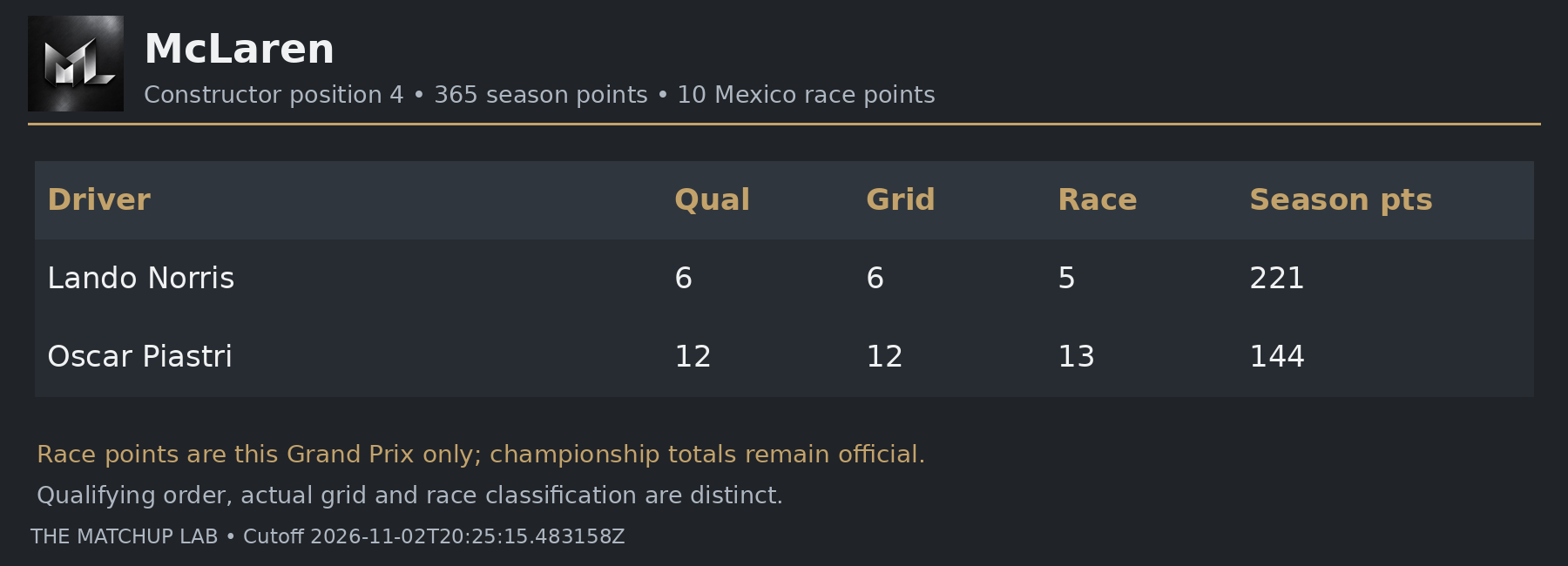
McLaren collected ten Mexico race points through Norris's fifth place, while Piastri finished thirteenth. The constructor remains fourth on 365, seventeen behind Red Bull Racing. Norris has 221 driver points in sixth and Piastri 144 in seventh. Those season positions show useful accumulated production, but Mexico widened the immediate constructors' comparison because Red Bull scored twenty seven to McLaren's ten. The next race is therefore an opportunity to improve the contribution of both cars, not merely to find a larger headline for the stronger finisher.
Norris qualified sixth, started sixth and finished fifth, 11.778 seconds behind Verstappen. Piastri qualified twelfth, started twelfth and finished thirteenth, 29.475 seconds behind the winner. The fastest-lap table puts Norris fourth and Piastri ninth; that is an ordered set of individual best laps, not evidence that those positions describe their whole-race pace. Across the nineteen completed Grand Prix podiums, Norris has five appearances and two victories, while Piastri has two podiums. São Paulo provides a chance to reconnect that season potential with a fuller points return. McLaren needs the second car closer to the scoring positions and the leading car capable of contesting more than a single-place improvement. The retained evidence does not identify the cause of Piastri's difficult result, so the assessment keeps that question open rather than manufacturing a mechanical or strategic explanation.
Racing Bulls
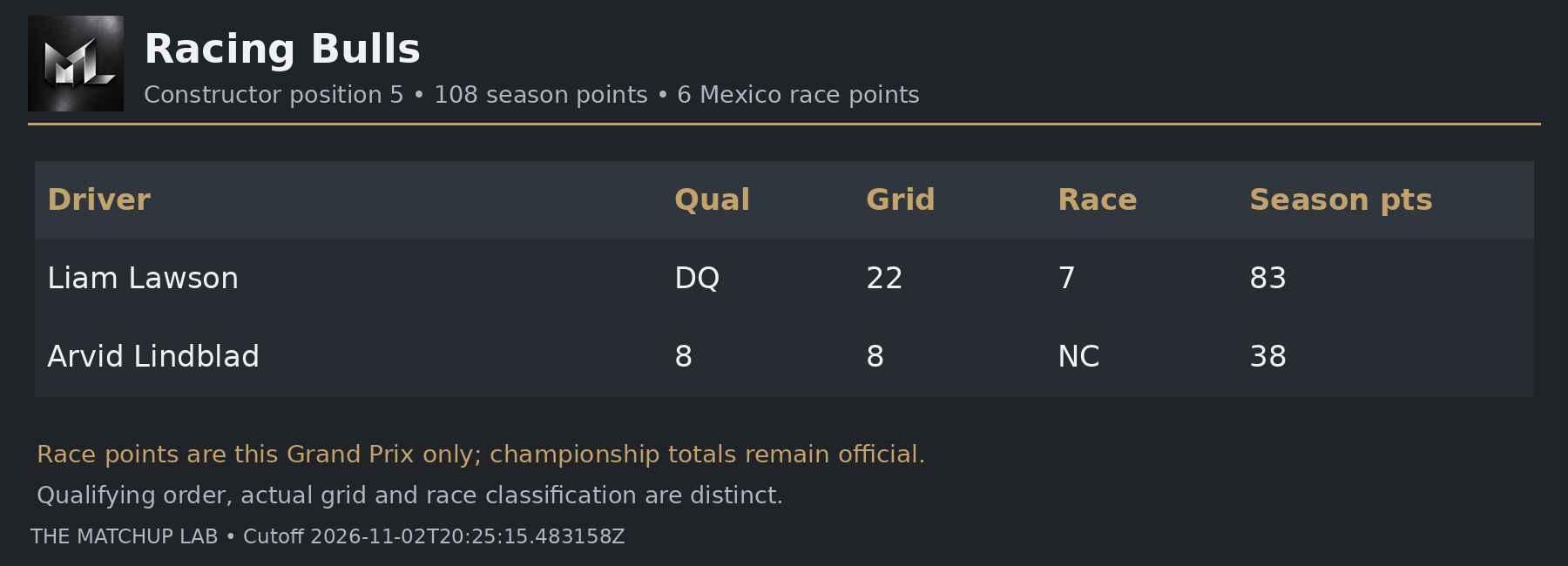
Racing Bulls produced one of Mexico's largest differences between starting position and classified finish. Lawson appears as disqualified in the qualifying table, twenty second on the published grid and seventh in the race. That supplies a fifteen-place improvement from grid to finish and six race points. It does not establish the disqualification's cause or mean that all fifteen places came through overtaking. Lindblad qualified and started eighth but is listed not classified after 58 laps. The retirement is a recorded outcome; its cause is not established by the retained tables.
The constructor is fifth on 108 points, thirty nine ahead of Alpine and well behind McLaren. Lawson's 83 driver points place him ninth, while Lindblad has 38 in eleventh. Tsunoda's retained one point also appears in the full championship table, and is preserved rather than dropped because he was absent from this Mexico classification. The season totals should remain the official totals, not a calculation based only on the two current race entrants. São Paulo asks Racing Bulls to preserve the scoring opportunity Lawson demonstrated while bringing both cars to a useful finish. Seventh from the back is a strong result in its own right. Repeating it should not become the plan; a less compromised starting position and a complete two-car race would create a different, more manageable task.
Alpine
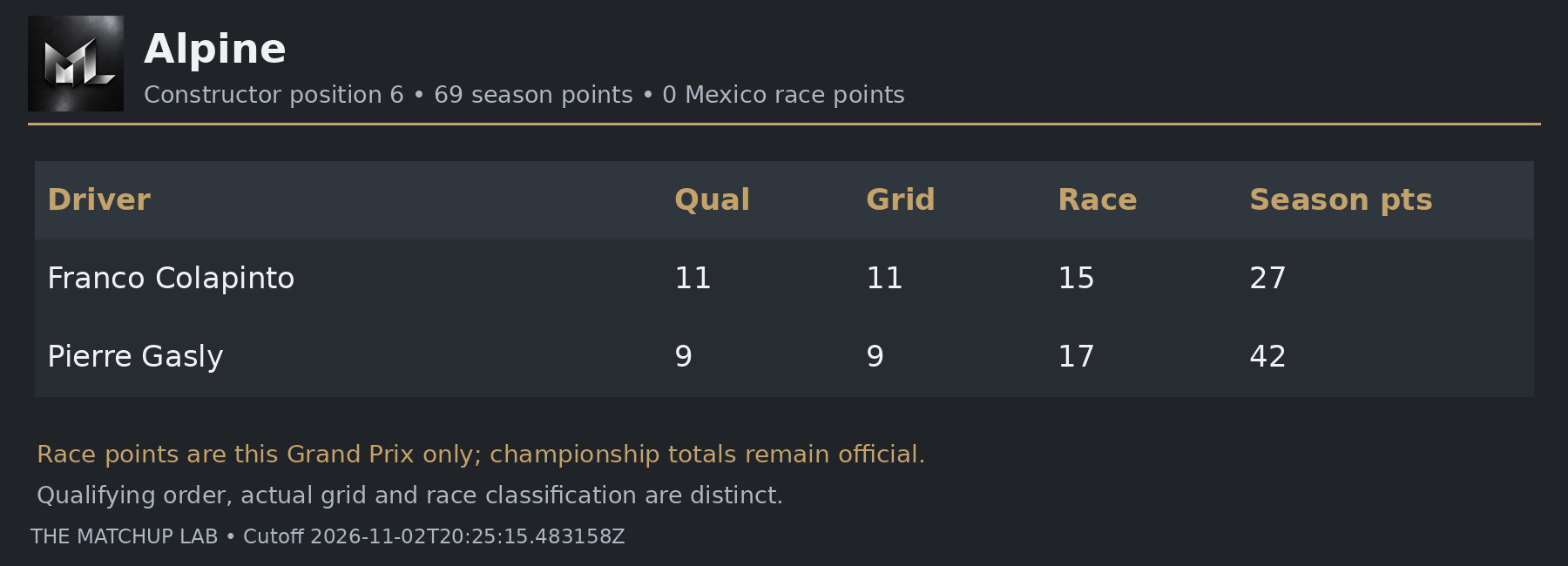
Alpine finished Mexico without race points despite placing one car in the final qualifying segment. Gasly qualified ninth, started ninth and finished seventeenth, 51.483 seconds behind Verstappen. Colapinto qualified and started eleventh, then finished fifteenth, 30.204 seconds behind the winner. Both completed 71 laps, so this was not a pair of retirement results. The absence of points must be distinguished from the separate question of why the cars lost classified places. The current source set does not establish a mechanical fault, a tyre problem or an incident cause.
The constructor remains sixth on 69 points, thirty nine behind Racing Bulls and thirty eight ahead of Haas. Gasly has 42 driver points and Colapinto 27. That season foundation gives the team some separation from the next constructor, but Mexico supplied no additional protection. Gasly's best lap ranks thirteenth in the fastest-lap table and Colapinto's twelfth; those isolated laps cannot explain the entire race. São Paulo offers a practical test of conversion. Alpine needs a competitive qualifying position to survive into a scoring Sunday, and needs its second car close enough to make a two-car return possible. The useful improvement would be visible in the actual race classification. An account that jumps directly from ninth on the grid to a confident strategy diagnosis would conceal the evidence gap instead of resolving it.
Haas F1 Team
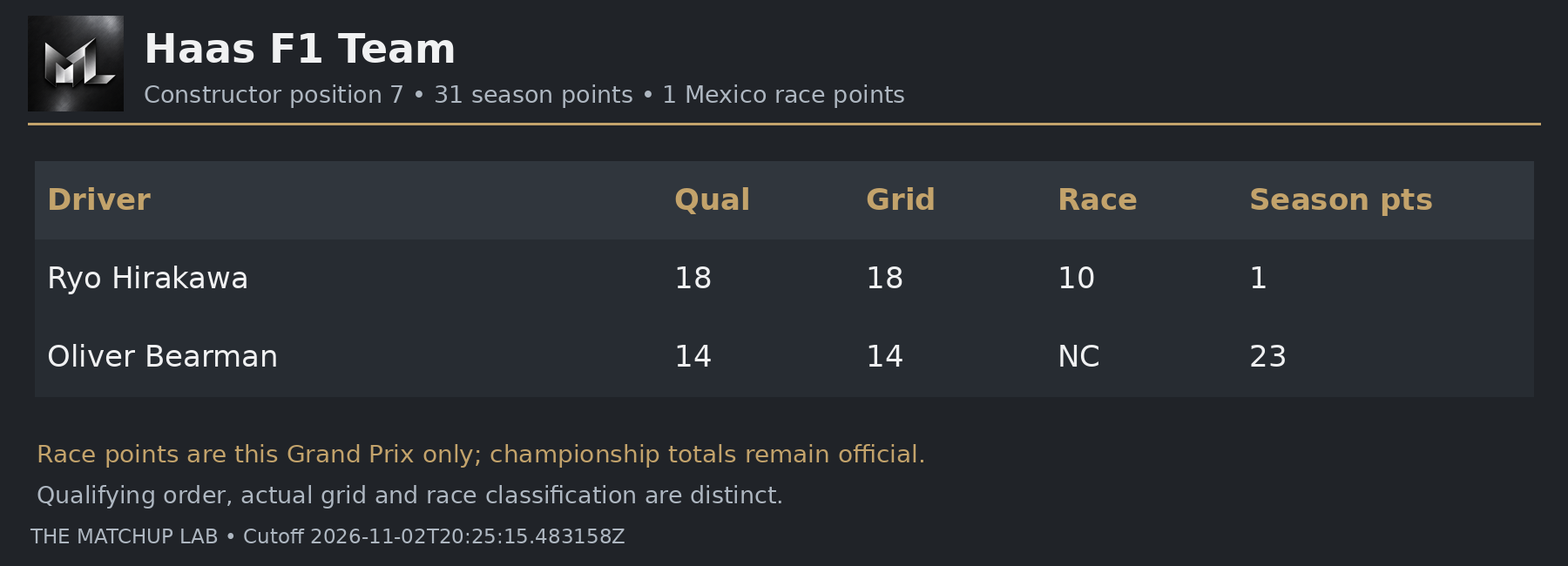
Hirakawa's tenth place delivered the final Mexico point and left Haas seventh in the constructors on 31. Audi's 27 makes that a four-point comparison, so the last scoring position had concrete value. Hirakawa qualified and started eighteenth, then finished tenth after completing all 71 laps. That is an eight-place classified gain from the grid, without an unsupported claim about how each place was obtained. Bearman qualified and started fourteenth and is listed not classified after 47 laps. The two outcomes must be kept separate rather than summarized as an uncomplicated team recovery.
The full driver standings retain Bearman on 23 points, Ocon on seven and Hirakawa on one. Those are season championship rows, not an assumption that Mexico's entrants represent every driver who contributed during the year. Hirakawa's fastest listed lap ranks fifteenth and Bearman's sixteenth. The pit-stop table includes Hirakawa entries numbered one, two and five; missing ordinals prevent a complete count of his stops or a reliable cumulative strategy comparison. São Paulo is an opportunity to defend the narrow constructor advantage with two useful finishes. Haas should value the point already earned while recognizing that a repeated recovery from eighteenth would remain a demanding route. Better starting position and a complete second-car result would make the scoring task less dependent on a large grid-to-finish gain.
Audi
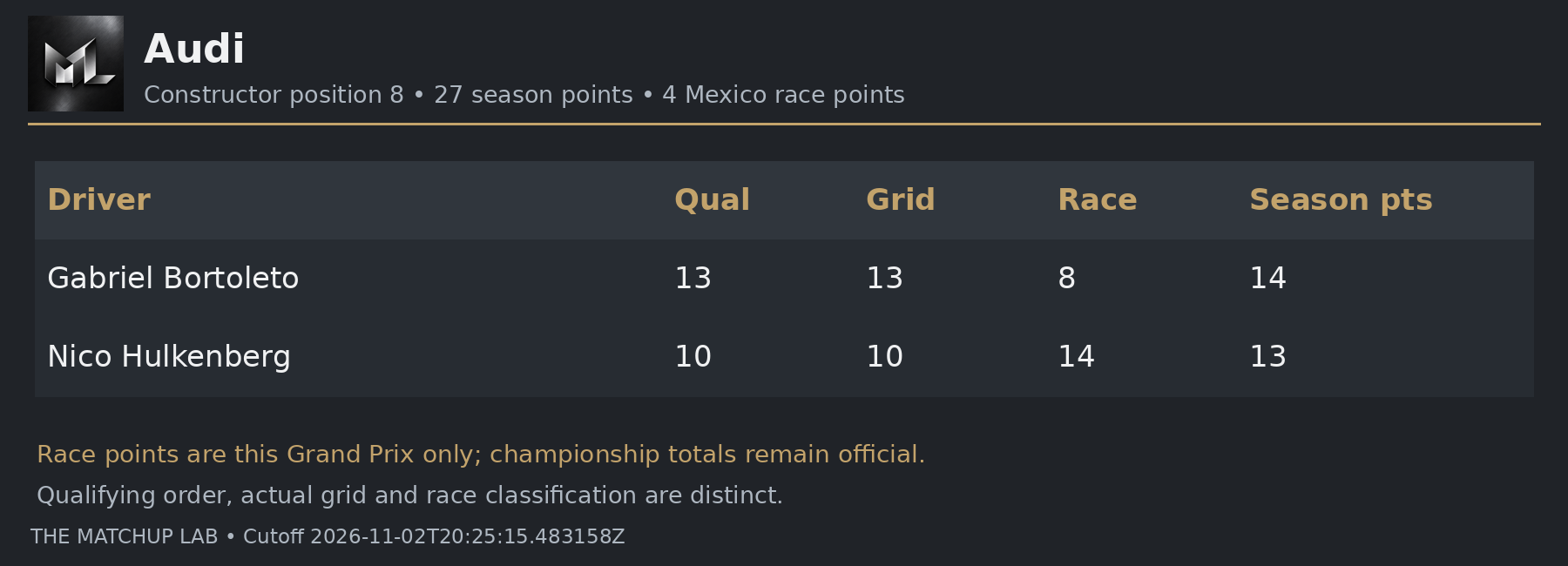
Bortoleto's eighth place supplied four Mexico points, an important addition to Audi's 27 in the constructors. Haas remains four points ahead on 31. Bortoleto qualified and started thirteenth, then finished eighth, 22.041 seconds behind Verstappen and 0.462 seconds ahead of Hadjar. Hulkenberg qualified and started tenth but finished fourteenth, 29.977 seconds behind the winner. Both completed the full 71 laps. The contrast makes the combined result more useful than a simple claim that one car gained and the other disappointed: Audi scored through the driver who began outside the top ten, while the better grid position did not become points.
The driver standings place Bortoleto fourteenth on fourteen points and Hulkenberg fifteenth on thirteen. The one-point season separation is much smaller than their six-place Mexico finishing difference. Hulkenberg's pit-stop entries jump from stop one to stop three, so the available table cannot certify his total stop count or justify a complete strategic explanation. Bortoleto now approaches his home-country São Paulo weekend with a verified scoring result behind him. That adds interest without establishing a performance advantage from nationality or crowd support. Audi's immediate objective is to turn both cars' qualifying potential into a stronger combined Sunday. With Haas only four points ahead, even another modest two-car return would be significant. The comparison should be decided by actual finishes, not an invented forecast for the home driver.
Williams
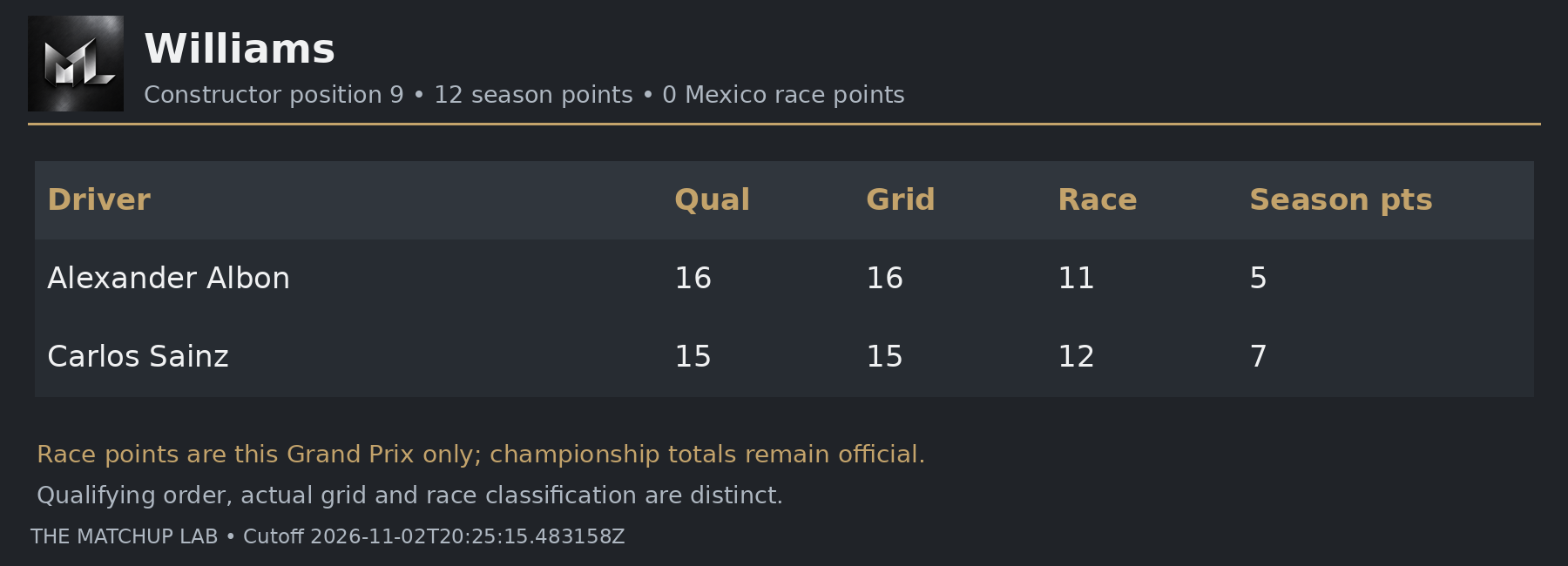
Williams finished just outside the Mexico points with Albon eleventh and Sainz twelfth. Both completed 71 laps, separated by 1.076 seconds in the final classification. Albon's 27.562-second deficit to Verstappen left him 2.189 seconds behind Hirakawa in the last scoring position. That is a specific measure of how close the result came to a point; it does not explain where those seconds were lost. Albon qualified and started sixteenth, while Sainz qualified and started fifteenth. Their five-place and three-place improvements therefore produced a better finishing order without adding championship points.
The constructor remains ninth on twelve, five ahead of Aston Martin and fifteen behind Audi. Sainz has seven driver points and Albon five. The small team total makes missed scoring opportunities consequential, even when both cars reach the finish. Their fastest laps rank nineteenth for Sainz and seventeenth for Albon, but an isolated best-lap ranking cannot be treated as a complete race-pace model. São Paulo offers another chance to move the stronger finishing result into the top ten and bring the second car close enough to benefit as well. Williams should preserve the value of completing the race while asking for more than a recovery to the edge of the points. The next improvement is clear in the classification it needs, even though the retained timing does not identify a single technical or strategic repair.
Aston Martin
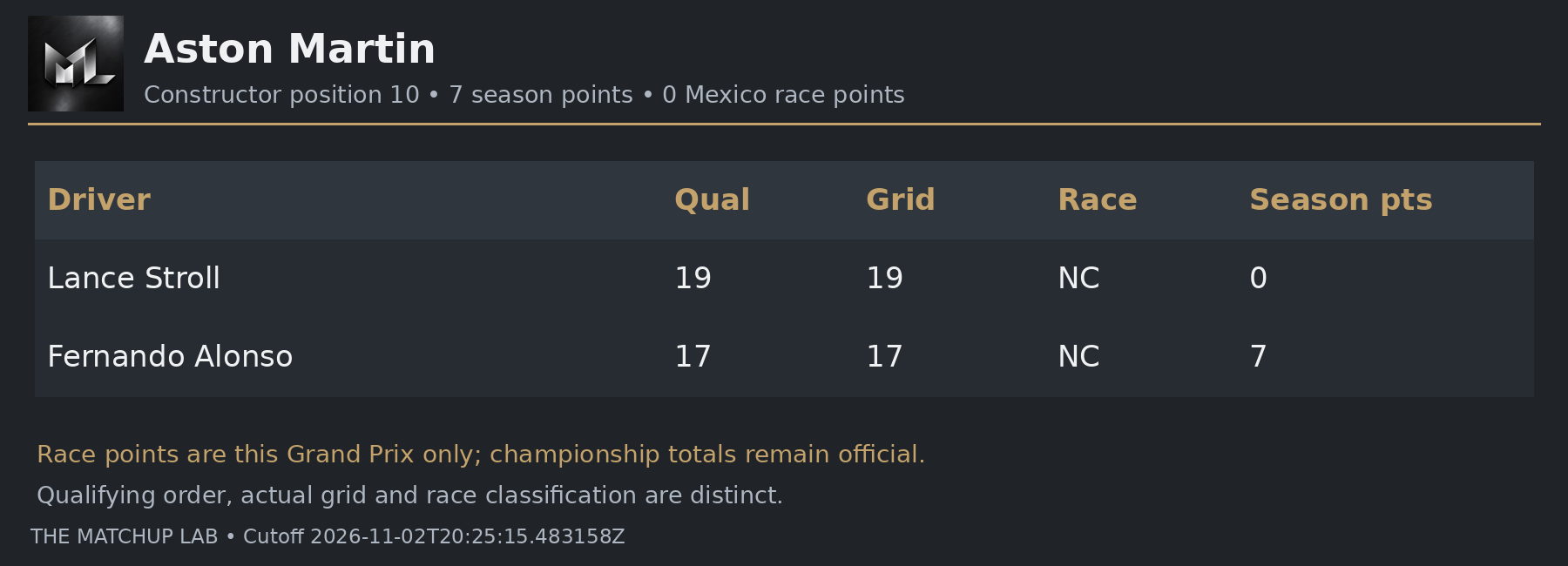
Aston Martin's Mexico classification lists both Alonso and Stroll not classified after five laps. That is the strongest verified fact about its Sunday and it is enough to explain the absence of race points. It does not establish whether either car stopped because of contact, a technical problem or another cause. Alonso qualified and started seventeenth, while Stroll qualified and started nineteenth. Both have a recorded first pit entry on lap three, but that timing alone cannot connect the visit to the later retirement or explain the team's decisions.
The constructor remains tenth on seven points, five behind Williams and seven ahead of Cadillac. Alonso's seven and Stroll's zero are retained in the complete driver table. The season has therefore produced some points without enough accumulated return to move the team out of the lower constructor positions. Mexico adds a more immediate requirement: a race long enough to create a useful scoring opportunity. São Paulo should be approached through that concrete standard rather than a dramatic diagnosis unsupported by the source set. Better qualifying would help the task, but a stronger grid position is not a replacement for completing the race. The useful next evidence will be two actual results, with the relevant technical or race-control account verified if it becomes available. Until then, five-lap retirements remain outcomes to report, not causes to invent.
Cadillac
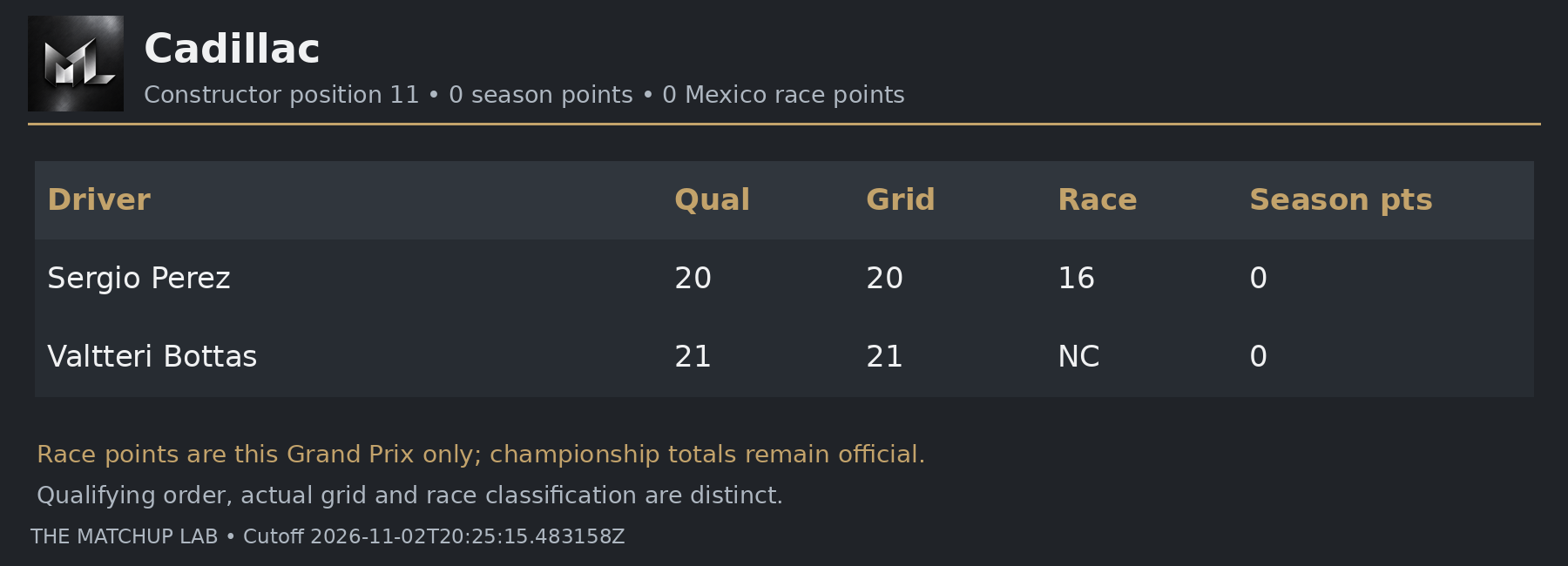
Cadillac remains eleventh in the constructors without a championship point. Mexico supplied a full-distance finish for Perez in sixteenth and a not-classified result for Bottas after 42 laps. Perez qualified and started twentieth, while Bottas qualified and started twenty first. Perez's four-place improvement from grid to finish is a measured classification change, but it did not bring him into the points. Bottas's retirement must retain its actual lap count without a guessed explanation. Both drivers remain on zero in the full championship standings.
The season comparison is immediate: Aston Martin has seven constructor points and Williams twelve. Cadillac needs a scoring result before small changes in its position can become a points-table advance. Perez finished 30.695 seconds behind Verstappen, just 0.491 seconds behind Colapinto, but that close local comparison was between fifteenth and sixteenth rather than a contest for the final point. His pit-stop entries skip from number two to number five, preventing a complete stop inventory or a reliable strategic total. São Paulo offers another opportunity to turn a completed race into a more competitive finish. The next assessment should ask whether both cars can reach a position from which points are realistically available, while avoiding an invented promise about a breakthrough. A first point would change the championship record; a tidy explanation for another non-scoring race would not.
São Paulo: the next test has a verified shape
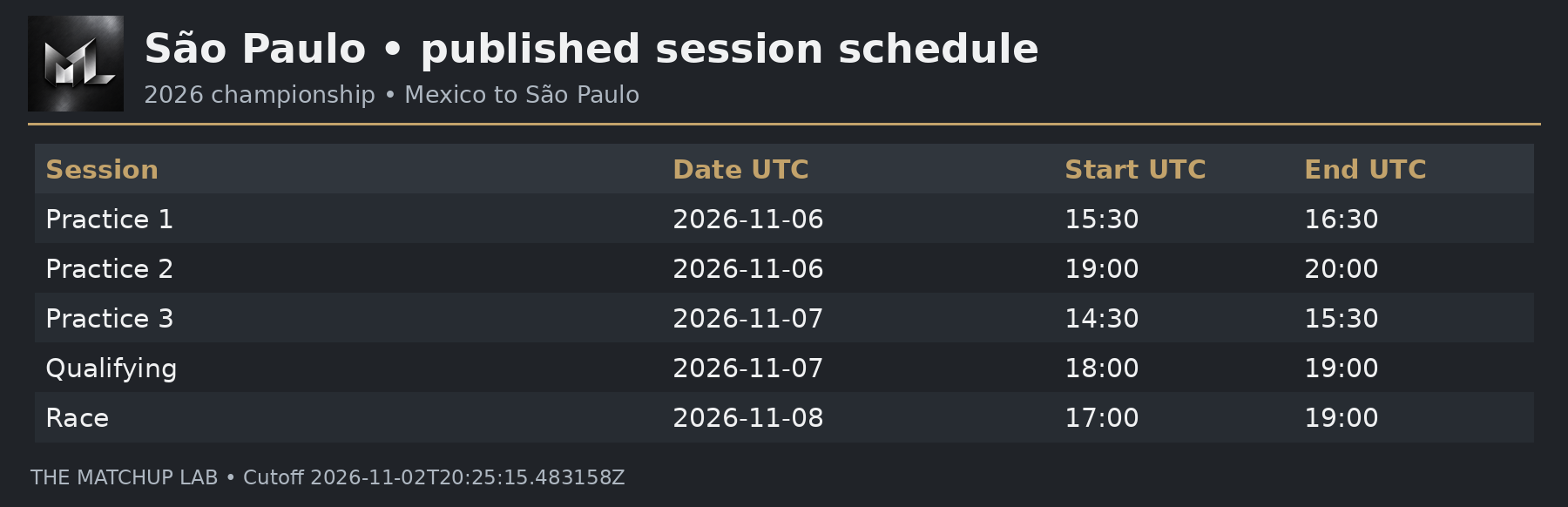
The official São Paulo schedule lists practice on November 6 at 15:30 and 19:00 UTC, a third practice on November 7 at 14:30 UTC, qualifying that day at 18:00 UTC and the race on November 8 at 17:00 UTC. These are the published session times at the checked cutoff, not a generic weekend template. The source currently shows a conventional three-practice sequence; the edition does not add a sprint because another season or another event used one. Session status and times need another check before a delayed release.
The Autódromo José Carlos Pace is listed at 4.309 kilometres, with a scheduled 71 laps and 305.879 kilometres of race distance. The official circuit account describes the descent through the Senna S, a winding infield and the climb toward the banked final turn. Those features explain why the coming assessment needs a different circuit context from Mexico. They do not establish the coming weather, a particular tyre compound choice or which car will produce the best qualifying lap. Bortoleto arrives at his home-country event after scoring four points in Mexico, while Audi sits four behind Haas in the constructors.
For the leading teams, the useful comparison is between Ferrari's close Mexico challenge, Red Bull's conversion to victory and Mercedes' sustained championship return. McLaren needs a more complete two-car score after collecting ten race points. Further back, Racing Bulls must combine Lawson's strong classified recovery with a better second-car outcome; Alpine needs its qualifying position to become points; the lower constructors need enough race completion to make their scoring ambitions meaningful. Those are evidence-based tasks, not predicted finishes. No current weather, tyre allocation or complete race-control dataset has been verified, so the outlook leaves those questions open until the appropriate evidence arrives.
A narrow finish and three different measures of speed
Hamilton held pole by nine thousandths of a second, Verstappen won the race by 0.799 seconds, and Hamilton recorded the fastest individual lap by 0.060 seconds. Each number answers a different question. The qualifying comparison measures the best Q3 laps of Hamilton and Russell. The finishing margin compares Hamilton with Verstappen after 71 laps. The fastest-lap difference compares their best listed race laps, both on lap 50. Combining those observations supports a close contest at several points in the weekend. It does not prove that the fastest qualifier or the fastest lap setter necessarily had the strongest complete race.
The published grid makes another distinction necessary. Verstappen qualified fourth but started fifth; Antonelli qualified fifth but started fourth. The source tables certify that difference, while the retained evidence does not certify its cause. Describing Verstappen as winning from fifth is accurate. Describing him as making four on-track passes would require a complete position and incident account that is not present here. His classified gain is four places, while Hamilton began and finished inside the leading two.
The practical lesson for São Paulo is to value conversion without inventing a single explanation for it. Ferrari had pole and fastest lap, yet Red Bull had the winner. Mercedes had the second grid position and finished third and sixth. Those outcomes give each constructor a different task at the next event. They do not provide tyre compounds, a complete stop sequence, traffic effects or race-control timing. The close finish is sufficient evidence for a compelling race review. It should not become a pretext for a more detailed strategic story than the verified inputs can support.
The season remains Antonelli's accumulation of results
Antonelli's third place in Mexico added fifteen race points to a season total of 380. Verstappen's victory took him to 261, leaving a 119-point gap, while Hamilton's second place put him on 259. The narrow separation between second and third in the championship is therefore a different story from the large separation behind the leader. The article preserves those standings without claiming a new championship probability or declaring a mathematical outcome from an unverified remaining-points model.
The calendar provides a reproducible measure of consistency. Its nineteen completed Grand Prix podiums contain sixteen Antonelli appearances and nine wins. Verstappen has eleven podiums and three wins; Russell has eight and three; Hamilton has seven and one; Leclerc has six and one; Norris has five and two. Piastri and Hadjar each have two podiums. The totals reconcile to all 57 podium positions and all nineteen winners. This is a count of the calendar's completed Grand Prix outcomes. It does not count sprint podiums, reconstruct every driver's starts or replace the official championship points calculation.
That evidence makes Antonelli's position easier to assess than a description based only on Mexico. He finished behind two rivals on Sunday, yet another podium maintained a pattern that most of the field has not matched across the year. São Paulo will supply a new race, with its own qualifying order and conditions. The season comparison should retain the distinction between winning that weekend and sustaining the accumulated advantage. Mercedes can pursue both objectives, but neither requires treating every rival victory as a reversal of the wider championship evidence.
Canonical race pages
Reporting sources and scope
Calendar · Mexico Race · Drivers · Teams · Qualifying · Grid · Pitstops · Fastest Laps · Brazil. Official championship positions/points,19 completed GP podium counts and individual best laps retain separate definitions. Detailed pit entries are incomplete; no tyre or race-control explanation is inferred.