
Results and calendar context from UEFA and the shared sports feed. Original assessment by The Matchup Lab.

Champions League Weekly Review and Outlook
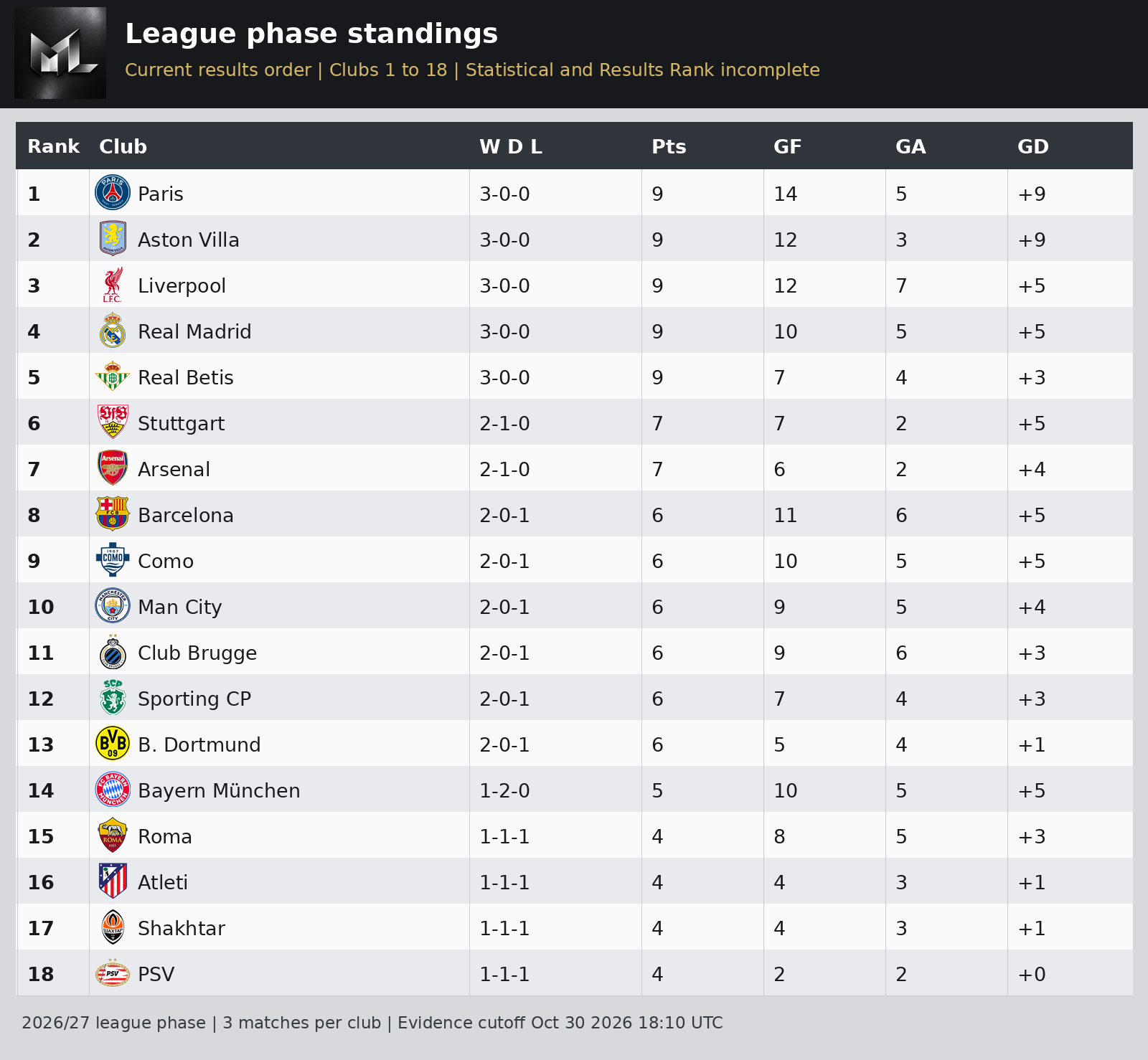
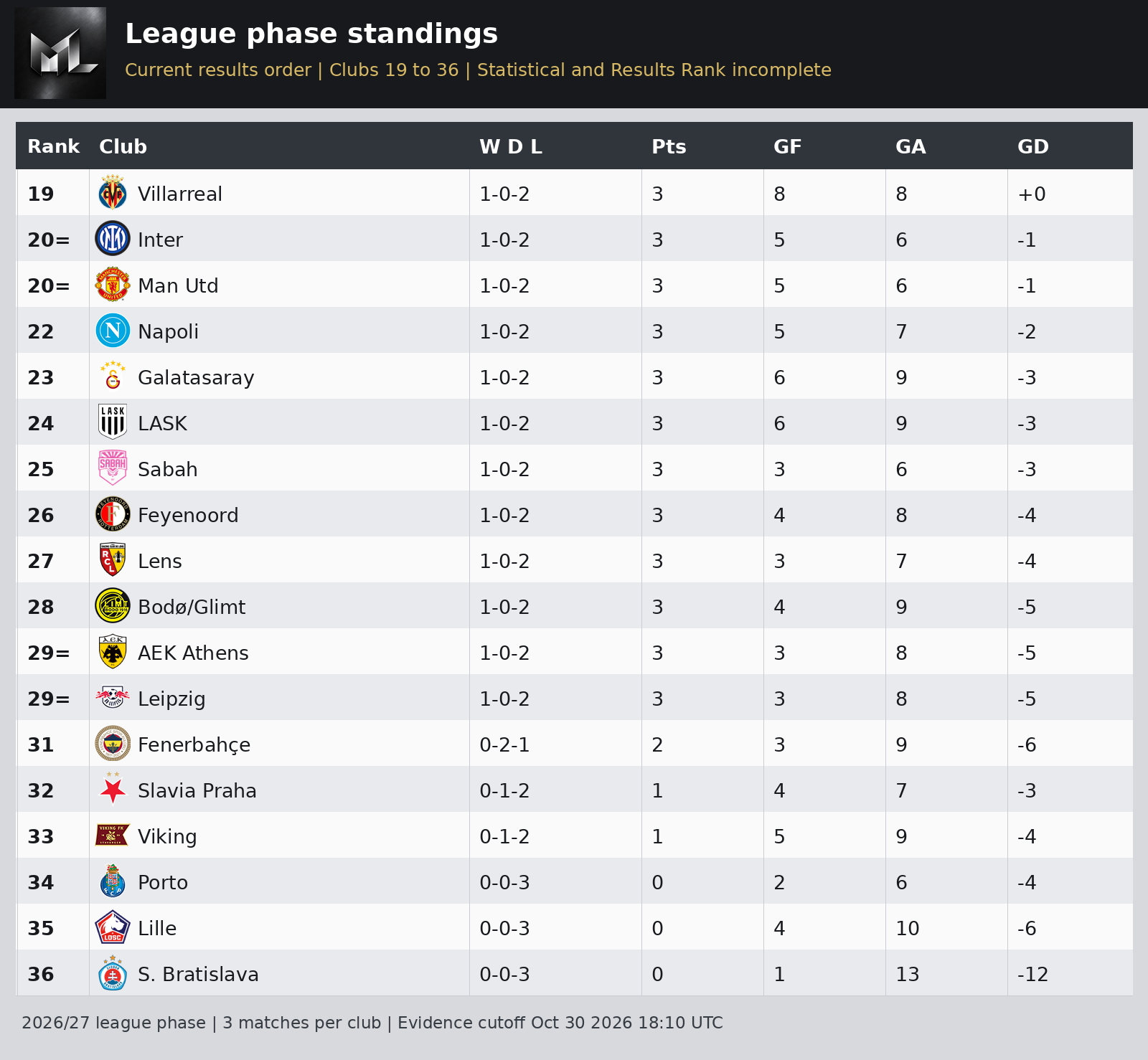
Paris lead an early league phase in which perfect records have several different foundations. Their fourteen goals include four against City and four against Barcelona. Villa, Liverpool, Madrid and Betis also have nine points, but their defensive records and winning margins tell different stories. After three matches, the table records what each club has earned. It cannot yet settle how reliable those returns will be.
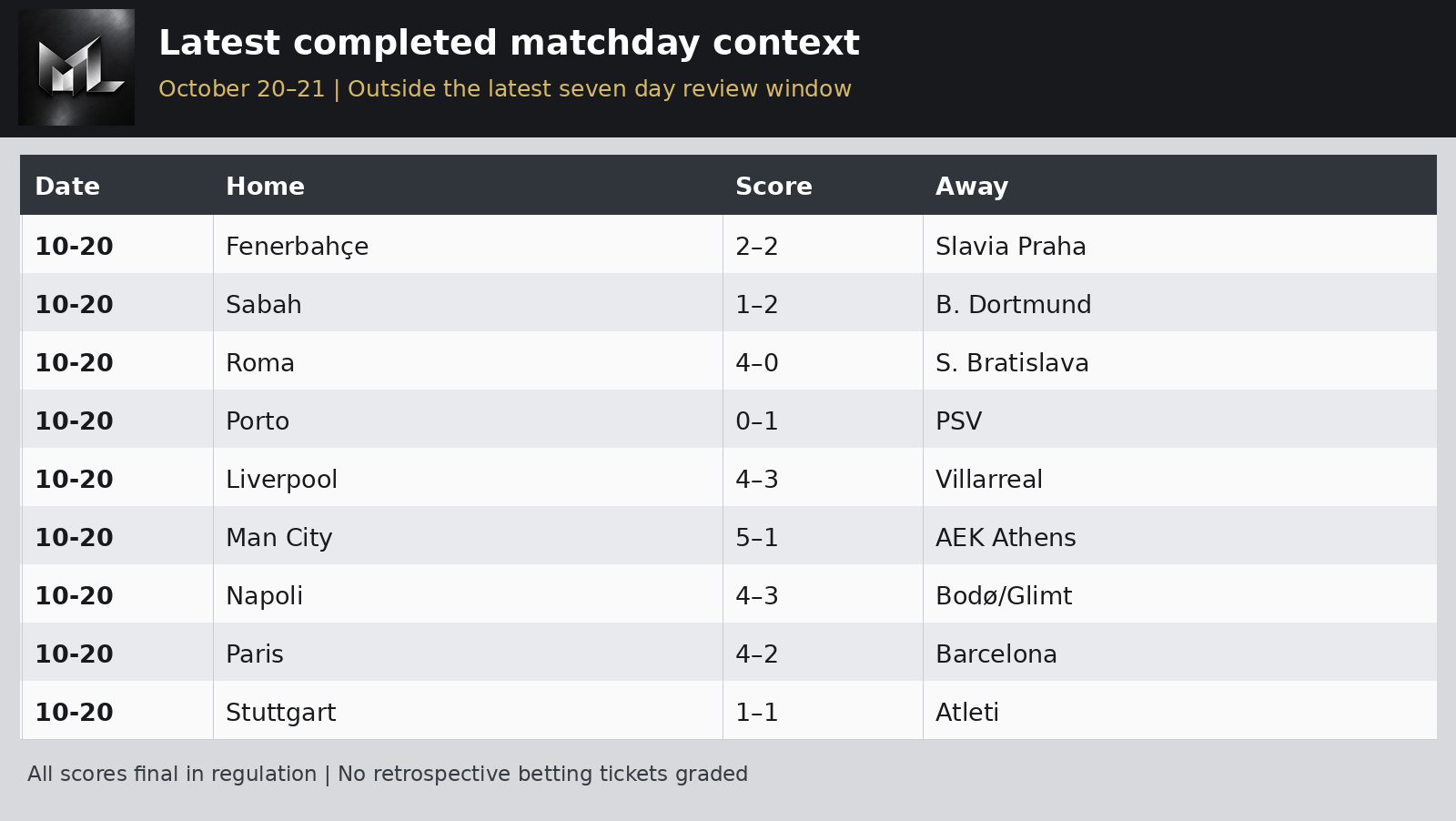
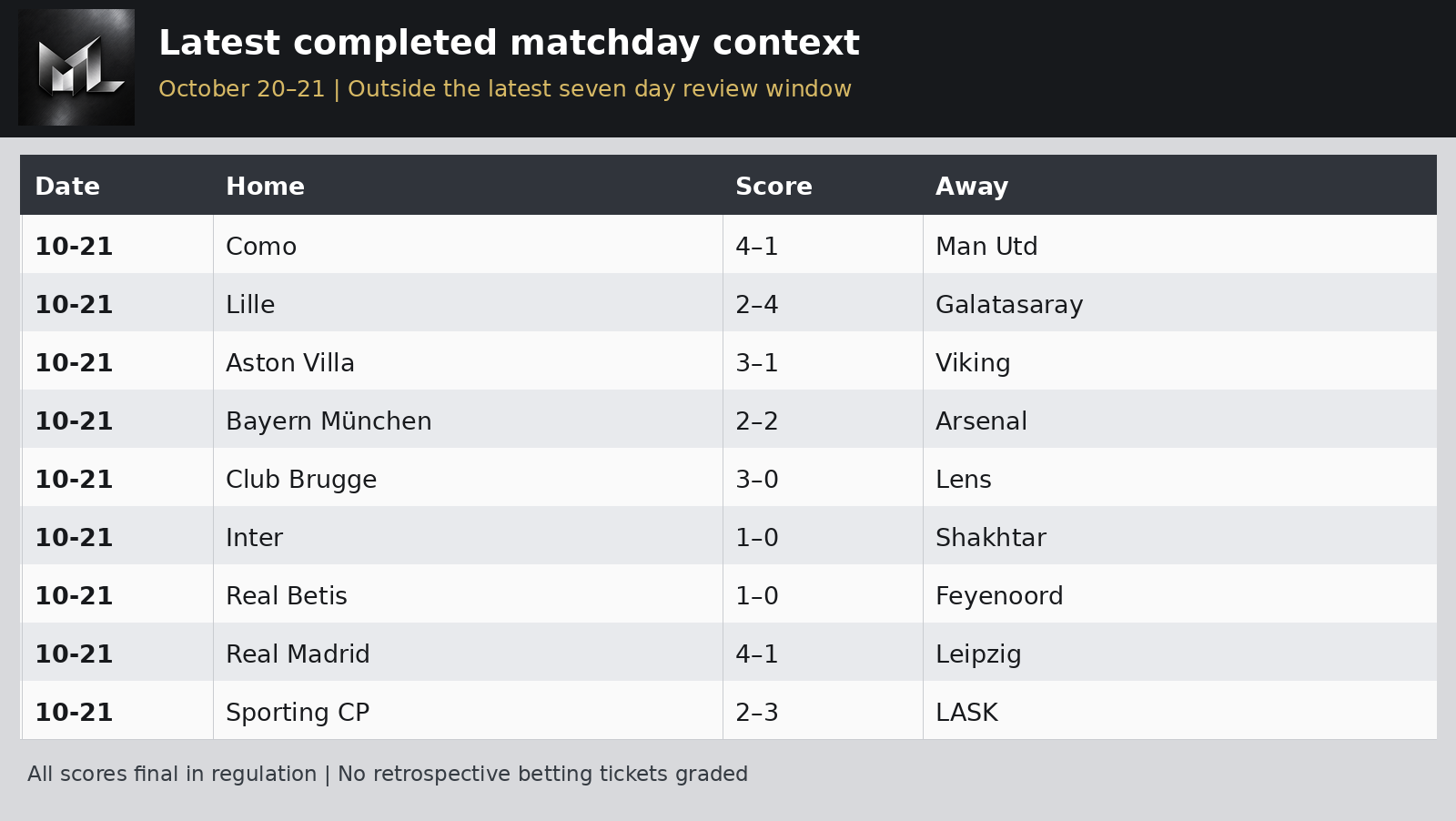
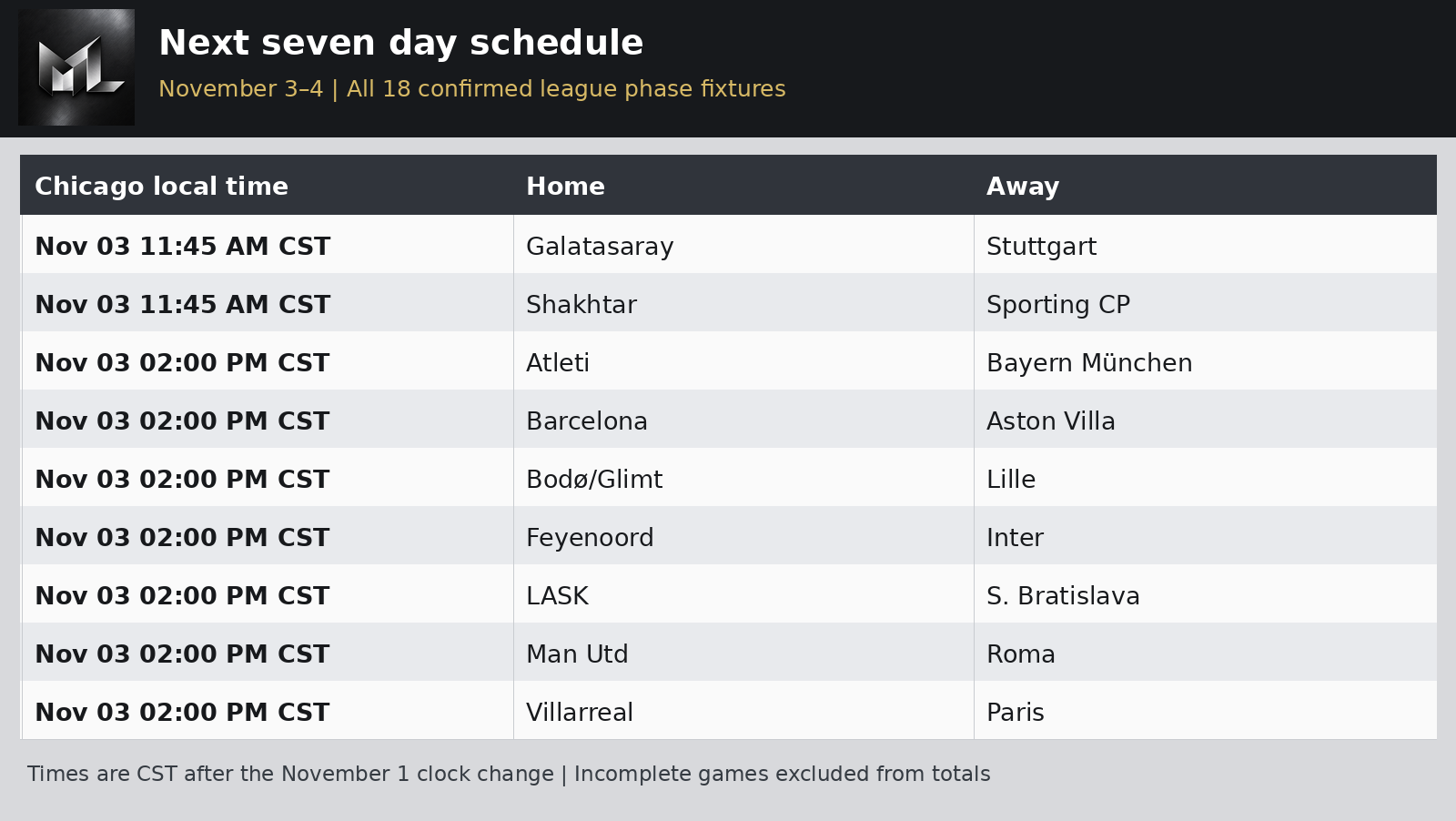
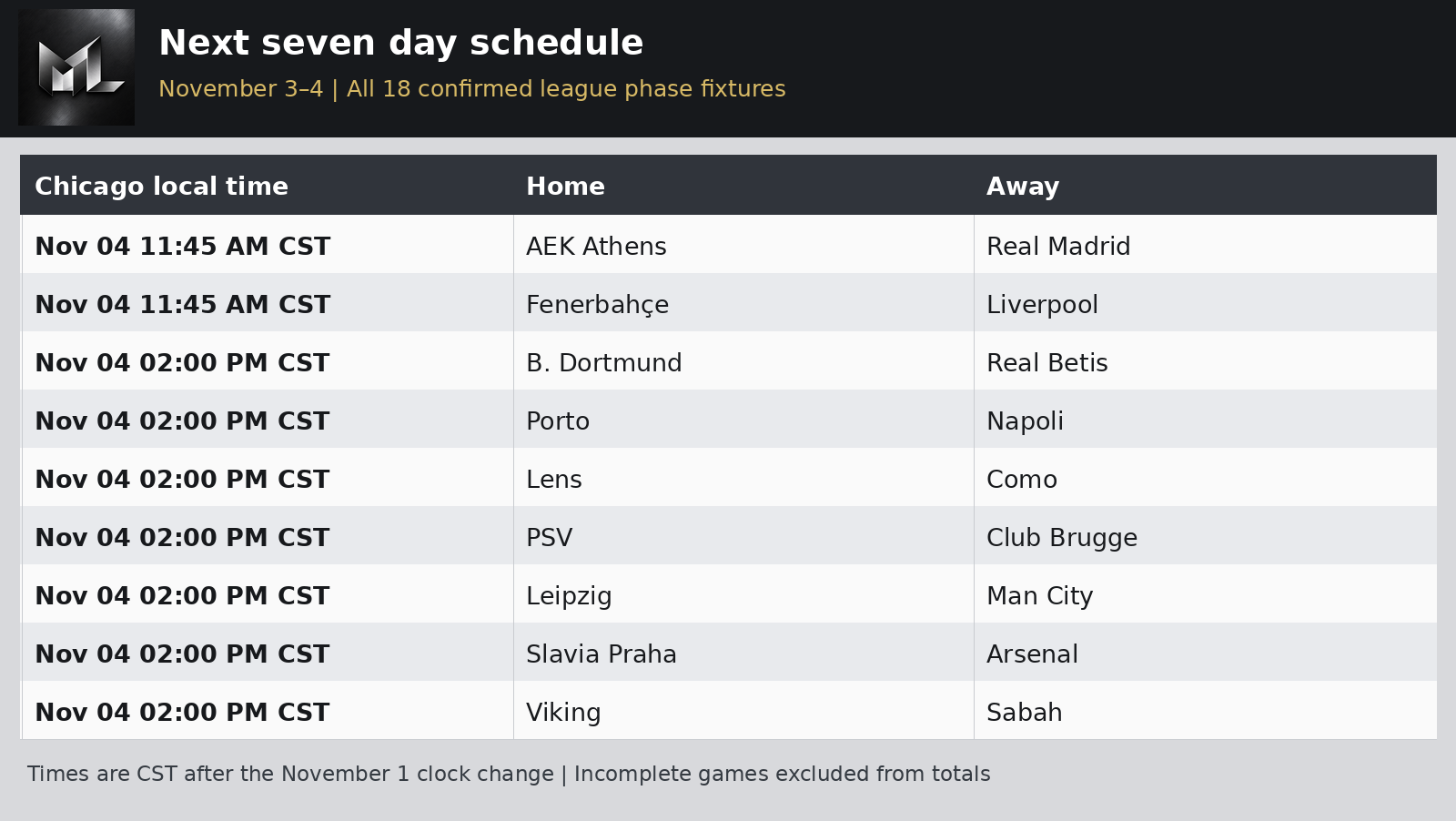
No Champions League match was completed in the seven days ending at the common evidence cutoff on October 30. The latest completed matchday was October 20–21. Its results appear separately as context, rather than being relabeled as this week's games. All thirty-six clubs have played three league-phase matches; all eighteen next fixtures fall on November 3–4.
This edition preserves the October 29 weekly identity and uses the newest verified shared-source population available at production. The common evidence cutoff is October 30 2026 at 18:10 UTC. The newest shared standings observation is 11:08:56 UTC, about seven hours earlier. Primary season/calendar evidence retained on October 29 places the current league phase between September 8 2026 and January 27 2027. A fresh direct primary recheck could not be retrieved; source latency and incomplete detailed statistics remain explicit.
League phase standings
These are league-phase standings and results order, not Matchup Lab Statistical Rank or a calculated Results Rank. Both ranking updates remain incomplete because an appropriate validated UCL model is not bound to this edition and detailed team statistics cover only 29 of 54 completed games. Records, points and goals are independently recomputed from all 54 finals. During matchdays one through seven, equal points are separated by goal difference, goals scored, away goals, wins and away wins. Clubs still equal share the same rank and display alphabetically by UEFA abbreviated name. Inter and United therefore share twentieth; AEK and Leipzig share twenty-ninth. The final-matchday opponent and disciplinary criteria are not applied early. Current positions do not mean qualification or elimination is already secured.
The quiet week and the latest completed round

The latest round separated productive attacks from secure results. Paris beat Barcelona 4–2, Liverpool outscored Villarreal 4–3, and Como beat United 4–1. Villa and Madrid maintained perfect starts. Betis added a first clean sheet, while Arsenal and Bayern shared four goals and a point each. These October 20–21 games explain the current season totals; none is counted as a game played in the latest seven days.
Every club assessed
Paris Saint-Germain
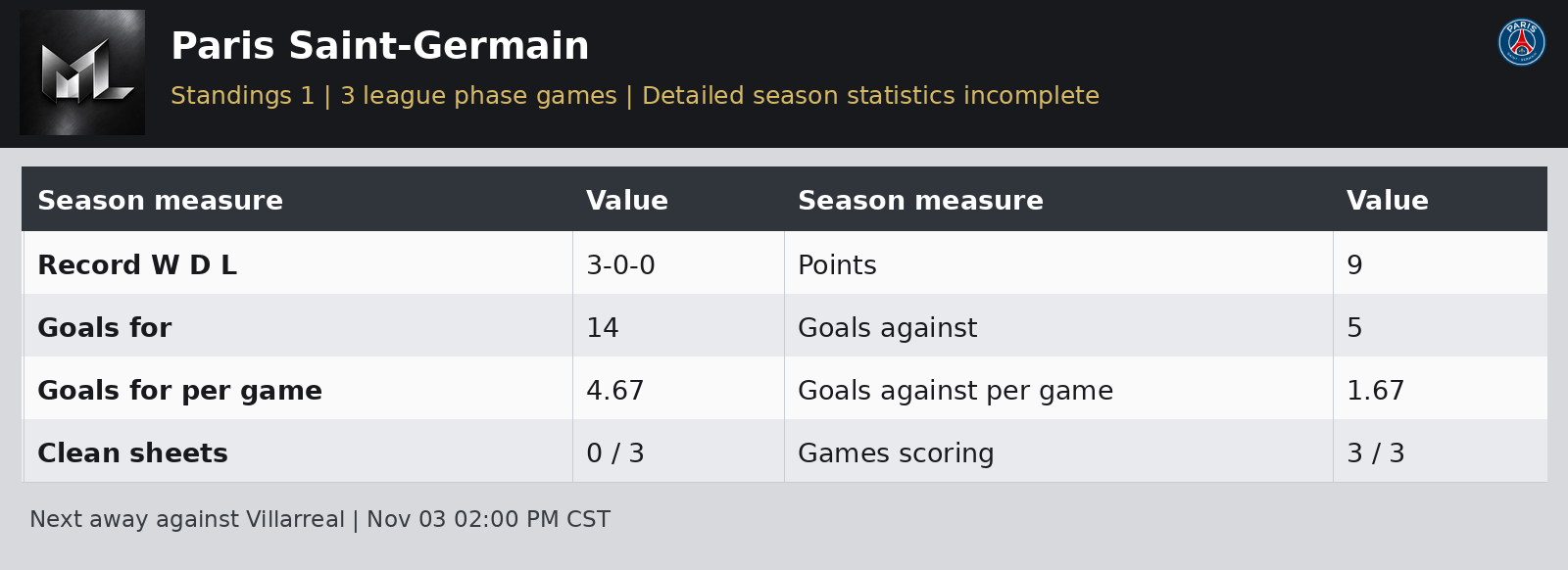
Paris have done more than collect nine points. Four goals away to Manchester City and another four against Barcelona give their scoring lead substance beyond the opening six against Slovan. Those two victories account for eight of the fourteen goals, so the attack has already carried its output into demanding fixtures. The qualification is at the other end. Paris conceded in all three matches and allowed two in each of the last two. Villarreal next offer a useful test of whether Paris can manage a game they are capable of opening up. Villarreal have scored eight and conceded eight. Paris need enough protection behind their attacks to avoid turning superior scoring into a weekly rescue operation. First place after three games is earned; a place in the last sixteen is not yet secured.
Aston Villa
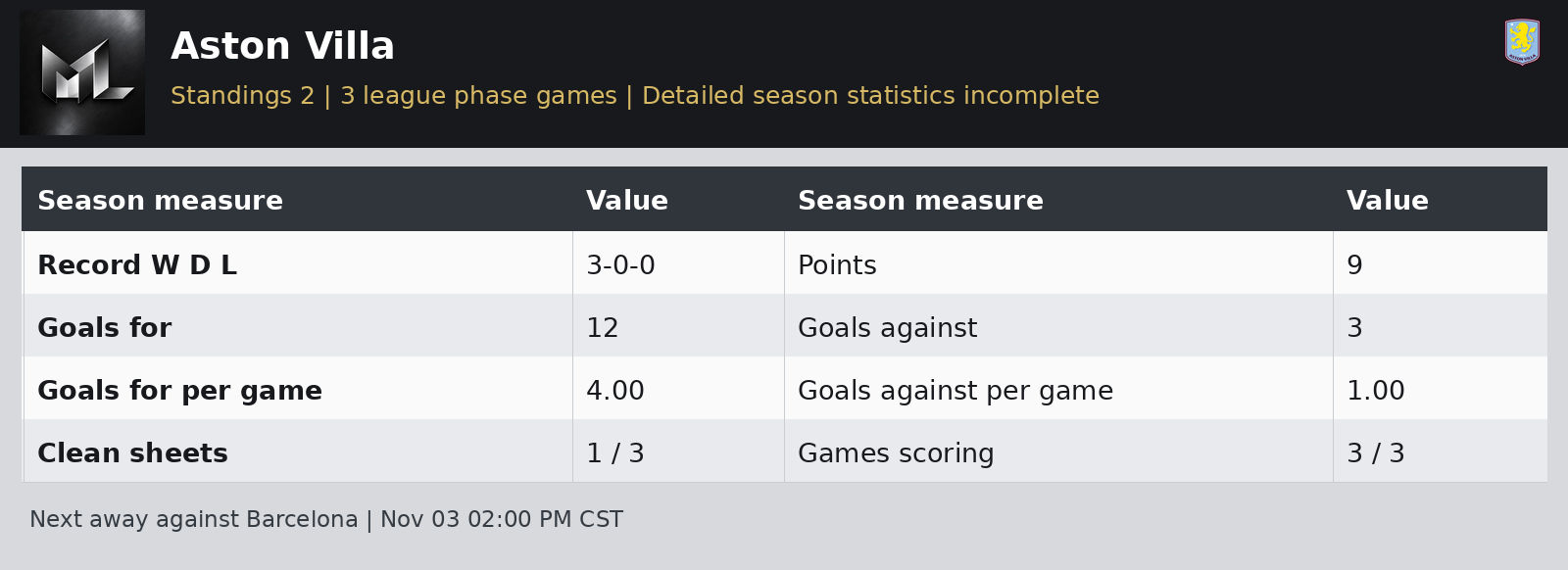
Villa's perfect start contains two different kinds of evidence. The opening 3–2 win at Club Brugge required more scoring than the defence would have wanted. The next two home games produced nine goals and only one conceded, including the 6–0 against Fenerbahçe. That large win supplies half the season's goals and should temper any assumption that four per game is a settled level. Barcelona away now changes both the venue and the difficulty of the assignment. Villa have already won their only away game, but have not yet shown they can keep an away opponent quiet. They need to preserve a scoring threat without allowing Barcelona the repeated exchanges that made the Brugge game so close. Nine points provide room to respond to a setback, not permission to accept one.
Liverpool
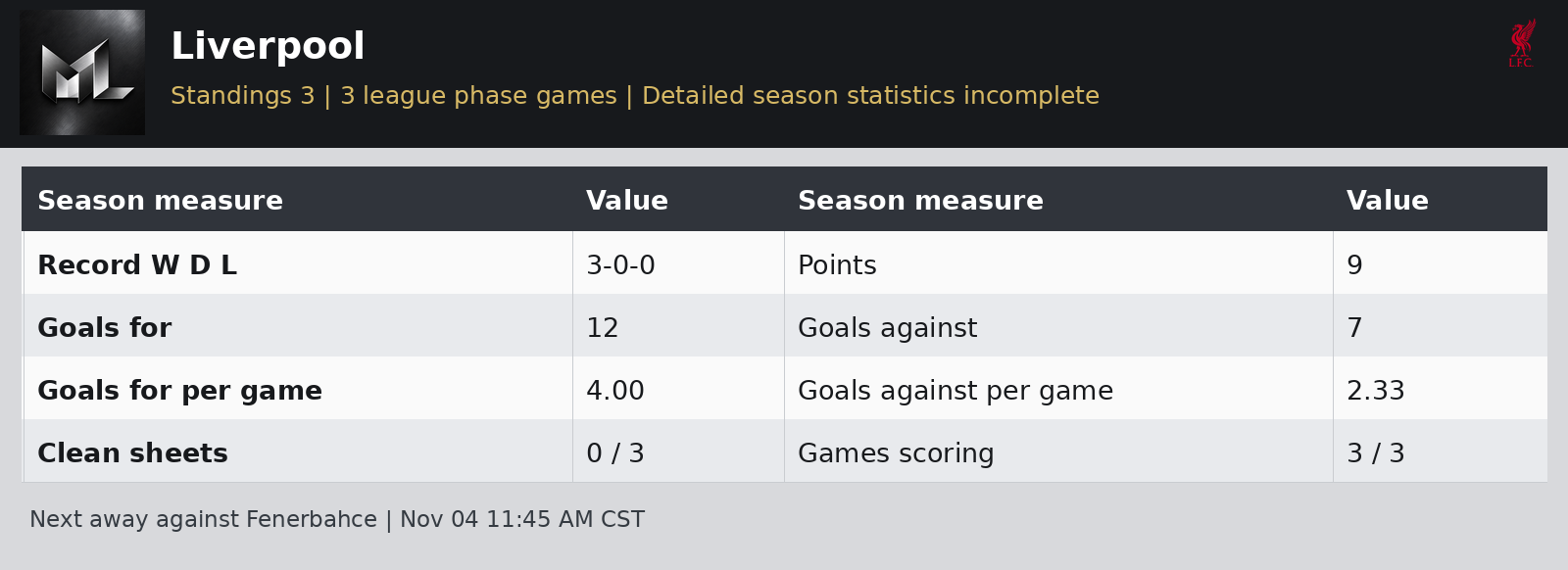
Liverpool have won every game while conceding seven goals. That is a powerful scoring start and a less comfortable foundation than the nine points suggest. A 6–3 at LASK and 4–3 against Villarreal account for ten of the twelve goals scored, but also six of the seven allowed. The latest win therefore reinforces the same question rather than resolving it. Can Liverpool close a game without having to score again? Fenerbahçe away comes next. Their hosts have conceded nine, including six against Villa, but have drawn both their home matches. Liverpool should expect an opponent with reasons to protect a point and wait for mistakes. Maintaining pressure matters, but so does keeping enough players in position when that pressure breaks. The record is flawless; the defending has not been.
Real Madrid
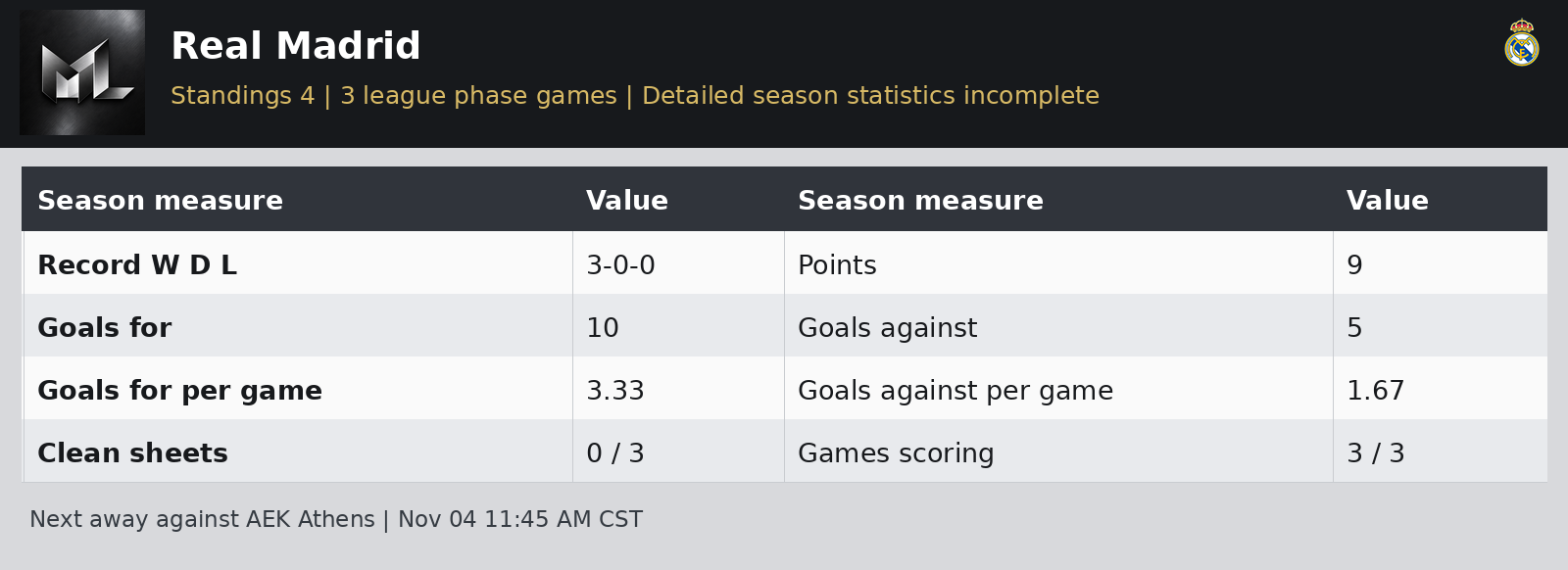
Madrid's three wins include two narrow decisions before the more comfortable 4–1 against Leipzig. The 4–3 away win over Roma demonstrates scoring away from home, while the three conceded there remain part of the season assessment. Five goals allowed across three games leave little basis for treating the latest margin as evidence that every defensive problem has disappeared. AEK away is the next assignment. The hosts won their first match but then conceded eight across two defeats. Madrid have the results to justify confidence and the attacking output to punish another loose game. Their practical task is to avoid giving an opponent recovering from heavy losses the encouragement of easy goals. Another efficient result would be more useful than another evening requiring four goals to settle the matter.
Real Betis
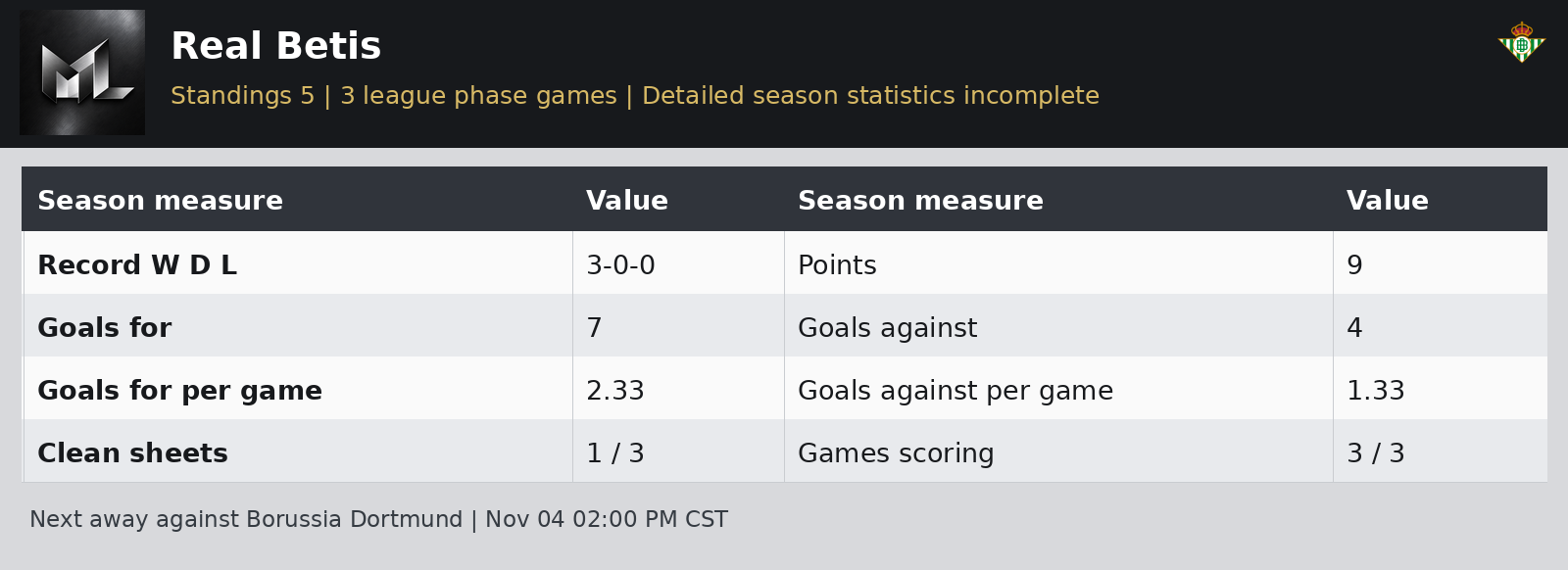
Betis have taken nine points without a comfortable margin in any game. Two 3–2 wins were followed by a 1–0 against Feyenoord, giving them a first clean sheet and three one-goal decisions. Winning close matches is valuable evidence of results. It does not establish that the next close match will also fall their way. Dortmund away makes that distinction especially relevant because all three of Dortmund's games have also been settled by one goal. Betis need to carry forward the reduction in goals conceded from the latest match while retaining the scoring that rescued the first two. Seven goals are enough for a perfect start so far, but there is little spare margin if either end deteriorates. Their position deserves respect without turning narrow victories into a permanent guarantee.
VfB Stuttgart
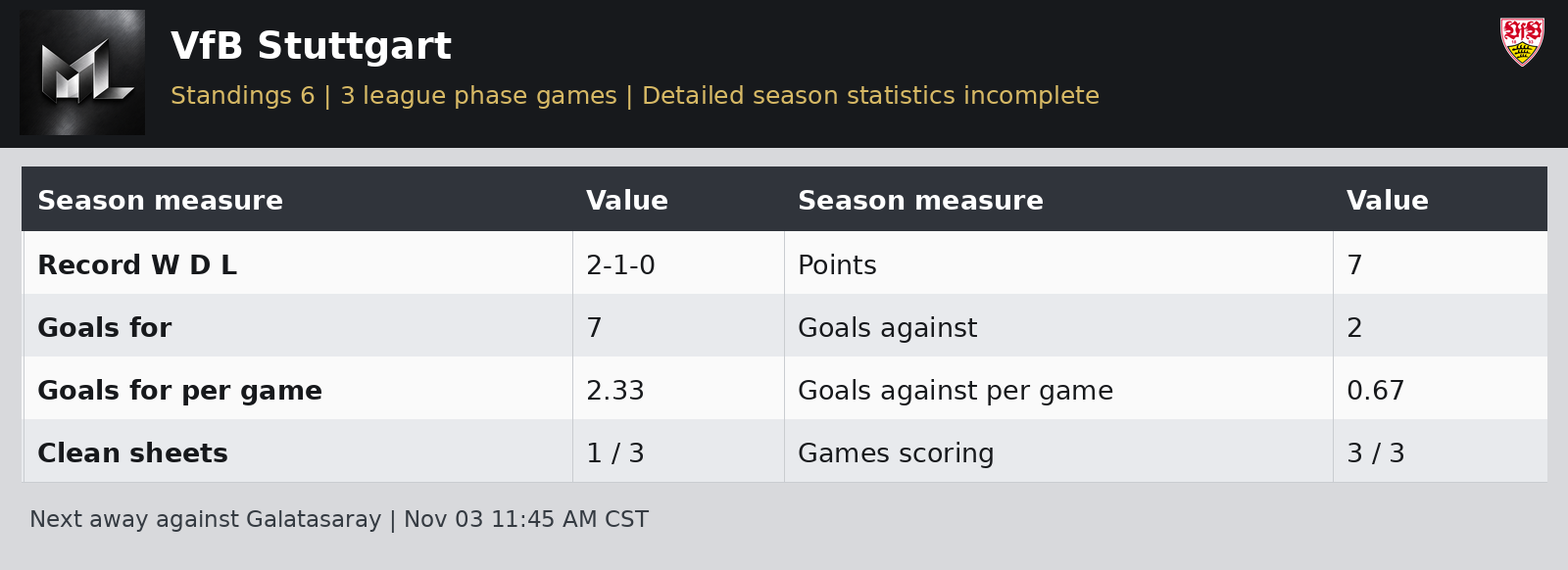
Stuttgart's unbeaten return has a stronger defensive base than most of the clubs around them. They have conceded two in three games, with the 3–0 away win at Slovan the only clean sheet. The 1–1 against Atlético then showed that the earlier victories were not followed by a defeat when scoring became harder. Seven points are useful, and their next trip to Galatasaray is a chance to make that resilience travel again. Galatasaray have scored six but allowed nine, so Stuttgart face an opponent capable of making a match productive at both ends. Repeating the Slovan margin should not be the expectation. Preserving the distances that have kept the total conceded low, while taking the openings available against a more exposed defence, is the clearer assignment.
Arsenal
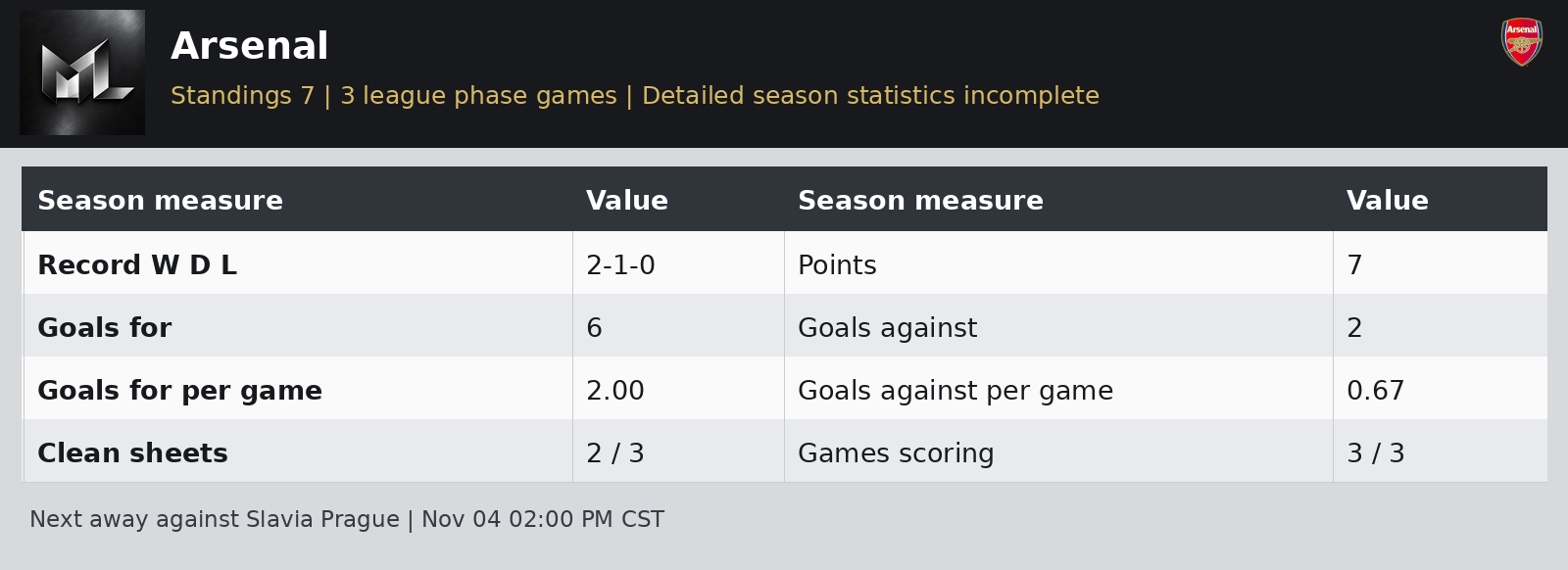
Arsenal have combined two wins with a draw at Bayern and conceded only twice. Their first two games were clean sheets, and the 2–2 in Munich added points without extending that defensive run. This is enough to support an assessment of a controlled start, although the Bayern game also shows why the season cannot be reduced to the first two opponents. Slavia away is next. Slavia have scored in two games but have yet to win, and their latest 2–2 supplied their first point. Arsenal need to avoid giving that recovery further assistance. Six goals from three matches are useful output alongside this defensive record. The next improvement would be taking the restraint of the opening wins into another away fixture, rather than relying on a second goal to compensate when the first is conceded.
Barcelona
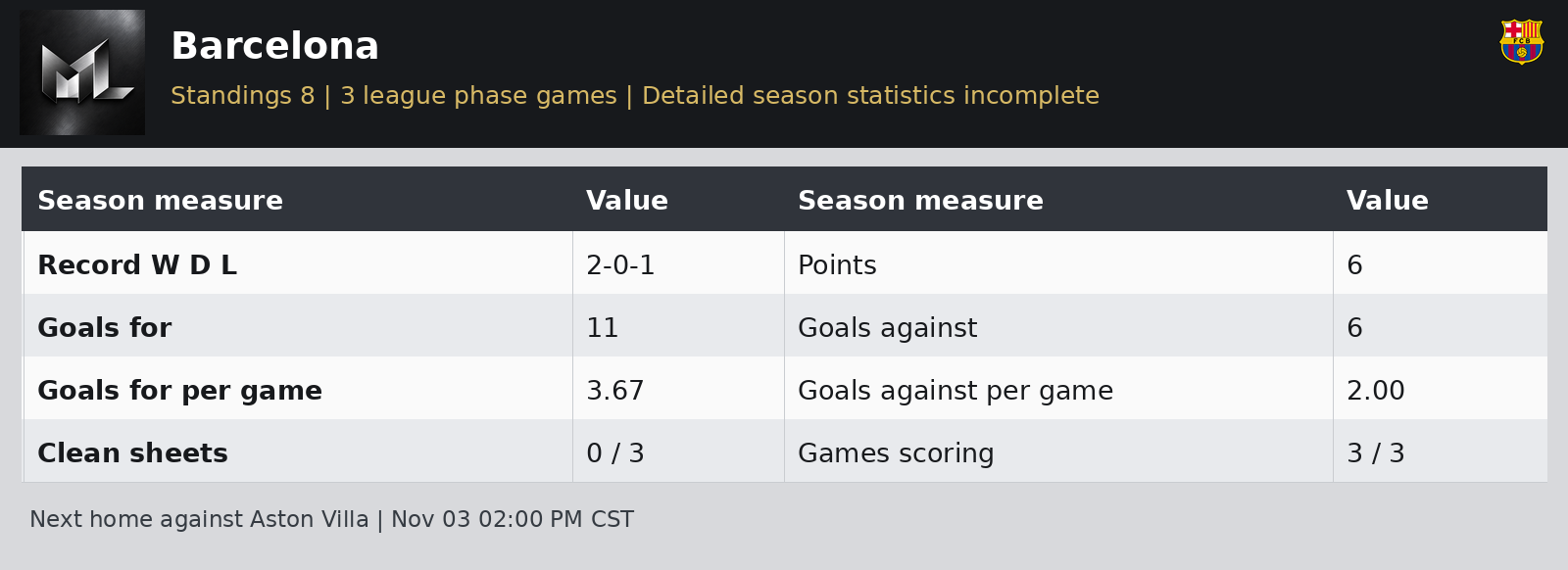
Barcelona's eleven goals have brought six points because Paris scored four against them in the latest match. The opening 5–1 and 4–1 wins had already included a goal conceded each time. Paris made the cost much larger. That result should sharpen the assessment without erasing the attack's output. Villa now arrive with twelve goals, three wins and a defence that has conceded only once in its last two games. Barcelona cannot assume that another productive attacking evening automatically settles the result. They need to reduce the openings they allow when committing players forward, and avoid requiring the attack to cancel out a growing deficit. The home fixture offers an immediate response, but the season evidence makes defending the opponent's next attack as important as creating their own.
Como
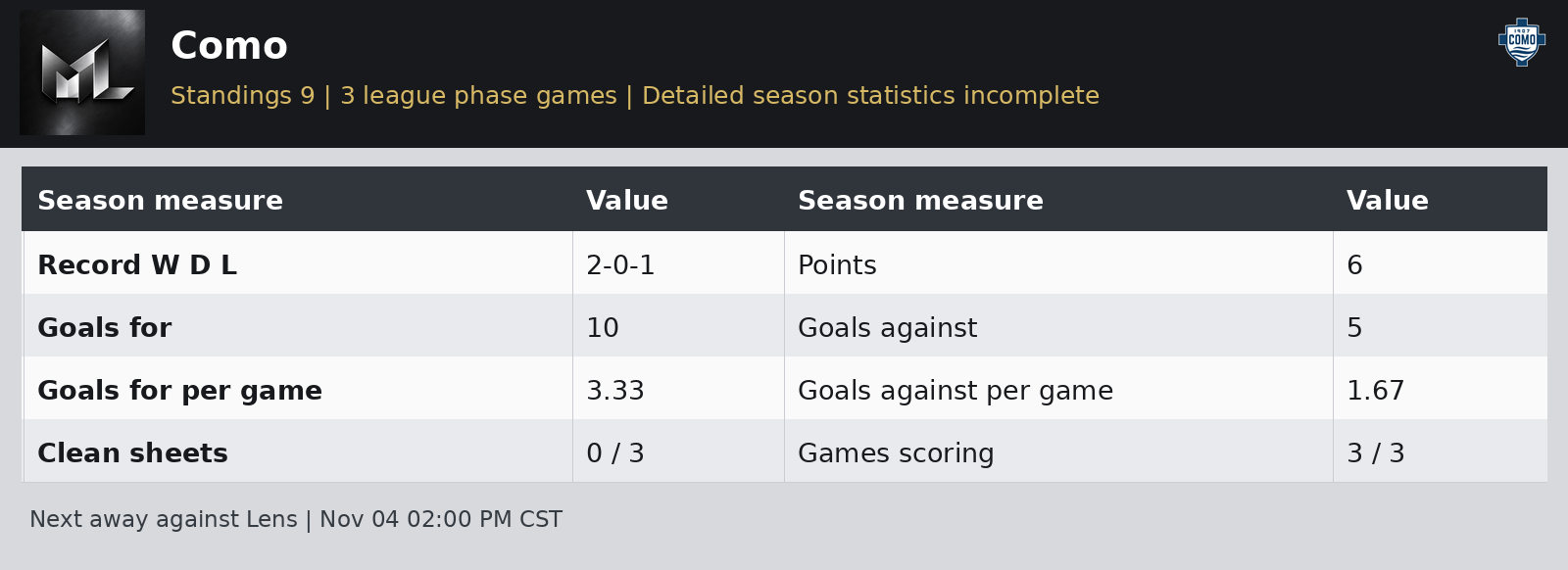
Como have scored four in both home matches, beating Leipzig and Manchester United by the same 4–1 score. The intervening 3–2 defeat at Feyenoord prevents that striking home pattern from becoming an all-purpose verdict. Their next match is away at Lens, so the less flattering part of the evidence is directly relevant. Ten goals demonstrate an attack that can punish an opponent. Five conceded, including three in the only away game, show why control still matters. Lens have failed to score in their last two matches, but that does not make the trip a formality. Como need to carry their scoring threat away from home while conceding fewer chances to alter the game. Six points are a strong platform; the next test is whether their best performance can survive a different venue.
Manchester City
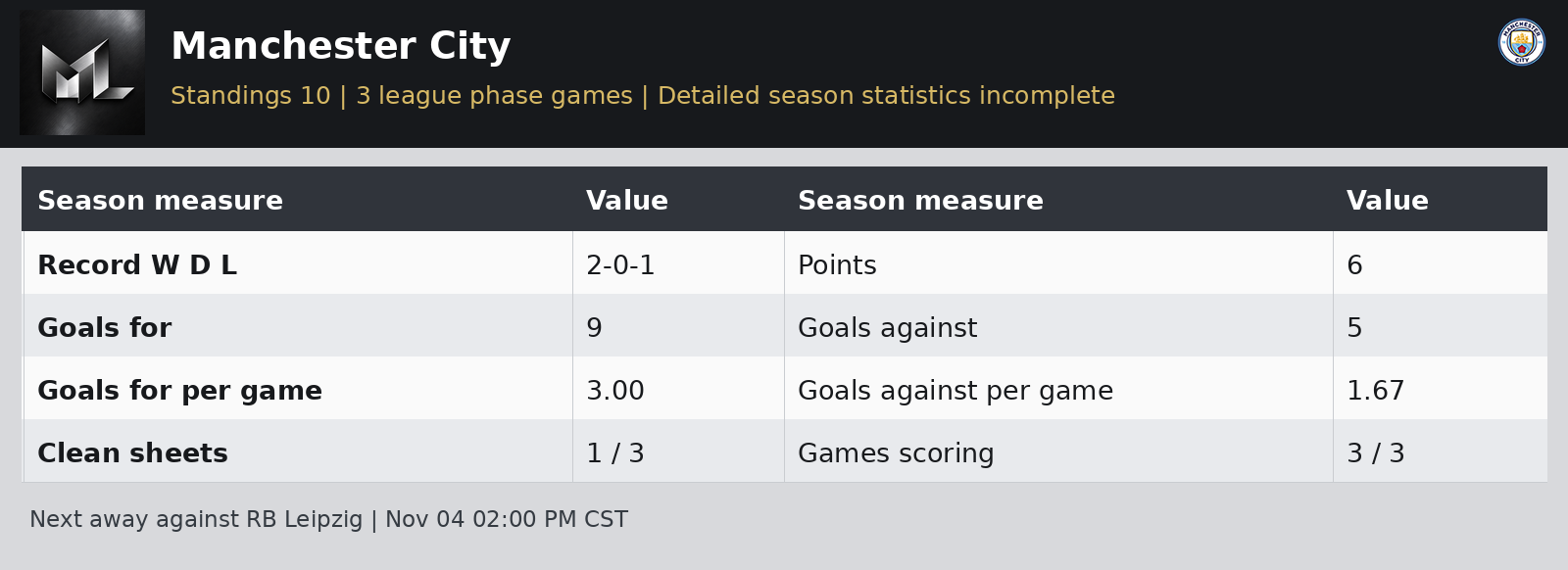
City's 5–1 against AEK restored the margin lost in the 4–2 defeat by Paris, leaving six points and nine goals from three games. Those figures should be read together. The attack has responded, but the Paris loss still accounts for four of the five conceded and shows what happens when the opponent can sustain scoring of its own. Leipzig away is next. Their hosts have lost twice by 4–1, either side of a 1–0 win, so City have clear evidence of an opponent whose defence has struggled in higher-scoring games. The appropriate ambition is pressure with protection behind it. Beating AEK emphatically does not prove that the defensive questions raised by Paris have been answered. A second away win, with fewer concessions, would add a more convincing kind of progress.
Club Brugge
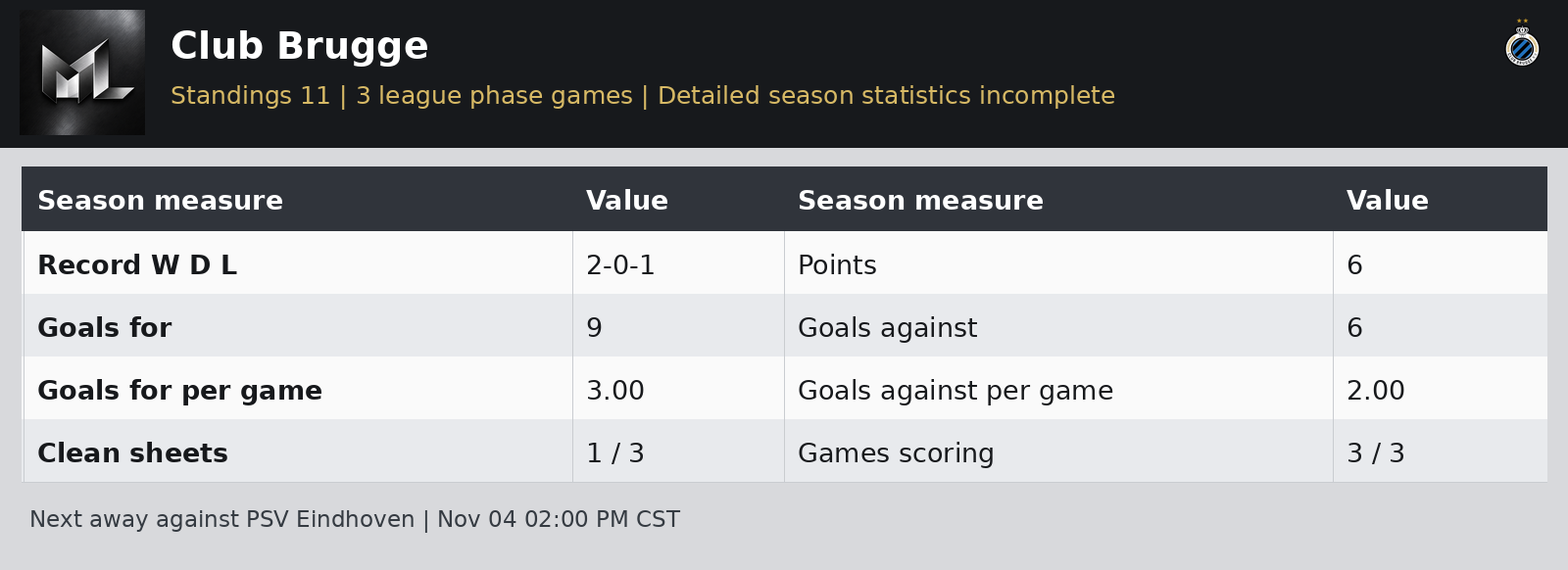
Brugge followed the opening 3–2 defeat by Villa with a 4–3 away win over Inter and a 3–0 against Lens. The latest clean sheet matters because the first two games required a great deal of scoring to stay competitive. Nine goals put Brugge among the productive attacks in this early table, but six conceded remain a substantial cost across only three matches. PSV away now presents a different scoring environment. PSV's three games have produced only four goals in total. Brugge need patience if their next opponent does not offer the exchanges that characterised the Inter match. They also need to preserve the defensive improvement against Lens. The clean sheet is a useful change in the record, not yet a repeated habit that can be taken for granted.
Sporting CP
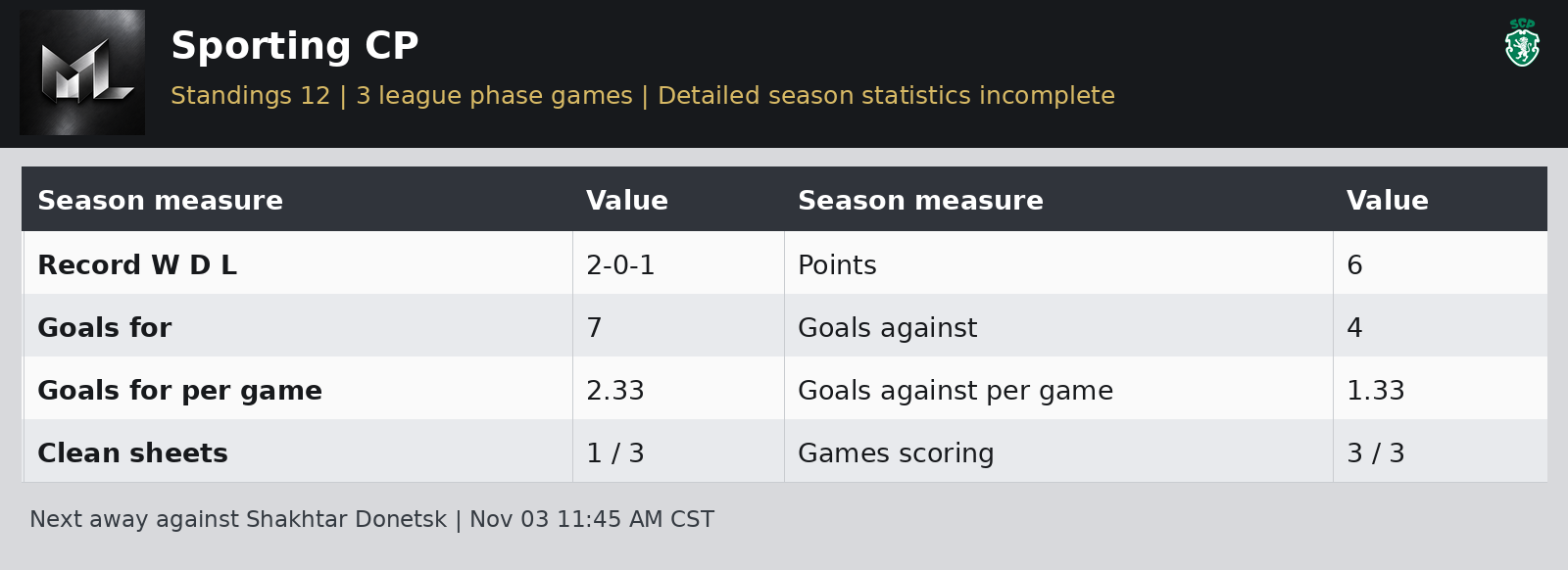
Sporting's first two matches produced five goals, two wins and one conceded. The 3–2 home defeat to LASK then removed the perfect record and supplied three quarters of the season's goals allowed. It is a material reversal, but still one match in a small sample. Shakhtar away offers an immediate measure of whether Sporting can restore the earlier balance. Shakhtar have conceded three across three games and have already earned a draw away to PSV. Sporting should not plan around another open home contest simply because the last one finished with five goals. Their seven goals show scoring capacity. The more pressing task is reducing the number they need to win by recovering the defensive restraint that accompanied the first six points.
Borussia Dortmund
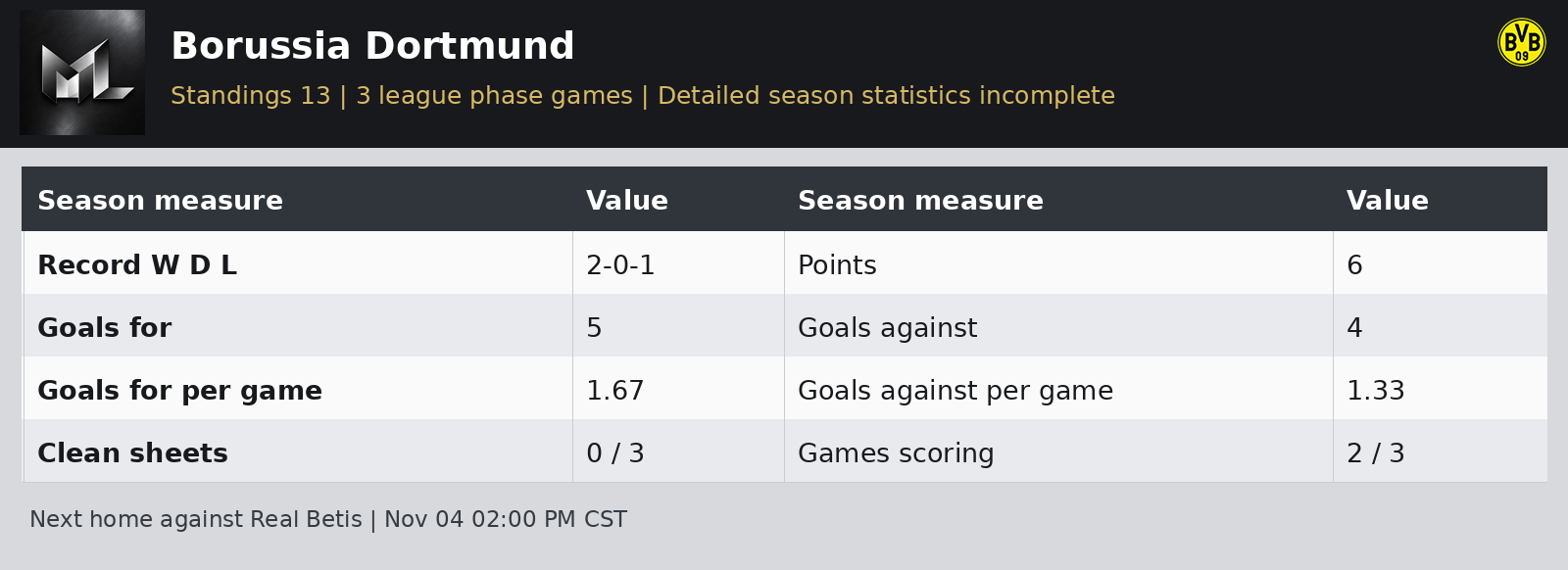
Dortmund have six points from three matches decided by one goal. They beat Villarreal 3–2, lost 1–0 at Bodø/Glimt and then won 2–1 at Sabah. That return is useful but fragile. Five scored and four conceded leave little spare room for a missed opportunity or an additional concession. Betis visit next with three one-goal wins of their own. Dortmund cannot count on a large scoring advantage and need to improve the defensive side of a home fixture without removing their own threat. Their only clean sheet is still outstanding. The Sabah win avoided a second defeat; it did not change the narrow margins underlying the campaign. Getting ahead and then making the next phase of the game quieter would be a meaningful step.
Bayern Munich
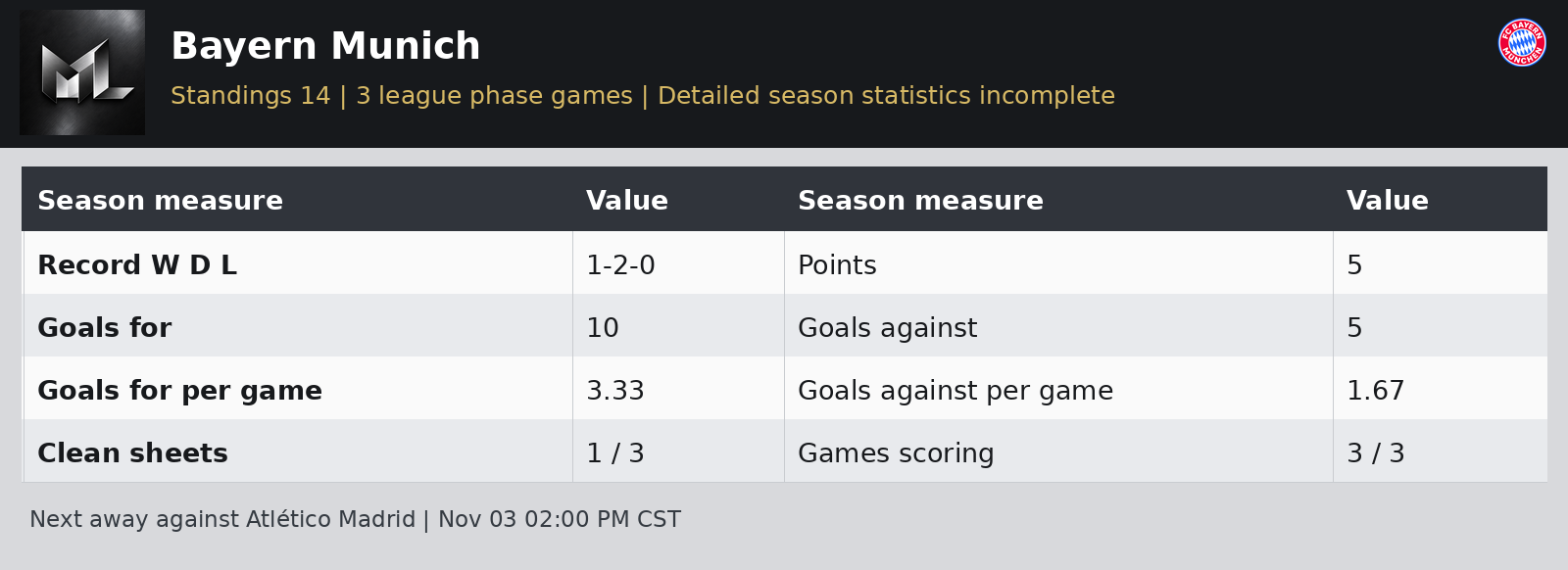
Bayern remain unbeaten but two draws have left them on five points. The 5–0 opening win supplies half their goals and the only clean sheet. Since then they have scored five and conceded five across the 3–3 at Viking and 2–2 against Arsenal. Those results make the issue clear without needing to invent an explanation from unavailable chance data. Bayern can score, but scoring has not been enough to separate them from the last two opponents. Atlético away now asks for a different balance. Atlético have allowed only three in total and kept Manchester United scoreless at home. Bayern need to prevent another game in which every goal they create is offset at the other end. Unbeaten is accurate; it should not conceal four points left uncollected in the two draws.
AS Roma
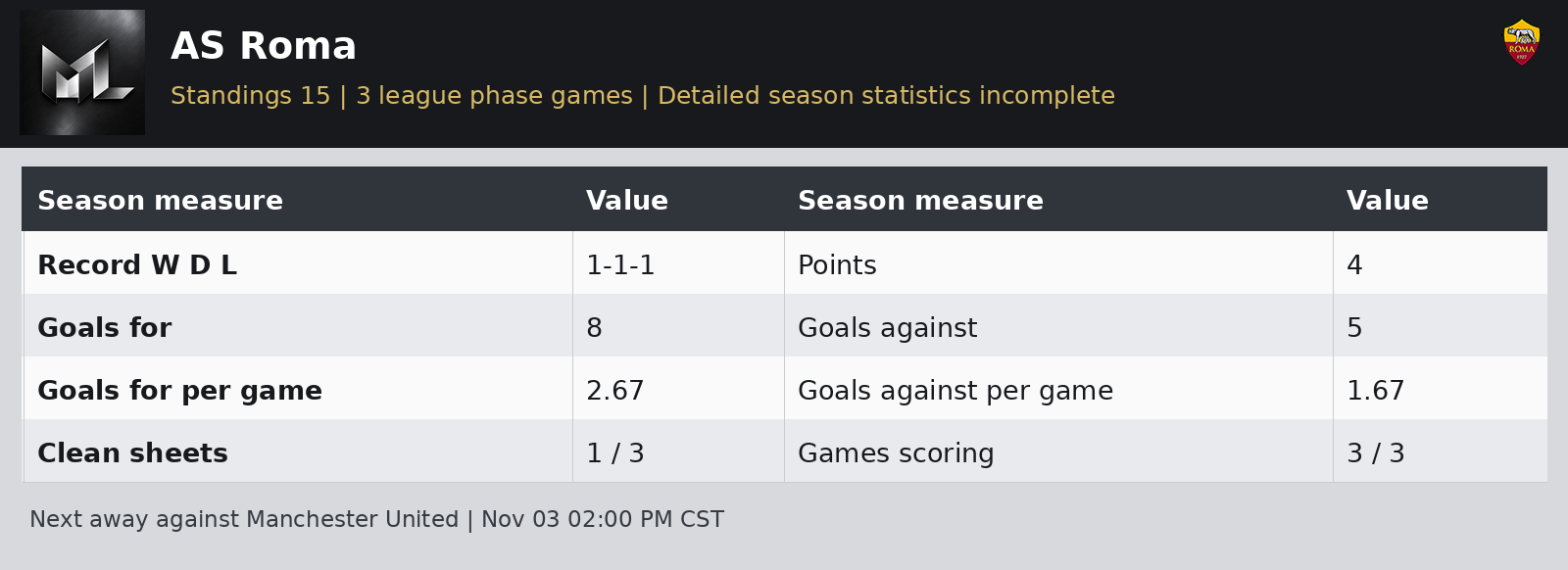
Roma's four points contain a draw away to Fenerbahçe, a 4–3 defeat by Madrid and a 4–0 against Slovan. The latest match improved both the return and the goal difference, but all four goals came against the current bottom club. That context matters when assessing how much has changed since Madrid scored four. Manchester United away will test whether Roma can turn attacking output into a more secure result against a club also trying to repair its start. Roma have eight goals, but the only away match produced one. They need to take enough threat to prevent United settling while avoiding the repeated concessions of the Madrid game. The clean sheet against Slovan is encouraging evidence, with a different examination still to come.
Atlético Madrid
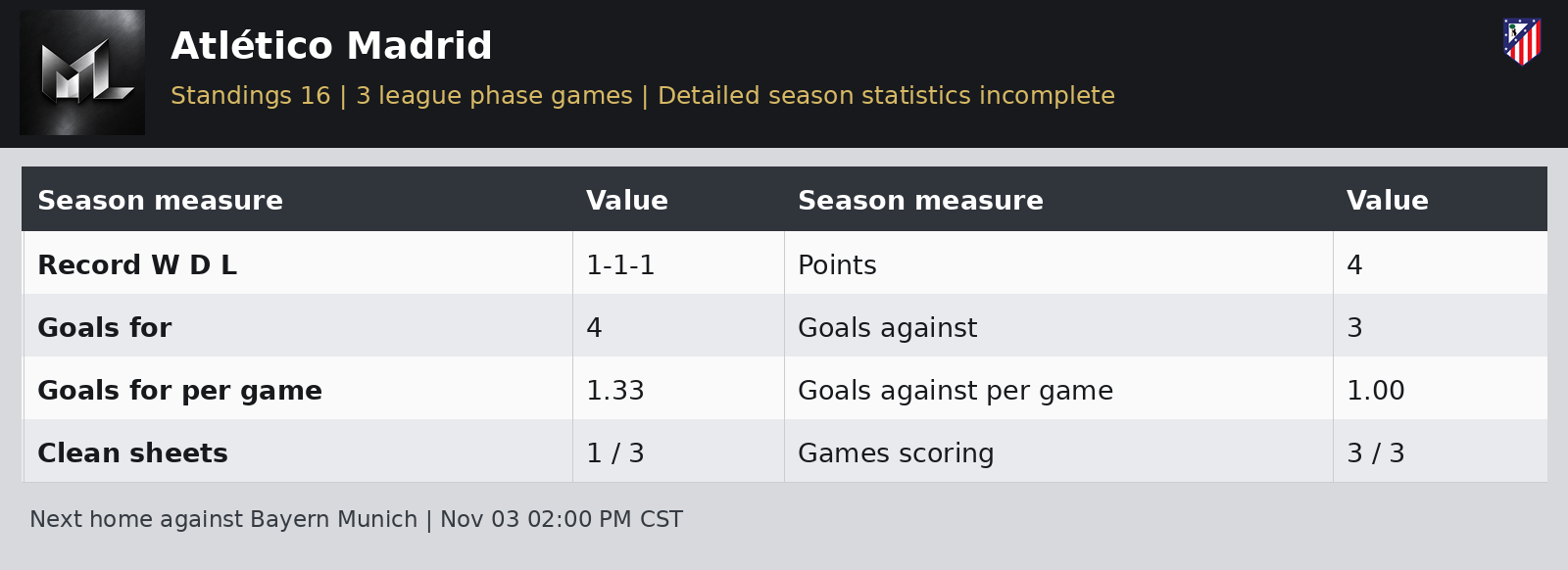
Atlético have improved their results since losing 2–1 at Liverpool. A 2–0 home win over United and a 1–1 away draw at Stuttgart leave four points and three goals conceded. The scoring total is only four, so the defensive restraint is carrying real weight rather than decorating a large attack. Bayern at home is the next test. Bayern have ten goals but have conceded five across the last two draws. Atlético need to keep the match within the kind of margins their own scoring can support, while taking advantage if Bayern again allow a productive opponent too many openings. The home win over United showed one clean sheet. Repeating that level against Bayern would say more than assuming the low season total will protect itself.
Shakhtar Donetsk
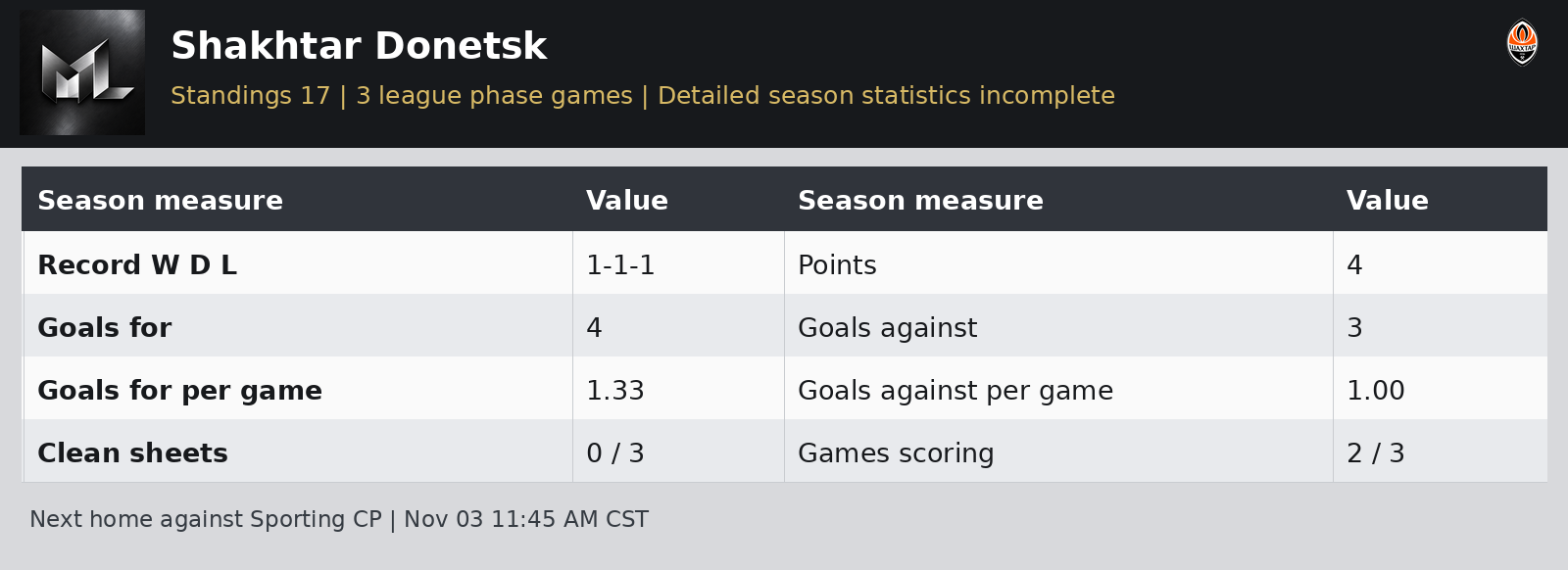
Shakhtar's four points have come from an away draw at PSV and a 3–1 home win over AEK, followed by the 1–0 defeat at Inter. They have remained within one goal of the opponent in both away matches, but have yet to keep a clean sheet anywhere. That distinction makes the next home game against Sporting useful. Sporting's attack has scored seven, while the latest home defeat exposed a defence that had previously conceded only once. Shakhtar need to build on the more productive home performance without allowing the game to become an exchange that suits Sporting's scoring better. Four goals across three games leave limited room for waste. The Inter result was narrow, but it still produced no points and no goal.
PSV Eindhoven
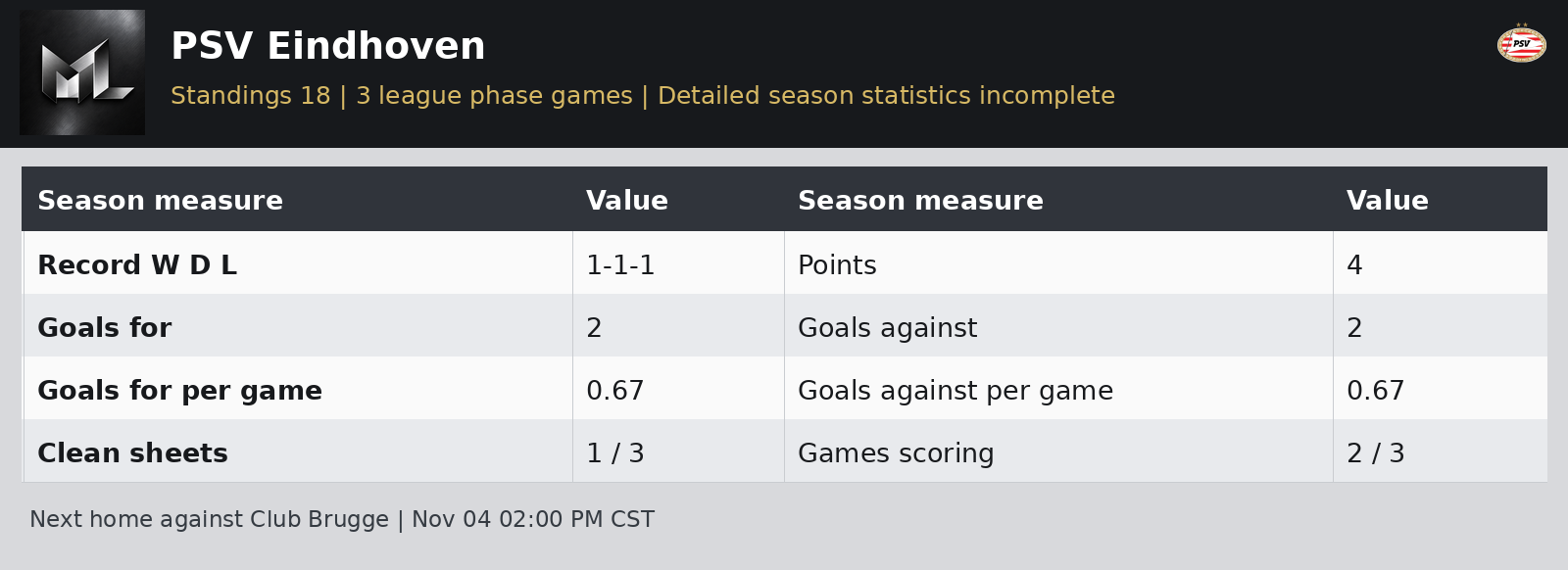
PSV's season has been defined by tight scores. A 1–1 with Shakhtar was followed by a 1–0 defeat at Leipzig and a 1–0 win at Porto. Two scored and two conceded are complete season totals, not evidence that every next game must be low scoring. They do show that PSV have so far depended on keeping the opponent close. Brugge arrive with nine goals and two consecutive wins. That is an important change from opponents against whom one goal was nearly enough. PSV need a route to more sustained scoring while preserving the organisation that earned the Porto clean sheet. Four points keep the campaign workable. They would look less secure if Brugge force PSV to chase a game with an attack that has not yet scored twice.
Villarreal
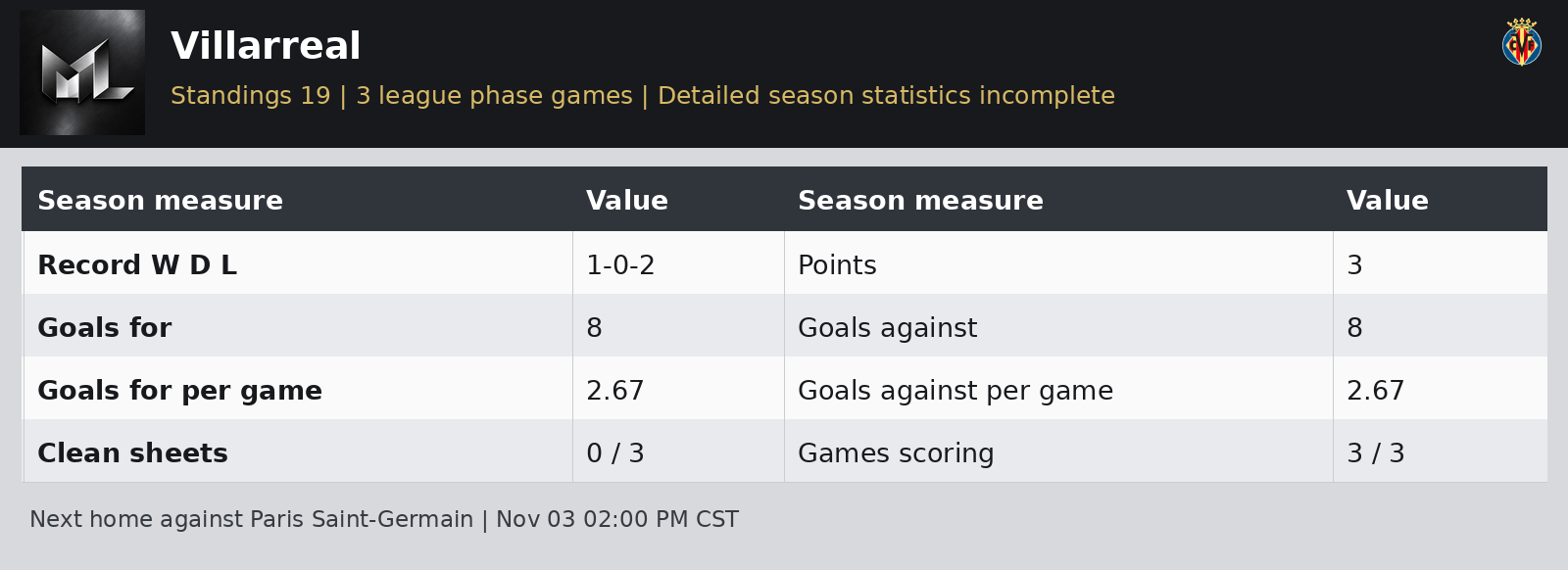
Villarreal have scored eight and conceded eight, yet have only three points. The latest 4–3 defeat at Liverpool and opening 3–2 loss at Dortmund explain the mismatch between attacking output and results. They were competitive on the scoreboard, but another goal at the other end kept deciding the match. Paris next arrive with fourteen goals and a perfect record. Villarreal cannot reasonably treat the ability to score three as sufficient protection against this opponent. They need to make their own attacking periods less expensive when possession changes, and avoid asking for a fourth goal simply to remain level. The 3–1 win over Napoli remains the better balance in the record. Recreating that restraint against a much more productive attack is the central challenge.
Internazionale
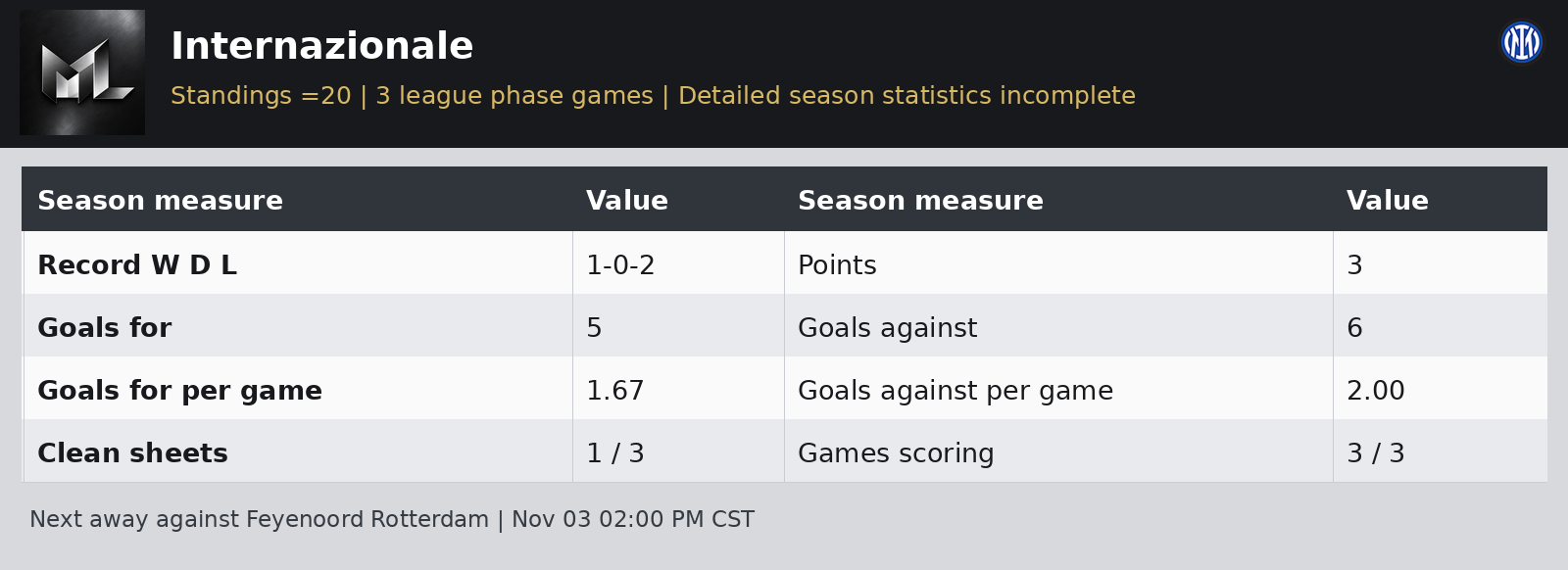
Inter's 1–0 against Shakhtar supplied their first points and first clean sheet after defeats by Madrid and Brugge. It was a useful correction after conceding six in two games. It also came with only one goal, so the improvement rests chiefly on making that goal enough. Feyenoord away is next. Feyenoord have conceded eight but also beat Como at home, giving Inter a reason to respect the setting rather than rely on the opponent's overall margin. Five goals scored across the campaign are respectable; the task is preventing a return to the costly exchanges of the first two matches. Inter share twentieth place under the interim tiebreak rules. The shared rank changes the label, not the need to add to three points.
Manchester United
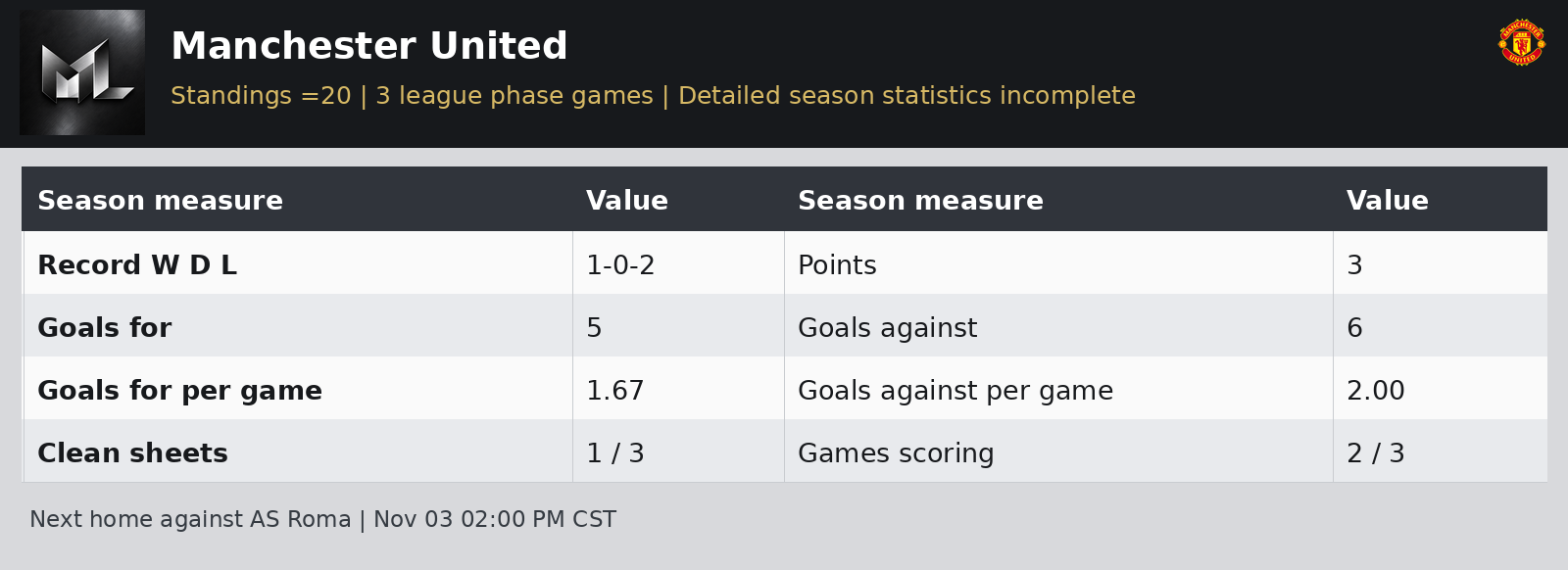
United's 4–0 opening win over Sabah has been followed by 2–0 and 4–1 away defeats. The sequence makes the six points lost more important than the positive opening margin. One goal scored and six conceded across those two trips is a sharp change in both directions. Roma at home now give United a chance to show that the opening result was more than a favourable start. Roma have just won 4–0 themselves, so neither side should confuse its largest margin with a complete season verdict. United need to restore a scoring threat while reducing the cost of the opponent's attacks. They share twentieth place with Inter on the interim criteria, but the table offers little comfort if the next performance repeats the last two.
Napoli
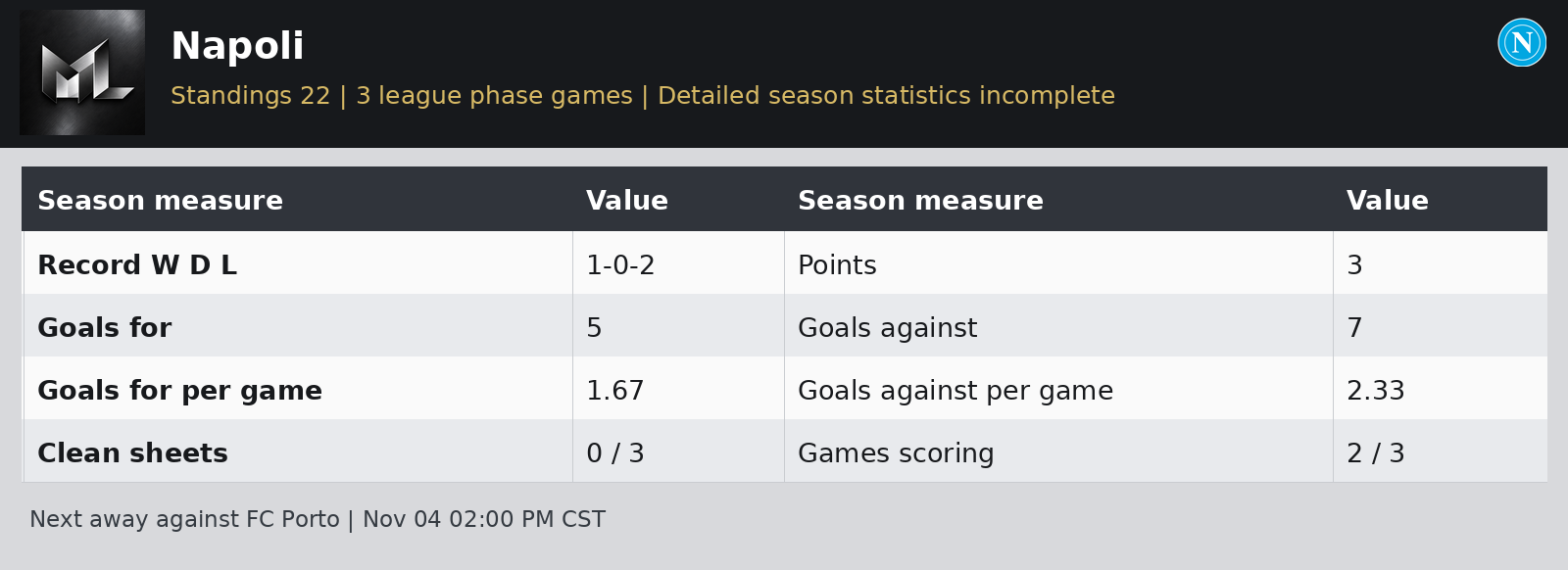
Napoli's 4–3 against Bodø/Glimt ended a run of two defeats, but the first win did not deliver defensive relief. Seven goals have been conceded across the three games and there is no clean sheet. The first two matches produced only one Napoli goal, so the latest four represent a genuine change in the scoring record, with repeatability still untested. Porto away is the next fixture. Porto have lost all three but kept the latest defeat to 1–0, making patience important if the match does not resemble the seven-goal contest. Napoli need to carry the improved threat without treating another three concessions as an acceptable price. A less dramatic result would provide stronger evidence that the campaign has stabilised.
Galatasaray
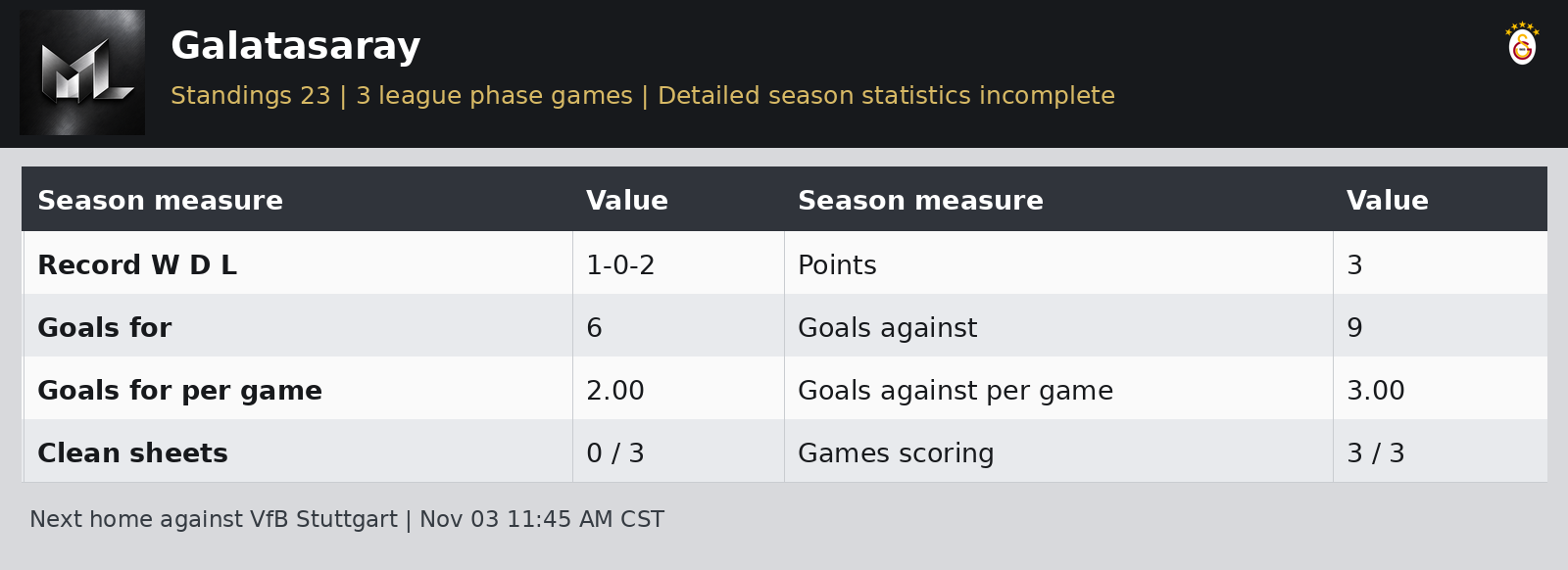
Galatasaray's 4–2 away win over Lille produced their first points after defeats by Sporting and Barcelona. Four goals are a substantial response to having scored only once in each of the first two matches. Two conceded also leave the season total at nine, so the defence remains the larger unresolved problem. Stuttgart visit next having allowed only two across an unbeaten start. Galatasaray therefore face an opponent less likely to need a high-scoring match to get a result. Their own improvement has to include conceding less, rather than assuming the latest four goals can be repeated. The Lille result creates a platform. It does not yet establish a reliable way to keep that platform intact against a more restrained visitor.
LASK Linz
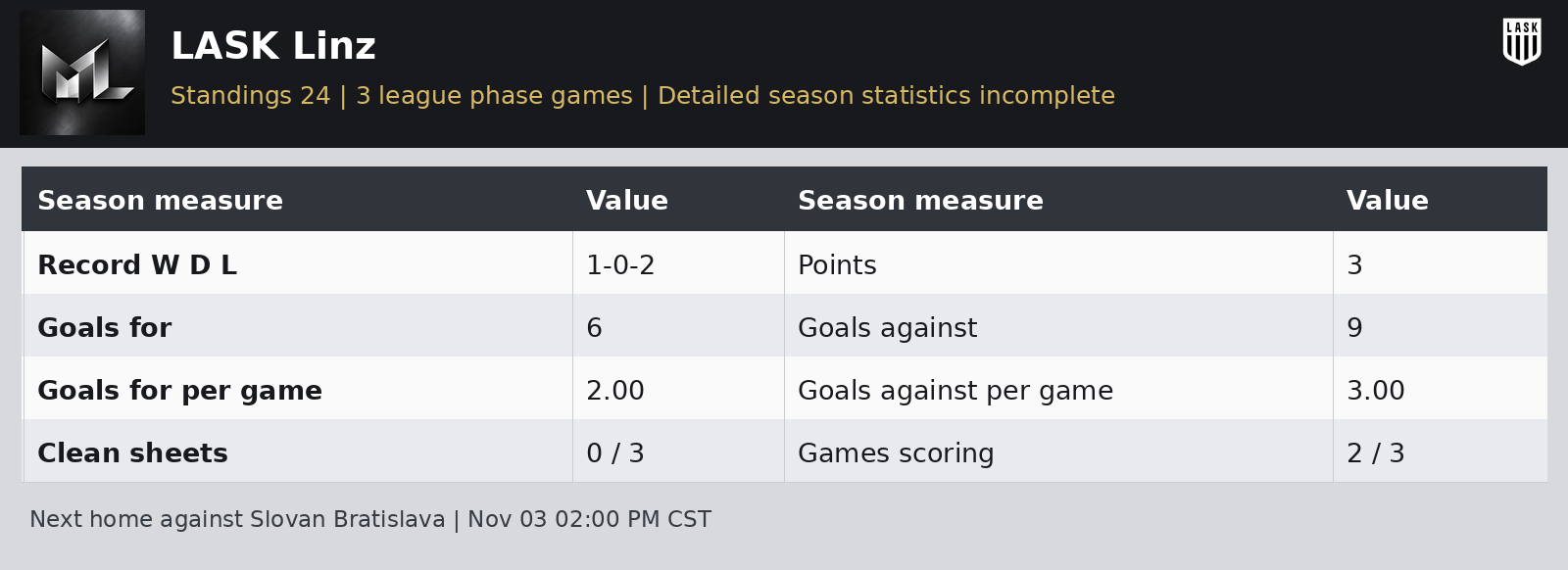
LASK's 3–2 away win at Sporting changed a pointless start into a campaign with a useful result to build on. Scoring three in both the Liverpool defeat and the Sporting win shows that the attack has carried a threat across very different outcomes. The difference is the six conceded against Liverpool. Nine goals allowed in three games remain too large a burden for six scored. Slovan at home is next, with the visitors still without a point and having conceded thirteen. LASK have an opportunity to make the latest win part of a sequence, but should not assume another open game is harmless. Reducing the opponent's scoring would let their own output work harder. That would be more persuasive than needing a third goal again.
Sabah FK
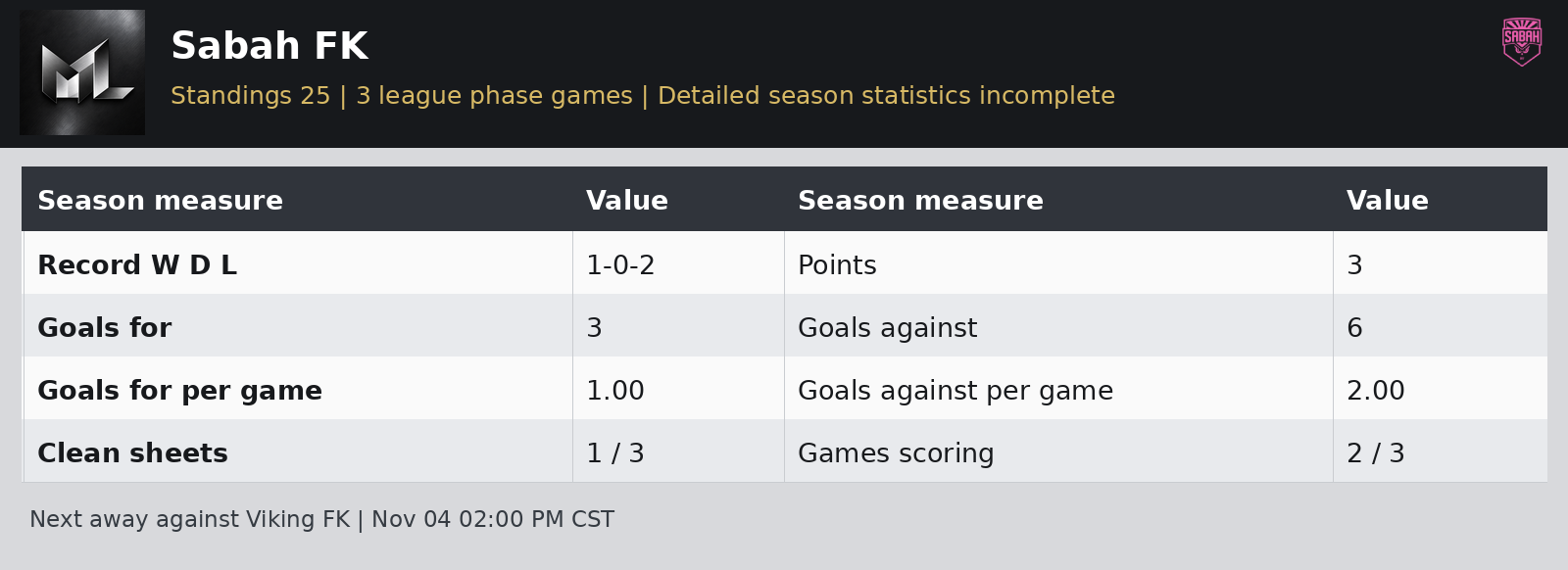
Sabah have three points from the 2–0 home win over Slavia, between a 4–0 loss at United and a 2–1 defeat by Dortmund. The latest result was closer, but the only away match still ended without a goal. Viking away now tests that part of the campaign. Viking have conceded nine, yet also scored three against Bayern and found the net in every game. Sabah need to take an attacking threat on the road without allowing the defensive cost of their first trip to return. Their clean sheet against Slavia shows one useful outcome, not an established defensive level. With three goals across three games, making chances count matters especially when the opponent has already shown it can score.
Feyenoord Rotterdam
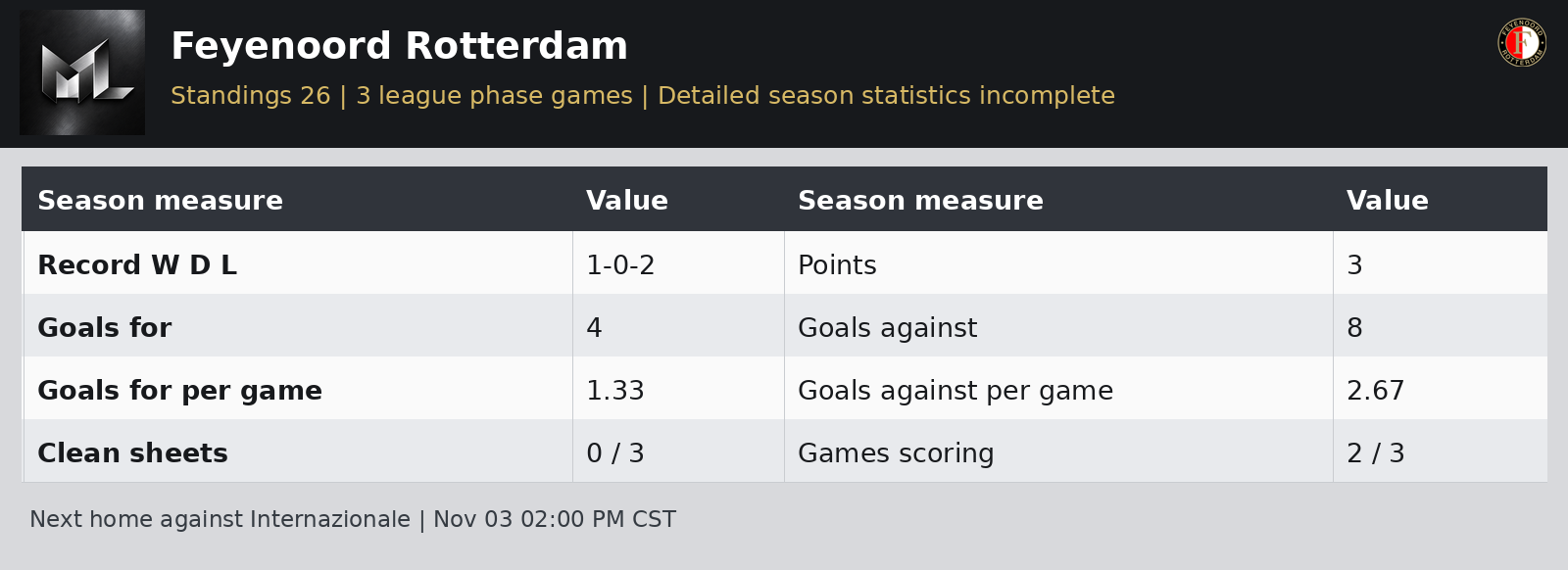
Feyenoord's 3–2 win over Como sits between a 5–1 defeat at Barcelona and a 1–0 loss at Betis. Their three points therefore depend on one productive home match, while both away games brought defeat. Inter at home next restores the setting of the win, but also brings an opponent fresh from its first clean sheet. Feyenoord need more than a venue change. Four goals scored and eight conceded leave the balance too exposed, and the Betis match showed that conceding less can still be insufficient when the attack is held scoreless. The next step is to connect the scoring from the Como game with the tighter margin of the latest match. Either improvement on its own has already proved inadequate.
Lens
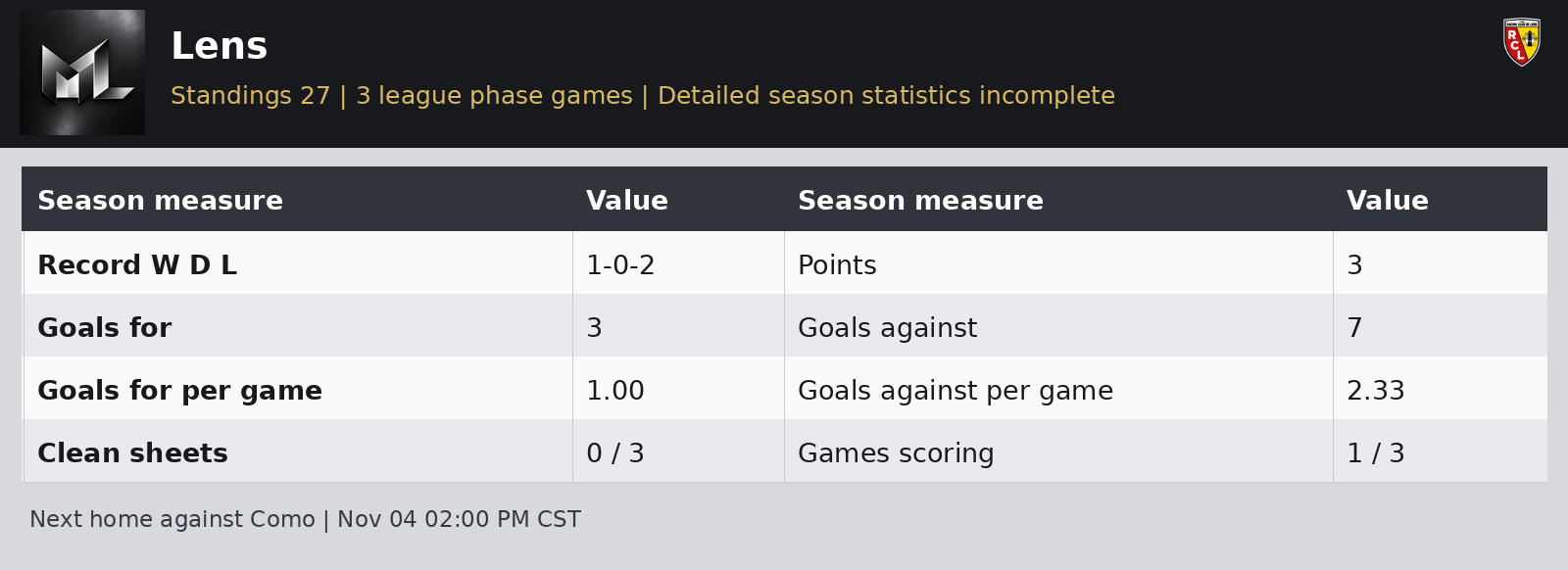
Lens have not scored since the opening 3–2 away win at Slavia. Home defeat to Sporting and a 3–0 loss at Brugge have turned that early return into three points from three games. The five unanswered goals across those defeats show deterioration in both scoring and prevention, without needing to assign an unsupported tactical cause. Como visit next with two 4–1 home wins but a 3–2 away defeat. Lens have an opening to test the visitor's less convincing away record, provided they recover enough threat of their own. Merely keeping the margin smaller will not be enough if another game passes without a goal. The first win remains useful evidence of scoring capacity. The two games since it demand a more immediate response.
Bodo/Glimt
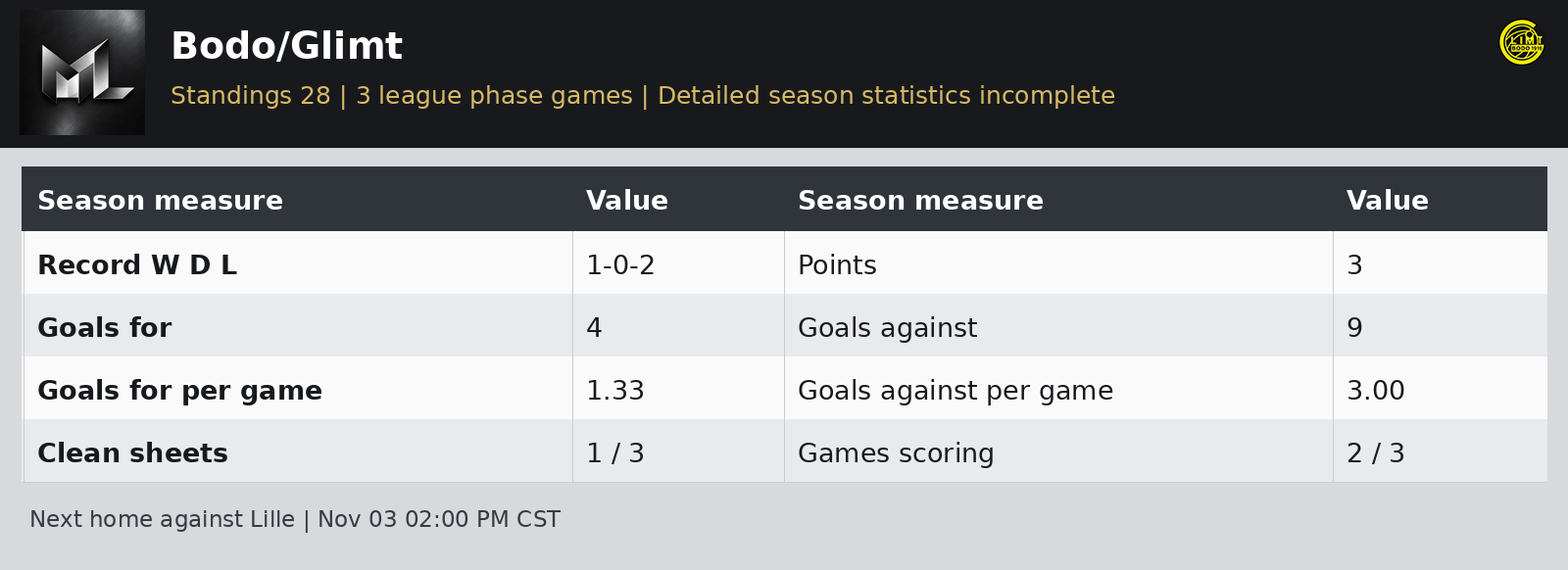
Bodø/Glimt's 1–0 against Dortmund demonstrated that one goal can bring three points when the opponent is kept out. The other two matches, 5–0 at Bayern and 4–3 at Napoli, demonstrate the much larger cost when that protection disappears. Four scored and nine conceded leave a campaign split between a successful home result and expensive away defeats. Lille at home comes next. Lille have no points but scored twice in two of their three games, so the home setting alone cannot be treated as protection. Bodø/Glimt need to reproduce the defensive outcome against Dortmund while carrying forward some of the scoring from Naples. The latest three goals were not wasted evidence; they were simply not enough to repair four conceded.
AEK Athens
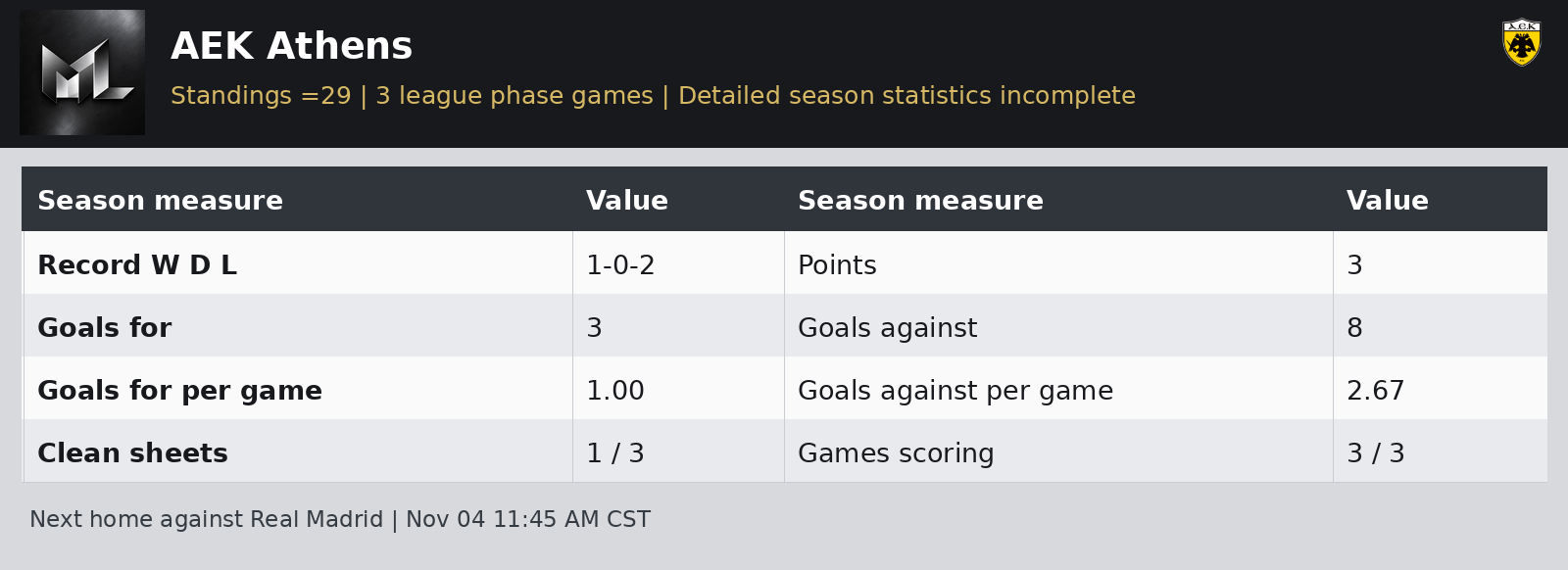
AEK's 1–0 opening win over LASK has been followed by 3–1 and 5–1 away defeats. They have scored in every match, but eight conceded across the last two have overwhelmed that consistency. Madrid at home now offers the hardest possible way to arrest the sequence in this table, with the visitors on nine points and ten goals. AEK need the match to remain within reach of an attack that has scored exactly once each time. Requiring two or three more goals would ask for something the campaign has not yet supplied. The opening clean sheet is the useful reference, though a different opponent makes repetition a demanding task. AEK share twenty-ninth place with Leipzig; neither has earned a separate interim rank.
RB Leipzig
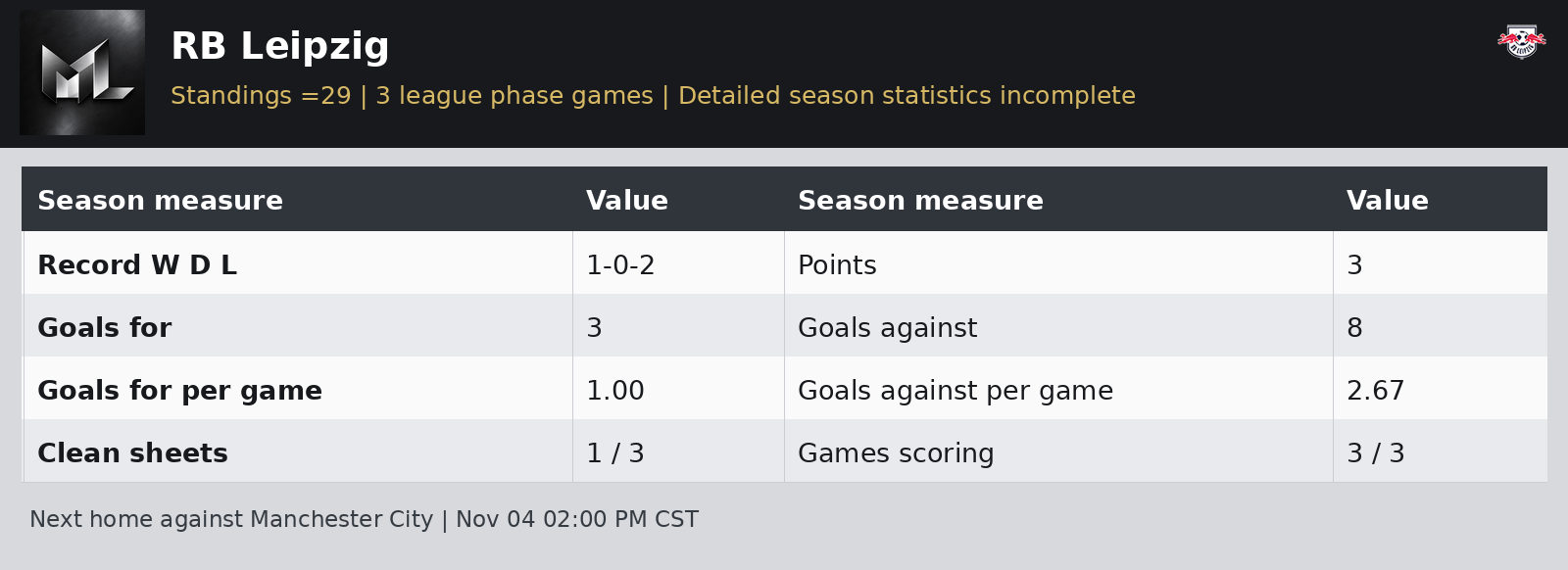
Leipzig's 1–0 win over PSV is surrounded by two 4–1 defeats, at Como and Madrid. That is a sharp home-away split, although only three games are available and the opponents differ. City visit next, so a return home cannot be used as an explanation in advance. The visitors have nine goals and have just won 5–1. Leipzig need to retain the low-concession outcome of the PSV match while finding enough scoring to prevent City controlling the consequences of an early lead. Three goals in three matches leave little margin if another four are conceded. Shared twenty-ninth place accurately reflects the current tiebreaks, but the more important distinction is between the narrow win and the two matches that became expensive.
Fenerbahce
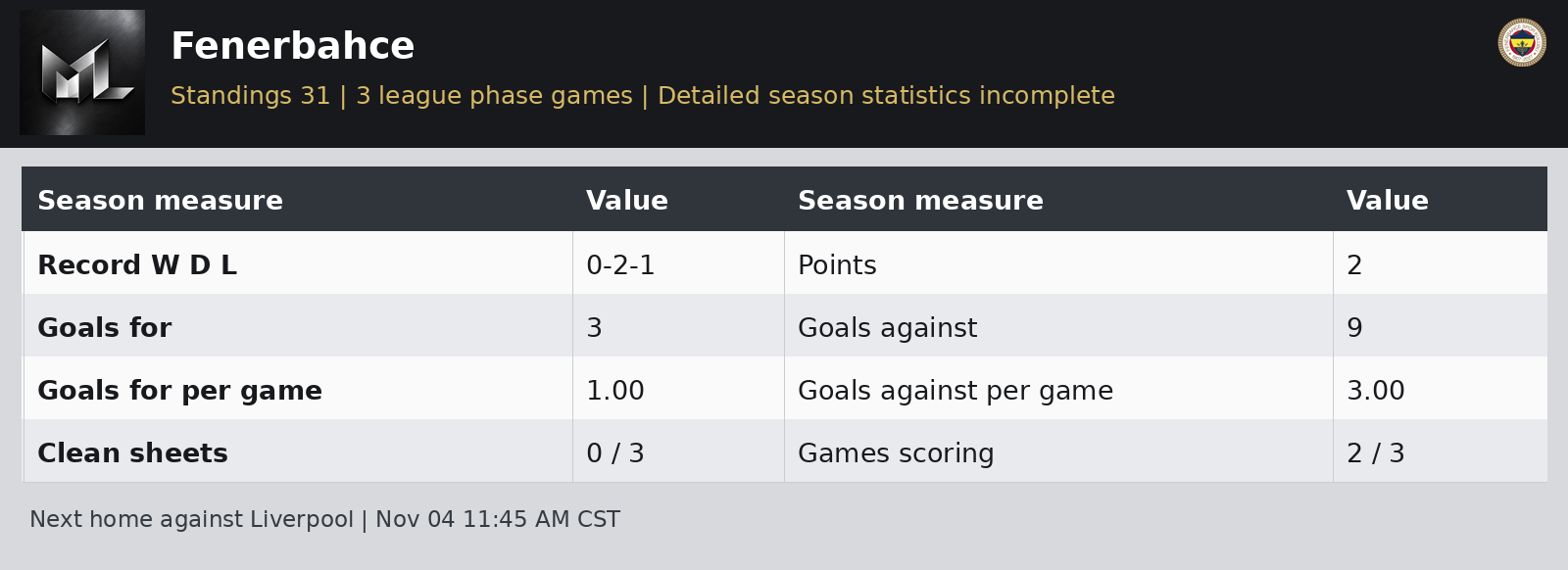
Fenerbahçe have drawn both home games, against Roma and Slavia, and lost 6–0 at Villa between them. Two points and a minus-six margin should therefore be read as a mixed record rather than three identical failures. The next match is at home to Liverpool, whose attack has scored twelve but whose defence has conceded seven. Fenerbahçe need to give that visiting defence work without repeating the exposure of the Villa trip. The home draws show they can remain competitive across ninety minutes, but neither has become a win. Three goals in total limit the room to absorb another concession. Turning a workable home performance into three points requires improvement at both ends, not simply assuming Liverpool's concessions will be enough.
Slavia Prague
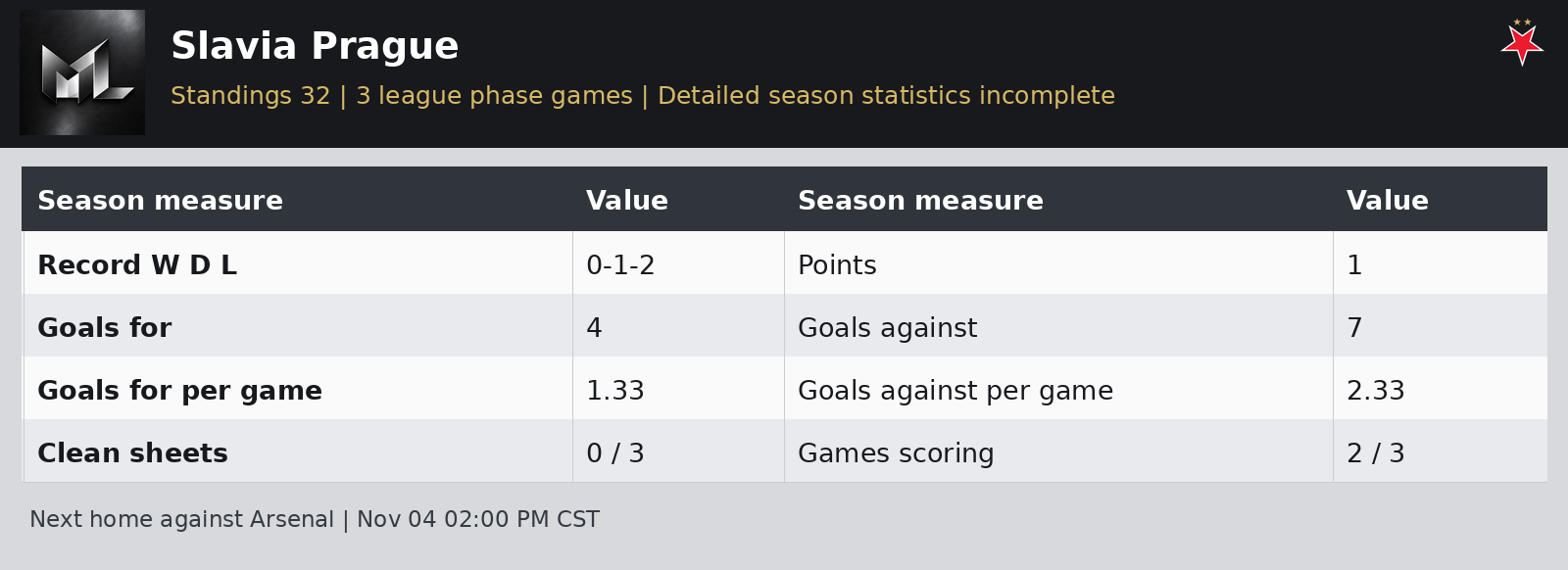
Slavia's 2–2 away draw with Fenerbahçe delivered their first point after two defeats. It also restored scoring after the 2–0 loss at Sabah. Seven conceded across three games remain a substantial obstacle, particularly with Arsenal visiting next. Arsenal have allowed only two and kept their first two opponents scoreless, so Slavia cannot plan on another two-goal return without improvement. Their opening 3–2 defeat at home to Lens showed scoring that was still outweighed at the other end. The next performance needs to make their own goals less expensive to support. The first point is a step forward, but a draw alone does not resolve the defensive burden carried through all three matches.
Viking FK
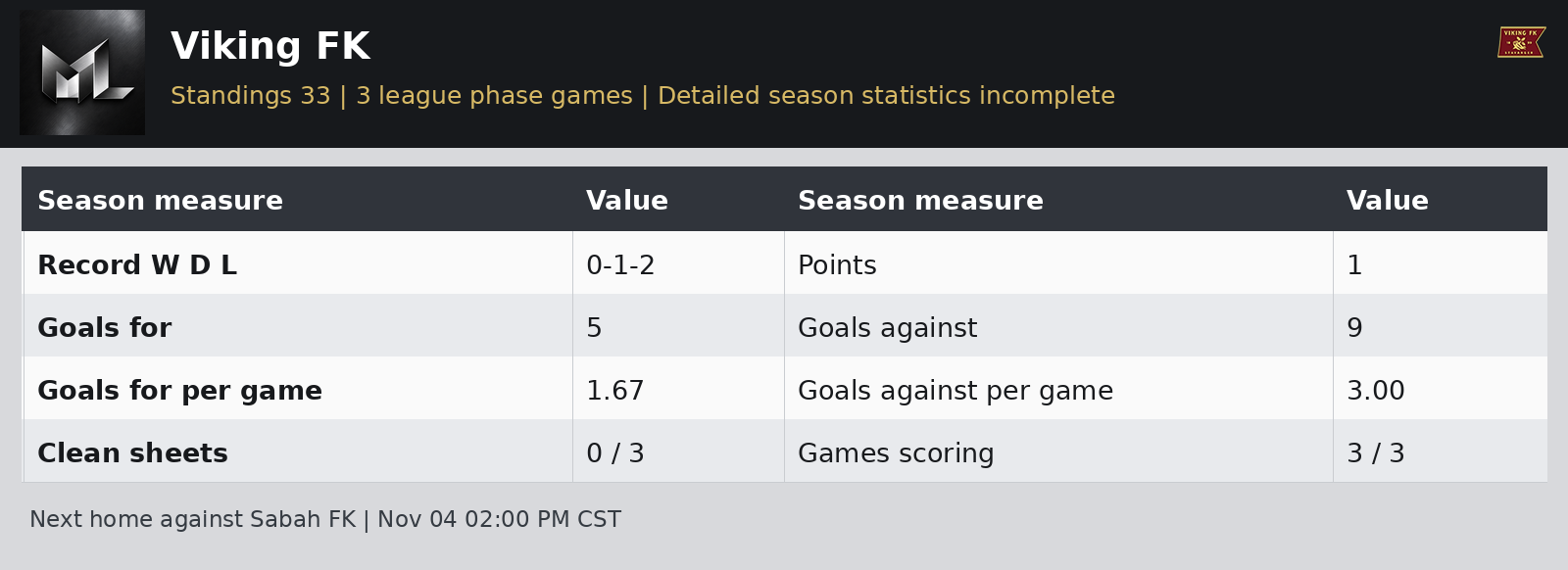
Viking have scored in every game and still have only one point. The 3–3 against Bayern is the most striking result, but the 3–1 defeats at Stuttgart and Villa left the same pattern of three conceded each time. This is a clear early problem in the results without evidence to assign it to individual players or a specific defensive scheme. Sabah at home is the next chance to change it. Viking need the match to demand fewer goals from their attack, especially because Sabah have already kept a clean sheet against Slavia. Five scored show a route into games. Nine allowed explain why that route has so rarely produced points. The first improvement has to survive beyond a single encouraging attacking spell.
FC Porto
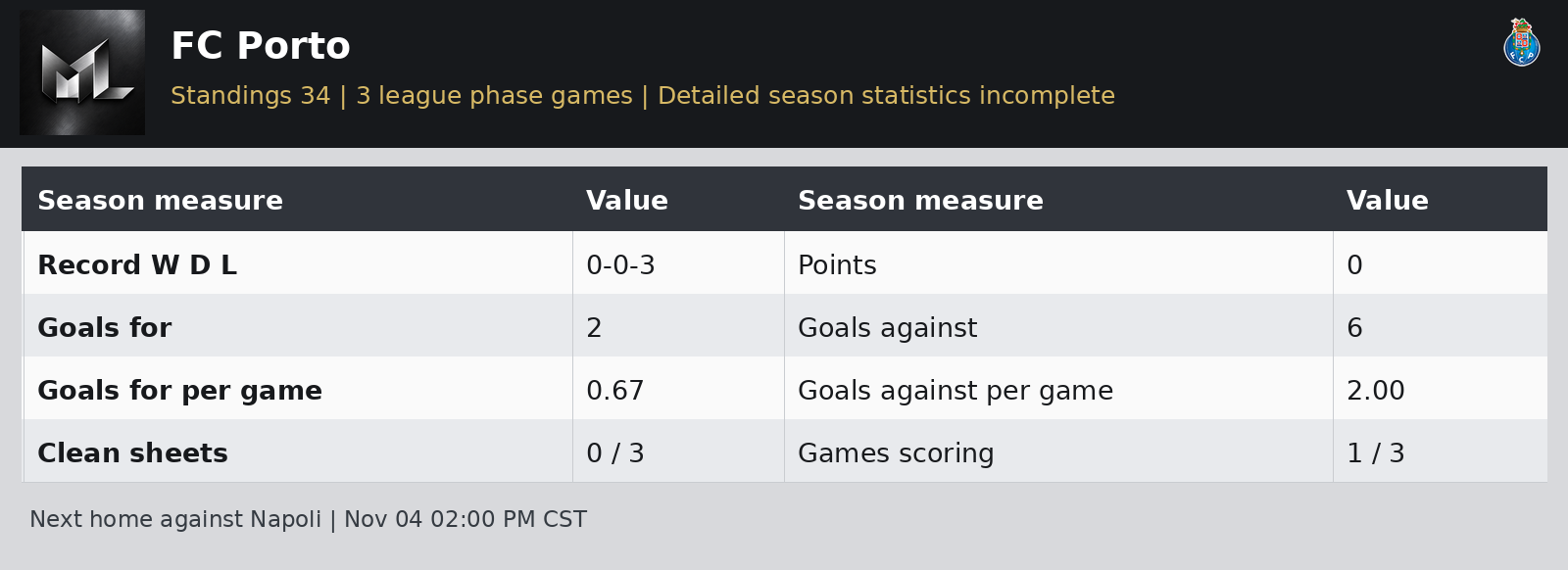
Porto have lost all three matches and failed to score in two of them. The 3–2 defeat at Betis showed they could threaten away from home, but the home losses to City and PSV produced no goal. Napoli visit next after a 4–3 win, offering a defence that has conceded seven but an attack with renewed evidence of scoring. Porto need to make that visiting defence uncomfortable without giving Napoli another game of repeated exchanges. Six conceded are fewer than several clubs above them have allowed. The zero points still reflect a scoring problem that a narrower latest defeat did not repair. Turning periods of resistance into a result requires a goal as well as a smaller margin.
Lille
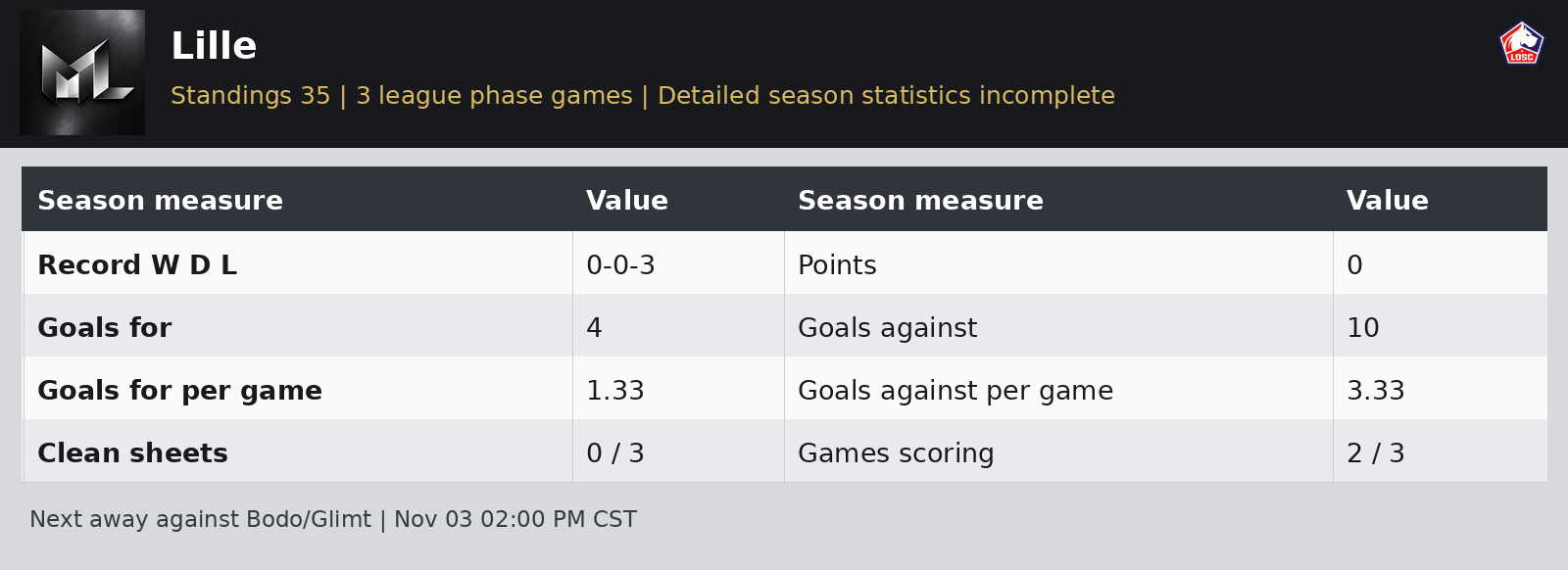
Lille have scored twice in each home game and lost both. Between those matches came a 3–0 defeat at Arsenal. Four scored and ten conceded therefore describe more than a simple lack of attack. The goals at home have repeatedly arrived with a larger cost at the other end. Bodø/Glimt away now brings an opponent whose own results have varied sharply by venue. Lille need enough restraint to avoid another match requiring three or more goals merely to compete. Their two-goal performances show some scoring capacity, but it has not travelled to the only away fixture. A first point would require those two improvements to meet in the same game. None of the three defeats can be repaired by the table alone.
Slovan Bratislava
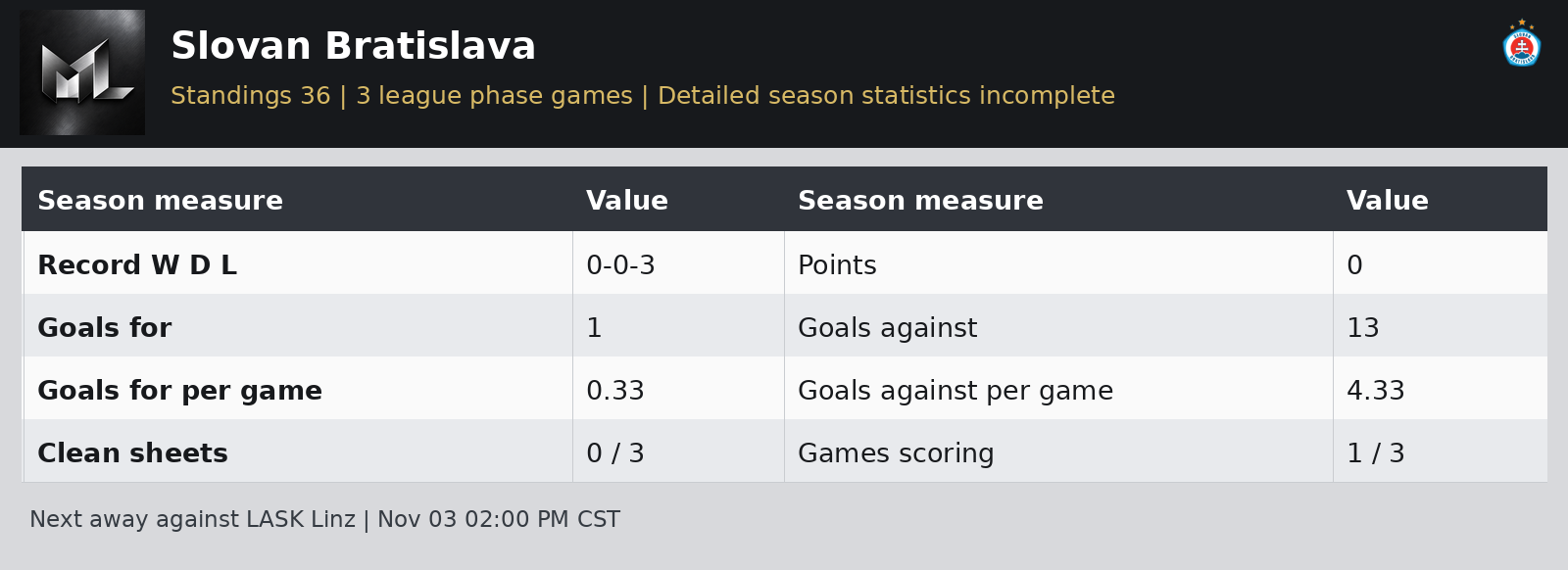
Slovan have conceded thirteen and scored once across three defeats. The latest 4–0 at Roma followed 6–1 at Paris and 3–0 at home to Stuttgart. That is an unambiguous difficult start, with no basis for softening it into a near miss. LASK away is next. LASK's nine conceded suggest an opening for Slovan's attack, but their six scored show why chasing that opening without protection is dangerous. Slovan need to make the next match manageable before asking a one-goal campaign to produce a sudden scoring surge. A smaller concession total would be progress, but a point still requires enough threat to prevent the opponent settling. Three games are a small sample; every game in that sample has nevertheless exposed the same severe imbalance.
Next seven days
Five matches per club remain after the opening three. The next round can change the early table substantially, especially around the tightly packed clubs on three and four points. Points decide progress, while goals and the current tiebreaks decide how level returns are displayed. That makes preventing an additional concession useful even in a game already difficult to win. No club here is described as qualified or eliminated from its provisional current position.
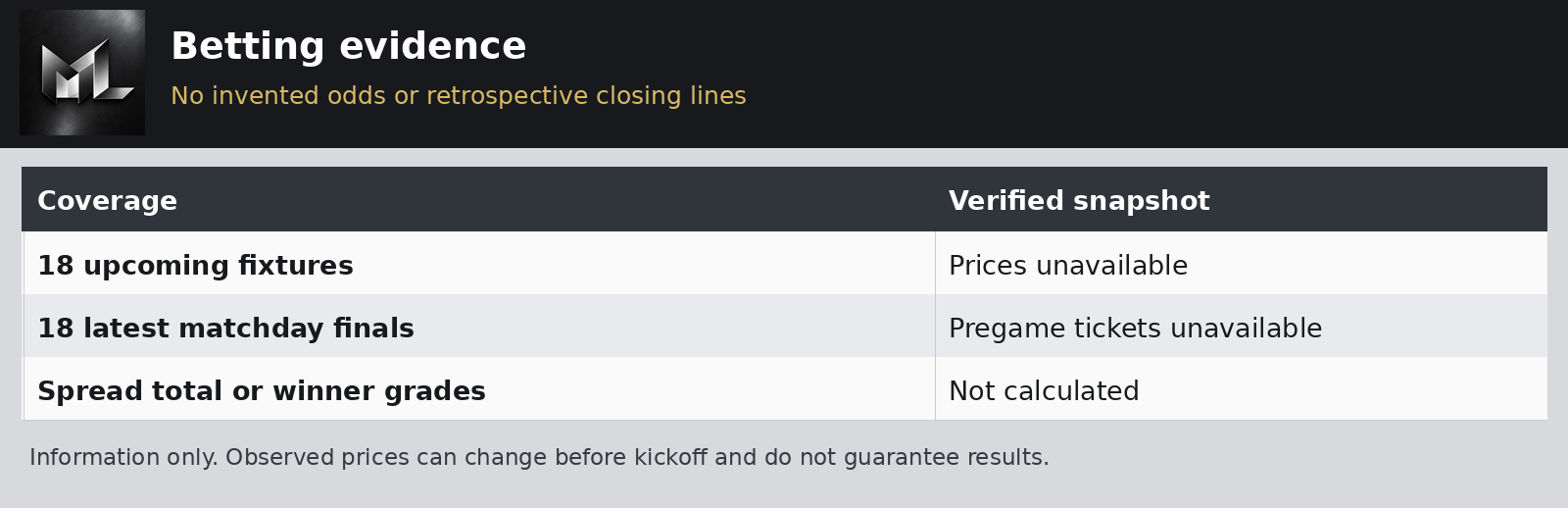
Verified current betting prices and recorded historical ticket snapshots are unavailable for this edition. No tickets are graded and no market is described as closing. Prices, when observed and timestamped, can change before kickoff and are informational rather than a guarantee. Availability and lineup claims are omitted where current primary verification is unavailable.
Featured matchups
Barcelona v Aston Villa
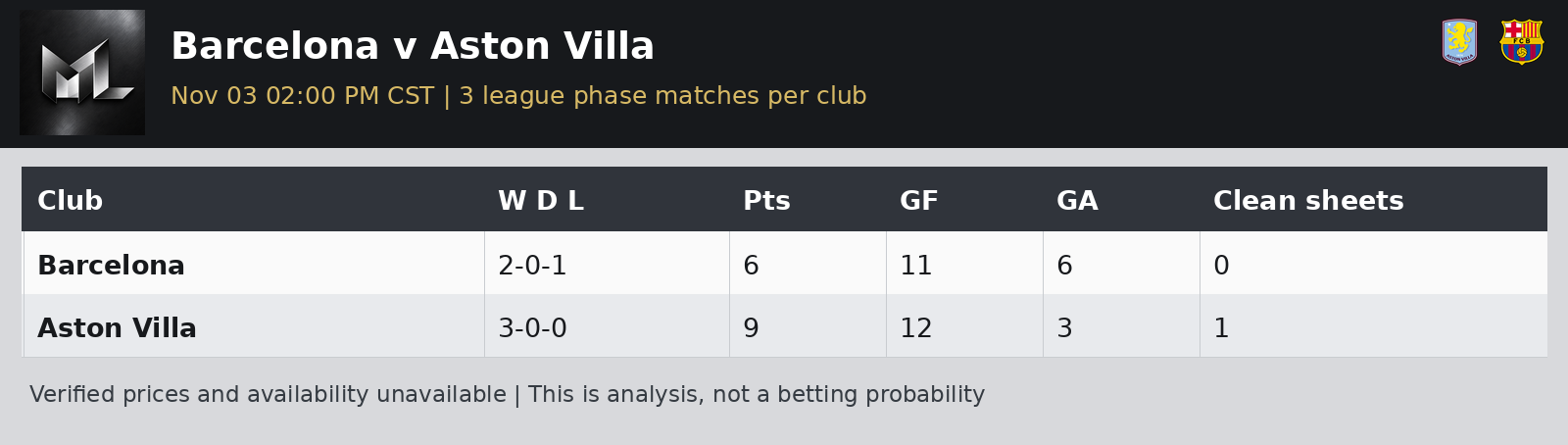
Barcelona and Villa arrive with twenty-three goals between them from six combined league-phase games. That gives this fixture obvious scoring interest, but the more useful distinction is how the goals have translated into points. Villa have won all three. Barcelona's latest two goals were not enough because Paris scored four. The home side now need to show that their attack can work alongside a more secure defensive result.
Villa's twelve goals are also unevenly distributed. Six came in one home game against Fenerbahçe. Their only away win, 3–2 at Brugge, was a much narrower decision and involved two concessions. Barcelona therefore should not be treated as facing a visitor that has already established a routine of comfortable away wins. Equally, Villa have scored in every match, and the home side have conceded in every match. That makes Barcelona's ability to limit the number of damaging exchanges a central question.
For Barcelona, patience does not mean abandoning the attack that has produced eleven goals. It means avoiding the need to score a third or fourth simply to compensate for concessions. Villa can benefit if the match repeatedly opens after either side attacks, but still have to protect themselves against a team that scored nine in its first two games. A low season total conceded is useful evidence, not insurance against this different test.
The decisive outcome will be whether Barcelona can keep Villa's scoring below the level that exposed them in Paris while creating enough at home. Villa need to carry their threat into a second away fixture and avoid letting Barcelona's response become a sequence of unanswered attacks. Neither the table position nor the combined scoring total supports a guaranteed winner or an invented goal forecast.
Villarreal v Paris Saint-Germain
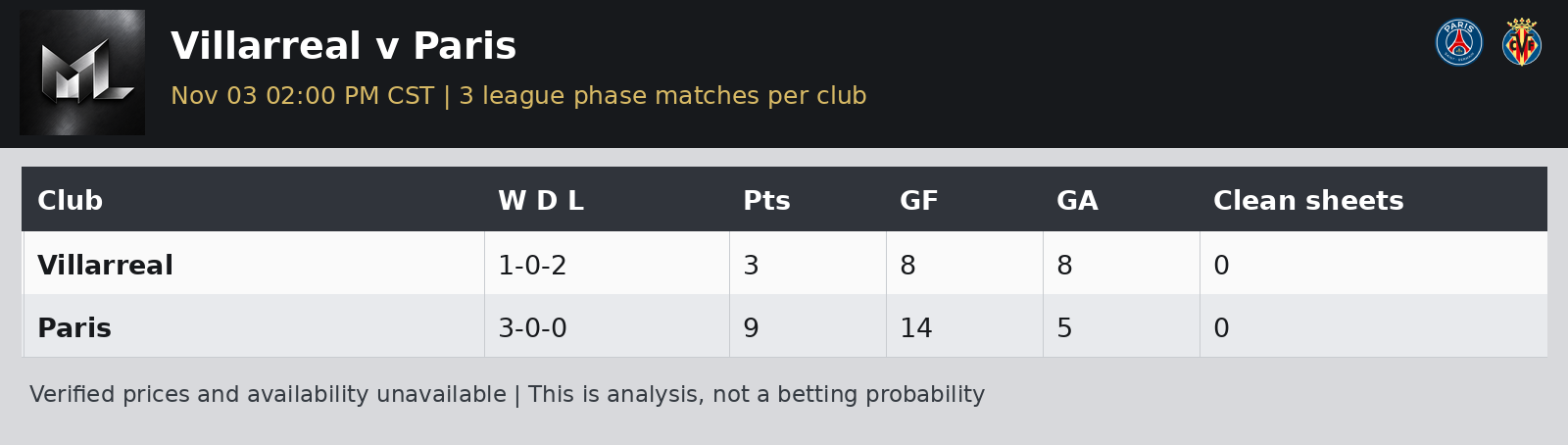
Villarreal's eight goals have brought three points because they have conceded eight. Paris have scored fourteen and collected nine points, yet have also conceded in every game. The meeting is compelling because both attacks have evidence of scoring against strong opponents, while neither defence has supplied an uninterrupted run of control.
Villarreal scored three at Liverpool and still lost. They scored two at Dortmund and lost there as well. Those results make another productive attacking evening an incomplete plan. Against Paris, keeping the game within reach of their own scoring matters at least as much as adding another goal to the season total. The 3–1 win over Napoli offers the better balance in their record, though Paris have already scored four against both City and Barcelona.
Paris should face scrutiny even after those impressive wins. The last two matches each required the attack to work with two goals conceded. Their scoring has been strong enough to make that affordable, but affordability is different from a sound defensive habit. Villarreal have shown enough threat to punish another loose period. Paris need to maintain pressure while making their own attacks less costly when the opponent next has the ball.
The practical question is which side can reduce the amount of scoring it needs. Villarreal cannot keep treating three goals as a nearly sufficient result after conceding four. Paris cannot assume that another four will always arrive. The early league phase supplies only three games per club, so these are observed patterns rather than stable forecasts. A match in which Villarreal concede fewer would challenge the current table more effectively than another narrow high-scoring defeat. Paris can strengthen their first-place assessment by winning with more defensive restraint, rather than merely adding to their scoring lead.
Atlético Madrid v Bayern Munich
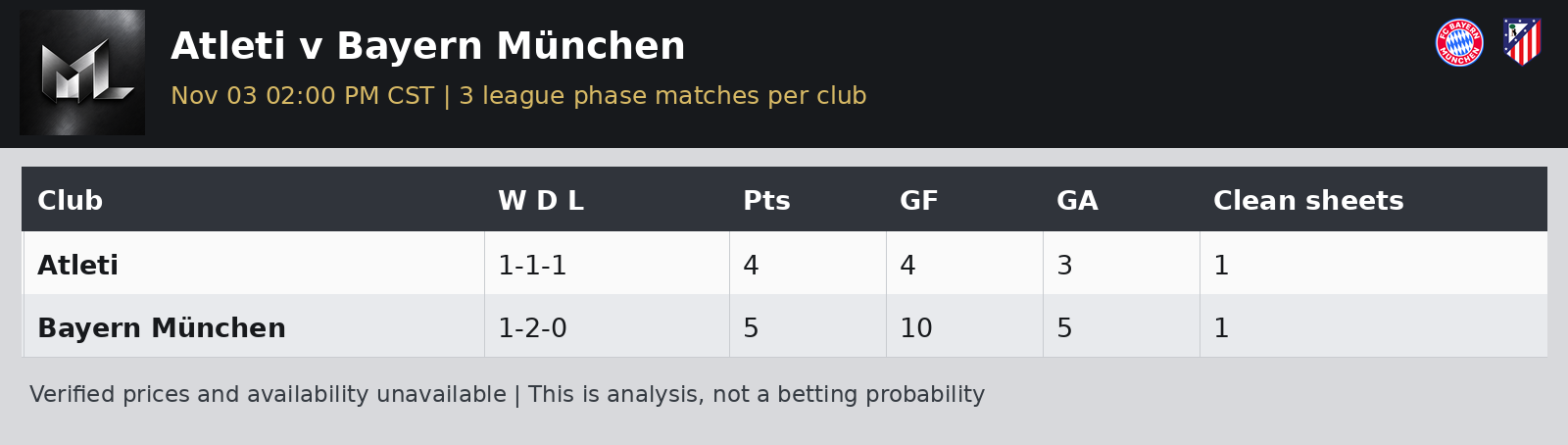
Bayern are unbeaten with five points; Atlético have four from a win, draw and defeat. That small separation disguises very different score patterns. Bayern's ten goals include five in the opening win, followed by draws of 3–3 and 2–2. Atlético have scored four and conceded three across the entire campaign. This meeting tests whether Bayern can turn attacking output into separation against an opponent whose results have remained much tighter.
Atlético's home evidence is a 2–0 win over Manchester United. Bayern's away evidence is the 3–3 at Viking. Neither should be stretched into a permanent home or away identity from one match. Both are nevertheless relevant references. Atlético have already made a modest scoring total sufficient at home. Bayern have already scored three away without taking three points.
For Bayern, the improvement is not simply more attacking ambition. Five goals scored across the last two matches were matched by five conceded. They need to reduce the burden placed on each goal they create. If Atlético keep the score close, Bayern may have fewer opportunities to recover the cost of a concession than in the Viking game. Atlético, meanwhile, cannot assume a low total conceded will survive without offering enough threat to interrupt Bayern's attacks.
The home side's four-goal season leaves limited room if the match becomes an exchange. Their better route is to make individual scoring opportunities carry more weight by keeping Bayern's total down. Bayern need to avoid another draw in which the attack appears productive and the points return still disappoints. The decisive test is whether the visitors can bring their scoring into a game with fewer concessions, or Atlético can again make two goals enough. No verified availability or betting evidence supports adding a selection claim beyond that matchup.
Manchester United v AS Roma
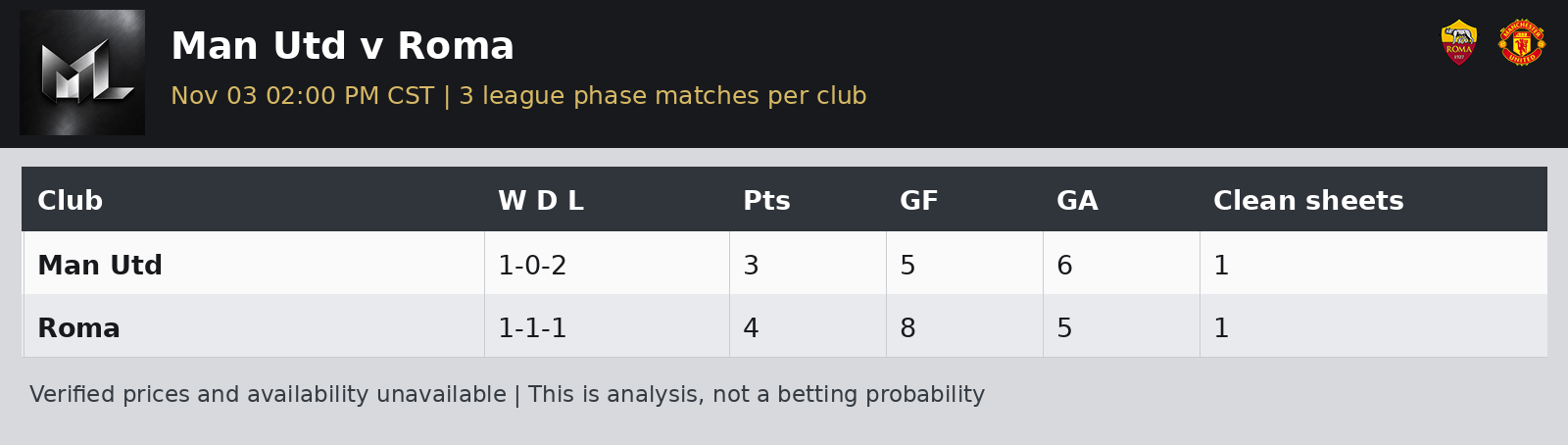
United and Roma both have a 4–0 win in their first three matches. Those largest margins can conceal the more important evidence between them. United followed their opening victory with two away defeats, scoring once and conceding six. Roma followed a draw and a 4–3 defeat by Madrid with their win over Slovan. Both now need to show that a comfortable result can become a more dependable campaign.
United's return home is relevant because their only home match produced the clean sheet against Sabah. It is not enough to establish that the difficulties were caused by travel or venue. Different opponents are involved, and only one home game exists in the sample. Roma have scored eight but their only away match finished 1–1. Their productive home results therefore cannot simply be carried into the next setting as a forecast.
The attacking challenge for United is to restore more than the single goal from the last two games without recreating the defensive cost of those defeats. Roma can test that response with an attack that scored three against Madrid even in defeat. They also need to avoid allowing the hosts the repeated scoring that Madrid found against them. The Slovan clean sheet was useful, but came against a side with only one goal in the competition.
Three points would materially change either start. The way they are earned matters for a season assessment. United need their scoring and defending to recover together, rather than using another large opening margin as reassurance. Roma need to turn their home output into an effective away performance while keeping the game within control. The decisive interaction is whether United can make home pressure productive without providing Roma the openings that have made their own defeats expensive.
Borussia Dortmund v Real Betis
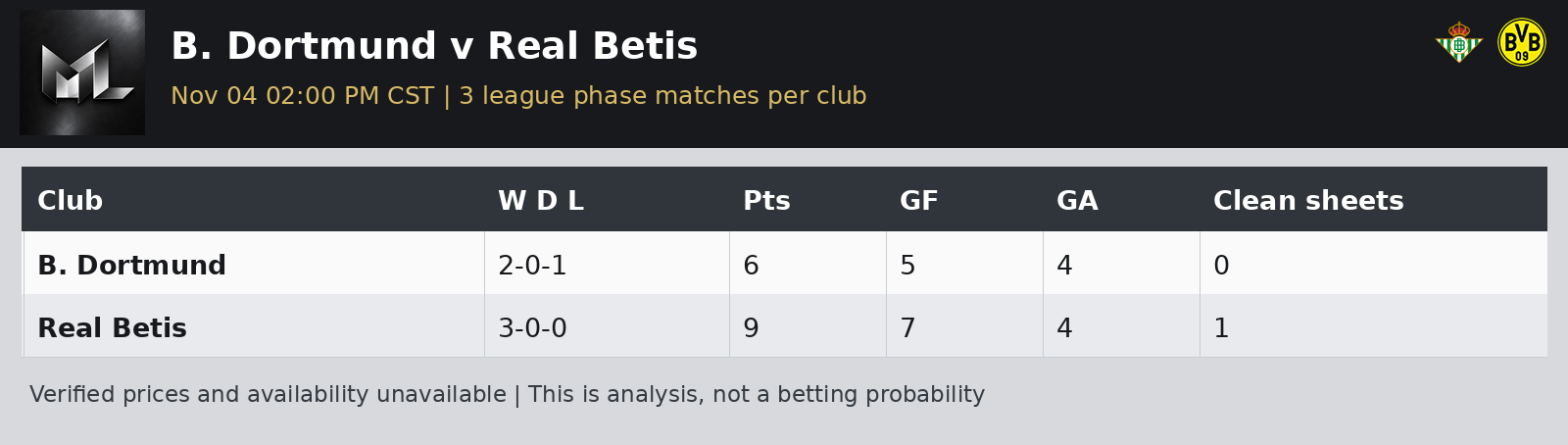
Every Dortmund match and every Betis match has been decided by one goal. The difference is that Betis have won all three, while Dortmund have won twice and lost once. That is a meaningful results advantage for the visitors, but it is also a warning against describing either campaign as comfortable. One additional concession has been enough to change every decision.
Betis scored three in each of their first two wins before beating Feyenoord 1–0. The latest result reduced the defensive cost and supplied a first clean sheet. Dortmund have not yet kept one. Their latest 2–1 away win over Sabah restored points after losing 1–0 at Bodø/Glimt, but it left the same requirement to score more than once to win.
Dortmund's home win over Villarreal finished 3–2, so home advantage has not yet produced a quiet defensive result. Betis won their only away match by the same score at Lille. These are small samples, and they do not justify inventing a style of play or a probability. They do identify the practical work. Dortmund need to make the opponent's scoring harder to sustain. Betis need to carry the latest reduction in concessions into an away fixture without losing the threat that has kept them ahead in close games.
The decisive question is which side can create a margin beyond the next mistake. Dortmund cannot assume five season goals will continue to support two wins from every three matches if the defence keeps conceding. Betis cannot assume that three narrow victories establish a permanent ability to win the next one. A first Dortmund clean sheet would change the demands on their attack. Another restrained Betis result would give their perfect start a firmer base than the opening pair of 3–2 decisions.
RB Leipzig v Manchester City
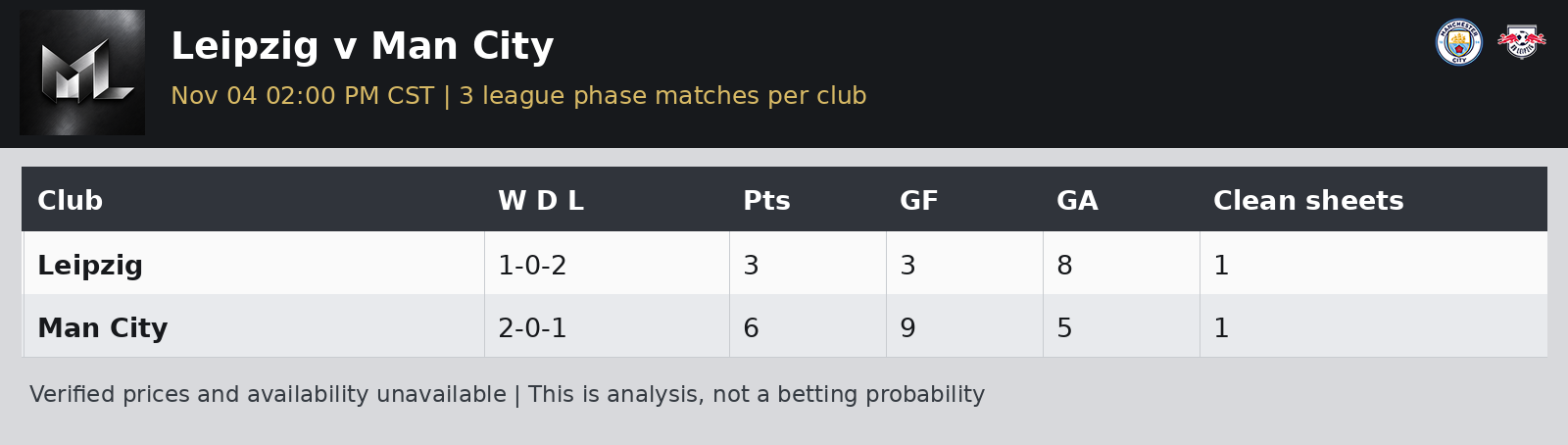
City have just beaten AEK 5–1. Leipzig have twice lost 4–1, with a 1–0 win between those defeats. Those margins make the visitor's attacking opportunity clear, but the season assessment should still include City's 4–2 defeat by Paris. A large latest win does not automatically answer the questions raised by an opponent able to score repeatedly.
Leipzig's two heavy defeats were away, and their win was at home. With only three games and different opponents, that split cannot establish venue as the cause. It does give the hosts one relevant reference for keeping the next match close. Against PSV they made one goal sufficient. Against City, whose three games have produced nine goals, the same defensive outcome would be a more demanding achievement.
City need to press their scoring advantage without giving Leipzig easy help at the other end. Their first away match ended in a 2–0 win at Porto, so a restrained road result is already part of the campaign. Repeating that balance would provide a stronger response to Paris than simply relying on the five scored against AEK. Leipzig need enough threat to prevent the match becoming a long exercise in damage limitation, but cannot afford another concession total far beyond their own three-game scoring output.
The central test is whether Leipzig can preserve the low-concession result of their home win when the opponent has a more productive attack. City can strengthen their season case by managing the game after creating an advantage, rather than requiring another high total to settle it. The table and margins favour a demanding assessment of Leipzig's defence, not a guaranteed pick. Neither unavailable betting prices nor unsupported lineup assumptions belong in that assessment.
Every covered official event
Season results referenced in the club assessments and the complete upcoming slate.
- AEK Athens v LASK Linz · 2026-09-08
- Club Brugge v Aston Villa · 2026-09-08
- Borussia Dortmund v Villarreal · 2026-09-08
- FC Porto v Manchester City · 2026-09-08
- Lille v Real Betis · 2026-09-08
- Real Madrid v Internazionale · 2026-09-08
- Barcelona v Feyenoord Rotterdam · 2026-09-09
- VfB Stuttgart v Viking FK · 2026-09-09
- Liverpool v Atlético Madrid · 2026-09-09
- Napoli v Arsenal · 2026-09-09
- Paris Saint-Germain v Slovan Bratislava · 2026-09-09
- Sporting CP v Galatasaray · 2026-09-09
- Fenerbahce v AS Roma · 2026-09-10
- PSV Eindhoven v Shakhtar Donetsk · 2026-09-10
- Bayern Munich v Bodo/Glimt · 2026-09-10
- Como v RB Leipzig · 2026-09-10
- Manchester United v Sabah FK · 2026-09-10
- Slavia Prague v Lens · 2026-09-10
- Lens v Sporting CP · 2026-10-13
- Sabah FK v Slavia Prague · 2026-10-13
- Arsenal v Lille · 2026-10-13
- Atlético Madrid v Manchester United · 2026-10-13
- Galatasaray v Barcelona · 2026-10-13
- Internazionale v Club Brugge · 2026-10-13
- RB Leipzig v PSV Eindhoven · 2026-10-13
- Viking FK v Bayern Munich · 2026-10-13
- Villarreal v Napoli · 2026-10-13
- Feyenoord Rotterdam v Como · 2026-10-14
- LASK Linz v Liverpool · 2026-10-14
- AS Roma v Real Madrid · 2026-10-14
- Aston Villa v Fenerbahce · 2026-10-14
- Bodo/Glimt v Borussia Dortmund · 2026-10-14
- Manchester City v Paris Saint-Germain · 2026-10-14
- Real Betis v FC Porto · 2026-10-14
- Shakhtar Donetsk v AEK Athens · 2026-10-14
- Slovan Bratislava v VfB Stuttgart · 2026-10-14
- Fenerbahce v Slavia Prague · 2026-10-20
- Sabah FK v Borussia Dortmund · 2026-10-20
- AS Roma v Slovan Bratislava · 2026-10-20
- FC Porto v PSV Eindhoven · 2026-10-20
- Liverpool v Villarreal · 2026-10-20
- Manchester City v AEK Athens · 2026-10-20
- Napoli v Bodo/Glimt · 2026-10-20
- Paris Saint-Germain v Barcelona · 2026-10-20
- VfB Stuttgart v Atlético Madrid · 2026-10-20
- Como v Manchester United · 2026-10-21
- Lille v Galatasaray · 2026-10-21
- Aston Villa v Viking FK · 2026-10-21
- Bayern Munich v Arsenal · 2026-10-21
- Club Brugge v Lens · 2026-10-21
- Internazionale v Shakhtar Donetsk · 2026-10-21
- Real Betis v Feyenoord Rotterdam · 2026-10-21
- Real Madrid v RB Leipzig · 2026-10-21
- Sporting CP v LASK Linz · 2026-10-21
- Galatasaray v VfB Stuttgart · 2026-11-03
- Shakhtar Donetsk v Sporting CP · 2026-11-03
- Atlético Madrid v Bayern Munich · 2026-11-03
- Barcelona v Aston Villa · 2026-11-03
- Bodo/Glimt v Lille · 2026-11-03
- Feyenoord Rotterdam v Internazionale · 2026-11-03
- LASK Linz v Slovan Bratislava · 2026-11-03
- Manchester United v AS Roma · 2026-11-03
- Villarreal v Paris Saint-Germain · 2026-11-03
- AEK Athens v Real Madrid · 2026-11-04
- Fenerbahce v Liverpool · 2026-11-04
- Borussia Dortmund v Real Betis · 2026-11-04
- FC Porto v Napoli · 2026-11-04
- Lens v Como · 2026-11-04
- PSV Eindhoven v Club Brugge · 2026-11-04
- RB Leipzig v Manchester City · 2026-11-04
- Slavia Prague v Arsenal · 2026-11-04
- Viking FK v Sabah FK · 2026-11-04