
Dortmund Hold the Lead as Leipzig and Leverkusen Keep the Bundesliga Tight
A two-point lead and two direct tests ahead
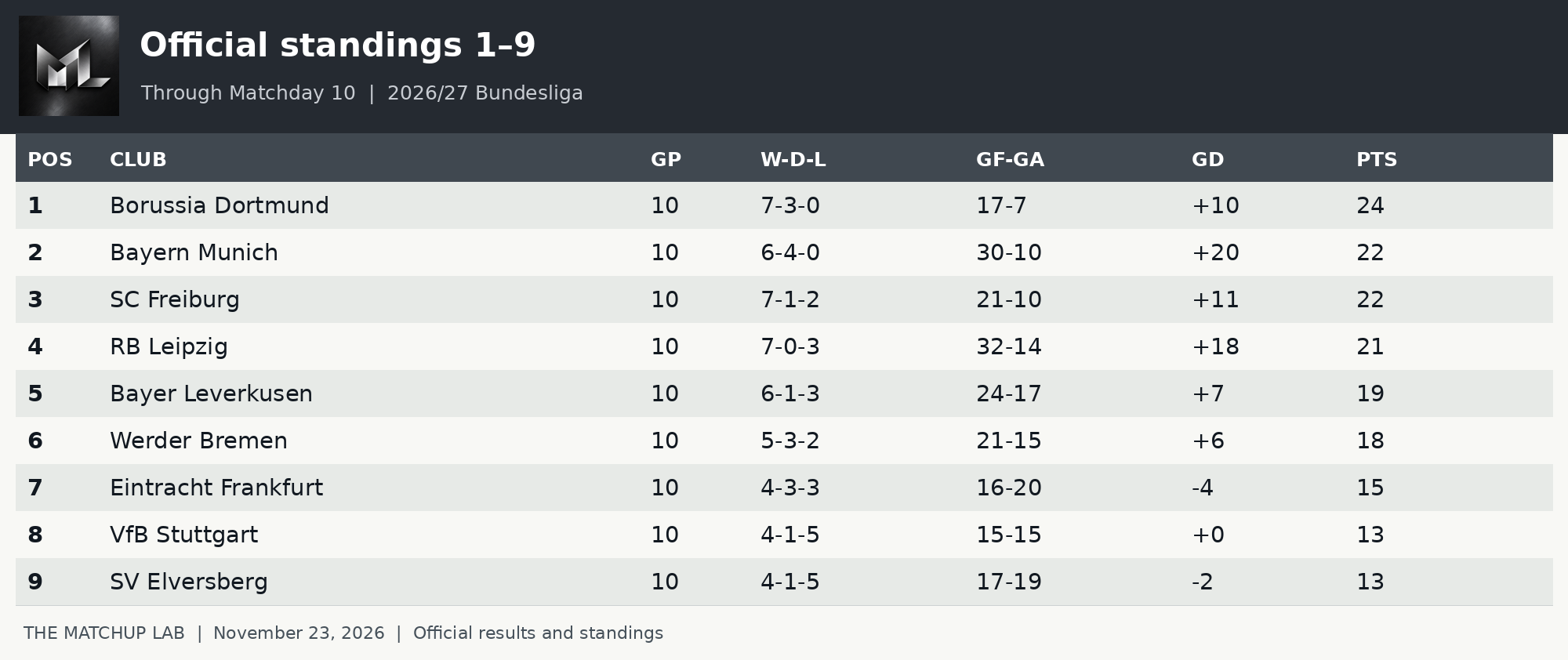
Borussia Dortmund lead with 24 points after winning 1–0 at Gladbach. Bayern Munich and Freiburg are two points behind, Leipzig are three back and Leverkusen arrive in Dortmund on Sunday only five off first place. Dortmund’s seven goals conceded are the division’s lowest total. Leipzig’s 32 scored are the highest. Bayern remain unbeaten, but four draws have allowed Dortmund to move ahead.
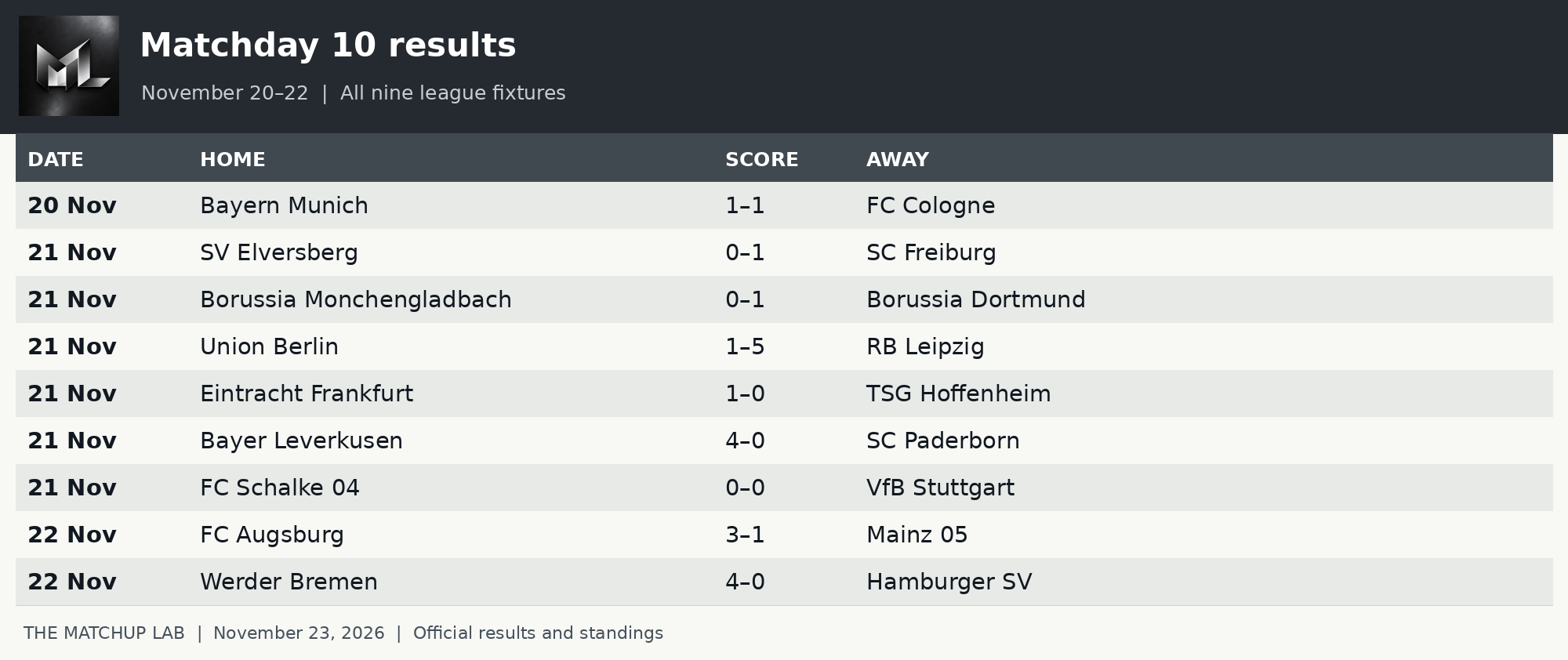
Matchday 10 produced 23 goals across nine games. Bremen and Leverkusen won 4–0, Leipzig scored five away from home, and Augsburg beat Mainz 3–1. Three other winners needed just one goal. The upcoming round brings first against fifth and third against fourth, making the next seven days a direct examination of the league’s leading attacking and defensive records.
The review below covers all eighteen clubs, then examines Dortmund–Leverkusen, Freiburg–Leipzig and Hamburg–Bayern in greater detail. Figures use completed league matches through November 22. Season rates describe what has happened; they are not win probabilities or predictions of a particular score.
The round in full
What changed
Dortmund’s narrow away victory matters most at the top because Bayern dropped two points at home. Freiburg maintained a seven-win record with their own 1–0 away result. Leipzig and Leverkusen kept pressure on the leaders through large margins, while Bremen’s derby win brought them within one point of fifth.
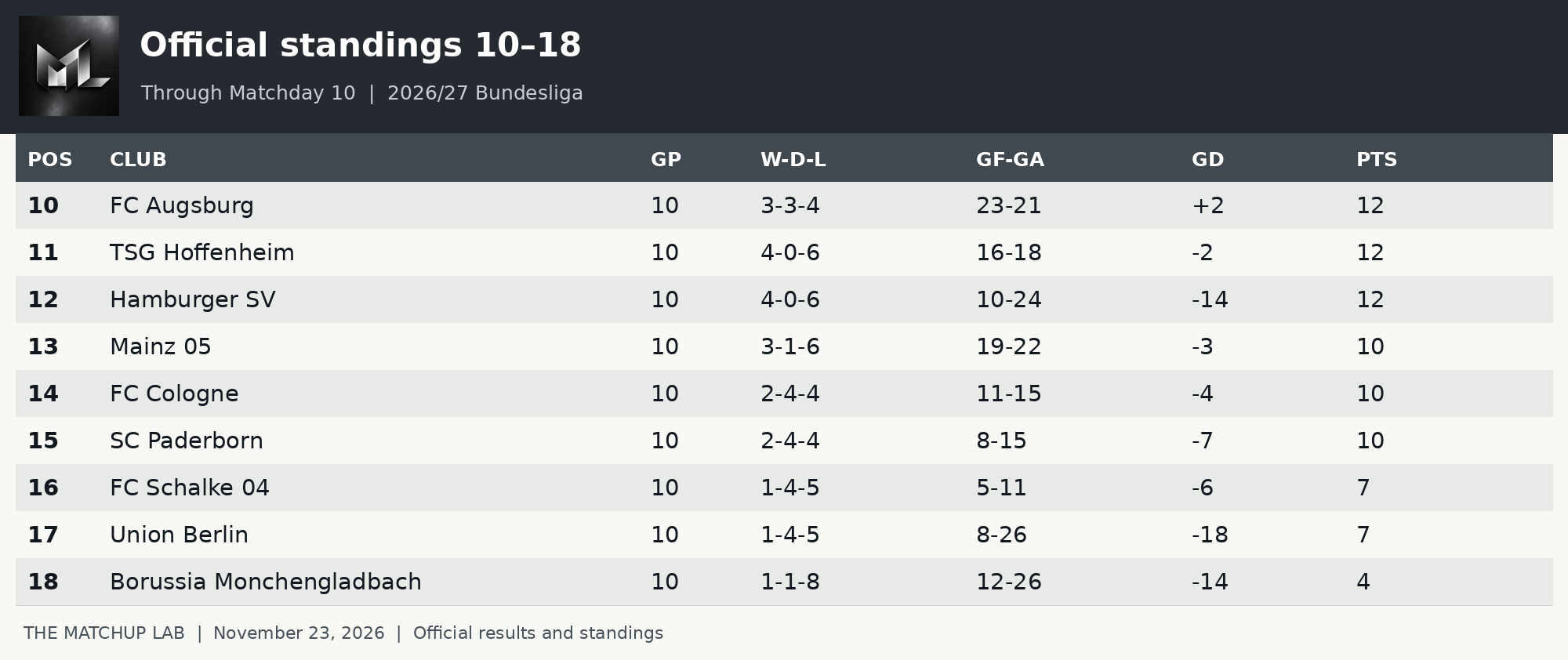
The lower half remains tightly grouped. Only three points separate Stuttgart in eighth from Paderborn in fifteenth. Augsburg’s victory moved them into a three-club group on twelve; Cologne’s point in Munich brought them level with Mainz and Paderborn on ten. Schalke gained a point but remain three short of that group, while Gladbach’s competitive display against Dortmund supplied no relief in the standings.
Four home wins, three away wins and two draws completed the round. That variety is why the analyses distinguish goals, results and table position. A wide victory improves goal difference, while a narrow one still provides the same three points.
The official league table
All clubs have played ten matches. These panels retain the competition’s published order. The record, goal balance and points are shown together so the position can be read alongside the results that produced it.
Every club in focus
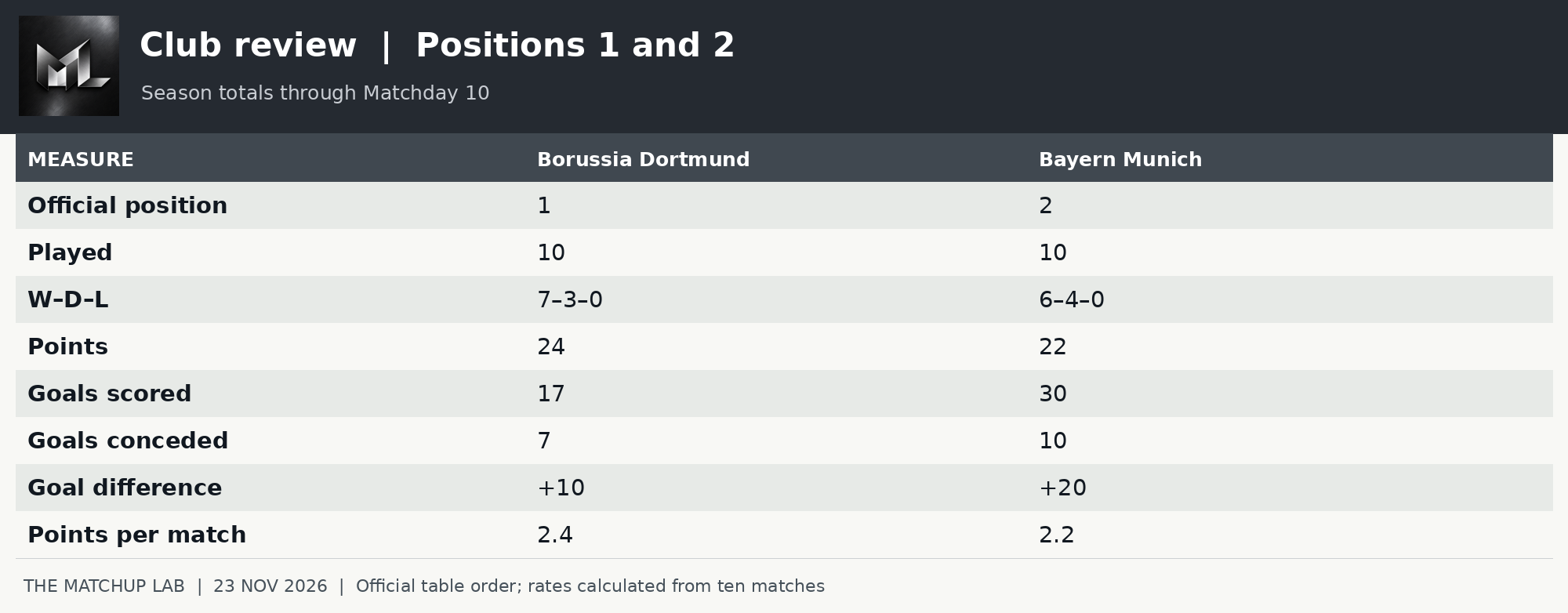
Borussia Dortmund
Felix Nmecha’s late goal at Gladbach lifted Dortmund to 24 points. Seven wins and three draws make them one of two unbeaten clubs, and their seven goals conceded are the league’s lowest total. Seventeen scored have been enough to lead because relatively few goals have been needed to turn their attacking work into points. That balance is the relevant distinction from the higher-scoring clubs behind them.
Leverkusen visit on Sunday with 24 goals, seven more than Dortmund, but ten more conceded. The test is whether Dortmund can keep the game compact without surrendering the initiative. A draw would preserve their five-point advantage over the visitors; a win would make it eight. Those stakes favor disciplined pressure over a game that becomes a succession of open transitions.
Bayern Munich
The 1–1 draw with Cologne was Bayern’s fourth draw in ten matches. Their 30 goals, ten conceded and plus-20 difference remain strong, but six wins leave them two points behind Dortmund. That is a useful distinction between scoring margin and the competition table: a large margin in one match cannot turn a subsequent draw into three points.
Hamburg’s 24 goals conceded provide an obvious opening on Saturday. Bayern’s job is to make their greater scoring output count while the match is still level, rather than rely on a late response to an awkward score. Hamburg have no draws, so their four wins also warn against treating a poor goal difference as a guarantee that they cannot turn one good afternoon into points.
Club review: positions 3–4
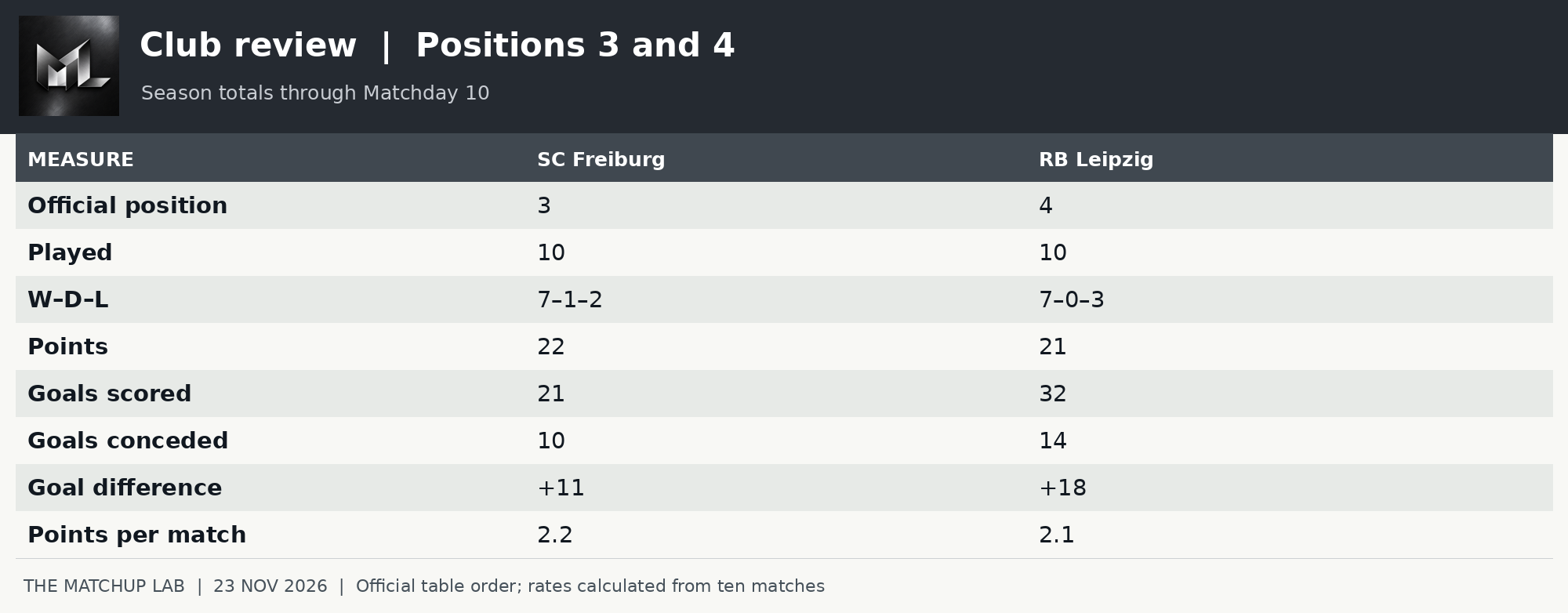
SC Freiburg
The 1–0 win at Elversberg gave Freiburg a seventh victory, matching Dortmund and Leipzig. They sit third on 22 points with 21 goals scored and ten conceded. Their record has produced the same points as Bayern despite nine fewer goals scored, a reminder that the distribution of goals across matches matters as much as the total.
Leipzig’s visit is the weekend’s clearest test of Freiburg’s defensive record. The visitors average 3.2 goals per match, against Freiburg’s 1.0 conceded. Those season averages are not a match forecast. They frame the tactical question: can Freiburg keep the space around their box controlled while retaining enough possession to prevent Leipzig from beginning another attack immediately?
RB Leipzig
Leipzig went from a level interval at Union to a 5–1 victory, scoring four times in the second half. Their 32 goals lead the league, and a plus-18 difference is second only to Bayern’s. Yet three defeats and no draws leave them fourth on 21 points. Their high scoring total has not insulated them from matches in which they leave with nothing.
Freiburg have conceded ten in ten and are one point ahead. Sunday therefore asks for more than another impressive goal count. Leipzig need to keep their attacking positions useful when an initial move breaks down. A win would put them above Freiburg; a defeat would widen the gap to four points regardless of how many chances either side creates.
Club review: positions 5–6
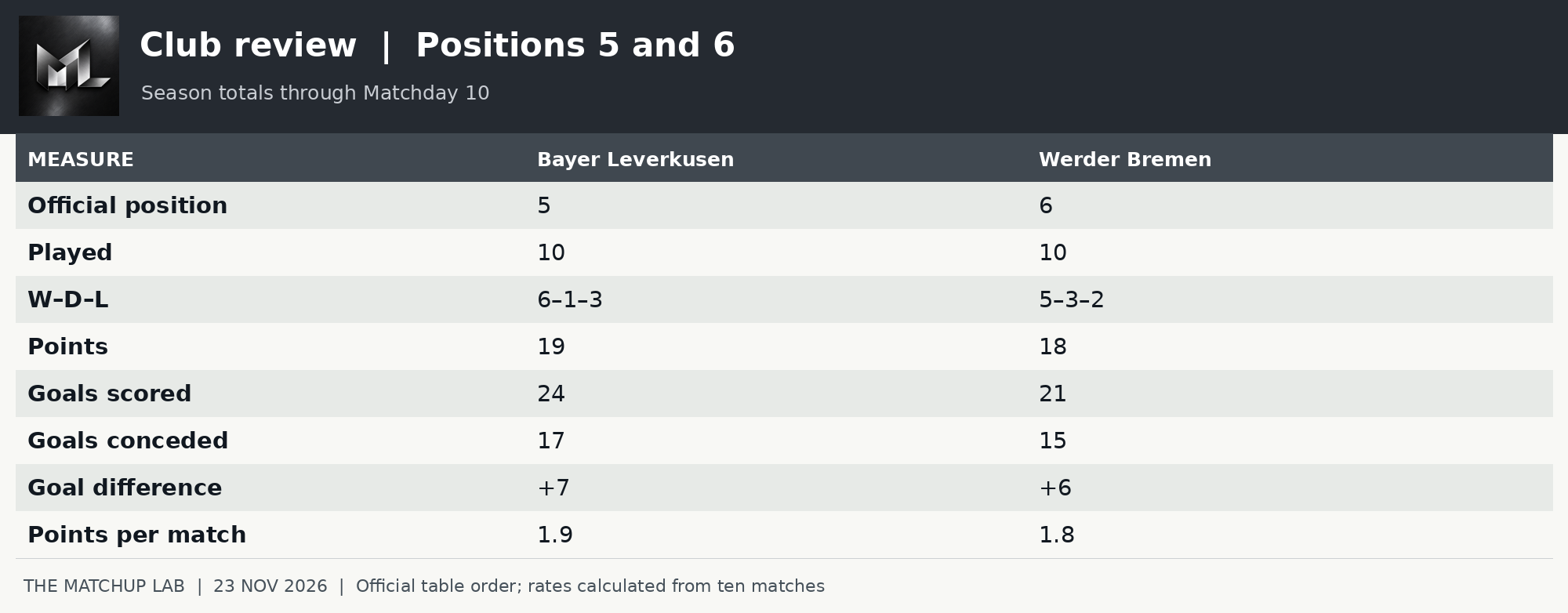
Bayer Leverkusen
A 4–0 win over Paderborn kept Leverkusen fifth with 19 points. Diego Moreira scored twice and Patrik Schick added his ninth league goal. Their 24 goals give them substantial attacking production, but 17 conceded are the most among the top five. That difference helps explain why a team capable of a four-goal win is still five points off first place.
Dortmund away is the chance to reduce that gap directly. Leverkusen’s attacking commitment needs to be supported by positions that protect the next turnover, because Dortmund’s seven conceded suggest that opportunities may be fewer than against Paderborn. Leaving the leaders only two points ahead would be a significant reward for a controlled away performance.
Werder Bremen
Bremen’s 4–0 derby win over Hamburg moved them to 18 points. Marco Friedl opened the scoring after the interval, Justin Njinmah scored twice and Niclas Füllkrug added the fourth. Bremen now have 21 goals, 15 conceded and only two defeats. Three draws separate their record from the seven-win clubs ahead of them.
Gladbach visit on Friday with four points and eight losses. The numbers make this a valuable opportunity, but the 1–0 margin of Gladbach’s defeat by Dortmund also shows why Bremen should not expect the same second-half space that Hamburg allowed. Converting sustained possession into patient attacks would make the derby result the start of a useful sequence.
Club review: positions 7–8
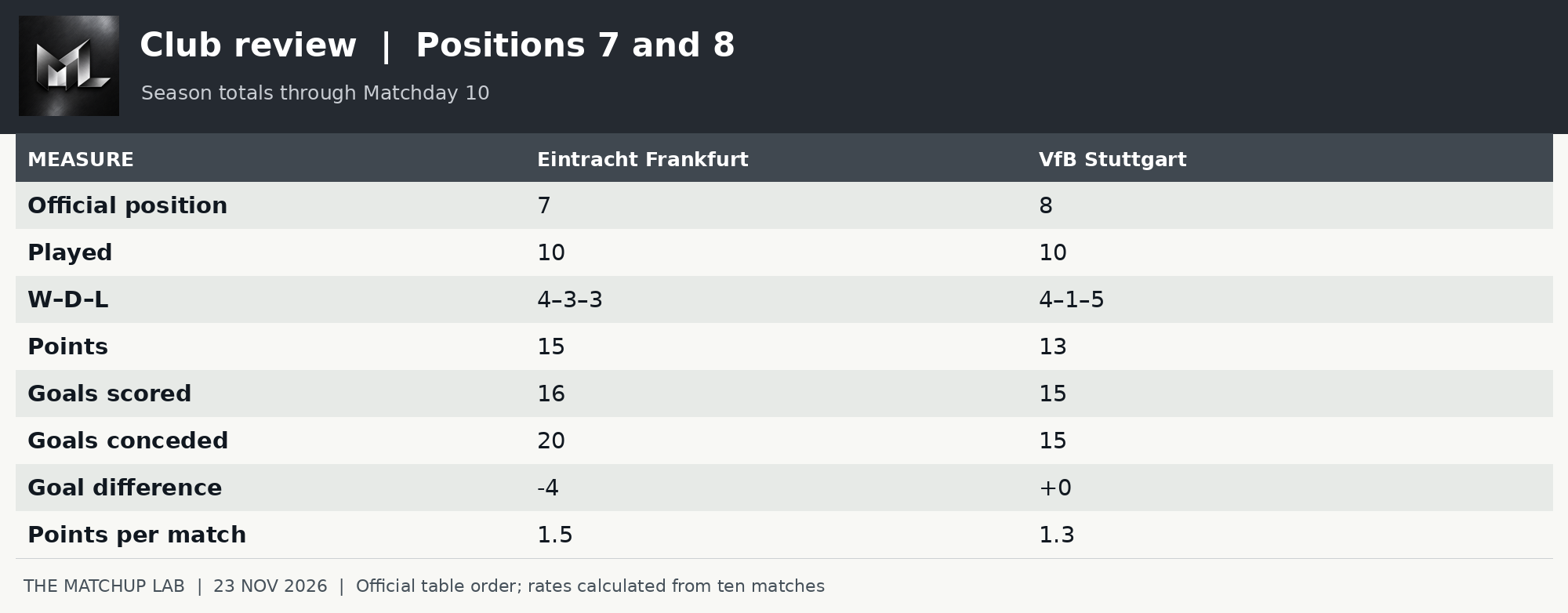
Eintracht Frankfurt
The 1–0 win over Hoffenheim took Frankfurt to 15 points while their goal difference remained minus four. Four wins and three draws have carried more competitive value than the raw 16–20 goal balance suggests. Their latest narrow victory reinforces the same point: a team does not need to erase its season deficit to make immediate progress in the table.
Stuttgart are two points below them and have an even 15–15 scoring record. Saturday is an opportunity to create separation from a crowded group, where three points cover eighth through fifteenth. Frankfurt can protect the value of their latest win by avoiding the type of open exchange that makes a narrow lead difficult to control.
VfB Stuttgart
Stuttgart’s 0–0 draw at Schalke was their first draw of the season. Four wins, one draw and five defeats leave them eighth with 13 points and an even goal difference. The absence of a goal in that match matters because Schalke have allowed only eleven all season; the result alone does not establish that Stuttgart’s attack has become generally ineffective.
Frankfurt arrive with 15 points despite having conceded five more goals. Stuttgart have a direct chance to move above them. The important attacking test is to create movement before receiving near the box, where a compact opponent can otherwise make a possession look controlled without allowing a clear attempt.
Club review: positions 9–10
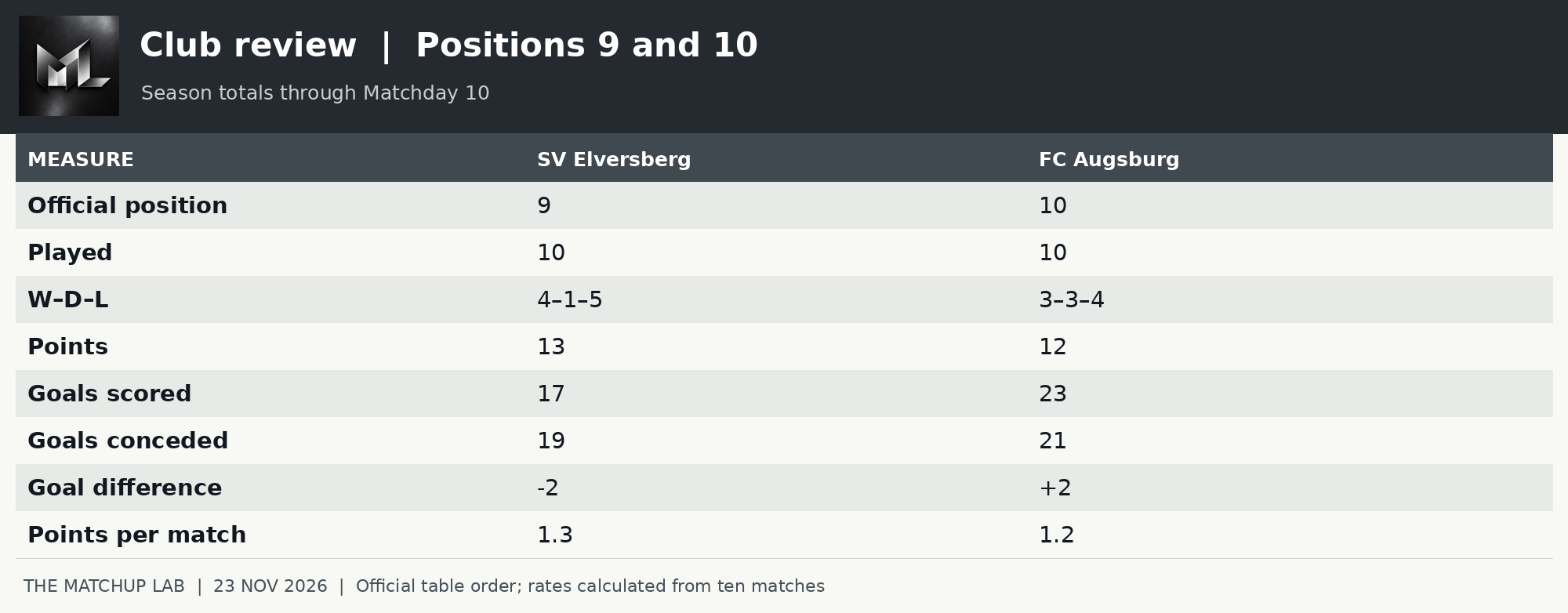
SV Elversberg
Elversberg’s 1–0 loss to Freiburg kept them on 13 points. Seventeen scored and 19 conceded describe a team near balance, while five defeats show how often that balance has ended on the wrong side. A narrow loss to a club now level on points with Bayern should be assessed in that context, rather than treated as equivalent to the heavier defeats elsewhere in the round.
Cologne are three points behind and have just drawn in Munich. Elversberg’s greater season scoring total, 17 to eleven, supplies a possible advantage, but Cologne have conceded four fewer. The away test is to preserve enough possession between attacks that every forward move does not immediately become a recovery run.
FC Augsburg
Augsburg’s 3–1 win over Mainz lifted them to twelve points and a plus-two goal difference. Their 23 goals are the fourth-highest total in the league, yet three wins leave them tenth. Twenty-one conceded have reduced the competitive value of that attacking output, so improving the balance behind the ball could matter as much as adding another scorer.
Hoffenheim are level on points with a 16–18 goal record. Sunday pits Augsburg’s more open scoring profile against a team whose ten matches have all produced a winner. Protecting the spaces behind an attack would give Augsburg a better chance to make their production decisive, without assuming that another high-scoring game is inevitable.
Club review: positions 11–12
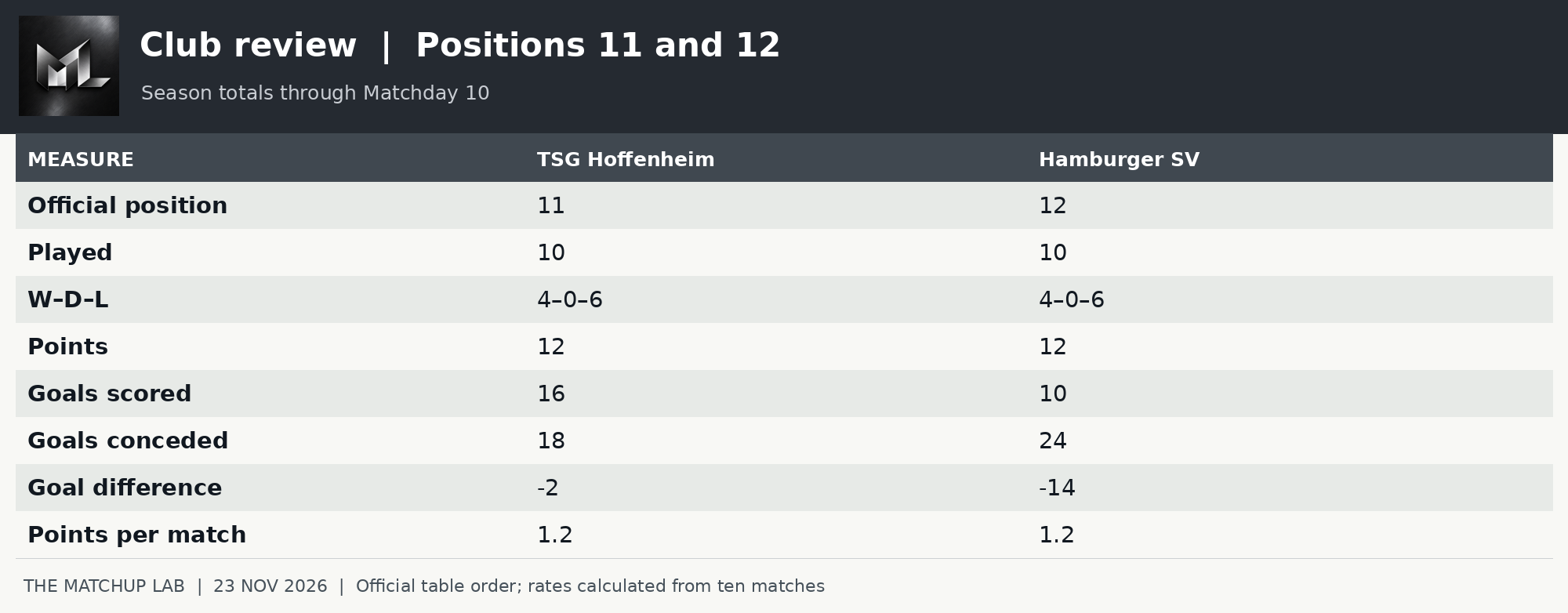
TSG Hoffenheim
Hoffenheim’s 1–0 defeat in Frankfurt left them with four wins and six losses. No draws have softened the effect of the losing games. Their minus-two goal difference is modest compared with that record, but the standings reward the outcome of each match; a close defeat still supplies no point.
Augsburg’s visit offers a clear comparison. Both have twelve points, while Augsburg have scored seven more and conceded three more. Hoffenheim need to avoid letting a missed attacking opportunity become a clear counter at the other end. A win would create a three-point advantage over a nearby rival even if their season goal difference remained the less attractive of the two.
Hamburger SV
Hamburg conceded four after halftime in Bremen and now have ten goals scored against 24 allowed. Their twelve points have come from four wins, with no draws. That is a very different profile from Cologne or Paderborn: Hamburg have more points, but a much larger negative scoring margin.
Bayern visit with 30 goals and an unbeaten record. Hamburg need a way to move the ball beyond the first pressure after recovering it, because defending the same area repeatedly would expose a back line that has already conceded 2.4 per match. Their limited scoring total also makes preventing early clear chances more valuable than accepting a high-risk exchange.
Club review: positions 13–14
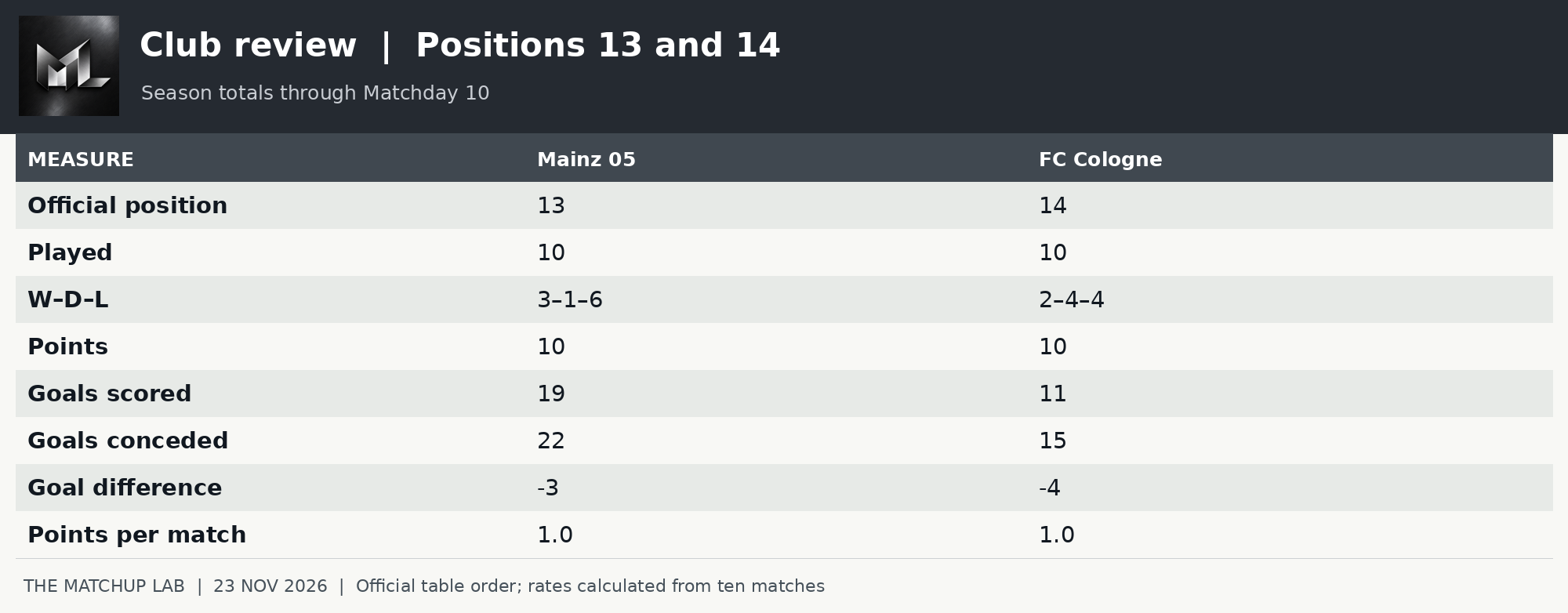
Mainz 05
The 3–1 loss at Augsburg left Mainz on ten points. Nineteen goals scored are the most among the bottom six, but 22 conceded have kept that advantage from becoming separation. Six defeats show that their attacking output has too often been accompanied by a larger concession.
Union arrive after allowing five to Leipzig and have conceded 26 overall. Mainz therefore have a plausible route to a stronger result, but the same comparison also warns against overcommitting. Union’s eight goals scored do not make every forward run harmless. Mainz’s best use of their stronger attack is to retain enough support behind it that one failed move does not undo the benefit.
FC Cologne
Cologne’s 1–1 draw at Bayern took them to ten points, with four draws providing four of those points. Their eleven goals scored and 15 conceded are far less extreme than Hamburg’s totals, despite sitting two points below them. The Munich result demonstrates the value of keeping a game close against a prolific opponent.
Elversberg visit with three more points and six more goals scored. Cologne’s next test is to retain the defensive organization that earned a point while creating more of their own pressure at home. Turning one of those draws into a win would be more useful than merely maintaining an orderly scoreline.
Club review: positions 15–16
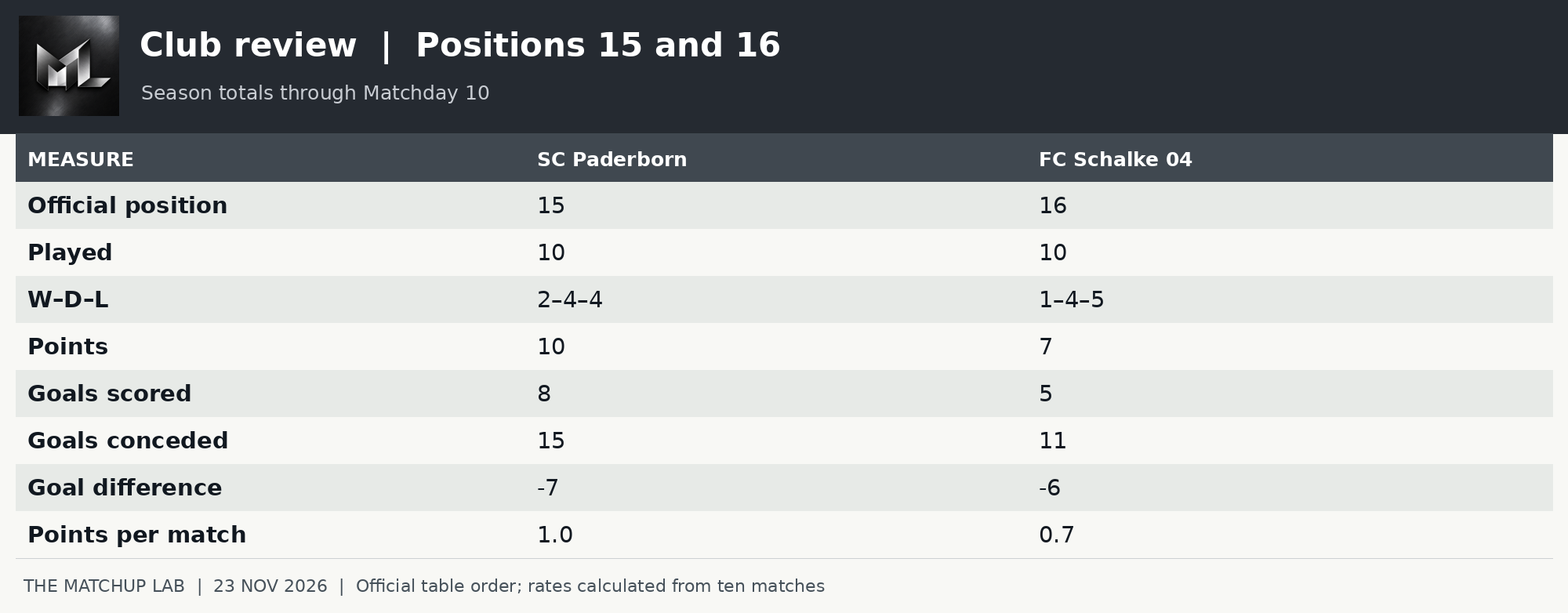
SC Paderborn
Paderborn’s 4–0 loss at Leverkusen moved their goal difference to minus seven. Eight goals in ten matches leave little capacity to recover when an opponent scores repeatedly. Four draws have kept them level on ten points with Mainz and Cologne, but only two wins limit the distance above the bottom three.
Schalke visit with five goals scored and eleven conceded. That makes the next game a test of attacking patience rather than a reason to assume a low score in advance. Paderborn can look to establish territory without making the first hurried forward pass their only plan. A win would extend their advantage over Schalke from three points to six.
FC Schalke 04
Schalke’s 0–0 draw with Stuttgart was their fourth draw and left them on seven points. Eleven conceded compare well with many clubs much higher in the standings. Five goals scored are the league’s lowest total, so a defensive performance that would support a stronger season elsewhere has rarely been enough to produce a win here.
Paderborn are only three points ahead and have scored eight. Saturday offers a direct chance to close that gap. Schalke need support around the first forward receiver so that a promising recovery develops into a second pass and a chance, instead of a duel that returns the ball to the opposition.
Club review: positions 17–18
Union Berlin
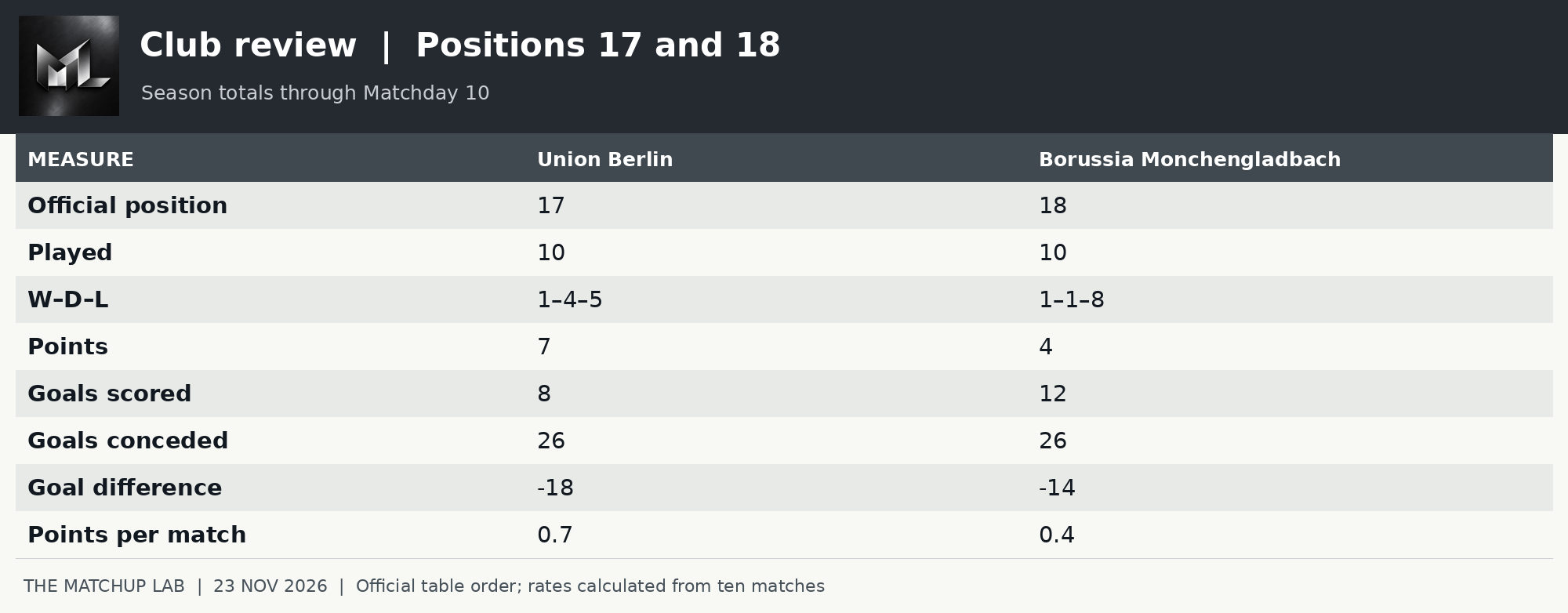
Union were level with Leipzig at halftime before losing 5–1. Their 26 goals conceded now match Gladbach for the most in the league, while eight scored leave a minus-18 difference. Seven points keep them alongside Schalke, but the two teams have arrived there through very different defensive records.
Mainz have scored 19 and conceded 22, so the next opponent offers openings while carrying a credible threat. Union’s first task is to keep one unsuccessful challenge from exposing the next defensive line. If they can make the game more stable, the three-point gap to Mainz gives their own attacking moments direct significance for the table.
Borussia Monchengladbach
Gladbach held Dortmund until the late winner but still suffered their eighth defeat. Four points leave them three behind both Union and Schalke. Their 12 goals scored are more than four clubs above them, while 26 conceded help explain why that production has delivered so little.
Bremen’s four-goal derby win makes Friday a demanding trip. Gladbach can carry forward the competitiveness of the Dortmund match, but a long sequence of defending requires an outlet. The useful test is whether their first clearance or recovery can become a retained possession, giving the defensive block time to move up instead of immediately absorbing the next attack.
Dortmund versus Leverkusen
Sunday November 29, 12:30 p.m. U.S. Central
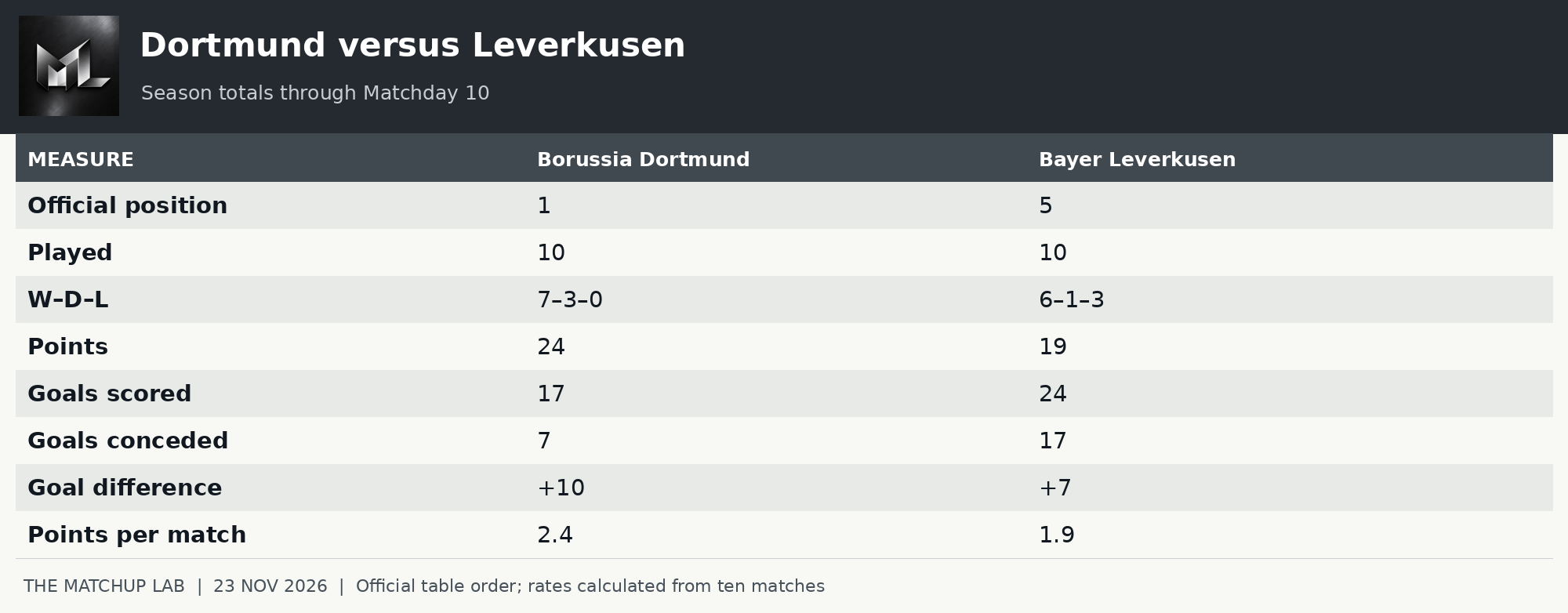
First hosts fifth, with five points between them. Dortmund’s 24 points have come from an unbeaten record and only seven goals conceded. Leverkusen have 19 points, 24 goals scored and 17 conceded. The contrast identifies the question for this match without settling its answer: can Leverkusen create enough danger against the league’s tightest defense while keeping their own greater concession rate from deciding the game?
Dortmund do not need to match Leverkusen’s season goal total to make their position count. Their 17 goals have supported seven victories because the defensive record has kept the required winning margin small. Against a visitor coming off a 4–0 win, that protection needs to extend beyond the penalty area. If an attack ends, the players behind it must be close enough to prevent the next pass from immediately turning the game toward their own goal. This is a match in which attacking structure also serves a defensive purpose.
Leverkusen’s win over Paderborn showed the value of more than one scoring route, with Moreira twice on the scoresheet and Schick adding his ninth league goal. That production gives Dortmund different problems to manage, but the previous opponent conceded four on the day; it does not prove the same openings will appear at the leaders. Leverkusen may need to work through periods in which an initial attack produces little, then choose carefully when to commit another player rather than force the move.
The table consequences are immediate. A Leverkusen win cuts the gap to two points; a Dortmund win stretches it to eight. A draw leaves the distance unchanged while giving the other leading clubs a chance to gain ground. Watch the quality of the first possession after each turnover. If either side can retain the ball there, it can choose the next phase instead of being pulled into a game dictated by repeated recovery runs. That is a more useful early indicator than possession volume alone.
Freiburg versus Leipzig
Sunday November 29, 8:30 a.m. U.S. Central
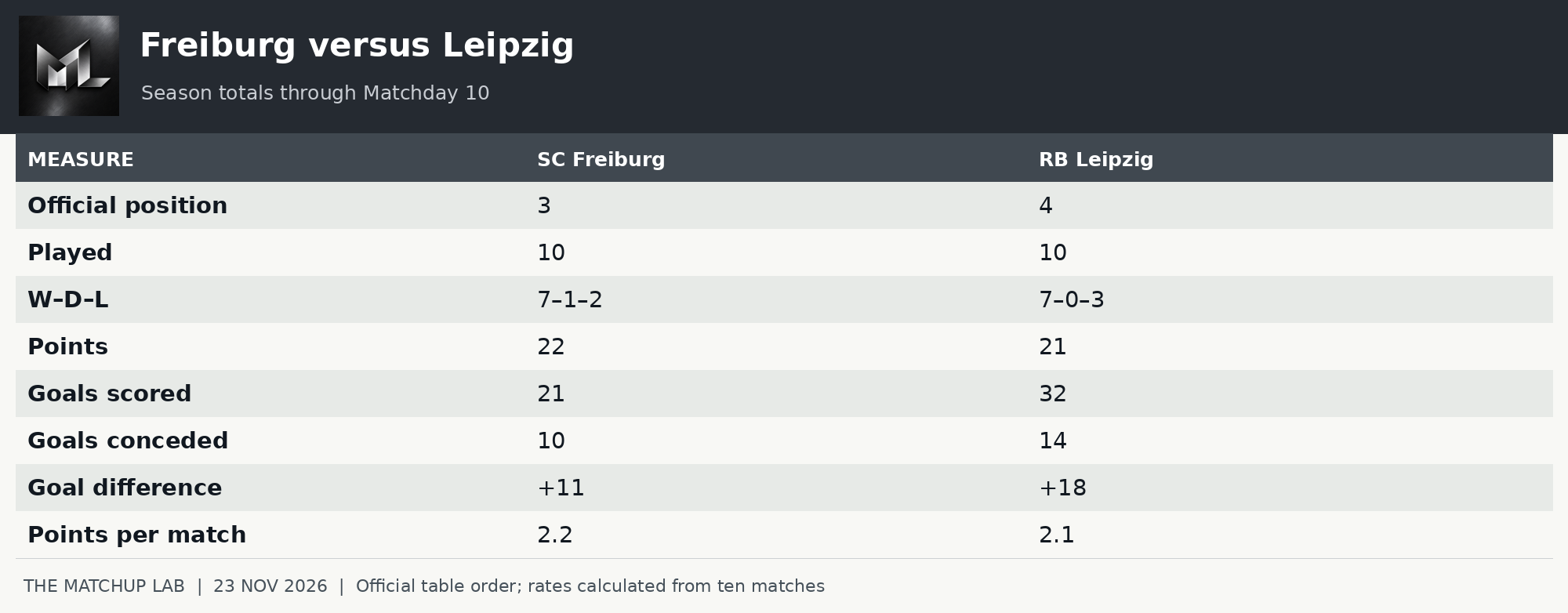
Third hosts fourth, with Freiburg on 22 points and Leipzig on 21. Both have seven wins. Freiburg’s one draw supplies the difference, while Leipzig have lost the other three matches. The goal columns are more separated: Leipzig have scored 32 to Freiburg’s 21 and conceded 14 to Freiburg’s ten. Sunday brings the league’s most productive attack against a defense allowing exactly one goal per game.
The season averages should guide the questions, not be treated as a predicted score. Freiburg’s recent 1–0 win at Elversberg was enough to keep pace with Bayern. Leipzig’s 5–1 win at Union demonstrated how quickly their scoring can accumulate once a match opens. The official account places four of those Leipzig goals after a level halftime. Freiburg therefore need a plan for the whole game, including the minutes after a promising attack or a change in score makes the next decision more urgent.
For Freiburg, keeping the defensive distances manageable cannot mean conceding every subsequent possession. A recovery that becomes a retained pass allows the team to move up together and gives Leipzig a defensive problem of their own. If Freiburg’s forward moves routinely end at the first challenge, even an organized defense can be forced into a long succession of difficult actions. The balance is to support the outlet without leaving a simple route back through the middle.
Leipzig’s task is to make attacking pressure sustainable. Their three defeats show that a large overall goal total does not protect every result. Sending more players forward may create options around the box, but it also increases the value of the positions left behind. The useful observation is whether the next pass after a broken attack still belongs to Leipzig, or whether Freiburg can use it to advance into open space. A Leipzig win reverses the current order and creates a two-point lead over Freiburg; a Freiburg win makes the gap four. With Dortmund and Leverkusen meeting later the same day, either winner can strengthen its place before the leaders finish the round.
Hamburg versus Bayern
Saturday November 28, 8:30 a.m. U.S. Central
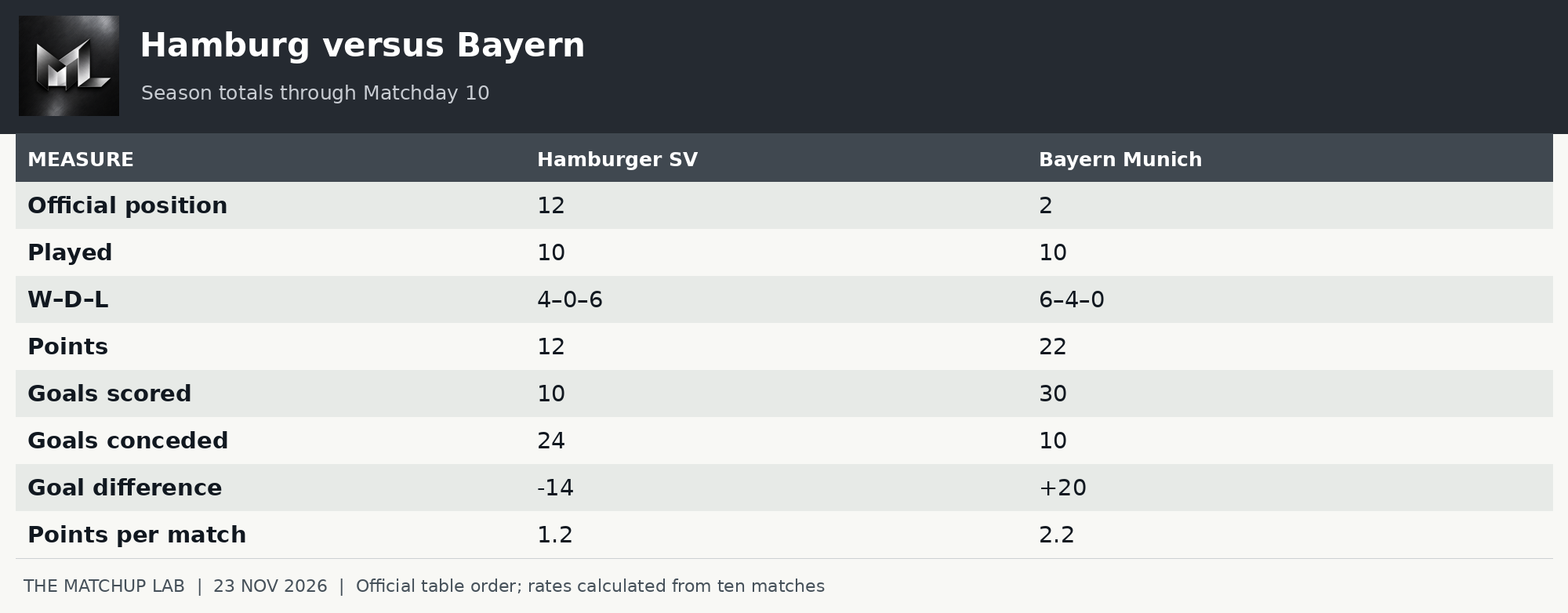
Hamburg enter with twelve points, ten goals scored and 24 conceded. Bayern have 22 points, 30 scored and ten conceded. That is the widest attacking and defensive contrast among the three featured matches. It makes the space around Hamburg’s box central to the contest, particularly after a Bremen derby in which all four goals against them arrived after halftime.
Bayern’s record also supplies a qualification. They are unbeaten, but four draws mean that strong season production has not always become a win. Cologne’s 1–1 draw in Munich is the immediate example. Hamburg should take the possibility of a competitive result seriously without assuming that another club’s performance can simply be repeated. The first requirement is to avoid giving Bayern a sequence of clear approaches while Hamburg’s own team is still moving back into position.
For the hosts, a route out of pressure is part of the defensive plan. A clearance that returns immediately may remove one danger while preserving the overall problem. If the first receiver has a second option nearby, Hamburg can sometimes retain the ball, move the back line up and force Bayern to restart their attack from farther away. That does not require an ambitious passing sequence on every recovery. It requires enough support that the decision can be made on the actual pressure rather than on the absence of any option.
Bayern need to turn their greater output into useful chances while the match is level. Hamburg’s four wins and six defeats, with no draws, show a record capable of delivering all three points on a good day even with a poor overall goal balance. The visitors should therefore judge their control by the openings they create and the counterattacks they prevent, not by possession alone. An early Bayern goal would change the decisions Hamburg must make; a level score deeper into the game would increase the value of every transition and set piece. The practical test is whether Bayern can make their pressure progressively more dangerous without allowing Hamburg an inexpensive way back into the match.
The full week ahead
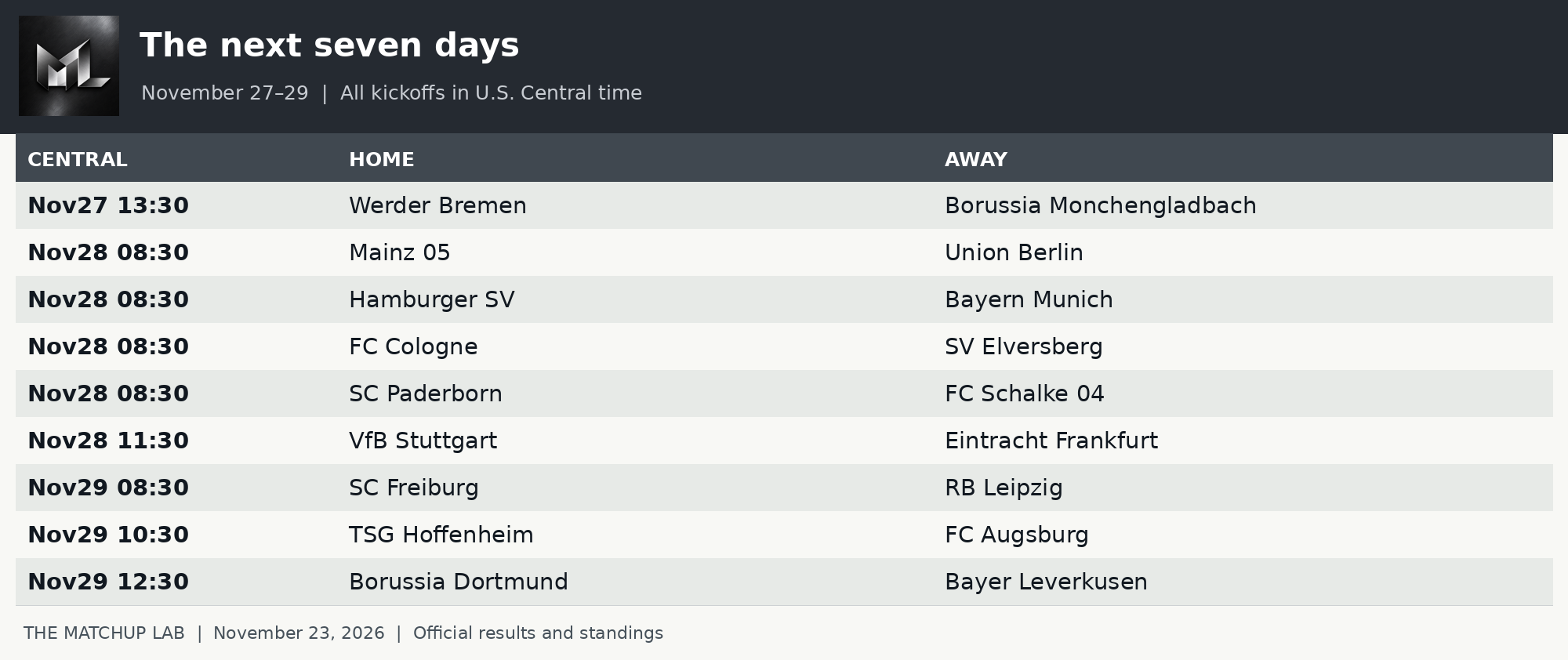
Bremen–Gladbach opens the round on Friday. Saturday brings five matches, including Hamburg–Bayern and the lower-table meeting between Paderborn and Schalke. Sunday has three fixtures, beginning with Freiburg–Leipzig and ending with Dortmund–Leverkusen.
All displayed kickoffs use U.S. Central Standard Time. Germany is seven hours ahead for these dates. Fixtures can change; the listed times reflect the published schedule checked for this edition.
The next round can reshape both ends of the table through direct meetings. The top-five contests put points within reach of clubs trying to close a specific gap, while Mainz–Union and Paderborn–Schalke give the lower group the same opportunity. Ten completed matches provide a useful picture of each team’s results, but the differences are still small enough for one weekend to change several positions.